Finding strong synonyms for occur helps you describe events, ideas, and actions clearly. Learning clear synonyms for occur gives you the best words to explain when something happens, appears, or comes to mind. Using accurate synonyms for occur sharpens your writing, builds your vocabulary, and makes every sentence easy to read.
Imagine you are telling a friend about a surprise party that happened yesterday. Instead of using the same plain word over and over, you can say the party was able to take place, unfold, or come about. To occur means for something to happen, take place, or pop into your head.
“Choosing the right word brings your story to life and makes every event clear.”
Expanding your vocabulary helps you share ideas with ease every single day:
- Students can write sharper essays and score higher on English tests.
- Bloggers can write catchy posts that keep readers scrolling.
- Content writers can craft clear articles that rank well on search engines.
- Daily English users can describe events and thoughts with confidence.
“Clear words make strong sentences and help you speak with total confidence.”
Connotative Meaning of Occur
The word occur has neutral and adaptable tones:
- Positive Connotation: Great ideas striking your mind, happy events taking place, or pleasant surprise moments.
- Negative Connotation: Problems arising, accidents taking place, or unexpected errors popping up during work.
- Neutral Connotation: Natural events happening, scheduled meetings taking place, or simple factual events.
Etymology of Occur
- Origin: From Latin occurrere, meaning to run to meet, meet, or present itself.
- Roots: Formed from ob- (towards) and currere (to run).
- Historical Context: Entered Middle English in the 15th century to describe events meeting or presenting themselves to the mind.
- Modern Evolution: Today, it means both “to happen” (an event occurs) and “to come to mind” (an idea occurs to me).
Pronunciation, Syllables, and Affixation Pattern
- US Pronunciation (IPA): /əˈkɝː/
- UK Pronunciation (IPA): /əˈkɜːr/
- Syllable Count: 2 syllables (oc-cur)
- Root Word: Occur
- Affixation Patterns:
- Prefixes: Re- (Reoccur – to happen again)
- Suffixes:
- -red (Occurred – Past tense)
- -ring (Occurring – Present participle)
- -rence (Occurrence – Noun for an event)
Word Comparison Table
| Keyword | Meaning | Usage Type | Context |
|---|---|---|---|
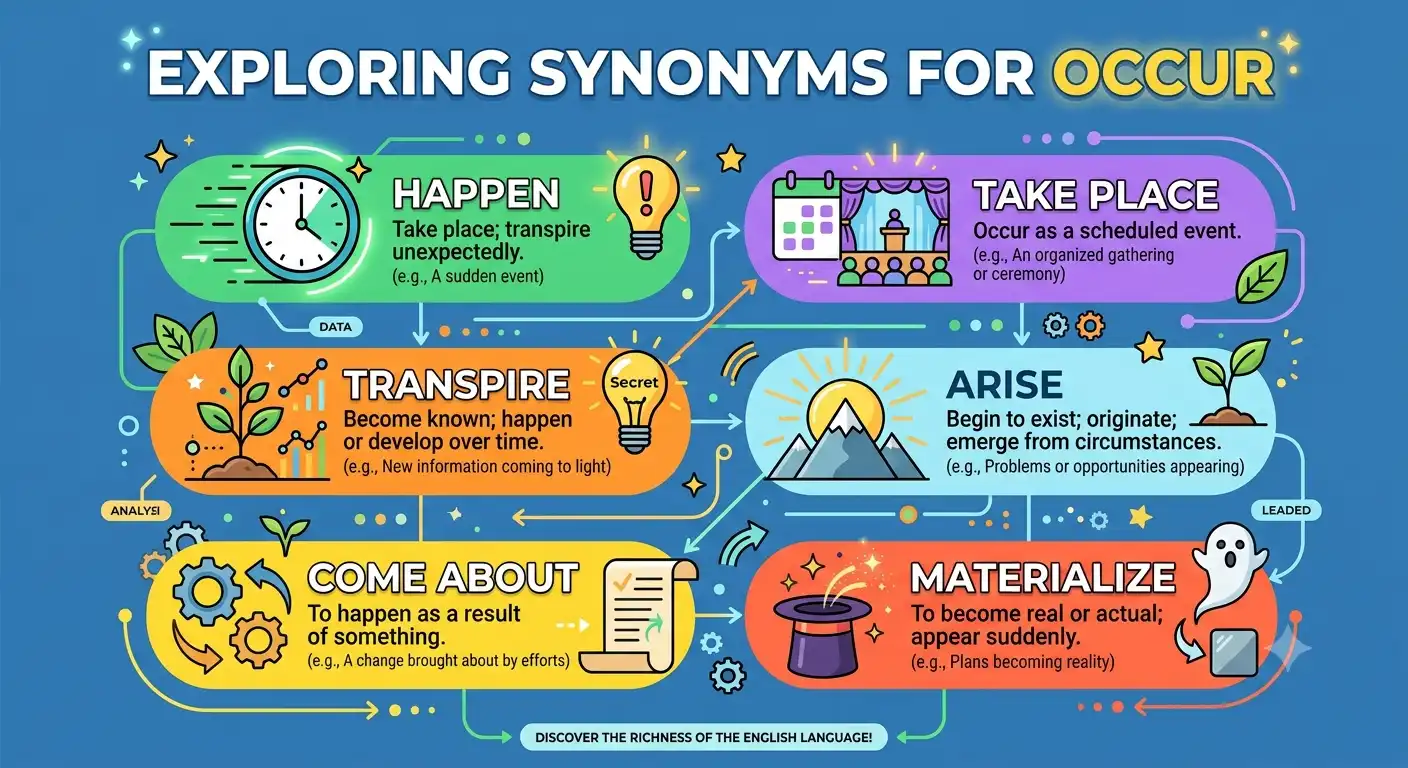
| Occur | To happen or come into existence | Neutral / Formal | General events, news, thoughts |
| Happen | To take place by chance or plan | Everyday / Casual | Daily life, stories, questions |
| Take place | To happen at a planned time | Professional / Neutral | Events, meetings, schedules |
| Transpire | To happen or become known over time | Formal / Academic | Reports, formal stories, investigations |
| Materialize | To appear or become real unexpectedly | Descriptive / Creative | Plans, objects, dreams |
| Arise | To begin to happen or exist | Formal / Professional | Problems, opportunities, questions |
| Crop up | To appear suddenly without warning | Casual / Conversational | Work issues, daily chats, surprises |
| Dawn on | To become clear to someone’s mind | Emotional / Casual | Realizations, lightbulb moments |
50 Synonyms for Occur
1. Happen
- Pronunciation: US: /ˈhæp.ən/ | UK: /ˈhæp.ən/
- Meaning: To take place by chance or as part of a plan.
- Examples:
- Strange things happen when the storm starts.
- The party will happen at the park tomorrow.
2. Take place
- Pronunciation: US: /teɪk pleɪs/ | UK: /teɪk pleɪs/
- Meaning: To happen at a specific time or set location.
- Examples:
- The big race will take place this Saturday.
- The meeting was able to take place in the main room.
3. Transpire
- Pronunciation: US: /trænˈspaɪɚ/ | UK: /trænˈspaɪər/
- Meaning: To happen or become known over time.
- Examples:
- We will see what secrets transpire during the meeting.
- No one knew what would transpire after the speech.
4. Materialize
- Pronunciation: US: /məˈtɪr.i.ə.laɪz/ | UK: /məˈtɪə.ri.ə.laɪz/
- Meaning: To appear or become real suddenly.
- Examples:
- Our holiday plans did not materialize this year.
- A thick fog began to materialize over the river.
5. Arise
- Pronunciation: US: /əˈraɪz/ | UK: /əˈraɪz/
- Meaning: To start to happen or come into view.
- Examples:
- A new question may arise during the lesson.
- Call me if any difficulties arise today.
6. Crop up
- Pronunciation: US: /krɑːp ʌp/ | UK: /krɒp ʌp/
- Meaning: To appear or happen without warning.
- Examples:
- Small problems often crop up at work.
- Her name keeps trying to crop up in conversation.
7. Pop up
- Pronunciation: US: /pɑːp ʌp/ | UK: /pɒp ʌp/
- Meaning: To appear quickly or unexpectedly.
- Examples:
- New ads pop up on the computer screen.
- A bright idea will pop up when you rest.
8. Surface
- Pronunciation: US: /ˈsɝː.fɪs/ | UK: /ˈsɜː.fɪs/
- Meaning: To become visible or known after being hidden.
- Examples:
- New facts began to surface during the trial.
- Old memories can surface when you look at photos.
9. Emerge
- Pronunciation: US: /ɪˈmɝːdʒ/ | UK: /ɪˈmɜːdʒ/
- Meaning: To come out into view or become clear.
- Examples:
- A strong leader will emerge during hard times.
- The sun began to emerge from behind clouds.
10. Befall
- Pronunciation: US: /bɪˈfɑːl/ | UK: /bɪˈfɔːl/
- Meaning: To happen to someone by bad luck or chance.
- Examples:
- We hope no harm will befall the travelers.
- Sad news can befall anyone at any time.
11. Result
- Pronunciation: US: /rɪˈzʌlt/ | UK: /rɪˈzʌlt/
- Meaning: To happen because of something else.
- Examples:
- Good test marks result from hard daily study.
- Delay can result in lost time for everyone.
12. Follow
- Pronunciation: US: /ˈfɑː.loʊ/ | UK: /ˈfɒl.əʊ/
- Meaning: To happen right after another event.
- Examples:
- Quiet times usually follow a big storm.
- Answers will follow after the main presentation.
13. Develop
- Pronunciation: US: /dɪˈvel.əp/ | UK: /dɪˈvel.əp/
- Meaning: To grow or start happening over time.
- Examples:
- A small crack can develop into a big hole.
- Good habits develop when you practice daily.
14. Unfold
- Pronunciation: US: /ʌnˈfoʊld/ | UK: /ʌnˈfəʊld/
- Meaning: To happen step by step before your eyes.
- Examples:
- We watched the excitement unfold on live television.
- The story will unfold in the final chapter.
15. Pass
- Pronunciation: US: /pæs/ | UK: /pɑːs/
- Meaning: To take place or happen as time goes by.
- Examples:
- Things came to pass just as he promised.
- Strange moments can pass without any warning.
16. Come about
- Pronunciation: US: /kʌm əˈbaʊt/ | UK: /kʌm əˈbaʊt/
- Meaning: To happen or take place through a cause.
- Examples:
- How did this mistake come about so fast?
- Great changes come about when people work together.
17. Come to pass
- Pronunciation: US: /kʌm tuː pæs/ | UK: /kʌm tuː pɑːs/
- Meaning: To happen after a long wait or prediction.
- Examples:
- The dream finally came to pass this morning.
- Ancient stories say this event would come to pass.
18. Eventuate
- Pronunciation: US: /ɪˈven.tʃu.eɪt/ | UK: /ɪˈven.tʃu.eɪt/
- Meaning: To happen as a final result of actions.
- Examples:
- Peace will eventuate if both sides sign the deal.
- A big win may eventuate from smart training.
19. Manifest
- Pronunciation: US: /ˈmæn.ə.fest/ | UK: /ˈmæn.ɪ.fest/
- Meaning: To show clearly or become easy to see.
- Examples:
- Stress can manifest as a bad headache.
- Joy will manifest on her face when she wins.
20. Break out
- Pronunciation: US: /breɪk aʊt/ | UK: /breɪk aʊt/
- Meaning: To start happening suddenly and with force.
- Examples:
- Fire can break out if dry wood catches sparks.
- Laughter would break out across the happy room.
21. Turn up
- Pronunciation: US: /tɝːn ʌp/ | UK: /tɜːn ʌp/
- Meaning: To happen or be found unexpectedly.
- Examples:
- Lost keys usually turn up in quiet corners.
- A new job offer might turn up next week.
22. Show up
- Pronunciation: US: /ʃoʊ ʌp/ | UK: /ʃəʊ ʌp/
- Meaning: To become visible or happen suddenly.
- Examples:
- Spots of ink show up on white paper clearly.
- Clues will show up if you search closely.
23. Strike
- Pronunciation: US: /straɪk/ | UK: /straɪk/
- Meaning: To hit the mind suddenly as an idea.
- Examples:
- A great thought can strike you in the shower.
- The truth will strike him later tonight.
24. Ensue
- Pronunciation: US: /ɪnˈsuː/ | UK: /ɪnˈsjuː/
- Meaning: To happen right after as a direct result.
- Examples:
- Arguments can ensue when rules are broken.
- Silence will ensue when the music stops playing.
25. Spring up
- Pronunciation: US: /sprɪŋ ʌp/ | UK: /sprɪŋ ʌp/
- Meaning: To appear or happen quickly in many places.
- Examples:
- New shops spring up all over town each spring.
- Flowers will spring up after gentle rain falls.
26. Dawn on
- Pronunciation: US: /dɑːn ɑːn/ | UK: /dɔːn ɒn/
- Meaning: To become clear to someone’s mind gradually.
- Examples:
- The true answer began to dawn on the student.
- It will dawn on him that he lost his hat.
27. Cross one’s mind
- Pronunciation: US: /krɑːs wʌnz maɪnd/ | UK: /krɒs wʌnz maɪnd/
- Meaning: To occur briefly as a thought.
- Examples:
- Did it cross your mind to call home early?
- The idea did not cross my mind until now.
28. Hit
- Pronunciation: US: /hɪt/ | UK: /hɪt/
- Meaning: To come to mind suddenly with strong impact.
- Examples:
- The realization will hit you when you wake up.
- Sadness can hit when you say goodbye.
29. Register
- Pronunciation: US: /ˈredʒ.ə.stɚ/ | UK: /ˈredʒ.ɪ.stər/
- Meaning: To become noticed or clear in the mind.
- Examples:
- The news took a minute to register with him.
- Danger did not register in her mind at first.
30. Form
- Pronunciation: US: /fɔːrm/ | UK: /fɔːm/
- Meaning: To take shape or begin to exist.
- Examples:
- Clouds form high up in the blue sky.
- Good ideas form when you think deeply.
“Precision in your word choices turns plain sentences into unforgettable thoughts.”
31. Formulate
- Pronunciation: US: /ˈfɔːr.mjə.leɪt/ | UK: /ˈfɔː.mjə.leɪt/
- Meaning: To create or take shape in a careful way.
- Examples:
- A clear plan will formulate in his mind.
- Answers begin to formulate as you study.
32. Play out
- Pronunciation: US: /pleɪ aʊt/ | UK: /pleɪ aʊt/
- Meaning: To happen and develop until the end.
- Examples:
- We must wait and see how things play out.
- The drama began to play out on stage.
33. Go down
- Pronunciation: US: /ɡoʊ daʊn/ | UK: /ɡəʊ daʊn/
- Meaning: To happen or take place in a specific way.
- Examples:
- Tell me what is about to go down at school.
- That game will go down in history as great.
34. Pan out
- Pronunciation: US: /pæn aʊt/ | UK: /pæn aʊt/
- Meaning: To turn out or happen in a good way.
- Examples:
- We hope the new job offer will pan out.
- Things did not pan out as planned yesterday.
35. Come off
- Pronunciation: US: /kʌm ɑːf/ | UK: /kʌm ɒf/
- Meaning: To happen as planned or be successful.
- Examples:
- The surprise party was able to come off well.
- Did the big event come off without trouble?
36. Come up
- Pronunciation: US: /kʌm ʌp/ | UK: /kʌm ʌp/
- Meaning: To happen soon or arise suddenly.
- Examples:
- Important questions will come up in the test.
- A new project came up at work today.
37. Reoccur
- Pronunciation: US: /ˌriː.əˈkɝː/ | UK: /ˌriː.əˈkɜːr/
- Meaning: To happen again after stopping.
- Examples:
- The same error must not reoccur tomorrow.
- Bad dreams can reoccur when you feel nervous.
38. Recur
- Pronunciation: US: /rɪˈkɝː/ | UK: /rɪˈkɜːr/
- Meaning: To happen repeatedly at regular times.
- Examples:
- Pain may recur if you do not rest well.
- The main theme will recur throughout the song.
39. Unravel
- Pronunciation: US: /ʌnˈræv.əl/ | UK: /ʌnˈræv.əl/
- Meaning: To happen in a way that separates or resolves.
- Examples:
- The mystery began to unravel slowly.
- Secret plans will unravel over time.
40. Originate
- Pronunciation: US: /əˈrɪdʒ.ə.neɪt/ | UK: /əˈrɪdʒ.ə.neɪt/
- Meaning: To start or begin in a certain place.
- Examples:
- High winds originate near cold oceans.
- The custom was able to originate long ago.
41. Stem
- Pronunciation: US: /stem/ | UK: /stem/
- Meaning: To happen as a result of a root cause.
- Examples:
- Many errors stem from simple tiredness.
- Good health can stem from fresh food and water.
42. Commence
- Pronunciation: US: /kəˈmens/ | UK: /kəˈmens/
- Meaning: To start happening at an official time.
- Examples:
- The show will commence in five minutes.
- Classes commence early in September.
43. Start
- Pronunciation: US: /stɑːrt/ | UK: /stɑːt/
- Meaning: To begin happening or existing.
- Examples:
- Rain will start to fall later today.
- The game is set to start right now.
44. Begin
- Pronunciation: US: /bɪˈɡɪn/ | UK: /bɪˈɡɪn/
- Meaning: To happen at the very first point in time.
- Examples:
- New life will begin every springtime.
- The lesson will begin with a fun video.
45. Proceed
- Pronunciation: US: /proʊˈsiːd/ | UK: /prəˈsiːd/
- Meaning: To continue happening in an orderly way.
- Examples:
- Work will proceed smoothly after lunch.
- The show must proceed despite bad weather.
46. Spark
- Pronunciation: US: /spɑːrk/ | UK: /spɑːk/
- Meaning: To cause an event or feeling to start suddenly.
- Examples:
- Bright ideas can spark great conversations.
- A small fight can spark a bigger trouble.
47. Trigger
- Pronunciation: US: /ˈtrɪɡ.ɚ/ | UK: /ˈtrɪɡ.ər/
- Meaning: To cause an event or reaction to happen fast.
- Examples:
- Loud noises can trigger dog barking.
- Cold wind may trigger a sudden cough.
48. Issue
- Pronunciation: US: /ˈɪʃ.uː/ | UK: /ˈɪʃ.uː/
- Meaning: To come out or flow forth into view.
- Examples:
- Smoke will issue from the warm chimney.
- Orders issue directly from the boss today.
49. Chance
- Pronunciation: US: /tʃæns/ | UK: /tʃɑːns/
- Meaning: To happen purely by luck or surprise.
- Examples:
- We may chance upon old friends in town.
- If luck should chance to favor us, we win.
50. Transpire
- Pronunciation: US: /trænˈspaɪɚ/ | UK: /trænˈspaɪər/
- Meaning: To come to light or take place visibly.
- Examples:
- It will soon transpire who took the prize.
- We watched events transpire step by step.
Antonyms of Occur
Knowing words with opposite meanings helps you describe events that stop or fail to happen:
- Cease: To stop happening or come to a final end.
- Halt: To stop moving or happening immediately.
- Fail: To not happen or not achieve the desired outcome.
- Vanish: To disappear completely so nothing is taking place.
- Prevent: To keep an event from happening in the first place.
- Stop: To cause an action or event to come to an end.
Prototype Meaning and Categorization of Occur
The core meaning of occur revolves around Happening, Appearing, Arising into Existence, and Striking the Mind.
Conceptual Categories:
- Planned & Natural Events: Take place, happen, proceed, commence, start, begin, play out.
- Sudden & Unexpected Happenings: Crop up, pop up, break out, spring up, materialize, turn up, strike.
- Mental Realizations & Thoughts: Dawn on, cross one’s mind, hit, register, formulate, strike.
- Causal & Resulting Events: Result, follow, ensue, stem, originate, eventuate, trigger, spark.
Frequently Asked Questions (FAQs)
1. What does occur mean in simple English?
To occur simply means to happen, take place, or pop into your mind as a new thought.
2. What are the most common synonyms for occur?
The most popular daily synonyms for occur are happen, take place, arise, crop up, and transpire.
3. What is the difference between “occur” and “happen”?
Happen is an everyday word used in casual talk. Occur is slightly more formal and is often used in news, reports, or scientific writing.
4. Can “occur” mean a thought entering your head?
Yes! You can say, “A great idea occurred to me,” which means a thought popped into your head.
5. Is “occur” a formal or informal word?
Occur is a neutral to formal word. It works well in academic essays, news articles, business emails, and official reports.
6. How do I use synonyms for occur in creative writing?
Instead of repeating occur, use materialize for magical appearances, crop up for sudden issues, or dawn on for sudden realizations.
Conclusion
Mastering a rich set of synonyms for occur elevates your writing and speaking skills immediately. Swapping out a single word for vivid choices like happen, take place, arise, or dawn on adds exact meaning and variety to every sentence you create.
For students, using varied vocabulary makes your essays clear and earns top marks from teachers, bloggers and content writers, fresh words hold reader attention and make your articles rank high on search engines, daily English speakers, expanding your word power builds total confidence in every conversation.
Start using these great words today:
- Use arise or take place in your next work email or school project.
- Use crop up or pop up when chatting about unexpected events with friends.
- Use dawn on when explaining how you figured out a tough problem.
“Varied words build clear ideas and make your communication shine bright.”
Regular vocabulary practice builds clear communication skills that last a lifetime.
“Mastering your vocabulary gives power and clarity to every word you write.”

Michael Turner is a published fiction writer and creative writing tutor with over a decade of experience helping writers find the words that make their stories breathe ( Biography ).