Finding the right synonyms for holiday can make your stories much more exciting. When you learn synonyms for holiday, you can talk about your trips with cool and colorful words. Knowing different synonyms for holiday helps you avoid repeating the same old words.
Imagine sitting at your desk on a hot Monday afternoon. You stare out the window, dreaming of a sandy beach and cool waves, You want to write an email to your boss to ask for time off, but you cannot find the perfect words. You do not want to say “holiday” four times in one paragraph. That is where a smart vocabulary comes in handy.
A holiday is a special day or time when you do not go to school or work. You can use these words to describe fun trips, rest days, or big celebrations.
Learning these terms is very useful for everyone. Students can write better essays and score higher grades. Bloggers can keep readers happy with fun stories. Content writers can sell travel deals and write great ads. Daily English users can speak with confidence during chats.
“A simple change of words can turn a boring trip into a grand adventure.”
“To find the perfect word for rest is to give your mind its own little getaway.”
Linguistic Profile of Holiday
To understand this word deeply, we can look at its origin, structure, and sounds.
- Connotative Meaning: “Holiday” suggests rest, joy, freedom, family time, and relaxation. It sounds warm and exciting.
- Etymology:
- Old English: Derived from hāligdæg, which means “holy day” or a day of religious feast.
- Middle English: Changed to haliday, meaning a day of rest or recreation.
- Modern English: Developed into any day of celebration or time away from work.
- Pronunciation (US & UK): US: /ˈhɑː.lə.deɪ/ | UK: /ˈhɒl.ə.deɪ/
- Syllables: Three syllables (hol-i-day).
- Affixation Pattern: Compound word (“holy” + “day”) that takes suffixes like -s (holidays) or -ing (holidaying).
Comparison of Key Synonyms
To speak and write clearly, we must learn how different words work. Here is a quick table to show you how the top synonyms compare. If you want to use advanced tools to check your writing or search for flight details, you can visit sites like TripAdvisor or search online for the “best dictionary apps” to find the right terms instantly.
| Keyword | Meaning | Usage Type | Context |
|---|---|---|---|
| Holiday | A day of festivity or recreation when no work is done | Neutral / Warm | General rest, national events, trips |
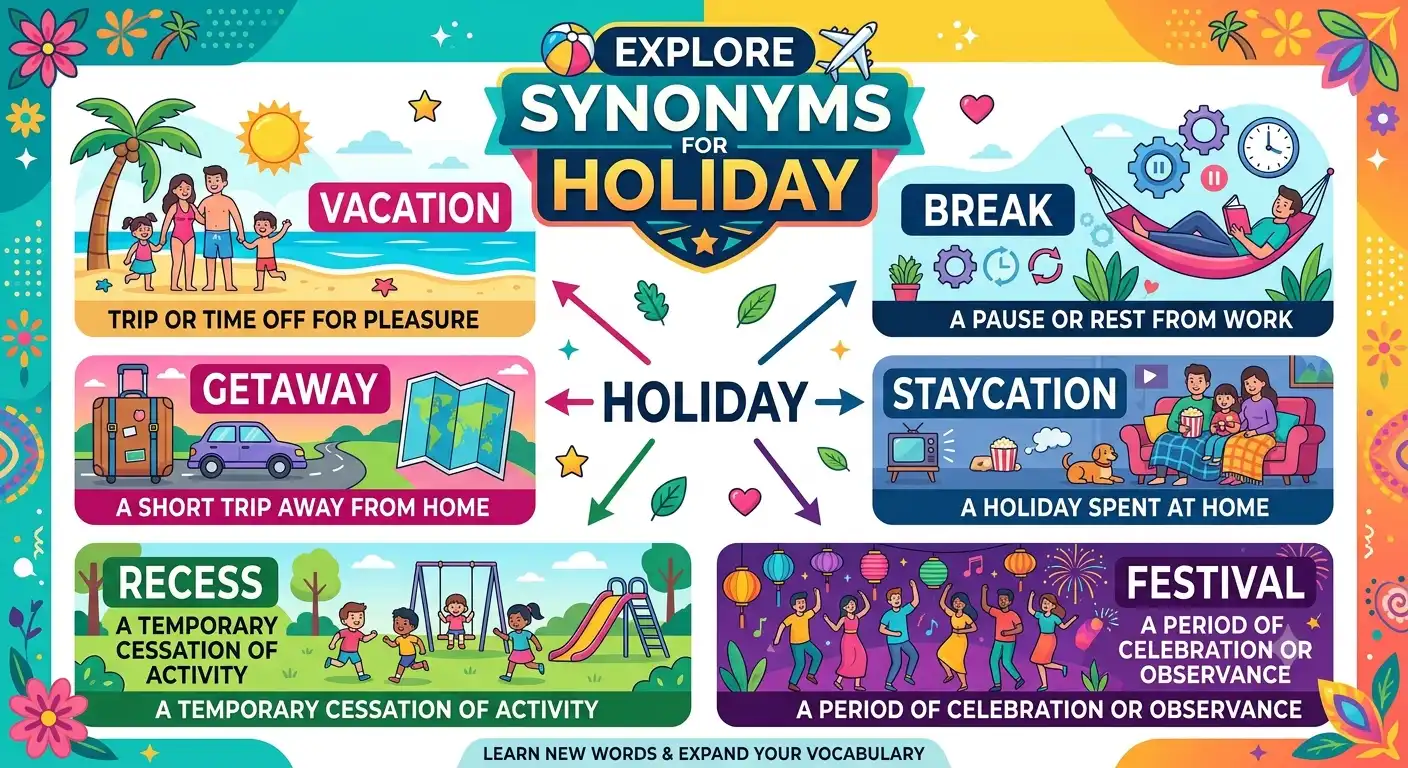
| Vacation | A long period of travel or rest away from home | Casual / Neutral | Summer trips, school breaks, travel plans |
| Staycation | A holiday spent at home or close to home | Casual / Modern | Budget weekends, local relaxing |
| Getaway | A quick trip to escape daily life and busy routines | Casual | Romantic weekends, quick beach trips |
| Sabbatical | A long break from work to study, travel, or rest | Professional | University teachers, corporate workers |
| Recess | A short pause from work, school, or court | Formal / Academic | School playtime, government pauses |
50 Synonyms for Holiday
1. Vacation
Pronunciation: US: /veɪˈkeɪ.ʃən/ | UK: /vəˈkeɪ.ʃən/
Meaning: A long period of time when you do not work and often travel.
Examples:
- We are planning a summer vacation to the beach.
- I need a long vacation to rest my mind.
2. Break
Pronunciation: US: /breɪk/ | UK: /breɪk/
Meaning: A short pause from your daily work or school activities.
Examples:
- Let us take a ten-minute break from the meeting.
- I love our winter break because we get to play in the snow.
3. Recess
Pronunciation: US: /ˈriː.ses/ | UK: /rɪˈses/
Meaning: A small rest period for children at school or for people in court.
Examples:
- The kids run to the swings during school recess.
- Parliament is in recess for the summer months.
4. Getaway
Pronunciation: US: /ˈɡet.ə.weɪ/ | UK: /ˈɡet.ə.weɪ/
Meaning: A quick trip to a nice place to escape your busy life.
Examples:
- They booked a weekend getaway in the mountains.
- I need a quiet getaway to finish my book.
5. Staycation
Pronunciation: US: /ˌsteɪˈkeɪ.ʃən/ | UK: /ˌsteɪˈkeɪ.ʃən/
Meaning: A holiday where you stay at home and relax in your city.
Examples:
- We had a fun staycation and visited local museums.
- A staycation is a great way to save money.
6. Sabbatical
Pronunciation: US: /səˈbæt̬.ɪ.kəl/ | UK: /səˈbæt.ɪ.kəl/
Meaning: A long period of time away from work for study or travel.
Examples:
- The professor took a sabbatical to write his research paper.
- She wants to go on a sabbatical for one year.
7. Leave
Pronunciation: US: /liːv/ | UK: /liːv/
Meaning: Time off from your job that is allowed by your boss.
Examples:
- I must ask for two days of sick leave.
- He is on annual leave until next Tuesday.
8. Trip
Pronunciation: US: /trɪp/ | UK: /trɪp/
Meaning: A journey to a place and back again for fun or work.
Examples:
- The family went on a road trip to the canyon.
- Our school trip to the zoo was very fun.
9. Journey
Pronunciation: US: /ˈdʒɝː.ni/ | UK: /ˈdʒɜː.ni/
Meaning: The act of traveling from one place to another over time.
Examples:
- The train journey through the hills was beautiful.
- We started our long journey before the sun came up.
10. Feast day
Pronunciation: US: /fiːst deɪ/ | UK: /fiːst deɪ/
Meaning: A day with a big meal to celebrate a religious event.
Examples:
- People cook sweet bread for the winter feast day.
- We gather at the church on this special feast day.
11. Festival
Pronunciation: US: /ˈfes.tə.vəl/ | UK: /ˈfes.tɪ.vəl/
Meaning: A series of public performances, events, or parties in one place.
Examples:
- The music festival lasts for three whole days.
- I bought a colorful shirt at the spring festival.
12. Festivity
Pronunciation: US: /fesˈtɪv.ə.t̬i/ | UK: /fesˈtɪv.ə.ti/
Meaning: Happy and loud celebration activities for a special event.
Examples:
- We joined the holiday festivity in the town square.
- The room was full of laughter and wedding festivity.
13. Celebration
Pronunciation: US: /ˌsel.əˈbreɪ.ʃən/ | UK: /ˌsel.əˈbreɪ.ʃən/
Meaning: A social event where people gather to mark a happy occasion.
Examples:
- Her birthday celebration had a big chocolate cake.
- The town held a celebration after the team won.
14. Day off
Pronunciation: US: /deɪ ɒf/ | UK: /deɪ ɒf/
Meaning: A single day when you do not have to go to work.
Examples:
- Friday is my day off, so I can sleep late.
- I will clean my room on my next day off.
15. Rest day
Pronunciation: US: /rest deɪ/ | UK: /rest deɪ/
Meaning: A planned day to stop training or working to heal your body.
Examples:
- Every Sunday is a rest day for the runners.
- You must take a rest day to keep your muscles strong.
16. Furlough
Pronunciation: US: /ˈfɝː.loʊ/ | UK: /ˈfɜː.ləʊ/
Meaning: A period of time when workers are told to stay home.
Examples:
- The factory workers were put on a short furlough.
- He used his furlough to spend time with his kids.
17. Excursion
Pronunciation: US: /ɪkˈskɝː.ʒən/ | UK: /ɪkˈskɜː.ʃən/
Meaning: A short trip made by a group of people for pleasure.
Examples:
- We went on a boat excursion to see the dolphins.
- The hotel organizes a daily excursion to the old ruins.
18. Tour
Pronunciation: US: /tʊr/ | UK: /tʊər/
Meaning: A journey through a country or city to see different sights.
Examples:
- We took a bus tour of London in the afternoon.
- The band is on a music tour across the country.
19. Outing
Pronunciation: US: /ˈaʊ.t̬ɪŋ/ | UK: /ˈaʊ.tɪŋ/
Meaning: A short, enjoyable trip that you take with other people.
Examples:
- Our office outing to the park was very relaxing.
- We planned a weekend outing to the lake house.
20. Retreat
Pronunciation: US: /rɪˈtriːt/ | UK: /rɪˈtriːt/
Meaning: A quiet, private place where you go to rest and think.
Examples:
- She spent a week at a quiet yoga retreat.
- His cabin in the woods is a perfect winter retreat.
21. Time off
Pronunciation: US: /taɪm ɒf/ | UK: /taɪm ɒf/
Meaning: A general period of rest away from your main job duties.
Examples:
- I need some time off to visit my grandmother.
- The company gives employees extra time off in December.
22. Breather
Pronunciation: US: /ˈbriː.ðɚ/ | UK: /ˈbriː.ðər/
Meaning: A very short pause to catch your breath after hard work.
Examples:
- Let us stop running and take a quick breather.
- I need a breather before I start the next task.
23. Respite
Pronunciation: US: /ˈres.pɪt/ | UK: /ˈres.paɪt/
Meaning: A short break from something that is difficult or painful.
Examples:
- The cool rain brought a brief respite from the hot sun.
- He worked without any respite for twelve hours.
24. Hiatus
Pronunciation: US: /haɪˈeɪ.t̬əs/ | UK: /haɪˈeɪ.təs/
Meaning: A temporary pause or gap in a series of events or work.
Examples:
- The TV show is on a winter hiatus until spring.
- She returned to her job after a two-year hiatus.
25. Intermission
Pronunciation: US: /ˌɪn.t̬ɚˈmɪʃ.ən/ | UK: /ˌɪn.təˈmɪʃ.ən/
Meaning: A short break between the parts of a play, movie, or concert.
Examples:
- We bought some popcorn during the theater intermission.
- The band took a short intermission after five songs.
“Rest is not laziness; it is the sweet repair of a busy mind.”
26. Pause
Pronunciation: US: /pɑːz/ | UK: /pɔːz/
Meaning: A temporary stop in action, speech, or music.
Examples:
- There was a long pause before she answered the phone.
- Click the button to pause the video for a minute.
27. Leisure
Pronunciation: US: /ˈliː.ʒɚ/ | UK: /ˈleʒ.ər/
Meaning: Free time when you are not working and can do what you enjoy.
Examples:
- I like to read books during my leisure hours.
- The park is a great place for sports and leisure.
28. Recreation
Pronunciation: US: /ˌrek.riˈeɪ.ʃən/ | UK: /ˌrek.riˈeɪ.ʃən/
Meaning: Playful activities that you do to relax and have fun.
Examples:
- Swimming and hiking are good forms of recreation.
- The school has a big hall for indoor recreation.
29. Gala
Pronunciation: US: /ˈɡeɪ.lə/ | UK: /ˈɡɑː.lə/
Meaning: A special public celebration with music, dancing, and performances.
Examples:
- The city held a charity gala to raise money for schools.
- Everyone wore beautiful clothes to the winter gala.
30. Jubilee
Pronunciation: US: /ˈdʒuː.bə.liː/ | UK: /ˈdʒuː.bɪ.liː/
Meaning: A big celebration to mark an important anniversary.
Examples:
- The nation celebrated the queen’s silver jubilee.
- We had a great party for the school’s golden jubilee.
31. Fiesta
Pronunciation: US: /fiˈes.tə/ | UK: /fiˈes.tə/
Meaning: A traditional festival or party in Spanish-speaking countries.
Examples:
- The street was full of bright lights for the annual fiesta.
- We danced to loud music at the local fiesta.
32. Carnival
Pronunciation: US: /ˈkɑːr.nə.vəl/ | UK: /ˈkɑː.nɪ.vəl/
Meaning: A public event with music, dancing, rides, and games.
Examples:
- I won a big toy bear at the summer carnival.
- The city streets were busy during the colorful carnival.
33. Commemoration
Pronunciation: US: /kəˌmem.əˈreɪ.ʃən/ | UK: /kəˌmem.əˈreɪ.ʃən/
Meaning: A special event to show respect and remember a past person or event.
Examples:
- The memorial service was a quiet commemoration of the soldiers.
- They put up a statue in commemoration of the founder.
34. Day of rest
Pronunciation: US: /deɪ ɒv rest/ | UK: /deɪ ɒv rest/
Meaning: A regular day of the week set aside to rest from labor.
Examples:
- For many people, Sunday is a sacred day of rest.
- I treat Saturday as my personal day of rest.
35. Bank holiday
Pronunciation: US: /bæŋk ˈhɑː.lə.deɪ/ | UK: /bæŋk ˈhɒl.ə.deɪ/
Meaning: An official public holiday in the UK when banks are closed.
Examples:
- The shops were very busy during the spring bank holiday.
- We are planning a picnic for the bank holiday Monday.
36. National day
Pronunciation: US: /ˈnæʃ.nəl deɪ/ | UK: /ˈnæʃ.nəl deɪ/
Meaning: A public holiday celebrating a country’s history or independence.
Examples:
- People wave flags in the street on our national day.
- There was a big military parade on the national day.
37. Holy day
Pronunciation: US: /ˈhoʊ.li deɪ/ | UK: /ˈhəʊ.li deɪ/
Meaning: A religious festival day of great spiritual importance.
Examples:
- Families gather to pray on this sacred holy day.
- The shops close early for the autumn holy day.
38. Sabbatical leave
Pronunciation: US: /səˈbæt̬.ɪ.kəl liːv/ | UK: /səˈbæt.ɪ.kəl liːv/
Meaning: A long break granted by a university or company to an employee.
Examples:
- He applied for sabbatical leave to write his book in Spain.
- Her sabbatical leave was approved for six months.
39. Half-holiday
Pronunciation: US: /hæf ˈhɑː.lə.deɪ/ | UK: /hɑːf ˈhɒl.ə.deɪ/
Meaning: A day where people only work or study for half the time.
Examples:
- The school gave the children a half-holiday on Friday.
- We enjoyed a sunny half-holiday walking in the park.
40. Long weekend
Pronunciation: US: /lɑːŋ ˌwiːkˈend/ | UK: /lɒŋ ˌwiːkˈend/
Meaning: A weekend that has one or two extra days of rest.
Examples:
- Since Monday is a holiday, we have a long weekend.
- We drove to the beach to enjoy our long weekend.
41. Mini-break
Pronunciation: US: /ˈmɪn.i.breɪk/ | UK: /ˈmɪn.i.breɪk/
Meaning: A very short trip or holiday that lasts for a few days.
Examples:
- We booked a mini-break to Paris for the weekend.
- A mini-break is enough to help you feel fresh again.
42. Jaunt
Pronunciation: US: /dʒɑːnt/ | UK: /dʒɔːnt/
Meaning: A short and happy journey made for pleasure.
Examples:
- They took a quick jaunt to the countryside on Sunday.
- We went on a sunny jaunt to the apple orchard.
43. Voyage
Pronunciation: US: /ˈvɔɪ.ɪdʒ/ | UK: /ˈvɔɪ.ɪdʒ/
Meaning: A very long journey across the sea or through space.
Examples:
- The ship set sail on a historic voyage to India.
- Space travel will make a voyage to Mars possible.
44. Passage
Pronunciation: US: /ˈpæs.ɪdʒ/ | UK: /ˈpæs.ɪdʒ/
Meaning: A journey by ship from one specific port to another.
Examples:
- They booked a safe passage across the Atlantic Ocean.
- The stormy seas made the passage very rough.
45. Sojourn
Pronunciation: US: /ˈsoʊ.dʒɝːn/ | UK: /ˈsɒdʒ.ɜːn/
Meaning: A short, temporary stay in a place away from home.
Examples:
- Her short sojourn in the mountain village was peaceful.
- He wrote many poems during his sojourn in Italy.
46. Stopover
Pronunciation: US: /ˈstɑːp.oʊ.vɚ/ | UK: /ˈstɒp.əʊ.vər/
Meaning: A brief pause in a long journey to rest before moving on.
Examples:
- We had a one-night stopover in Dubai on our way to Tokyo.
- I slept at an airport hotel during my stopover.
47. Layover
Pronunciation: US: /ˈleɪ.oʊ.vɚ/ | UK: /ˈleɪ.əʊ.vər/
Meaning: A short waiting time between flights at an airport.
Examples:
- Our flight has a six-hour layover in Chicago.
- I read a book to pass the time during the layover.
48. Expedition
Pronunciation: US: /ˌek.spəˈdɪʃ.ən/ | UK: /ˌek.spəˈdɪʃ.ən/
Meaning: A long journey organized for a special scientific purpose.
Examples:
- The scientists went on an expedition to the cold South Pole.
- They found ancient ruins during their mountain expedition.
49. Pilgrimage
Pronunciation: US: /ˈpɪl.ɡrə.mɪdʒ/ | UK: /ˈpɪl.ɡrɪ.mɪdʒ/
Meaning: A special journey to a holy place for religious reasons.
Examples:
- Thousands of people make a pilgrimage to Rome each year.
- The family went on a peaceful pilgrimage to the old temple.
50. Safari
Pronunciation: US: /səˈfɑːr.i/ | UK: /səˈfɑː.ri/
Meaning: A holiday trip to watch or hunt wild animals in nature.
Examples:
- We went on an exciting safari in Africa to see lions.
- Do not forget your camera when you go on the safari.
Antonyms of Holiday
To understand “holiday” fully, it helps to know its opposite terms. When you are not enjoying a holiday, you might be dealing with:
- Work: Activity involving mental or physical effort done for a purpose.
- Labor: Hard physical work or toil.
- Duty: A moral or legal obligation; a task that must be done.
- Business: The practice of making one’s living by engaging in commerce.
- Shift: A scheduled period of work in a factory or hospital.
- Employment: The state of having paid work or a stable job.
Prototype Meaning and Categorization of Holiday
We can group these 50 synonyms into four easy categories to keep them clear in your mind:
- The Travel and Adventure Group (Trip and Expedition): These words focus on moving from one place to another. Words like trip, journey, excursion, tour, voyage, passage, jaunt, expedition, pilgrimage, and safari fit here.
- The Mind and Rest Group (Break and Retreat): These terms focus on stopping work to heal your brain and body. Words like break, recess, vacation, staycation, getaway, sabbatical, leave, rest day, day off, retreat, time off, breather, respite, hiatus, intermission, pause, leisure, recreation, sojourn, stopover, layover, long weekend, mini-break, sabbatical leave, half-holiday, and day of rest belong here.
- The Celebration and Joy Group (Festival and Fiesta): These words are about noisy parties, special dinners, and public events. Words like feast day, festival, festivity, celebration, gala, jubilee, fiesta, and carnival go here.
- The Official and Public Group (National Day and Bank Holiday): These words refer to official days off that are marked by governments or communities. Words like bank holiday, national day, holy day, furlough, and commemoration fit here.
Frequently Asked Questions
1. What is the difference between holiday and vacation?
In British English, “holiday” is used for any time off from work or school. In American English, “vacation” is used for trips away from home, while “holiday” usually refers to national days like Christmas or Thanksgiving.
2. Can I use the word “sabbatical” for a quick weekend trip?
No. A sabbatical is a formal, long-term break from your career or university position. It usually lasts from a few months to a full year and is meant for deep research, writing, or resting.
3. What is the best travel site to book cheap holiday deals?
To find the best prices, go to the official website of Skyscanner or Expedia. These portals help you search, compare, and book flights and hotel stays easily in real-time.
4. How does Merriam-Webster define a staycation?
According to Merriam-Webster, a staycation is a holiday spent at home or nearby, enjoying local attractions and activities without traveling far away.
5. Why do British people say “bank holiday” instead of public holiday?
In the UK, public holidays were historically days when banks were officially closed. Today, the term “bank holiday” is used by everyone to mean a general day off from work.
6. Is “getaway” considered formal or informal?
“Getaway” is an informal word. It is perfect for travel blogs, casual chats, and newsletters, but you should use words like “leave of absence” or “vacation” in a professional email to your boss.
Conclusion
Learning different synonyms for holiday is a wonderful way to boost your writing, blogging, and speaking skills. When you replace common words with these exciting choices, your travel blogs feel much more alive. Your school essays will sound polished, and your everyday business emails will be sharp and easy to understand.
Using the same word too many times can make your sentences feel repetitive and boring. By using these fifty choices, you give your brain new ways to describe rest. Try to pick at least one new synonym from this list today. Use it when you write an email to a coworker, write a class paper, or talk with your friends!
“A holiday gives us the space to breathe and the time to dream.”
“Speak of your travels with beautiful words, and you will inspire others to explore.”
“The best vocabulary is not the one with the biggest words, but the one with the truest feelings.”

Michael Turner is a published fiction writer and creative writing tutor with over a decade of experience helping writers find the words that make their stories breathe ( Biography ).