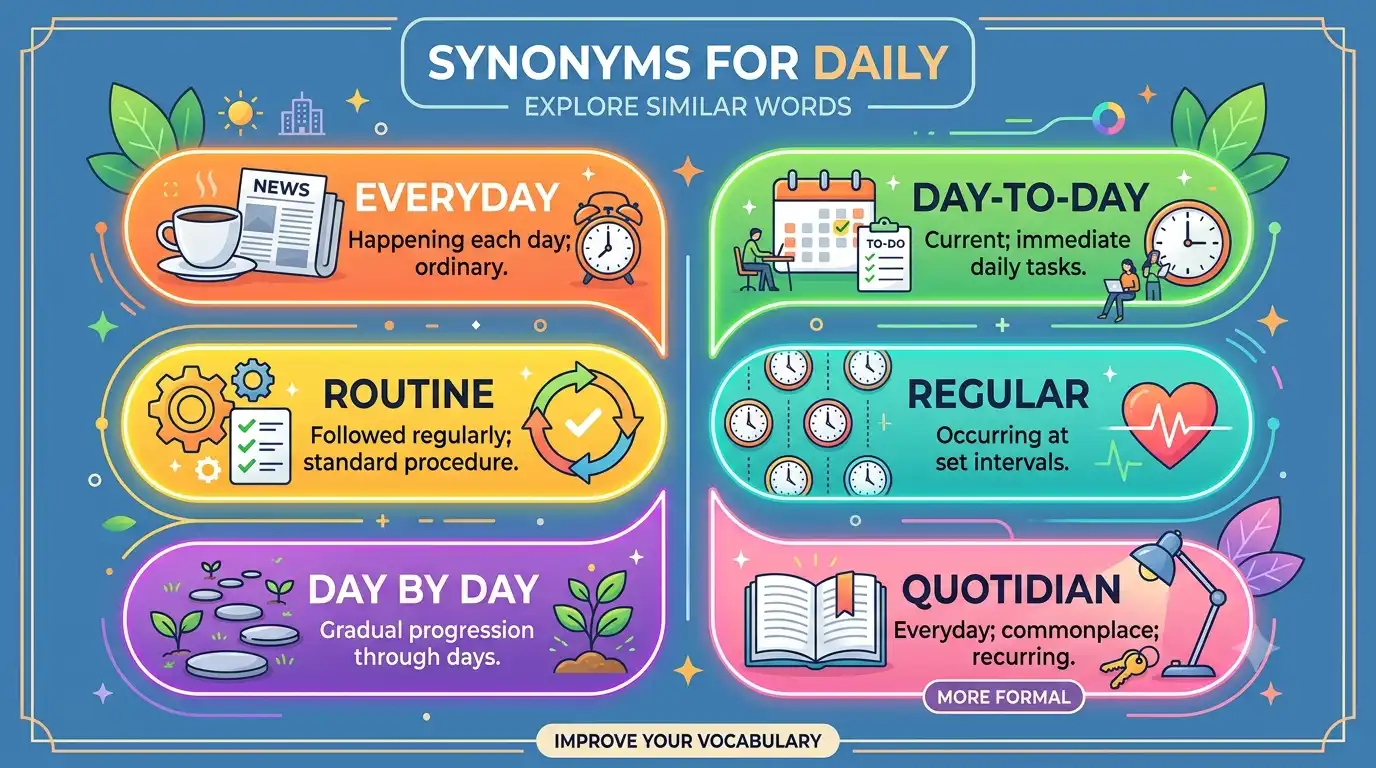
When you look for synonyms for daily, you find words that describe things happening every single day. Learning different synonyms for daily helps you choose the perfect words for your school essays, business emails, or daily talks. Knowing these useful synonyms for daily allows you to show patterns and habits in your writing with clear details.
Imagine a warm cup of sweet coffee waiting on your table every single morning. The alarm rings at six o’clock, and you reach for your mug without even thinking. This simple task is part of your regular morning routine. In very simple English, “daily” means something that occurs, is done, or is paid every single day. It can also describe a newspaper that comes out every morning.
Learning these fresh words is highly useful for many people:
- Students can write strong homework papers and show clear habits in creative stories.
- Bloggers can write exciting posts about morning habits, self-care routines, and life plans.
- Content Writers can create clear, trustable ads and marketing pages that talk directly to readers.
- Daily English Users can express their real habits and schedules with greater word power.
To improve your writing, you can search for the “best dictionary apps” online or buy a classic book like The Merriam-Webster Thesaurus on Amazon. You can also download a helpful writing assistant app like Grammarly or use the Hemingway Editor tool to make your sentences clear and simple.
“Your daily habits build your long-term success.”
“A clear word choice makes your daily thoughts shine bright.”
Linguistic Profile of Daily
Let us look at how this keyword is built, how it sounds, and where it comes from.
- Connotative Meaning: “Daily” has a stable, comfortable, and rhythmic feel. It points to a state of steady routine, reliable habits, or sometimes a slightly boring pattern.
- Etymology:
- Old English: From dæglīc (of a day).
- Proto-Germanic: Related to dagaz (day).
- Suffix: “-ly” comes from Old English markers to make an adjective or adverb.
- Pronunciation (US & UK): US: /ˈdeɪli/ | UK: /ˈdeɪli/
- Syllables: Two syllables (dai-ly).
- Affixation Pattern: It is a root word (“day”) combined with the standard suffix (“-ly”).
Comparison of Key Synonyms
To write well, you must know how different words work. Here is a quick table to show you how the top synonyms compare. To search for more words, you can check them on platforms like Thesaurus.com or check out writing tools like Grammarly.
| Keyword | Meaning | Usage Type | Context |
|---|---|---|---|
| Daily | Happening or done every single day | Neutral | Daily schedules, newspapers, habits |
| Everyday | Ordinary, common, or used on normal days | Casual | Casual clothes, simple chores, daily tools |
| Diurnal | Active during the day rather than at night | Formal | Science studies, wild animals, nature habits |
| Quotidian | Occurring or returning every day | Formal | Literary essays, history books, deep thoughts |
| Routine | Following a fixed, regular pattern | Professional | Work plans, gym habits, morning schedules |
| Customary | According to the usual practice of a group | Formal | Family events, law, traditional styles |
50 Synonyms for Daily
1. Everyday
Pronunciation: US: /ˈevribænd/ | UK: /ˈevrideɪ/
Meaning: Used or happening on normal days.
Examples:
- I wear my everyday shoes to walk the dog.
- These are everyday problems that we can fix easily.
2. Diurnal
Pronunciation: US: /daɪˈɜːrnl/ | UK: /daɪˈɜːnl/
Meaning: Active during the daytime rather than at night.
Examples:
- Hawks are diurnal birds that hunt in the light.
- The forest has a busy diurnal cycle.
3. Quotidian
Pronunciation: US: /kwoʊˈtɪdiən/ | UK: /kwəʊˈtɪdiən/
Meaning: Occurring or returning every single day.
Examples:
- He wrote about the quiet, quotidian life of the farmers.
- Doing dishes is a quotidian chore for me.
4. Routine
Pronunciation: US: /ruːˈtiːn/ | UK: /ruːˈtiːn/
Meaning: Done as part of a regular and fixed plan.
Examples:
- The doctor made a routine check of her eyes.
- We had a routine meeting to plan our work.
5. Regular
Pronunciation: US: /ˈreɡjələr/ | UK: /ˈreɡjʊlə/
Meaning: Happening at even times or in a steady way.
Examples:
- You should eat regular meals to stay healthy.
- He is a regular customer at our local shop.
6. Habitual
Pronunciation: US: /həˈbɪtʃuəl/ | UK: /həˈbɪtʃʊəl/
Meaning: Done constantly or as a deep habit.
Examples:
- Her habitual lateness made her friends angry.
- He took his habitual seat near the warm window.
7. Customary
Pronunciation: US: /ˈkʌstəmeri/ | UK: /ˈkʌstəməri/
Meaning: According to the usual way of doing things.
Examples:
- It is customary to shake hands when you meet.
- He finished his work with his customary speed.
8. Usual
Pronunciation: US: /ˈjuːʒuəl/ | UK: /ˈjuːʒʊəl/
Meaning: Happening or used most of the time.
Examples:
- I will meet you at the usual time tomorrow.
- She took her usual path through the green park.
9. Common
Pronunciation: US: /ˈkɑːmən/ | UK: /ˈkɒmən/
Meaning: Found frequently or done by many people.
Examples:
- Colds are very common during the cold winter.
- They share a common interest in classic books.
10. Ordinary
Pronunciation: US: /ˈɔːrdneri/ | UK: /ˈɔːdnəri/
Meaning: Normal and not special in any way.
Examples:
- Today was just an ordinary day at school.
- He is a kind and ordinary man who loves his family.
11. Day-to-day
Pronunciation: US: /ˌdeɪ tə ˈdeɪ/ | UK: /ˌdeɪ tə ˈdeɪ/
Meaning: Dealing with the daily tasks of running a life or business.
Examples:
- She manages the day-to-day work of the busy office.
- I do not worry about day-to-day problems.
12. Day-by-day
Pronunciation: US: /ˌdeɪ baɪ ˈdeɪ/ | UK: /ˌdeɪ baɪ ˈdeɪ/
Meaning: Happening slowly as each new day passes.
Examples:
- The sick puppy got better day-by-day.
- We planned our long summer trip day-by-day.
13. Ongoing
Pronunciation: US: /ˈɑːnˌɡoʊɪŋ/ | UK: /ˈɒnˌɡəʊɪŋ/
Meaning: Continuing to happen or develop without stopping.
Examples:
- The police have an ongoing search for the missing bag.
- There is an ongoing talk about the new rules.
14. Constant
Pronunciation: US: /ˈkɑːnstənt/ | UK: /ˈkɒnstənt/
Meaning: Happening all the time or staying the same.
Examples:
- The loud clock made a constant ticking sound.
- She is a constant friend who always helps me.
15. Steady
Pronunciation: US: /ˈstedi/ | UK: /ˈstedi/
Meaning: Firm, stable, and not shaking or changing.
Examples:
- He held the heavy camera with a steady hand.
- The company has seen a steady rise in sales.
16. Consistent
Pronunciation: US: /kənˈsɪstənt/ | UK: /kənˈsɪstənt/
Meaning: Always acting or behaving in the same positive way.
Examples:
- She is a consistent player who scores every match.
- Your work must be consistent to get a top grade.
17. Systematic
Pronunciation: US: /ˌsɪstəˈmætɪk/ | UK: /ˌsɪstəˈmætɪk/
Meaning: Done according to a neat and fixed plan.
Examples:
- He made a systematic search of the entire house.
- We need a systematic way to clean the room.
18. Methodical
Pronunciation: US: /məˈθɑːdɪkl/ | UK: /məˈθɒdɪkl/
Meaning: Doing things in a very careful and orderly way.
Examples:
- She is a methodical student who takes great notes.
- He has a methodical plan to build the garden.
19. Clockwork
Pronunciation: US: /ˈklɑːkwɜːrk/ | UK: /ˈklɒkwɜːk/
Meaning: Working with perfect regularity and speed.
Examples:
- The busy kitchen runs like clockwork during dinner.
- He arrives at his desk every morning like clockwork.
20. Fixed
Pronunciation: US: /fɪkst/ | UK: /fɪkst/
Meaning: Set firmly and not able to be changed.
Examples:
- The school has a fixed schedule for lunch.
- He has a fixed idea about how to cook rice.
21. Set
Pronunciation: US: /set/ | UK: /set/
Meaning: Ready, fixed, or established beforehand.
Examples:
- We have set times to wash our clothes.
- There are set rules for this board game.
22. Chronic
Pronunciation: US: /ˈkrɑːnɪk/ | UK: /ˈkrɒnɪk/
Meaning: Lasting for a very long time or recurring often.
Examples:
- He suffers from a chronic pain in his back.
- The city has a chronic traffic problem.
23. Persistent
Pronunciation: US: /pərˈsɪstənt/ | UK: /pəˈsɪstənt/
Meaning: Continuing firmly even when there are problems.
Examples:
- The persistent salesman kept calling our home.
- She won the race due to her persistent practice.
24. Recurrent
Pronunciation: US: /rɪˈkɜːrənt/ | UK: /rɪˈkʌrənt/
Meaning: Happening again and again at different times.
Examples:
- I have a recurrent dream about flying.
- The company had recurrent problems with their computers.
“Consistency in our steady work brings the best results.”
25. Periodic
Pronunciation: US: /ˌpɪriˈɑːdɪk/ | UK: /ˌpɪəriˈɒdɪk/
Meaning: Happening at regular intervals of time.
Examples:
- We make periodic visits to see our grandmother.
- The car needs periodic checks to run safely.
26. Frequent
Pronunciation: US: /ˈfriːkwənt/ | UK: /ˈfriːkwənt/
Meaning: Happening often or many times.
Examples:
- He is a frequent traveler to warm places.
- We make frequent stops to drink fresh water.
27. Repeated
Pronunciation: US: /rɪˈpiːtɪd/ | UK: /rɪˈpiːtɪd/
Meaning: Done or happening many times over.
Examples:
- She ignored his repeated warnings about the hot stove.
- The song had repeated beats that made us dance.
28. Rhythmic
Pronunciation: US: /ˈrɪðmɪk/ | UK: /ˈrɪðmɪk/
Meaning: Having a strong, regular, and repeating beat.
Examples:
- We listened to the rhythmic sound of the waves.
- Her rhythmic breathing showed that she was asleep.
29. Cyclic
Pronunciation: US: /ˈsaɪklɪk/ | UK: /ˈsaɪklɪk/
Meaning: Happening in a circle that repeats over time.
Examples:
- The seasons follow a cyclic pattern every year.
- Business sales have a cyclic rise and fall.
30. Continuous
Pronunciation: US: /kənˈtɪnjuəs/ | UK: /kənˈtɪnjʊəs/
Meaning: Going on without any stop or break.
Examples:
- The heavy rain was continuous for three whole days.
- He needs a continuous stream of fresh ideas.
31. Unbroken
Pronunciation: US: /ʌnˈbroʊkən/ | UK: /ʌnˈbrəʊkən/
Meaning: Continuing without being split or interrupted.
Examples:
- He has an unbroken record of winning games.
- We enjoyed eight hours of unbroken sleep.
32. Nonstop
Pronunciation: US: /ˌnɑːnˈstɑːp/ | UK: /ˌnɒnˈstɒp/
Meaning: Traveling or acting without making any stops.
Examples:
- We took a nonstop flight to New York.
- She did nonstop work to finish the project.
33. Unceasing
Pronunciation: US: /ʌnˈsiːsɪŋ/ | UK: /ʌnˈsiːsɪŋ/
Meaning: Not stopping or coming to an end.
Examples:
- The noisy street had an unceasing flow of cars.
- I appreciate your unceasing help with my chores.
34. Perpetual
Pronunciation: US: /pərˈpetʃuəl/ | UK: /pəˈpetʃʊəl/
Meaning: Continuing forever or for a very long time.
Examples:
- The tall mountains are covered in perpetual snow.
- He lives in a perpetual state of worry.
35. Endless
Pronunciation: US: /ˈendləs/ | UK: /ˈendləs/
Meaning: Having no limit, end, or boundary.
Examples:
- The kids had endless energy to play outside.
- We stared at the endless blue sky.
36. Relentless
Pronunciation: US: /rɪˈlentləs/ | UK: /rɪˈlentləs/
Meaning: Continuing in a severe or determined way.
Examples:
- The relentless sun made the ground very hot.
- He was relentless in his pursuit of the truth.
37. Familiar
Pronunciation: US: /fəˈmɪliər/ | UK: /fəˈmɪliə/
Meaning: Well-known from being seen or heard often.
Examples:
- I saw a familiar face in the busy crowd.
- She walked down the familiar street to her home.
38. Traditional
Pronunciation: US: /trəˈdɪʃənl/ | UK: /trəˈdɪʃənl/
Meaning: Following ideas or customs from the past.
Examples:
- We ate a traditional dinner for the holiday.
- He loves traditional music from his home country.
39. Conventional
Pronunciation: US: /kənˈvenʃənl/ | UK: /kənˈvenʃənl/
Meaning: Following what is common or generally accepted.
Examples:
- She lives a very conventional life in the suburbs.
- He gave a conventional speech to the students.
40. Established
Pronunciation: US: /ɪˈstæblɪʃt/ | UK: /ɪˈstæblɪʃt/
Meaning: Accepted and used by many people for a long time.
Examples:
- The school has many established rules for safety.
- He is an established writer with three top books.
41. Standard
Pronunciation: US: /ˈstændərd/ | UK: /ˈstændəd/
Meaning: Regular, normal, or used as a rule.
Examples:
- This is the standard size for a twin bed.
- He gave a standard answer to the easy question.
42. Normal
Pronunciation: US: /ˈnɔːrml/ | UK: /ˈnɔːml/
Meaning: Usual, typical, or expected in a situation.
Examples:
- It is normal to feel nervous before a big test.
- We returned to our normal routine after vacation.
43. Monotonous
Pronunciation: US: /məˈnɑːtənəs/ | UK: /məˈnɒtənəs/
Meaning: Dull, tedious, and repetitious; lacking in variety.
Examples:
- The factory workers did monotonous tasks all day.
- He spoke in a monotonous voice that made us sleepy.
44. Humdrum
Pronunciation: US: /ˈhʌmdrʌm/ | UK: /ˈhʌmdrʌm/
Meaning: Lacking excitement or variety; boring.
Examples:
- She wanted to escape her humdrum office life.
- We had a humdrum lunch of plain bread and cheese.
45. Plodding
Pronunciation: US: /ˈplɑːdɪŋ/ | UK: /ˈplɒdɪŋ/
Meaning: Slow-moving and continuous, but lacking any excitement.
Examples:
- The horse made a plodding journey up the hill.
- I spent a plodding afternoon filing old papers.
46. Run-of-the-mill
Pronunciation: US: /ˌrʌn əv ðə ˈmɪl/ | UK: /ˌrʌn əv ðə ˈmɪl/
Meaning: Ordinary and not special or exciting.
Examples:
- It was a run-of-the-mill movie with a simple plot.
- He did a run-of-the-mill job fixing the wooden fence.
47. Workaday
Pronunciation: US: /ˈwɜːrkədeɪ/ | UK: /ˈwɜːkədeɪ/
Meaning: Relating to ordinary workdays or normal life.
Examples:
- She put on her workaday clothes to paint the room.
- We must deal with the workaday world every morning.
48. Twenty-four-hour
Pronunciation: US: /ˌtwenti fɔːr ˈaʊər/ | UK: /ˌtwenti fɔː ˈaʊə/
Meaning: Running or open all day and all night.
Examples:
- The hospital has a twenty-four-hour care unit.
- We bought food at the twenty-four-hour shop.
49. Hourly
Pronunciation: US: /ˈaʊərli/ | UK: /ˈaʊəli/
Meaning: Happening or done every single hour.
Examples:
- The bus runs on an hourly schedule during the day.
- She got hourly updates about the bad storm.
50. Night-and-day
Pronunciation: US: /ˌnaɪt ən dē/ | UK: /ˌnaɪt ən dē/
Meaning: Continuing all the time, both day and night.
Examples:
- The factory has a night-and-day shift of workers.
- He gave night-and-day care to his sick pet.
Antonyms of Daily
To understand “daily” fully, it is helpful to look at its opposite terms. When something does not happen every day, you can use these simple words:
- Infrequent: Not happening often.
- Rare: Very unusual and not seen every day.
- Occasional: Happening only once in a while.
- Weekly: Occurring once every week.
- Monthly: Occurring once every month.
- Irregular: Not following any set time or pattern.
Prototype Meaning and Categorization of Daily
We can group these 50 synonyms into four easy categories to keep them clear in your mind:
- The Day and Routine Group: These words are for things that happen on normal days as part of a habit. Words like everyday, diurnal, quotidian, routine, regular, habitual, customary, usual, common, ordinary, day-to-day, day-by-day, workaday, hourly, and twenty-four-hour belong here.
- The Constant and Steady Group: Use these words to describe something that does not stop or change. Words like ongoing, constant, steady, consistent, systematic, methodical, clockwork, fixed, set, persistent, continuous, unbroken, nonstop, unceasing, perpetual, endless, relentless, and night-and-day fit this group.
- The Repeating Pattern Group: These words describe things that happen again and again at set times. Words like chronic, recurrent, periodic, frequent, repeated, rhythmic, and cyclic belong in this category.
- The Normal and Boring Group: These words are for things that feel very familiar and lack excitement. Words like familiar, traditional, conventional, established, standard, normal, monotonous, humdrum, plodding, and run-of-the-mill go here.
Frequently Asked Questions
1. What is the most common synonym for daily?
The most common everyday word is “everyday.” In work and school schedules, people also use “routine” or “regular” very often.
2. Is there a difference between daily and everyday?
Yes. “Daily” is an adverb or adjective meaning every day. “Everyday” is an adjective that means common, ordinary, or casual. You wear “everyday shoes,” but you brush your teeth “daily.”
3. What does “diurnal” mean in science class?
“Diurnal” is used to describe animals that are awake and active during the day. This is the opposite of “nocturnal,” which means active at night.
4. Can “quotidian” be used in casual chats?
No. “Quotidian” is a very formal and literary word. It is best used in school essays or classic books to describe normal, daily life.
5. Why do writers use the term “clockwork”?
Writers use “clockwork” to show that a system runs perfectly without any mistakes or delays. It sounds very organized and professional.
6. What is a good synonym for a daily task that is boring?
A great word for a boring daily task is “monotonous” or “humdrum.” These words show that the task lacks variety and excitement.
Conclusion
Learning different synonyms for daily is a wonderful way to improve your writing, blogging, and daily speaking. When you choose the right words, your school essays sound much more thoughtful. Your blog posts feel warm and highly professional, and your emails become clear and exciting to read.
Using the same word over and over can make your writing feel dry and repetitive. By practicing these fifty terms, you give your mind the power to describe habits, schedules, and daily events with great care. Try to pick at least one respectful synonym from this list today. Use it in a class paper, an email to a study group, or when talking with your close friends!
“Every small word you practice today builds a better tomorrow.”
“Speak with clear words, and the world will listen to your ideas.”

Michael Turner is a published fiction writer and creative writing tutor with over a decade of experience helping writers find the words that make their stories breathe ( Biography ).