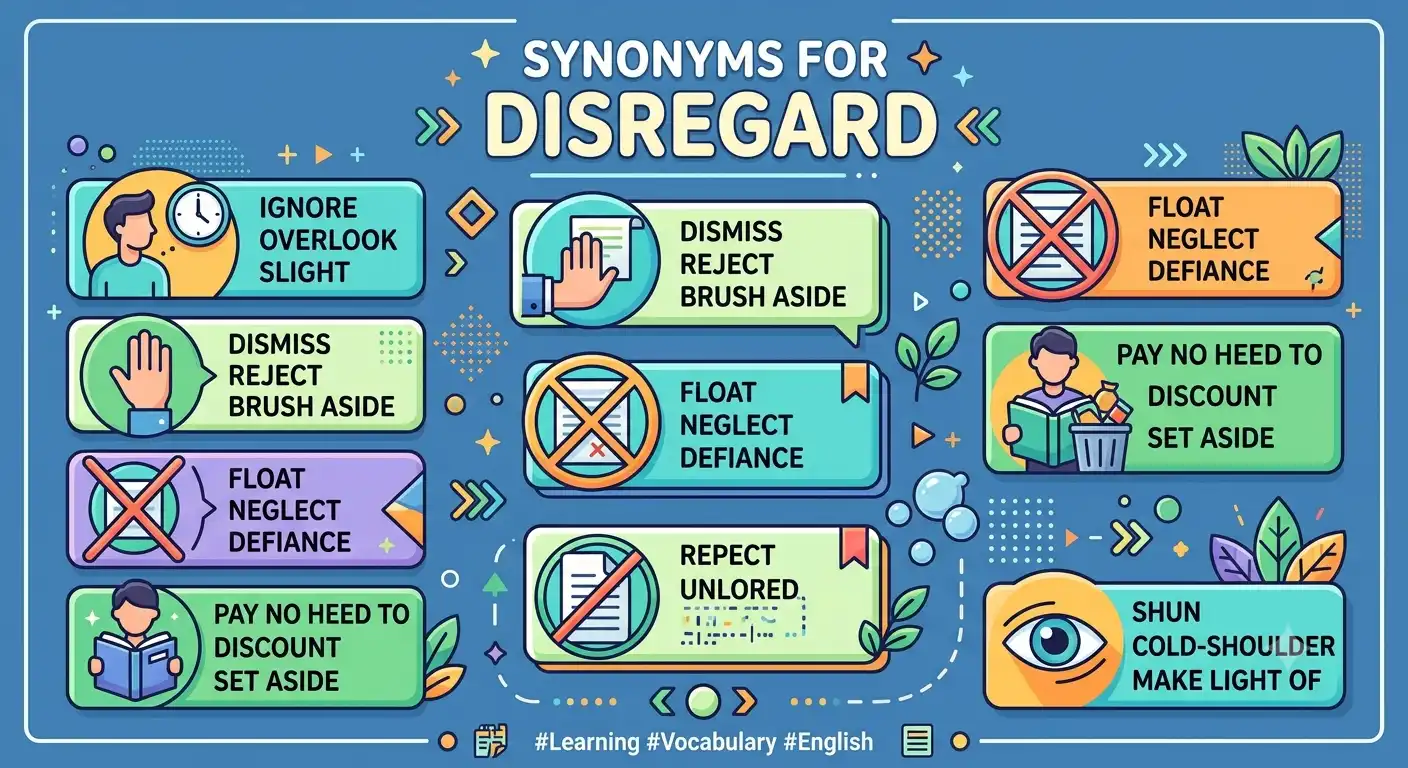
Learning strong synonyms for disregard helps you explain when people ignore rules, skip advice, or pay no attention to details. Finding clear synonyms for disregard gives you the right words to describe actions, feelings, and choices in daily life. Using exact synonyms for disregard improves your writing, expands your word bank, and makes every message easy to read.
Imagine a driver who sees a red stop sign but keeps driving anyway. That person chooses to disregard the traffic rule. To disregard means to ignore something, pay no attention to a warning, or treat an idea like it does not matter.
“Choosing the right word brings your story to life and makes every event clear.”
Expanding your vocabulary helps you share ideas with ease every single day:
- Students can write sharper essays and score higher on English tests.
- Bloggers can write catchy posts that keep readers scrolling.
- Content writers can craft clear articles that rank well on search engines.
- Daily English users can describe actions and choices with confidence.
“Clear words make strong sentences and help you speak with total confidence.”
Connotative Meaning of Disregard
The word disregard carries distinct tones depending on the situation:
- Positive Connotation: Ignoring negative thoughts, setting aside fear to stay brave, or disregarding minor flaws to focus on the good.
- Negative Connotation: Ignoring safety rules, showing disrespect to others, or failing to care about someone’s feelings.
- Neutral Connotation: Setting aside old data during a study, filtering out background noise, or choosing not to use a suggestion.
Etymology of Disregard
- Origin: Formed in the late 16th century in English by combining a prefix and a base word.
- Roots: Combines the prefix dis- (meaning “not” or “opposite of”) with regard (from Old French regarder, meaning “to look at” or “to heed”).
- Historical Context: Originally meant “to fail to look at” or “to treat without respect.”
- Modern Evolution: Today, it means “to ignore,” “to pay no attention to,” or “to treat as unimportant.”
Pronunciation, Syllables, and Affixation Pattern
- US Pronunciation (IPA): /ˌdɪs.rɪˈɡɑːrd/
- UK Pronunciation (IPA): /ˌdɪs.rɪˈɡɑːd/
- Syllable Count: 3 syllables (dis-re-gard)
- Root Word: Regard
- Affixation Patterns:
- Prefixes: Dis- (Disregard – opposite of regard)
- Suffixes:
- -ed (Disregarded – Past tense)
- -ing (Disregarding – Present participle)
- -ful (Disregardful – Adjective)
Word Comparison Table
| Keyword | Meaning | Usage Type | Context |
| Disregard | To ignore or pay no attention to | Neutral / Formal | Rules, advice, warnings, feelings |
| Ignore | To intentionally take no notice of | Casual / Daily | Conversations, alerts, people |
| Overlook | To fail to notice or choose to forgive | Neutral / Soft | Small mistakes, details, errors |
| Neglect | To fail to care for properly | Serious / Emotional | Duty, health, pets, responsibilities |
| Flout | To openly break or mock a law | Formal / Strong | Laws, rules, social standards |
| Snub | To intentionally ignore or insult someone | Emotional / Casual | Friendships, social events, chats |
| Brush aside | To dismiss an idea quickly | Conversational | Suggestions, fears, objections |
| Bypass | To go around an official path or person | Professional | Systems, bosses, standard steps |
50 Synonyms for Disregard
1. Ignore
- Pronunciation: US: /ɪɡˈnɔːr/ | UK: /ɪɡˈnɔːr/
- Meaning: To pay no attention to someone or something on purpose.
- Examples:
- He decided to ignore the loud noise outside.
- Please do not ignore my text message.
2. Overlook
- Pronunciation: US: /ˌoʊ.vɚˈlʊk/ | UK: /ˌəʊ.vəˈlʊk/
- Meaning: To fail to see or notice a small detail.
- Examples:
- Teachers sometimes overlook a small spelling mistake.
- Do not overlook the main rule on the list.
3. Neglect
- Pronunciation: US: /nɪˈɡlekt/ | UK: /nɪˈɡlekt/
- Meaning: To fail to take care of something properly.
- Examples:
- Do not neglect your homework this week.
- Water the plant so you do not neglect it.
4. Dismiss
- Pronunciation: US: /dɪsˈmɪs/ | UK: /dɪsˈmɪs/
- Meaning: To decide that an idea is not worth thinking about.
- Examples:
- The boss chose to dismiss the bad suggestion.
- You should not dismiss his advice so fast.
5. Slight
- Pronunciation: US: /slaɪt/ | UK: /slaɪt/
- Meaning: To treat someone without respect or attention.
- Examples:
- She did not mean to slight her friend at lunch.
- It is rude to slight guests at your house.
6. Snub
- Pronunciation: US: /snʌb/ | UK: /snʌb/
- Meaning: To ignore someone cold-heartedly to hurt their feelings.
- Examples:
- He tried to snub his rival at the party.
- Why did she snub your friendly wave?
7. Brush aside
- Pronunciation: US: /brʌʃ əˈsaɪd/ | UK: /brʌʃ əˈsaɪd/
- Meaning: To reject an idea or fear without giving it thought.
- Examples:
- She was able to brush aside her fear and speak.
- Do not brush aside good health advice.
8. Pass over
- Pronunciation: US: /pæs ˈoʊ.vɚ/ | UK: /pɑːs ˈəʊ.və/
- Meaning: To leave someone out or skip over them.
- Examples:
- They might pass over him for the new job.
- The teacher will pass over the easy page today.
9. Bypass
- Pronunciation: US: /ˈbaɪ.pæs/ | UK: /ˈbaɪ.pɑːs/
- Meaning: To avoid following the usual path or authority.
- Examples:
- You cannot bypass the main security check.
- They chose to bypass the slow process.
10. Shirk
- Pronunciation: US: /ʃɝːk/ | UK: /ʃɜːk/
- Meaning: To avoid doing work or a duty.
- Examples:
- Good workers do not shirk their hard duties.
- Never shirk your chores at home.
11. Discount
- Pronunciation: US: /dɪsˈkaʊnt/ | UK: /dɪsˈkaʊnt/
- Meaning: To consider a fact or idea as unimportant.
- Examples:
- Do not discount his help before you try.
- We should not discount the storm warning.
12. Disobey
- Pronunciation: US: /ˌdɪs.əˈbeɪ/ | UK: /ˌdɪs.əˈbeɪ/
- Meaning: To refuse to follow a rule or order.
- Examples:
- Dogs should not disobey their owners.
- Children must not disobey safety rules.
13. Flout
- Pronunciation: US: /flaʊt/ | UK: /flaʊt/
- Meaning: To break a rule openly without fear.
- Examples:
- Drivers must not flout the speed limit.
- He liked to flout school rules every day.
14. Defy
- Pronunciation: US: /dɪˈfaɪ/ | UK: /dɪˈfaɪ/
- Meaning: To openly resist a power or command.
- Examples:
- Brave soldiers defy bad orders.
- The team will defy the hard odds to win.
15. Scorn
- Pronunciation: US: /skɔːrn/ | UK: /skɔːn/
- Meaning: To treat an idea or person with no respect.
- Examples:
- Fools scorn good advice from old friends.
- She chose to scorn the mean rumors.
16. Disdain
- Pronunciation: US: /dɪsˈdeɪn/ | UK: /dɪsˈdeɪn/
- Meaning: To feel that someone or something is not worthy.
- Examples:
- He looks at junk food with disdain.
- Do not disdain small acts of kindness.
17. Spurn
- Pronunciation: US: /spɝːn/ | UK: /spɜːn/
- Meaning: To reject something with hatred or anger.
- Examples:
- She chose to spurn his fake apology.
- The king will spurn the enemy offer.
18. Cold-shoulder
- Pronunciation: US: /koʊld ˈʃoʊl.dɚ/ | UK: /kəʊld ˈʃəʊl.də/
- Meaning: To intentionally act unfriendly toward someone.
- Examples:
- It is unkind to cold-shoulder a new student.
- She gave him the cold-shoulder all day.
19. Shun
- Pronunciation: US: /ʃʌn/ | UK: /ʃʌn/
- Meaning: To stay away from a person or place on purpose.
- Examples:
- Wise people shun dangerous places at night.
- He chose to shun bad habits completely.
20. Wave aside
- Pronunciation: US: /weɪv əˈsaɪd/ | UK: /weɪv əˈsaɪd/
- Meaning: To dismiss a thought or warning with a hand move.
- Examples:
- He chose to wave aside her gentle warning.
- You should not wave aside medical advice.
21. Set aside
- Pronunciation: US: /set əˈsaɪd/ | UK: /set əˈsaɪd/
- Meaning: To put something away so you can focus on another thing.
- Examples:
- Let us set aside our differences and work.
- She will set aside her fear to take the test.
22. Minimize
- Pronunciation: US: /ˈmɪn.ə.maɪz/ | UK: /ˈmɪn.ɪ.maɪz/
- Meaning: To make something seem smaller or less important.
- Examples:
- Do not minimize the value of hard work.
- He tried to minimize his huge mistake.
23. Forget
- Pronunciation: US: /fɚˈɡet/ | UK: /fəˈɡet/
- Meaning: To fail to remember or think about something.
- Examples:
- Do not forget to bring your book to class.
- I hope you do not forget my birthday.
24. Omit
- Pronunciation: US: /oʊˈmɪt/ | UK: /əʊˈmɪt/
- Meaning: To leave out a detail on purpose or by accident.
- Examples:
- You can omit the last step if you want.
- Do not omit key facts from your report.
25. Skip
- Pronunciation: US: /skɪp/ | UK: /skɪp/
- Meaning: To pass over a item or step without doing it.
- Examples:
- You should not skip breakfast in the morning.
- Feel free to skip the hard questions first.
26. Misprize
- Pronunciation: US: /mɪsˈpraɪz/ | UK: /mɪsˈpraɪz/
- Meaning: To undervalue or fail to appreciate something.
- Examples:
- Critics often misprize fresh art styles.
- Do not misprize the efforts of your team.
27. Write off
- Pronunciation: US: /raɪt ɑːf/ | UK: /raɪt ɒf/
- Meaning: To decide that something is a failure and useless.
- Examples:
- Do not write off the game before it ends.
- They had to write off the broken car.
28. Leave out
- Pronunciation: US: /liːv aʊt/ | UK: /liːv aʊt/
- Meaning: To not include a person or thing in an event.
- Examples:
- Do not leave out any names on the list.
- Try not to leave out your friend at recess.
29. Turn a blind eye
- Pronunciation: US: /tɝːn ə blaɪnd aɪ/ | UK: /tɜːn ə blaɪnd aɪ/
- Meaning: To pretend not to see something wrong.
- Examples:
- Guards must not turn a blind eye to crime.
- She decided to turn a blind eye to his joke.
30. Tune out
- Pronunciation: US: /tuːn aʊt/ | UK: /tjuːn aʊt/
- Meaning: To stop listening to sound or talk around you.
- Examples:
- He likes to tune out noisy chatter with music.
- Students might tune out if the talk is long.
“Precision in your word choices turns plain sentences into unforgettable thoughts.”
31. Laugh off
- Pronunciation: US: /læf ɑːf/ | UK: /lɑːf ɒf/
- Meaning: To treat a problem as a funny joke.
- Examples:
- She was able to laugh off her small fall.
- Try to laugh off minor annoyances at work.
32. Pooh-pooh
- Pronunciation: US: /ˈpuː.puː/ | UK: /ˈpuː.puː/
- Meaning: To dismiss an idea as silly or foolish.
- Examples:
- Do not pooh-pooh my new plan so fast.
- Experts used to pooh-pooh that original theory.
33. Gloss over
- Pronunciation: US: /ɡlɑːs ˈoʊ.vɚ/ | UK: /ɡlɒs ˈəʊ.və/
- Meaning: To treat a serious mistake as if it does not matter.
- Examples:
- Do not gloss over main errors in the text.
- The report tried to gloss over the lost money.
34. Leave unheeded
- Pronunciation: US: /liːv ʌnˈhiː.dɪd/ | UK: /liːv ʌnˈhiː.dɪd/
- Meaning: To pay no attention to a warning given to you.
- Examples:
- They chose to leave unheeded the storm sign.
- Good rules should not be left unheeded.
35. Relegate
- Pronunciation: US: /ˈrel.ə.ɡeɪt/ | UK: /ˈrel.ɪ.ɡeɪt/
- Meaning: To put someone or something in a lower position.
- Examples:
- Do not relegate health to second place.
- They will relegate old files to the basement.
36. Marginalize
- Pronunciation: US: /ˈmɑːr.dʒɪ.nə.laɪz/ | UK: /ˈmɑː.dʒɪ.nə.laɪz/
- Meaning: To treat a group as if they are not important.
- Examples:
- Society should not marginalize quiet voices.
- Bad policies marginalize poor communities.
37. Sidestep
- Pronunciation: US: /ˈsaɪd.step/ | UK: /ˈsaɪd.step/
- Meaning: To avoid dealing with a hard issue or question.
- Examples:
- The speaker tried to sidestep the hard question.
- You cannot sidestep your main duty here.
38. Contemn
- Pronunciation: US: /kənˈtem/ | UK: /kənˈtem/
- Meaning: To treat someone with total lack of respect.
- Examples:
- Wise leaders do not contemn fair criticism.
- Laws penalize those who contemn the courts.
39. Deride
- Pronunciation: US: /dɪˈraɪd/ | UK: /dɪˈraɪd/
- Meaning: To laugh at someone in a mean or insulting way.
- Examples:
- Do not deride new learners for trying.
- Cruel people often deride fresh ideas.
40. Underestimate
- Pronunciation: US: /ˌʌn.dɚˈes.tə.meɪt/ | UK: /ˌʌn.dərˈes.tɪ.meɪt/
- Meaning: To guess that something is smaller or weaker than it is.
- Examples:
- Never underestimate the power of teamwork.
- Do not underestimate how long the task takes.
41. Depreciate
- Pronunciation: US: /dɪˈpriː.ʃi.eɪt/ | UK: /dɪˈpriː.ʃi.eɪt/
- Meaning: To lower the value or importance of something.
- Examples:
- Cars depreciate in value over time.
- Do not depreciate her achievements at school.
42. Slur
- Pronunciation: US: /slɝː/ | UK: /slɜː/
- Meaning: To speak badly about someone’s good name.
- Examples:
- Rumors can slur a person’s honest reputation.
- Do not slur the efforts of your team.
43. Disesteem
- Pronunciation: US: /ˌdɪs.ɪˈstiːm/ | UK: /ˌdɪs.ɪˈstiːm/
- Meaning: To hold a low opinion of someone or something.
- Examples:
- Bad deeds bring disesteem to a person.
- Dishonesty will cause disesteem among friends.
44. Override
- Pronunciation: US: /ˌoʊ.vɚˈraɪd/ | UK: /ˌəʊ.vəˈraɪd/
- Meaning: To use official power to reject a decision.
- Examples:
- The manager can override the system settings.
- Safety rules override speed goals every time.
45. Sidetrack
- Pronunciation: US: /ˈsaɪd.træk/ | UK: /ˈsaɪd.træk/
- Meaning: To distract someone from their main target.
- Examples:
- Do not let loud noise sidetrack your study.
- Minor problems can sidetrack a big project.
46. Shelve
- Pronunciation: US: /ʃelv/ | UK: /ʃelv/
- Meaning: To stop working on a plan for a while.
- Examples:
- They decided to shelve the project till next year.
- Let us shelve this talk until tomorrow.
47. Bury
- Pronunciation: US: /ˈber.i/ | UK: /ˈber.i/
- Meaning: To hide a detail deep so no one notices it.
- Examples:
- Do not bury important news at the bottom.
- He tried to bury his past mistakes.
48. Freeze out
- Pronunciation: US: /friːz aʊt/ | UK: /friːz aʊt/
- Meaning: To prevent someone from joining a group or activity.
- Examples:
- Unkind kids try to freeze out new classmates.
- The company tried to freeze out its rival.
49. Mind not
- Pronunciation: US: /maɪnd nɑːt/ | UK: /maɪnd nɒt/
- Meaning: To pay no attention or give no care to a thing.
- Examples:
- Mind not the silly noise outside the room.
- Mind not his words when he is angry.
50. Pay no heed
- Pronunciation: US: /peɪ noʊ hiːd/ | UK: /peɪ nəʊ hiːd/
- Meaning: To give zero attention or care to a warning.
- Examples:
- You should pay no heed to foolish rumors.
- He chose to pay no heed to the red sign.
Antonyms of Disregard
Knowing words with opposite meanings helps you describe careful focus and respect:
- Attend: To pay close attention to something or someone.
- Heed: To listen carefully to advice or a warning.
- Notice: To see and pay attention to a detail.
- Respect: To show deep care and honor for rules or people.
- Regard: To consider or think about something with care.
- Observe: To follow a rule, law, or custom carefully.
Prototype Meaning and Categorization of Disregard
The core meaning of disregard revolves around Ignoring, Rejecting, Skipping, and Showing Lack of Respect.
Conceptual Categories:
- General Inattention & Skipping: Ignore, overlook, omit, skip, forget, pass over, leave out.
- Intentional Rejection of Ideas: Dismiss, brush aside, discount, set aside, wave aside, laugh off, pooh-pooh.
- Breaking Rules & Defiance: Disobey, flout, defy, bypass, override, shirk, sidestep.
- Social & Personal Disrespect: Slight, snub, cold-shoulder, shun, marginalize, contemn, freeze out.
Frequently Asked Questions (FAQs)
1. What does disregard mean in simple English?
To disregard means to ignore something, pay no attention to advice, or treat a rule like it does not matter.
2. What are the most common synonyms for disregard?
The most popular daily synonyms for disregard are ignore, overlook, neglect, dismiss, and bypass.
3. What is the main difference between “disregard” and “ignore”?
Ignore is an everyday word used in casual settings. Disregard is slightly more formal and is often used regarding rules, warnings, or official advice.
4. Can “disregard” be used as a noun?
Yes! As a noun, disregard means a complete lack of care or attention, such as in “total disregard for safety rules.”
5. Is “disregard” a formal or informal word?
Disregard is a neutral to formal word. It works well in academic essays, news articles, business letters, and legal documents.
6. How do I use synonyms for disregard in creative writing?
Instead of repeating disregard, use brush aside for dismissing fears, snub for personal insults, or flout for openly breaking rules.
Conclusion
Mastering a rich set of synonyms for disregard elevates your writing and speaking skills immediately. Swapping out a single word for vivid choices like ignore, overlook, dismiss, or brush aside adds exact meaning and clarity to every sentence you write.
For students, using varied vocabulary makes your essays sharp and earns top marks from teachers, bloggers and content writers, fresh words hold reader attention and make your articles rank high on search engines, daily English speakers, expanding your word power builds total confidence in every conversation.
Start using these great words today:
- Use dismiss or set aside in your next business email or school essay.
- Use brush aside or laugh off when talking about minor daily problems with friends.
- Use pay no heed or ignore when sharing advice on staying focused.
“Varied words build clear ideas and make your communication shine bright.”
Regular vocabulary practice builds clear communication skills that last a lifetime.
“Mastering your vocabulary gives power and clarity to every word you write.”

Michael Turner is a published fiction writer and creative writing tutor with over a decade of experience helping writers find the words that make their stories breathe ( Biography ).