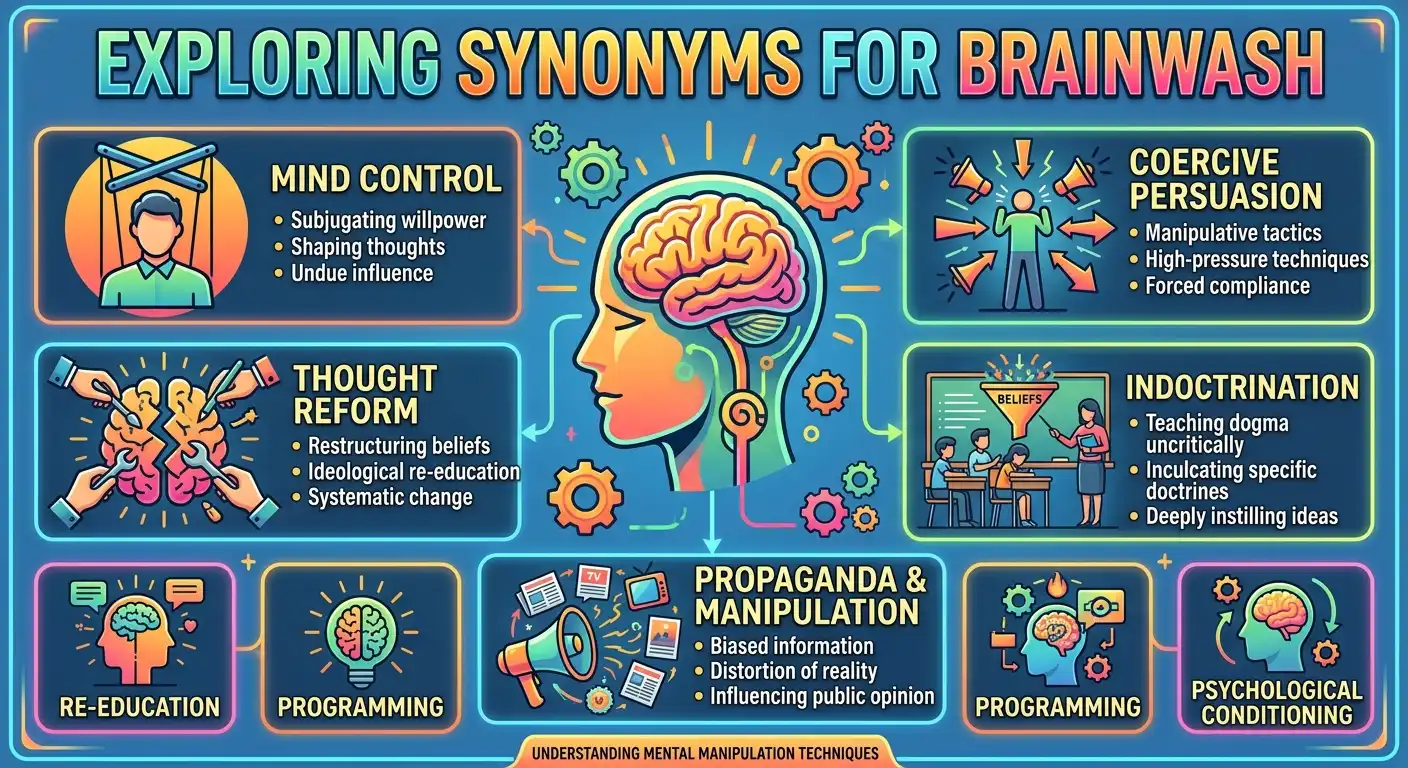
Finding strong synonyms for brainwash helps you express how people influence, control, or change minds. Learning clear synonyms for brainwash gives you the right words to describe psychological pressure, subtle trickery, or heavy propaganda. Using accurate synonyms for brainwash improves your vocabulary, sharpens your writing, and makes your ideas clear to every reader.
Imagine a close friend who suddenly changes all their long-held opinions after watching hours of tricky online videos. You might say someone tried to manipulate, indoctrinate, or condition them instead of using the same basic term over and over. To brainwash means to force someone to drop their old beliefs and adopt new ones through constant pressure, repetition, or control.
“Choosing the right word unmasks subtle pressure and brings truth into clear view.”
Expanding your vocabulary helps you communicate with power and accuracy every day:
- Students can write deeper essays and earn higher marks in social studies and literature tests.
- Bloggers can create compelling content that keeps readers interested from start to finish.
- Content writers can craft clear, persuasive articles that rank high on search engines.
- Daily English users can describe complex human behavior and social pressure with total confidence.
“Clear words unlock deep understanding and protect minds from silent control.”
Connotative Meaning of Brainwash
The word brainwash carries strong emotional tones depending on the context:
- Positive Connotation: Rarely positive, but sometimes used playfully to mean adopting good habits through repetition (e.g., training yourself to eat healthy).
- Negative Connotation: Forced mental control, loss of free will, harmful cult tactics, dangerous propaganda, and psychological abuse.
- Neutral Connotation: Technical psychological retraining, systematic learning, or intense corporate onboarding processes.
Etymology of Brainwash
- Origin: Coined during the Korean War in the early 1950s as a translation of the Chinese term xǐ nǎo (洗脑).
- Literal Translation: Xǐ means “to wash” and nǎo means “brain.”
- Historical Context: First used to describe methods applied to prisoners of war to force them to accept new political ideologies.
- Modern Evolution: Expanded from military contexts to describe aggressive advertising, cult tactics, media bias, and intense social pressure.
Pronunciation, Syllables, and Affixation Pattern
- US Pronunciation (IPA): /ˈbreɪn.wɑːʃ/
- UK Pronunciation (IPA): /ˈbreɪn.wɒʃ/
- Syllable Count: 2 syllables (brain-wash)
- Root Word: Brainwash (Compound noun/verb formed from brain + wash)
- Affixation Patterns:
- Prefixes: Re- (Rebrainwash – rare)
- Suffixes:
- -ed (Brainwashed – Past tense verb/Adjective)
- -ing (Brainwashing – Present participle/Gerund noun)
- -er (Brainwasher – Noun for the person doing it)
Word Comparison Table
| Keyword | Meaning | Usage Type | Context |
| Brainwash | To force someone to change beliefs using intense mental pressure | Critical / Descriptive | Cults, military, heavy propaganda, abuse |
| Indoctrinate | To teach a set of beliefs so deeply that people do not question them | Formal / Academic | Schools, political groups, religions |
| Manipulate | To control or trick someone to your own advantage | Everyday / Emotional | Relationships, advertising, workplace |
| Persuade | To convince someone to do or believe something through logic | Positive / Professional | Sales, debates, daily choices |
| Coerce | To force someone to act against their will using threats | Formal / Legal | Crime, strict rules, physical threats |
| Condition | To train a person or animal to react in a certain way over time | Psychological / Formal | Habits, behavior training, media |
| Sway | To move someone gently toward a specific opinion or choice | Casual / Conversational | Politics, friendly advice, voting |
| Proselytize | To try to convert someone to your religion or belief system | Formal / Religious | Missionaries, passion projects, activism |
50 Synonyms for Brainwash
1. Indoctrinate
- Pronunciation: US: /ɪnˈdɑːk.trə.neɪt/ | UK: /ɪnˈdɒk.trɪ.neɪt/
- Meaning: To teach a group to accept ideas without questioning them.
- Examples:
- The new leader tried to indoctrinate young members with strict rules.
- Books were used to indoctrinate students with foreign ideas.
2. Manipulate
- Pronunciation: US: /məˈnɪp.jə.leɪt/ | UK: /məˈnɪp.jʊ.leɪt/
- Meaning: To control or guide someone in a sneaky way for your benefit.
- Examples:
- He knew how to manipulate his friends to get free meals.
- Clever ads can manipulate people into buying things they do not need.
3. Condition
- Pronunciation: US: /kənˈdɪʃ.ən/ | UK: /kənˈdɪʃ.ən/
- Meaning: To train someone over time to react automatically to something.
- Examples:
- Fear can condition people to obey strict laws without fight.
- Parents try to condition children to wash hands before eating.
4. Coerce
- Pronunciation: US: /koʊˈɝːs/ | UK: /kəʊˈɜːs/
- Meaning: To force a person to do something by making threats.
- Examples:
- You should not coerce anyone into signing a contract.
- The guard tried to coerce the prisoner to give up secrets.
5. Persuade
- Pronunciation: US: /pɚˈsweɪd/ | UK: /pəˈsweɪd/
- Meaning: To convince someone to do something using good reasons.
- Examples:
- She managed to persuade her brother to join the gym.
- Clear facts will persuade the team to try the new plan.
6. Influence
- Pronunciation: US: /ˈɪn.flu.əns/ | UK: /ˈɪn.flu.əns/
- Meaning: To affect how someone thinks, acts, or feels.
- Examples:
- Good teachers influence students in positive ways.
- Social media can influence what young people wear today.
7. Re-educate
- Pronunciation: US: /ˌriːˈedʒ.ə.keɪt/ | UK: /ˌriːˈedʒ.ʊ.keɪt/
- Meaning: To train someone to drop old thoughts and learn new ones.
- Examples:
- The agency decided to re-educate workers on safety rules.
- Camps were built long ago to re-educate political rivals.
8. Subjugate
- Pronunciation: US: /ˈsʌb.dʒə.ɡeɪt/ | UK: /ˈsʌb.dʒʊ.ɡeɪt/
- Meaning: To bring someone under complete control by force.
- Examples:
- The king tried to subjugate all neighboring lands.
- Harsh laws were passed to subjugate the local people.
9. Drill
- Pronunciation: US: /drɪl/ | UK: /drɪl/
- Meaning: To teach someone something by making them repeat it often.
- Examples:
- Coaches drill basic steps into athletes every single day.
- The teacher chose to drill math facts until everyone knew them.
10. Inculcate
- Pronunciation: US: /ɪnˈkʌl.keɪt/ | UK: /ˈɪn.kʌl.keɪt/
- Meaning: To fix an idea firmly in someone’s mind through repeated lessons.
- Examples:
- Schools try to inculcate honesty and respect in young minds.
- Good parents inculcate healthy habits early in life.
11. Sway
- Pronunciation: US: /sweɪ/ | UK: /sweɪ/
- Meaning: To change someone’s mind or opinion gently.
- Examples:
- The strong speech helped sway the voters in her favor.
- Do not let angry words sway your final decision.
12. Reprogram
- Pronunciation: US: /ˌriːˈproʊ.ɡræm/ | UK: /ˌriːˈprəʊ.ɡræm/
- Meaning: To completely alter the way a person thinks or behaves.
- Examples:
- Therapists help victims reprogram negative self-thoughts.
- Cult leaders work hard to reprogram new members completely.
13. Proselytize
- Pronunciation: US: /ˈprɑː.sə.lə.taɪz/ | UK: /ˈprɒs.əl.ɪ.taɪz/
- Meaning: To try to persuade people to accept your beliefs or religion.
- Examples:
- Visitors came to the town to proselytize their faith.
- He began to proselytize his political views at lunch.
14. Beguile
- Pronunciation: US: /bɪˈɡaɪl/ | UK: /bɪˈɡaɪl/
- Meaning: To charm, attract, or trick someone into believing something.
- Examples:
- The smooth salesman tried to beguile buyers with sweet talk.
- She used her charm to beguile the guards into opening doors.
15. Hoodwink
- Pronunciation: US: /ˈhʊd.wɪŋk/ | UK: /ˈhʊd.wɪŋk/
- Meaning: To trick or deceive someone into doing something wrong.
- Examples:
- Scammers tried to hoodwink the elderly woman out of cash.
- Do not let dishonest ads hoodwink you into spending money.
16. Deceive
- Pronunciation: US: /dɪˈsiːv/ | UK: /dɪˈsiːv/
- Meaning: To make someone believe something that is not true.
- Examples:
- It is wrong to deceive people who trust you.
- Fake news can deceive readers who do not check facts.
17. Dupe
- Pronunciation: US: /duːp/ | UK: /dʒuːp/
- Meaning: To trick someone into taking a false action.
- Examples:
- The trickster tried to dupe people with a fake contest.
- Buyers were easy to dupe because the offer looked real.
18. Lead on
- Pronunciation: US: /liːd ɑːn/ | UK: /liːd ɒn/
- Meaning: To make someone believe false promises over time.
- Examples:
- It was unfair of him to lead on his coworker with false hope.
- The company used fake deals to lead on new customers.
19. Overpersuade
- Pronunciation: US: /ˌoʊ.vɚ.pɚˈsweɪd/ | UK: /ˌəʊ.və.pəˈsweɪd/
- Meaning: To talk someone into something using too much pressure.
- Examples:
- Sales reps can overpersuade tired shoppers into buying cars.
- Try not to overpersuade your brother into giving up his toy.
20. Cajole
- Pronunciation: US: /kəˈdʒoʊl/ | UK: /kəˈdʒəʊl/
- Meaning: To persuade someone using gentle flattery or nice words.
- Examples:
- She tried to cajole her father into extending her curfew.
- He managed to cajole his team into working extra hours.
21. Coax
- Pronunciation: US: /koʊks/ | UK: /kəʊks/
- Meaning: To gently urge or trick someone into doing something.
- Examples:
- We tried to coax the shy cat out from under the bed.
- She used treats to coax her dog into the bathtub.
22. Pressure
- Pronunciation: US: /ˈpreʃ.ɚ/ | UK: /ˈpreʃ.ər/
- Meaning: To push or force someone mentally to accept an idea.
- Examples:
- Friends should not pressure you into making bad choices.
- The boss tried to pressure staff into working late shifts.
23. Entice
- Pronunciation: US: /ɪnˈtaɪs/ | UK: /ɪnˈtaɪs/
- Meaning: To attract someone by offering something pleasant.
- Examples:
- Bakeries use sweet smells to entice hungry shoppers inside.
- High pay can entice workers to relocate to new cities.
24. Lure
- Pronunciation: US: /lʊr/ | UK: /lʒʊər/
- Meaning: To tempt someone to go somewhere or do something risky.
- Examples:
- Bright lights lure small bugs into the mosquito trap.
- Fake emails lure people into giving up private passwords.
25. Seduce
- Pronunciation: US: /səˈduːs/ | UK: /səˈdʒuːs/
- Meaning: To lead someone away from good sense using strong attraction.
- Examples:
- Easy money can seduce people into taking risky loans.
- The false promises managed to seduce young job seekers.
26. Wheedle
- Pronunciation: US: /ˈhwiː.dəl/ | UK: /ˈwiː.dəl/
- Meaning: To try to persuade someone using clever, pleasing compliments.
- Examples:
- He tried to wheedle a discount out of the store clerk.
- Children often wheedle extra sweets from loving grandparents.
27. Fast-talk
- Pronunciation: US: /ˈfæst.tɑːk/ | UK: /ˈfɑːst.tɔːk/
- Meaning: To convince someone quickly using clever, rapid speech.
- Examples:
- The vendor tried to fast-talk tourists into buying cheap watches.
- Do not let anyone fast-talk you into signing quick papers.
28. Instill
- Pronunciation: US: /ɪnˈstɪl/ | UK: /ɪnˈstɪl/
- Meaning: To put an idea or feeling gradually into someone’s mind.
- Examples:
- Good teachers instill a deep love for reading in kids.
- Courage is something parents should instill early on.
29. Imprint
- Pronunciation: US: /ɪmˈprɪnt/ | UK: /ɪmˈprɪnt/
- Meaning: To fix a strong mark or belief permanently in the mind.
- Examples:
- Early memories can imprint lifelong habits on young children.
- Traumatic events may imprint lasting fear in a person.
30. Subvert
- Pronunciation: US: /səbˈvɝːt/ | UK: /səbˈvɜːt/
- Meaning: To weaken or ruin established beliefs or authority secretly.
- Examples:
- Traitors tried to subvert the peace talks with false rumors.
- Spied groups can subvert public trust in honest news.
“When you master precise words, you gain the power to explain human thought clearly.”
31. Control
- Pronunciation: US: /kənˈtroʊl/ | UK: /kənˈtrəʊl/
- Meaning: To have power over someone and direct their actions completely.
- Examples:
- No boss has the right to control your personal life outside work.
- Fear can control how people think during hard times.
32. Dominate
- Pronunciation: US: /ˈdɑː.mə.neɪt/ | UK: /ˈdɒm.ɪ.neɪt/
- Meaning: To rule over or have total power over someone’s mind.
- Examples:
- A forceful leader can dominate group discussions easily.
- Strong feelings of fear can dominate your choices.
33. Mesmerize
- Pronunciation: US: /ˈmez.mə.raɪz/ | UK: /ˈmez.mə.raɪz/
- Meaning: To hold someone’s full attention as if by magic.
- Examples:
- The magician managed to mesmerize the audience with tricks.
- Colorful movies can mesmerize young children for hours.
34. Hypnotize
- Pronunciation: US: /ˈhɪp.nə.taɪz/ | UK: /ˈhɪp.nə.taɪz/
- Meaning: To put someone into a trance-like state of deep suggestibility.
- Examples:
- The speaker tried to hypnotize listeners with soft tones.
- Moving lights can hypnotize drivers on long dark roads.
35. Convince
- Pronunciation: US: /kənˈvɪns/ | UK: /kənˈvɪns/
- Meaning: To make someone believe that something is true using proof.
- Examples:
- Facts will convince the jury of his complete innocence.
- She tried to convince her brother that hard work pays off.
36. Prompt
- Pronunciation: US: /prɑːmpt/ | UK: /prɒmpt/
- Meaning: To encourage or move someone to take a specific action.
- Examples:
- High prices may prompt consumers to save more money.
- Wise advice will prompt students to start studying early.
37. Incline
- Pronunciation: US: /ɪnˈklaɪn/ | UK: /ɪnˈklaɪn/
- Meaning: To lean mentally toward a specific belief or decision.
- Examples:
- Warm weather will incline people to spend time outside.
- Past success will incline investors to fund new ideas.
38. Urge
- Pronunciation: US: /ɝːdʒ/ | UK: /ɜːdʒ/
- Meaning: To strongly advise or encourage someone to do something.
- Examples:
- Doctors urge patients to drink water every day.
- Leaders urge citizens to vote in every local election.
39. Exhort
- Pronunciation: US: /ɪɡˈzɔːrt/ | UK: /ɪɡˈzɔːt/
- Meaning: To encourage someone strongly and earnestly to take action.
- Examples:
- The coach had to exhort the team to keep pushing hard.
- Teachers exhort students to pursue their biggest dreams.
40. Mold
- Pronunciation: US: /moʊld/ | UK: /məʊld/
- Meaning: To shape or form someone’s character or opinions over time.
- Examples:
- Great mentors help mold young workers into strong leaders.
- Life experiences mold our personal values over time.
41. Guide
- Pronunciation: US: /ɡaɪd/ | UK: /ɡaɪd/
- Meaning: To show someone the right way or assist their thinking.
- Examples:
- Good parents guide children toward making smart choices.
- Maps and signs guide tourists safely through big cities.
42. Direct
- Pronunciation: US: /daɪˈrekt/ | UK: /dɪˈrekt/
- Meaning: To give orders or manage the way someone thinks or acts.
- Examples:
- The manager will direct staff on how to handle complaints.
- Rules direct how games are played fairly by all sides.
43. Program
- Pronunciation: US: /ˈproʊ.ɡræm/ | UK: /ˈprəʊ.ɡræm/
- Meaning: To cause someone to behave in a specific preset manner.
- Examples:
- Strict rules can program workers to avoid taking risks.
- Media habits program how people react to daily news.
44. Bias
- Pronunciation: US: /ˈbaɪ.əs/ | UK: /ˈbaɪ.əs/
- Meaning: To unfairly influence someone’s opinion for or against something.
- Examples:
- Bad reporting can bias readers against new ideas.
- Personal feelings should not bias a judge in court.
45. Slant
- Pronunciation: US: /slænt/ | UK: /slɑːnt/
- Meaning: To present information in a biased or one-sided way.
- Examples:
- Writers should not slant news stories to favor one party.
- The report tried to slant the facts to cover up mistakes.
46. Skew
- Pronunciation: US: /skjuː/ | UK: /skjuː/
- Meaning: To change information so it is no longer fair or balanced.
- Examples:
- Fake survey results can skew public opinion quickly.
- Bad data will skew the results of a scientific study.
47. Intimidate
- Pronunciation: US: /ɪnˈtɪm.ə.deɪt/ | UK: /ɪnˈtɪm.ɪ.deɪt/
- Meaning: To frighten someone into doing what you want.
- Examples:
- Big bullies try to intimidate smaller children at school.
- Threats were used to intimidate witnesses before trial.
48. Strong-arm
- Pronunciation: US: /ˈstrɑːŋ.ɑːrm/ | UK: /ˈstrɒŋ.ɑːm/
- Meaning: To use physical force or heavy pressure to achieve something.
- Examples:
- Officials tried to strong-arm locals into selling land.
- Never let a firm strong-arm you into buying bad service.
49. Overawe
- Pronunciation: US: /ˌoʊ.vɚˈɑː/ | UK: /ˌəʊ.vərˈɔː/
- Meaning: To make someone quiet or submissive through power or size.
- Examples:
- The grand castle seemed to overawe all the new visitors.
- The famous singer managed to overawe her young fans.
50. Wash someone’s brain
- Pronunciation: US: /wɑːʃ ˈsʌm.wʌnz breɪn/ | UK: /wɒʃ ˈsʌm.wʌnz breɪn/
- Meaning: To alter someone’s thoughts completely through heavy manipulation.
- Examples:
- Propaganda aims to wash someone’s brain with constant slogans.
- The cult worked daily to wash someone’s brain till free choice was lost.
Antonyms of Brainwash
Understanding words with opposite meanings helps you write balanced comparisons:
- Enlighten: To give someone greater knowledge, truth, or spiritual understanding.
- Liberate: To set someone free from control, pressure, or mental limits.
- Disabuse: To free someone from a false belief, error, or misconception.
- Educate: To teach someone using facts, logic, and open discussion.
- Unshackle: To remove emotional or mental bonds so someone can think freely.
- Empower: To give someone the power, confidence, and freedom to act independently.
Prototype Meaning and Categorization of Brainwash
The core idea of brainwash centers on Forced Mind Control, Psychological Pressure, Systematic Belief Change, and Loss of Independent Thinking.
Conceptual Categories:
- Systematic & Institutional Manipulation: Indoctrinate, re-educate, inculcate, program, reprogram, condition, subvert.
- Deceptive & Sneaky Influence: Manipulate, beguile, hoodwink, deceive, dupe, lead on, fast-talk, sway, slant, skew, bias.
- Coercive & Forceful Tactics: Coerce, subjugate, pressure, intimidate, strong-arm, overawe, control, dominate.
- Gentle & Persuasive Urging: Persuade, influence, cajole, coax, entice, lure, wheedle, instill, prompt, urge, exhort, mold, guide.
Frequently Asked Questions (FAQs)
1. What does brainwash mean in plain English?
To brainwash someone means to force them to drop their real beliefs and accept new, controlled ideas through pressure, repetition, or isolation.
2. What are the most common synonyms for brainwash?
The most popular everyday synonyms for brainwash are indoctrinate, manipulate, condition, coerce, re-educate, and sway.
3. What is the main difference between “brainwash” and “persuade”?
Persuade uses honest facts and logic so people make free choices. Brainwash uses pressure, trickery, or control to take away free choice.
4. How can I use synonyms for brainwash in creative writing?
Instead of repeating the word brainwash, choose precise options like indoctrinate for political groups, beguile for sneaky villains, or condition for learned habits.
5. Where did the word brainwash come from?
The term originated during the Korean War in the 1950s. It comes from the Chinese phrase xǐ nǎo, which literally translates to “wash brain.”
6. Is brainwash a formal or informal word?
Brainwash is an informal to mid-level term. In formal, legal, or academic writing, authors usually prefer words like indoctrinate, coerce, or systematically condition.
Conclusion
Mastering a rich collection of synonyms for brainwash gives your speech and writing far greater impact. Replacing a single repeating term with accurate choices like indoctrinate, manipulate, condition, or coax brings vibrant detail and exact emotion to every paragraph.
For students, using varied vocabulary makes your academic essays stand out and earns top marks from teachers, bloggers and content writers, fresh words make headlines punchy and keep readers engaged through long articles, daily English speakers, expanding your vocabulary helps you describe human behavior, social pressure, and media tactics with total confidence.
Start applying these powerful words today:
- Swap out generic words for indoctrinate or condition in your next paper or report.
- Use beguile or hoodwink in creative stories to describe clever villains.
- Try using persuade or sway accurately when discussing work proposals or everyday choices.
“Varied words build strong thoughts and elevate your writing from basic to brilliant.”
Regular vocabulary practice builds clear communication skills that last a lifetime.
“Mastering your language protects your mind and empowers your voice.”

Michael Turner is a published fiction writer and creative writing tutor with over a decade of experience helping writers find the words that make their stories breathe ( Biography ).