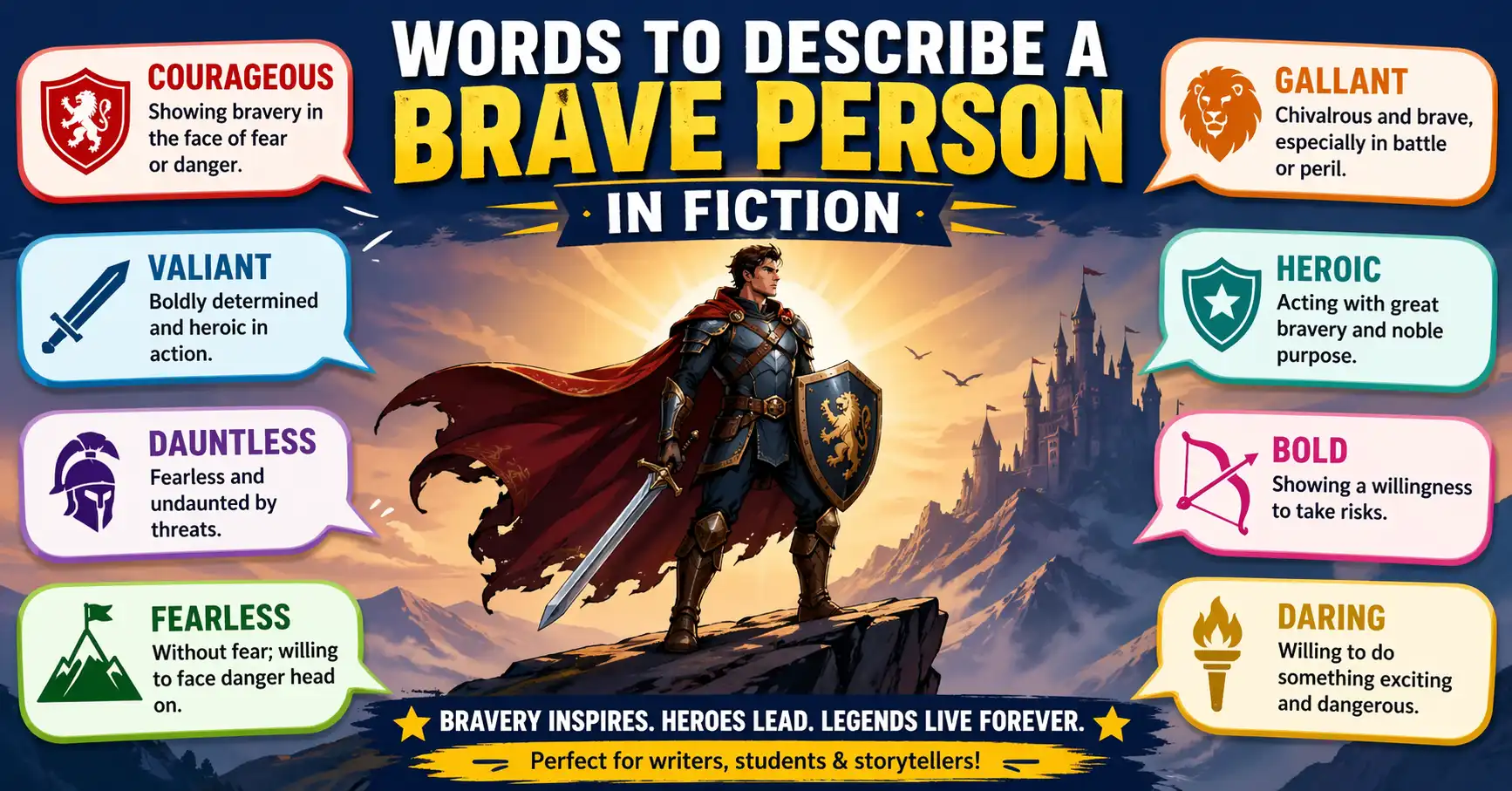
Have you ever read a thrilling fantasy book and felt your heart race? You watch the main hero face a giant, scary dragon without running away. That character is not just brave; they are legendary! If you write stories or read books, you need the best words to describe a brave person in fiction.
In simple words, this means special terms we use to show a character is not scared of danger. Knowing these words to describe a brave person in fiction helps everyone. Students can write better book reports for school. Bloggers and content writers can build much more exciting character profiles. Even daily English users can share cool stories with friends. Let us explore fifty amazing words to describe a brave person in fiction to boost your vocabulary today!
1. Brave
Meaning: Ready to face danger or pain without showing fear.
Examples:
- The brave knight stepped into the dark cave to find the sword.
- She made a brave choice to speak up for her friends.
2. Bold
Meaning: Ready to take big risks and show no fear.
Examples:
- The young pirate made a bold plan to capture the ship.
- His bold words surprised everyone in the quiet room.
3. Fearless
Meaning: Having absolutely no fear of anything.
Examples:
- Our fearless leader marched straight toward the enemy castle.
- She is a fearless climber who loves tall mountains.
4. Courageous
Meaning: Showing great courage in a very tough situation.
Examples:
- The courageous firefighter ran into the burning library.
- He gave a courageous speech against the bad king.
5. Heroic
Meaning: Acting like a great hero who saves other people.
Examples:
- Her heroic rescue of the lost puppy made the news.
- The soldier made a heroic stand at the city gates.
6. Valiant
Meaning: Showing great bravery when facing a huge threat.
Examples:
- The valiant warriors protected their home from the giants.
- He made a valiant effort to win the final race.
7. Gallant
Meaning: Brave and very polite, especially toward other people.
Examples:
- The gallant prince offered his horse to the tired traveler.
- She gave a gallant smile before entering the scary maze.
8. Daring
Meaning: Willing to do dangerous things to reach a goal.
Examples:
- The thief made a daring escape through the open window.
- We watched her make a daring leap across the deep canyon.
9. Plucky
Meaning: Having a lot of spirit and heart despite being small.
Examples:
- The plucky little hobbit refused to give up the ring.
- Our plucky team won the game in the last minute.
10. Gutsy
Meaning: Having a lot of courage and strong determination.
Examples:
- It was a gutsy move to challenge the champion to a fight.
- The gutsy reporter asked the hard questions.
11. Intrepid
Meaning: Extremely brave and ready to explore new, dangerous places.
Examples:
- The intrepid explorer walked deep into the thick jungle.
- Our intrepid crew sailed across the wild ocean.
12. Dauntless
Meaning: Showing fearlessness and determination that cannot be stopped.
Examples:
- The dauntless detective never stopped looking for the truth.
- She stood dauntless before the angry storm.
13. Lionhearted
Meaning: Having the great courage of a brave lion.
Examples:
- The lionhearted queen led her army to a big victory.
- He showed a lionhearted spirit during the difficult journey.
14. Stouthearted
Meaning: Having a strong, brave, and stubborn heart.
Examples:
- A stouthearted guard stood at the palace doors all night.
- The stouthearted sailors kept the ship safe during the storm.
15. Unafraid
Meaning: Not feeling any fear or worry about danger.
Examples:
- The young wizard stood unafraid in front of the monster.
- She walked into the dark forest completely unafraid.
16. Chivalrous
Meaning: Brave, kind, and honorable like an old-fashioned knight.
Examples:
- The chivalrous warrior helped the poor villagers rebuild their homes.
- He showed a chivalrous spirit by defending the weak.
17. Spirited
Meaning: Full of energy, courage, and excitement.
Examples:
- The spirited girl refused to let the villains win.
- Our horse gave a spirited run across the green fields.
18. Spunky
Meaning: Brave and lively in an active, fun way.
Examples:
- The spunky princess decided to save herself from the tower.
- He is a spunky kid who always stands up for others.
19. Tough
Meaning: Strong enough to deal with hard and painful times.
Examples:
- The tough ranger survived alone in the freezing forest.
- She is a tough fighter who never gives up a match.
20. Gritty
Meaning: Showing brave determination and a strong mind.
Examples:
- The gritty detective worked all night to solve the mystery.
- He gave a gritty performance in the final battle.
21. Resolute
Meaning: Having a firm mind that does not change easily.
Examples:
- She stood resolute in her choice to help the rebels.
- His resolute gaze told the enemy he would not run.
22. Determined
Meaning: Having a strong plan to do something no matter what.
Examples:
- The determined hero walked up the active volcano.
- She was determined to pass the difficult magic exam.
23. Stalwart
Meaning: Very loyal, reliable, and brave over a long time.
Examples:
- The stalwart knight never left the king’s side.
- We need stalwart friends when times get hard.
24. Hardy
Meaning: Strong and brave enough to survive difficult conditions.
Examples:
- The hardy adventurers climbed the icy mountain top.
- Only hardy travelers can cross the hot desert.
25. Strong
Meaning: Having great power of mind or body to face danger.
Examples:
- He was a strong leader who kept his people safe.
- Her strong spirit helped her survive the long winter.
26. Valorous
Meaning: Full of great bravery and honor in battle.
Examples:
- The valorous knight received a gold medal from the king.
- She made a valorous stand against the dark army.
27. Undaunted
Meaning: Not discouraged or scared by dangers or setbacks.
Examples:
- Undaunted by the cold rain, the travelers kept walking.
- He remained undaunted even after losing his sword.
28. Unflinching
Meaning: Facing danger directly without blinking or pulling back.
Examples:
- She stared at the giant beast with unflinching eyes.
- The guard showed unflinching loyalty to the royal family.
29. Unyielding
Meaning: Refusing to bend or surrender to pressure.
Examples:
- The unyielding hero stood his ground against the crowd.
- Her unyielding belief in justice inspired the whole town.
30. Indomitable
Meaning: Having a brave spirit that cannot be defeated.
Examples:
- The indomitable spirit of the villagers helped them win.
- He showed indomitable courage throughout the long war.
31. Unshakable
Meaning: So strong and firm that it cannot be changed.
Examples:
- She had an unshakable trust in her best friend.
- His unshakable courage kept the group calm during the crisis.
32. Steadfast
Meaning: Very loyal, steady, and brave in your actions.
Examples:
- The steadfast soldier kept watch at the border.
- They remained steadfast friends through many years of adventure.
33. Defiant
Meaning: Bravely standing up against someone in power.
Examples:
- The defiant boy refused to bow to the evil emperor.
- She threw a defiant look at the guards who caught her.
34. Fierce
Meaning: Showing strong, wild, and brave energy.
Examples:
- The fierce warrior fought like a wild tiger.
- She has a fierce desire to protect her little brother.
35. Mighty
Meaning: Having great, brave strength and power.
Examples:
- The mighty giant protected the forest from the woodcutters.
- He swung his mighty sword to block the flying arrow.
36. Tenacious
Meaning: Holding on very tightly to a goal and not letting go.
Examples:
- The tenacious climber finally reached the peak of the mountain.
- She is a tenacious helper who never stops fighting for others.
37. Audacious
Meaning: Bravely taking surprisingly bold risks.
Examples:
- The thief came up with an audacious plan to steal the crown.
- Her audacious jump over the wall shocked the guards.
38. Venturesome
Meaning: Ready and eager to take risks in new adventures.
Examples:
- The venturesome children loved to explore the old, empty house.
- He is a venturesome traveler who visits wild places.
39. Confident
Meaning: Sure of your own brave skills and power.
Examples:
- The confident wizard cast his spell without any worry.
- She gave a confident smile before starting the big duel.
40. Persistent
Meaning: Continuing to be brave and try hard despite difficulties.
Examples:
- The persistent hero kept looking for the lost city.
- She was persistent in her search for the healing herb.
41. Relentless
Meaning: Never stopping or becoming less intense in your courage.
Examples:
- The relentless knight chased the dragon across three kingdoms.
- Her relentless drive helped her finish the hard quest.
42. Bravehearted
Meaning: Having a heart that is completely brave and true.
Examples:
- The bravehearted girl stood up to the school bully.
- We need bravehearted leaders to guide us through the dark times.
43. Greathearted
Meaning: Brave, generous, and kind to other people.
Examples:
- The greathearted king shared his food with the poor.
- She showed a greathearted spirit by forgiving her rival.
44. Boldhearted
Meaning: Having a daring and fearless heart.
Examples:
- A boldhearted sailor volunteered to steer the ship through the storm.
- The boldhearted princess led the charge out of the castle.
45. Firm
Meaning: Strong, steady, and not easily shaken.
Examples:
- He took a firm step forward to block the doorway.
- She kept a firm grip on her wooden shield.
46. Daredevil
Meaning: A person who loves to do dangerous things for fun.
Examples:
- The daredevil pilot flew his plane through the narrow canyon.
- He is a daredevil who loves to jump off tall cliffs.
47. Adventurous
Meaning: Loving to go on brave, exciting, and new journeys.
Examples:
- The adventurous puppy ran out of the yard to explore.
- We had an adventurous trip through the mysterious hills.
48. Honorable
Meaning: Brave and honest, doing what is morally right.
Examples:
- The honorable knight refused to fight an unarmed opponent.
- He made an honorable choice to tell the truth.
49. Noble
Meaning: Having fine, brave, and honest qualities of character.
Examples:
- The noble leader sacrificed his own safety for his team.
- She has a noble heart that always cares for the weak.
50. Proud
Meaning: Showing self-respect and brave dignity.
Examples:
- The proud warrior stood tall before the conqueror.
- She walked with a proud and brave step into the courtroom.
Conclusion
Learning a variety of words to describe a brave person in fiction is a wonderful way to boost your writing. Using these diverse terms makes your stories, essays, and descriptions much more exciting to read. We encourage you to practice these fifty words in your next emails, school papers, and daily chats. The more you use them, the more natural they will feel to you. Keep practicing and watch your English vocabulary grow!

Michael Turner is a published fiction writer and creative writing tutor with over a decade of experience helping writers find the words that make their stories breathe ( Biography ).