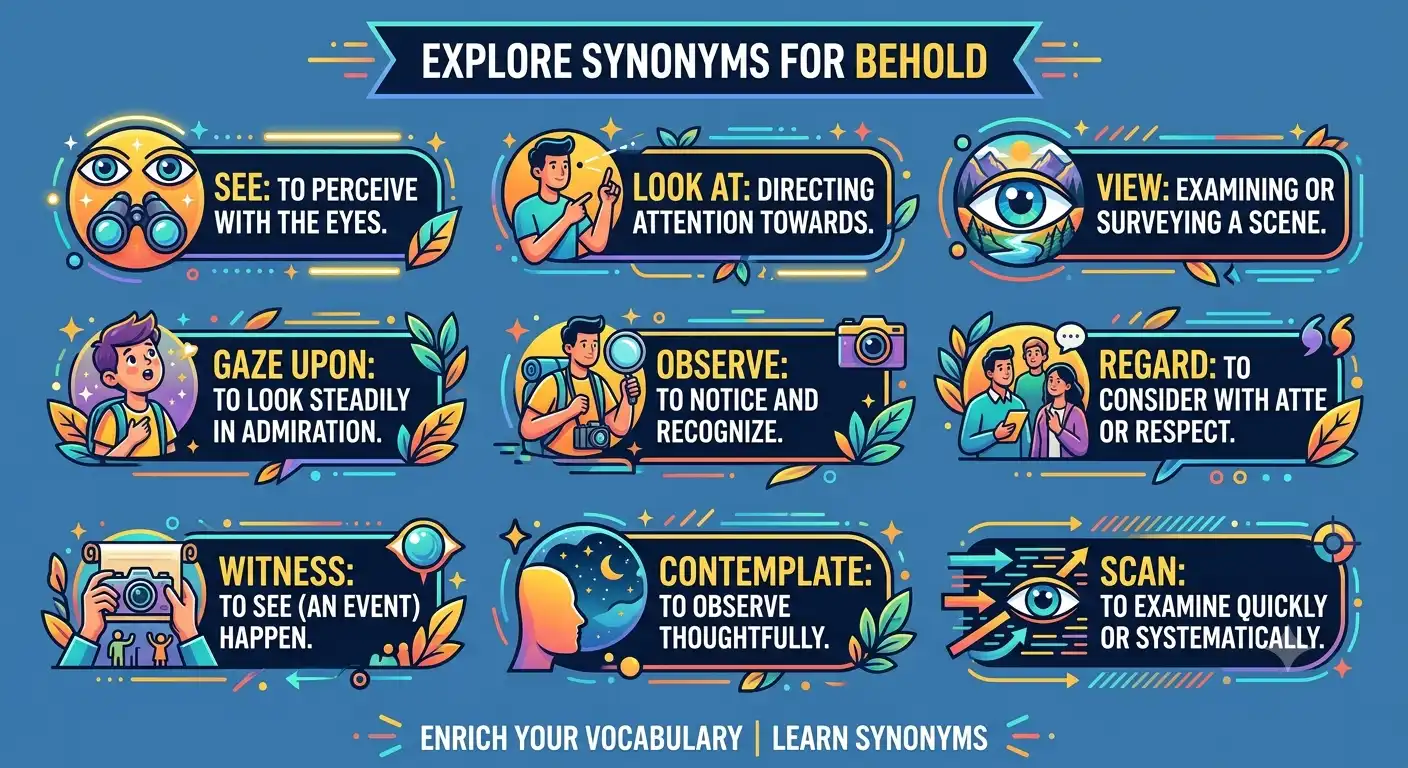
Finding synonyms for behold helps you choose better words when describing something amazing you see. Using fresh synonyms for behold makes your speech and writing far more exciting. Learning clear synonyms for behold gives you the power to share grand ideas with everyone.
Imagine standing on top of a big green mountain at sunrise. The bright golden light spreads across the sky and fills you with wonder. You stop and look at the beautiful view with total awe. That special moment of watching something grand is what it means to behold something. To behold means to look at or observe something with great attention or wonder.
Expanding your vocabulary helps you express your thoughts easily every single day:
- Students can write stronger story essays and get better marks in English class.
- Bloggers can write catchy headlines that make readers stop and read every post.
- Content writers can build vivid descriptions that make products and places sound exciting.
- Daily English users can share amazing stories with friends using clear and lively words.
“To look at something with wonder is to open your mind to magic.”
“The right word paints a picture that stays in the heart forever.”
Connotative Meaning of Behold
The word behold carries deep, formal, and poetic feelings depending on how you use it:
- Positive Connotation: Looking at a gorgeous sunset, a cute newborn baby, or a grand work of art with wonder.
- Negative Connotation: Watching a dramatic storm, a huge mistake, or a scary event unfold before your eyes.
- Neutral Connotation: Simply directing someone’s eyes toward an object, a person, or a scene in a story.
Etymology of Behold
- Origin: Old English word behealdan (meaning “to hold in view,” “to guard,” or “to keep”).
- Roots: Formed by joining be- (thoroughly) and healdan (to hold or keep).
- Historical Context: In early English, it meant holding something in your mind or keeping it in safe view.
- Modern Evolution: Over time, it grew into a famous literary word that means to look at something grand with awe.
Pronunciation, Syllables, and Affixation Pattern
- US Pronunciation (IPA): /bɪˈhoʊld/
- UK Pronunciation (IPA): /bɪˈhəʊld/
- Syllable Count: 2 syllables (be-hold)
- Root Word: Hold
- Affixation Patterns:
- Prefixes: be- (attached to the root verb)
- Suffixes:
- -ing (Beholding – Present Participle)
- -en (Beholden – Adjective / Past Participle)
- -er (Beholder – Noun)
Word Comparison Table
| Keyword | Meaning | Usage Type | Context |
| Behold | To look at something with great wonder | Formal / Poetic | Art, nature, grand moments, stories |
| Look | To turn your eyes toward something | Daily / Casual | Everyday sights, objects, directions |
| See | To notice something with your eyes | General / Basic | Daily life, casual chats, fast checks |
| Observe | To watch something carefully to learn | Academic / Formal | Science, rules, behavior, research |
| Witness | To see an event happen live | Serious / Legal | News, events, accidents, history |
| Gaze | To look for a long time with love or thought | Emotional / Warm | Star-gazing, dreams, romantic moments |
| Inspect | To look very closely for flaws | Professional | Work safety, building checks, tests |
| Gawk | To stare at something in a silly way | Casual / Rude | Crowds, strange sights, street events |
50 Synonyms for Behold
1. Look
- Pronunciation: US: /lʊk/ | UK: /lʊk/
- Meaning: To turn your eyes toward something so you can see it clearly.
- Examples:
- Look at that beautiful red bird in the tree!
- Please look at the board while the teacher speaks.
2. See
- Pronunciation: US: /siː/ | UK: /siː/
- Meaning: To notice things around you using your eyes.
- Examples:
- I can see the bright blue ocean from my window.
- Did you see where I placed my keys?
3. View
- Pronunciation: US: /vjuː/ | UK: /vjuː/
- Meaning: To look at something in a calm and clear way.
- Examples:
- We sat on the porch to view the sunset.
- Many people came to view the new paintings.
4. Watch
- Pronunciation: US: /wɑːtʃ/ | UK: /wɒtʃ/
- Meaning: To look at something moving for a period of time.
- Examples:
- The kids love to watch funny cartoons on Saturday.
- We can watch the boats move across the lake.
5. Observe
- Pronunciation: US: /əbˈzɝːv/ | UK: /əbˈzɜːv/
- Meaning: To watch someone or something carefully to learn more.
- Examples:
- Scientists observe how wild animals live in winter.
- Please observe how the baker shapes the bread dough.
6. Witness
- Pronunciation: US: /ˈwɪt.nəs/ | UK: /ˈwɪt.nəs/
- Meaning: To see an important event happen right in front of you.
- Examples:
- They were happy to witness their team win the big game.
- Crowds gathered to witness the rocket blast into space.
7. Gaze
- Pronunciation: US: /ɡeɪz/ | UK: /ɡeɪz/
- Meaning: To look at something for a long time with quiet joy.
- Examples:
- We laid on the grass to gaze at the shiny stars.
- She would gaze out the window and dream about travel.
8. Stare
- Pronunciation: US: /steər/ | UK: /steə/
- Meaning: To look at something for a long time without blinking.
- Examples:
- It is not polite to stare at people on the bus.
- The cat began to stare at the little mouse.
9. Notice
- Pronunciation: US: /ˈnoʊ.t̬ɪs/ | UK: /ˈnəʊ.tɪs/
- Meaning: To see or become aware of something small.
- Examples:
- Did you notice her new green coat today?
- I did not notice the sign on the door.
10. Perceive
- Pronunciation: US: /pɚˈsiːv/ | UK: /pəˈsiːv/
- Meaning: To see and understand something clearly with your mind.
- Examples:
- Dogs can perceive tiny movements in the dark.
- I could perceive a soft light down the dark hall.
11. Sight
- Pronunciation: US: /saɪt/ | UK: /saɪt/
- Meaning: To suddenly see something you were looking for.
- Examples:
- The sailors managed to sight land after many days.
- Hikers hope to sight wild deer on the trail.
12. Eye
- Pronunciation: US: /aɪ/ | UK: /aɪ/
- Meaning: To look at something with great care or interest.
- Examples:
- The hungry boy began to eye the fruit pie.
- The guard started to eye the strange box carefully.
13. Regard
- Pronunciation: US: /rɪˈɡɑːrd/ | UK: /rɪˈɡɑːd/
- Meaning: To look at someone or something in a steady way.
- Examples:
- He turned to regard the visitor at the door.
- The old lion would regard the visitors with quiet calm.
14. Inspect
- Pronunciation: US: /ɪnˈspekt/ | UK: /ɪnˈspekt/
- Meaning: To look at something very closely to find mistakes or damage.
- Examples:
- The mechanic will inspect the car brakes today.
- Teachers inspect the desks to make sure they stay clean.
15. Examine
- Pronunciation: US: /ɪɡˈzæm.ɪn/ | UK: /ɪɡˈzæm.ɪn/
- Meaning: To check every part of something with great care.
- Examples:
- The doctor will examine your sore throat now.
- Use a glass to examine the tiny insect legs.
16. Survey
- Pronunciation: US: /sɚˈveɪ/ | UK: /səˈveɪ/
- Meaning: To look across a wide area from a high place.
- Examples:
- The king stood up high to survey his kingdom.
- We stopped to survey the valley from the hilltop.
17. Spy
- Pronunciation: US: /spaɪ/ | UK: /spaɪ/
- Meaning: To catch sight of something that is hidden or far off.
- Examples:
- I can spy a small nest hidden in the branches.
- The children tried to spy on the birthday gifts.
18. Discern
- Pronunciation: US: /dɪˈsɝːn/ | UK: /dɪˈsɜːn/
- Meaning: To see something clearly when it is hard to spot.
- Examples:
- It was hard to discern the road through the fog.
- She could discern two figures walking in the distance.
19. Admire
- Pronunciation: US: /ədˈmaɪr/ | UK: /ədˈmaɪə/
- Meaning: To look at something because you think it is beautiful.
- Examples:
- We stopped to admire the lovely flower garden.
- Everyone came to admire the new sports car.
20. Mark
- Pronunciation: US: /mɑːrk/ | UK: /mɑːk/
- Meaning: To pay close attention to something important.
- Examples:
- Mark my words, it will rain before noon today!
- Please mark how the cook mixes the ingredients.
“Choosing exact words makes every simple sentence shine bright.”
21. Note
- Pronunciation: US: /noʊt/ | UK: /nəʊt/
- Meaning: To notice something special and keep it in mind.
- Examples:
- Please note the change in our meeting time.
- I did note that she was feeling much better today.
22. Contemplate
- Pronunciation: US: /ˈkɑːn.t̬əm.pleɪt/ | UK: /ˈkɒn.təm.pleɪt/
- Meaning: To look at something while thinking deeply about it.
- Examples:
- He sat by the pond to contemplate his future plans.
- Artists often contemplate nature before they paint.
23. Peer
- Pronunciation: US: /pɪr/ | UK: /pɪə/
- Meaning: To look closely when it is hard to see well.
- Examples:
- She had to peer through the dark window to see inside.
- Drivers peer through heavy rain on the highway.
24. Scan
- Pronunciation: US: /skæn/ | UK: /skæn/
- Meaning: To look quickly across every part of a space.
- Examples:
- The lifeguard will scan the pool to keep kids safe.
- I will scan the paper to find my name on the list.
25. Glance
- Pronunciation: US: /ɡlæns/ | UK: /ɡlɑːns/
- Meaning: To take a very quick look at something.
- Examples:
- He took a quick glance at his watch during class.
- She gave a friendly glance as she walked past me.
26. Gawk
- Pronunciation: US: /ɡɑːk/ | UK: /ɡɔːk/
- Meaning: To stare at something in a silly or amazed way.
- Examples:
- People started to gawk at the tall street performer.
- Do not stand there and gawk at the big mess!
27. Mind
- Pronunciation: US: /maɪnd/ | UK: /maɪnd/
- Meaning: To watch and pay attention to something carefully.
- Examples:
- Please mind your step on the wet stairs.
- Mother told us to mind our manners at dinner.
28. Heed
- Pronunciation: US: /hiːd/ | UK: /hiːd/
- Meaning: To pay close attention to advice or warnings.
- Examples:
- Wise drivers always heed speed limit signs.
- You should heed the doctor’s good advice today.
29. Scrutinize
- Pronunciation: US: /ˈskruː.t̬ən.aɪz/ | UK: /ˈskruː.tɪ.naɪz/
- Meaning: To look at something with super close attention.
- Examples:
- Bank staff will scrutinize every check for safety.
- Experts scrutinize old paintings to see if they are real.
30. Envision
- Pronunciation: US: /ɪnˈvɪʒ.ən/ | UK: /ɪnˈvɪʒ.ən/
- Meaning: To see a clear picture of something in your mind.
- Examples:
- I can envision a grand park built in our town.
- Builders envision how the house will look when done.
31. Spot
- Pronunciation: US: /spɑːt/ | UK: /spɒt/
- Meaning: To catch sight of something specific in a crowd.
- Examples:
- Can you spot the yellow ball in the green grass?
- I managed to spot my friend at the busy mall.
32. Gape
- Pronunciation: US: /ɡeɪp/ | UK: /ɡeɪp/
- Meaning: To look at something with your mouth wide open in surprise.
- Examples:
- The crowd began to gape at the amazing trick.
- Tourists gape at the huge tall buildings in the city.
33. Study
- Pronunciation: US: /ˈstʌd.i/ | UK: /ˈstʌd.i/
- Meaning: To look at something very carefully to learn its details.
- Examples:
- The artist will study the light before painting.
- Please study the map before we take our road trip.
34. Marvel
- Pronunciation: US: /ˈmɑːr.vəl/ | UK: /ˈmɑː.vəl/
- Meaning: To look at something with feelings of deep wonder.
- Examples:
- Visitors marvel at the giant ice mountains.
- We marvel at how fast tiny puppies grow up.
35. Monitor
- Pronunciation: US: /ˈmɑː.nə.t̬ɚ/ | UK: /ˈmɒn.ɪ.tər/
- Meaning: To watch something steadily over time to stay safe.
- Examples:
- Nurses monitor the sleeping patient all night long.
- Teachers monitor the kids while they play outside.
36. Check
- Pronunciation: US: /tʃek/ | UK: /tʃek/
- Meaning: To look at something to make sure it is correct or safe.
- Examples:
- Please check your pocket to see if you have the key.
- Always check the door lock before you go to sleep.
37. Focus
- Pronunciation: US: /ˈfoʊ.kəs/ | UK: /ˈfəʊ.kəs/
- Meaning: To direct your eyes and mind straight toward one thing.
- Examples:
- Try to focus on the ball when you swing the bat.
- You must focus your eyes on the road while driving.
38. Size up
- Pronunciation: US: /saɪz ʌp/ | UK: /saɪz ʌp/
- Meaning: To look at something to judge its value or strength.
- Examples:
- The coach will size up the new players today.
- Buyers size up the house before making an offer.
39. Scope
- Pronunciation: US: /skoʊp/ | UK: /skəʊp/
- Meaning: To look over an entire area carefully.
- Examples:
- We went out to scope the area for our campsite.
- The team will scope out the new store location.
40. Trace
- Pronunciation: US: /treɪs/ | UK: /treɪs/
- Meaning: To follow something with your eyes step by step.
- Examples:
- You can trace the river line on this state map.
- Her eyes began to trace the flight of the bird.
41. Glare
- Pronunciation: US: /ɡleər/ | UK: /ɡleə/
- Meaning: To look at someone with a strong and angry face.
- Examples:
- The angry man gave a sharp glare at the noisy kids.
- Do not glare at your brother like that.
42. Look upon
- Pronunciation: US: /lʊk əˈpɑːn/ | UK: /lʊk əˈpɒn/
- Meaning: To view someone or something with a special feeling.
- Examples:
- We look upon our grandmother with great love and respect.
- Leaders look upon the project as a big success.
43. Catch sight of
- Pronunciation: US: /kætʃ saɪt ɑːv/ | UK: /kætʃ saɪt ɒv/
- Meaning: To see something for just a brief second.
- Examples:
- I managed to catch sight of a deer in the woods.
- Did you catch sight of the falling star last night?
44. Take in
- Pronunciation: US: /teɪk ɪn/ | UK: /teɪk ɪn/
- Meaning: To look at everything around you and enjoy the view.
- Examples:
- We stood on the deck to take in the fresh ocean air.
- Tourists love to take in the beautiful sights of Rome.
45. Feast eyes on
- Pronunciation: US: /fiːst aɪz ɑːn/ | UK: /fiːst aɪz ɒn/
- Meaning: To look at something glorious with huge pleasure.
- Examples:
- Come into the bakery and feast eyes on these cakes!
- Guests arrived to feast eyes on the gorgeous party hall.
46. Keep an eye on
- Pronunciation: US: /kiːp æn aɪ ɑːn/ | UK: /kiːp æn aɪ ɒn/
- Meaning: To watch something closely so nothing goes wrong.
- Examples:
- Please keep an eye on the soup so it does not burn.
- Can you keep an eye on my bag for one minute?
47. Pay attention to
- Pronunciation: US: /peɪ əˈten.ʃən tuː/ | UK: /peɪ əˈten.ʃən tuː/
- Meaning: To look directly at something and listen with focus.
- Examples:
- Always pay attention to safety signs on the road.
- Students must pay attention to the morning lesson.
48. Visualise
- Pronunciation: US: /ˈvɪʒ.u.əl.aɪz/ | UK: /ˈvɪʒ.u.əl.aɪz/
- Meaning: To form a clear mental image of something you want to see.
- Examples:
- Close your eyes and visualise a peaceful sunny beach.
- Athletes visualise winning before the race starts.
49. Greet
- Pronunciation: US: /ɡriːt/ | UK: /ɡriːt/
- Meaning: To look at and welcome someone arriving at your place.
- Examples:
- Dogs run to the front door to greet you with happy wags.
- Hosts stand near the entrance to greet every arriving guest.
50. Discover
- Pronunciation: US: /dɪˈskʌv.ɚ/ | UK: /dɪˈskʌv.ər/
- Meaning: To see or find something completely new for the first time.
- Examples:
- Kids love to explore the forest and discover cool bugs.
- We hope to discover a peaceful beach on our vacation.
Antonyms of Behold
Knowing words with opposite meanings helps you describe ignoring or turning away from things:
- Ignore: Choosing not to look at or pay attention to something.
- Overlook: Failing to see something that is right in front of you.
- Disregard: Paying no attention to a sight, sign, or person.
- Miss: Failing to catch sight of an event or object in time.
- Neglect: Leaving something unwatched or uncared for over time.
- Blink away: Closing your eyes quickly to avoid seeing a sight.
Prototype Meaning and Categorization of Behold
The central idea of behold is Focused Seeing, Wonder, Deep Attention, and Careful Watching.
Conceptual Categories:
- Awe & Grand Seeing: Behold, marvel, feast eyes on, admire, contemplate, gaze.
- Everyday Visual Action: Look, see, view, watch, glance, spot, sight.
- Deep Check & Inspection: Observe, inspect, examine, survey, scrutinize, study, monitor.
- Attention & Care: Mark, note, mind, heed, keep an eye on, pay attention to.
Frequently Asked Questions (FAQs)
1. What does behold mean in simple English?
To behold simply means to look at something or someone with attention, wonder, or excitement.
2. What are the most common synonyms for behold?
The most common daily synonyms for behold are look, see, watch, observe, and gaze.
3. Is “behold” a formal or casual word?
Behold is a formal and literary word. It is used often in stories, poems, history books, and speeches.
4. How is “observe” different from “behold”?
Observe means to watch something carefully to learn facts or rules. Behold means to look at something with feelings of awe, wonder, or deep emotion.
5. Can I use “behold” in everyday spoken English?
While people understand behold, it sounds very dramatic in daily chats. Words like look or see work much better for casual talks.
6. Why should I use different synonyms for behold in my writing?
Using varied words like inspect for checks or gaze for stargazing makes your descriptions vivid, accurate, and fun to read.
Conclusion
Mastering a rich selection of synonyms for behold boosts your writing and speech right away. Swapping repeated terms for sharp options like observe, gaze, inspect, or admire brings exact meaning and bright clarity to every line you create.
For students, using varied action verbs makes story writing strong and earns top marks from English teachers, bloggers and content writers, active sight words grab attention and keep readers on your site longer, daily English users, growing your vocabulary builds lasting confidence during chats and presentations.
Start using these great words today:
- Use inspect or observe in work reports and school assignments.
- Use gaze or marvel when sharing vacation photos with family and friends.
- Use glance or spot when describing fast daily events.
“A rich vocabulary helps you share your world with total clarity.”
“Great writers build strong bridges using clear and beautiful words.”

Michael Turner is a published fiction writer and creative writing tutor with over a decade of experience helping writers find the words that make their stories breathe ( Biography ).