
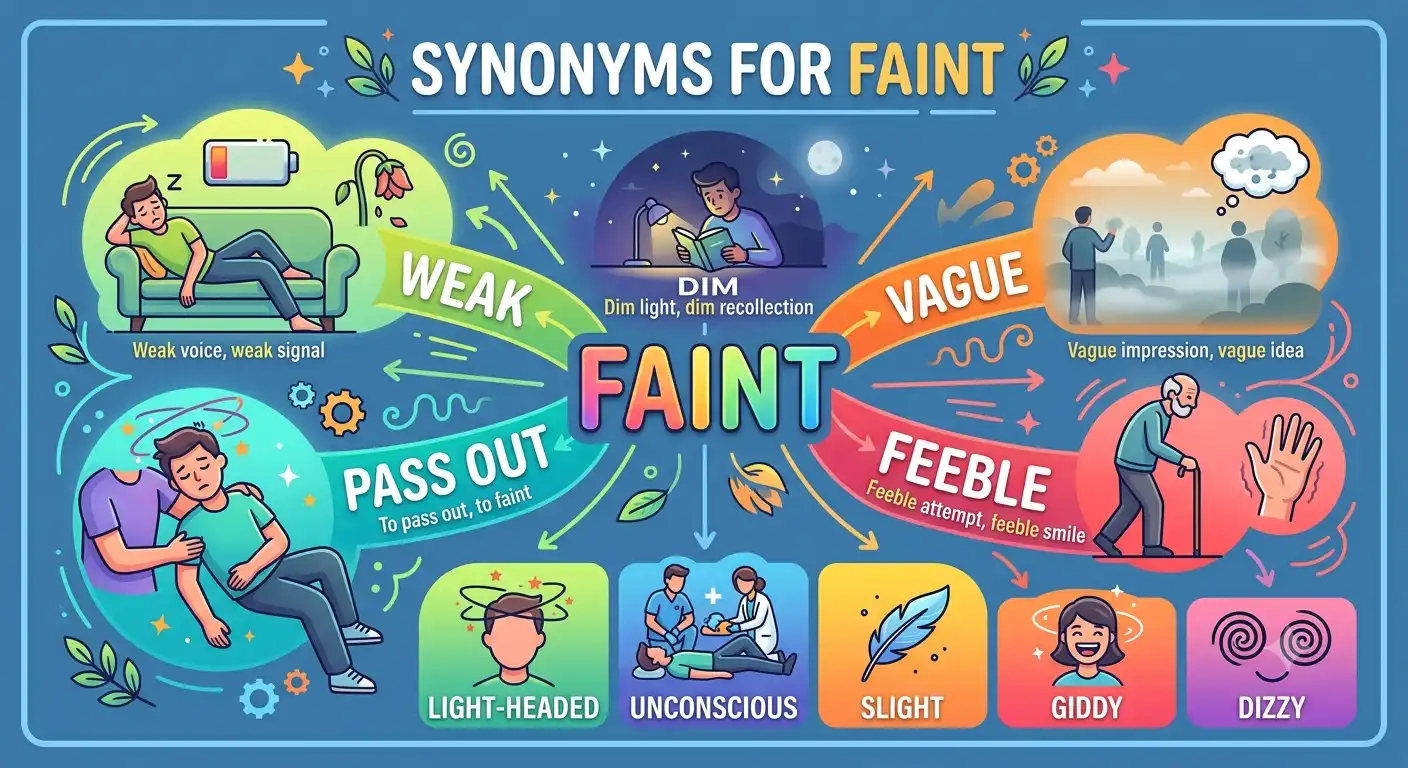
Finding the best synonyms for faint helps you describe dim lights, quiet sounds, and lightheaded feelings with high clarity. Learning accurate synonyms for faint gives you the exact words to express weak signals, soft colors, or sudden passing out. Using rich synonyms for faint strengthens your writing, improves your vocabulary, and makes every sentence easy to understand.
Imagine standing on a quiet beach late at night while a distant lighthouse flashes a barely visible beam across the dark water. You might call that light dim, soft, or pale instead of relying on the same plain word every time. To faint means to become weak, dim, or lose consciousness for a brief period.
“Soft words and subtle details turn simple writing into unforgettable stories.”
Expanding your choice of words helps people communicate clearly every single day:
- Students can craft vivid stories and achieve higher grades on creative writing tests.
- Bloggers can keep readers interested with expressive, dynamic description.
- Content writers can craft clear articles that match search intent effortlessly.
- Daily English users can explain feelings and sights with natural confidence.
“Choosing the precise word brings bright clarity to every quiet thought.”
Connotative Meaning of Faint
The word faint carries different feelings depending on how you use it in a sentence:
- Positive Connotation: Delicate beauty, gentle softness, subtle detail, and calm quietness.
- Negative Connotation: Physical weakness, sudden dizziness, fading hope, or lack of strength.
- Neutral Connotation: Small amounts, light shadows, distant sounds, or pale colors.
Etymology of Faint
- Origin: Entered Middle English in the 13th century from Old French feint (meaning false, weak, or lazy).
- Latin Root: Derived from the Latin verb fingere (meaning to shape, touch, or feign).
- Modern Evolution: Shifted over time from describing deceit or cowardice to describing physical weakness, dim light, quiet sounds, and losing consciousness.
Pronunciation, Syllables, and Affixation Pattern
- US Pronunciation (IPA): /feɪnt/
- UK Pronunciation (IPA): /feɪnt/
- Syllable Count: 1 syllable (faint)
- Root Word: Faint
- Affixation Patterns:
- Prefixes: Un- (Unfainting – rare)
- Suffixes:
- -ed (Fainted – Past tense verb)
- -ing (Fainting – Present participle)
- -er (Fainter – Comparative adjective)
- -est (Faintest – Superlative adjective)
- -ness (Faintness – Noun form)
- -ly (Faintly – Adverb form)
Word Comparison Table
| Keyword | Meaning | Usage Type | Context |
| Faint | Hard to see, hear, or feel; or to lose consciousness | Descriptive / Conversational | Sights, sounds, physical feelings, health |
| Dim | Giving off or reflecting very little light | Visual / Casual | Lighting, room settings, screens, eyes |
| Swoon | To faint from extreme emotion or joy | Expressive / Dramatic | Romances, excitement, historical tales |
| Pale | Light in color or lacking warm skin color | Visual / Descriptive | Art, health, faces, sunrise, paint |
| Subtle | So delicate or quiet that it is hard to analyze | Intellectual / Refined | Flavors, hints, changes, art, logic |
| Feeble | Lacking physical strength, power, or volume | Physical / Critical | Health, voice, arguments, old age |
| Dizzy | Feeling unsteady, spinning, or lightheaded | Physical / Everyday | Motion, heat, medical checkups, rides |
| Slight | Small in degree, size, amount, or importance | Quantitative / General | Changes, differences, hopes, injuries |
50 Synonyms for Faint
1. Dim
- Pronunciation: US: /dɪm/ | UK: /dɪm/
- Meaning: Having very little light so things are hard to see clearly.
- Examples:
- A dim lamp lit up the quiet hallway.
- We could barely see the dim stars behind the clouds.
2. Weak
- Pronunciation: US: /wiːk/ | UK: /wiːk/
- Meaning: Lacking normal physical power, brightness, or sound strength.
- Examples:
- He felt weak after running in the hot sun.
- A weak signal made the radio static loud.
3. Pale
- Pronunciation: US: /peɪl/ | UK: /peɪl/
- Meaning: Having a light color that lacks strong bright tones.
- Examples:
- Her face looked pale when she heard the news.
- The sky turned a pale yellow at sunrise.
4. Slight
- Pronunciation: US: /slaɪt/ | UK: /slaɪt/
- Meaning: Very small in amount, size, or importance.
- Examples:
- There is a slight chance of rain today.
- I felt a slight breeze on my face.
5. Soft
- Pronunciation: US: /sɑːft/ | UK: /sɒft/
- Meaning: Gentle and quiet to hear or smooth to see.
- Examples:
- She heard a soft tap on the window.
- The room was lit with soft warm lighting.
6. Feeble
- Pronunciation: US: /ˈfiː.bəl/ | UK: /ˈfiː.bəl/
- Meaning: Very weak from age, sickness, or low energy.
- Examples:
- The old dog made a feeble attempt to jump.
- He gave a feeble smile from his bed.
7. Muted
- Pronunciation: US: /ˈmjuː.t̬ɪd/ | UK: /ˈmjuː.tɪd/
- Meaning: Softened in sound, color, or deep emotional intensity.
- Examples:
- The walls were painted in muted gray tones.
- We heard muted voices from the next room.
8. Hazy
- Pronunciation: US: /ˈheɪ.zi/ | UK: /ˈheɪ.zi/
- Meaning: Unclear because of fog, dust, or thin smoke.
- Examples:
- The morning sky looked hazy over the city.
- He had a hazy memory of his old school.
9. Vague
- Pronunciation: US: /veɪɡ/ | UK: /veɪɡ/
- Meaning: Not clearly described, shaped, or stated in detail.
- Examples:
- She gave a vague answer to his question.
- I saw a vague shape moving in the fog.
10. Subtle
- Pronunciation: US: /ˈsʌt̬.əl/ | UK: /ˈsʌt.əl/
- Meaning: Small and delicate so it is hard to notice right away.
- Examples:
- The soup has a subtle taste of fresh lemon.
- He made a subtle change to his painting.
11. Indistinct
- Pronunciation: US: /ˌɪn.dɪˈstɪŋkt/ | UK: /ˌɪn.dɪˈstɪŋkt/
- Meaning: Not clear enough to see, hear, or recognize easily.
- Examples:
- We saw indistinct figures standing in the dark.
- A low indistinct noise came from the basement.
12. Faded
- Pronunciation: US: /ˈfeɪ.dɪd/ | UK: /ˈfeɪ.dɪd/
- Meaning: Having lost original brightness, color, or strength over time.
- Examples:
- He wore a pair of faded blue jeans.
- An old faded photo hung on the wall.
13. Dull
- Pronunciation: US: /dʌl/ | UK: /dʌl/
- Meaning: Lacking shine, sharpness, bright light, or clear tone.
- Examples:
- The street was lit by a dull yellow bulb.
- I felt a dull ache in my knee.
14. Blurred
- Pronunciation: US: /blɝːd/ | UK: /blɜːd/
- Meaning: Lacking sharp edges or clear lines to look at.
- Examples:
- Without glasses, everything looked blurred to him.
- Rain created a blurred view through the car window.
15. Quiet
- Pronunciation: US: /ˈkwaɪ.ət/ | UK: /ˈkwaɪ.ət/
- Meaning: Making very little sound or noise.
- Examples:
- She spoke in a quiet voice so as not to wake the baby.
- They enjoyed a quiet afternoon in the park.
16. Distant
- Pronunciation: US: /ˈdɪs.tənt/ | UK: /ˈdɪs.tənt/
- Meaning: Far away in space, time, or sound strength.
- Examples:
- We heard the distant rumble of thunder.
- She watched the distant ships on the ocean.
17. Shadowy
- Pronunciation: US: /ˈʃæd.oʊ.i/ | UK: /ˈʃæd.əʊ.i/
- Meaning: Full of shadows or hard to see clearly.
- Examples:
- A shadowy figure walked past the fence.
- We entered the shadowy woods at sunset.
18. Delicate
- Pronunciation: US: /ˈdel.ə.kət/ | UK: /ˈdel.ɪ.kət/
- Meaning: Very light, fine, soft, or easily broken.
- Examples:
- The cake had a delicate vanilla flavor.
- Spring flowers have delicate soft petals.
19. Light
- Pronunciation: US: /laɪt/ | UK: /laɪt/
- Meaning: Low in brightness, weight, or force.
- Examples:
- A light rain began to fall on the garden.
- The room was painted in light green colors.
20. Low
- Pronunciation: US: /loʊ/ | UK: /ləʊ/
- Meaning: Quiet in volume or small in level.
- Examples:
- He spoke in a low whisper near the door.
- The phone battery is getting very low.
21. Murky
- Pronunciation: US: /ˈmɝː.ki/ | UK: /ˈmɜː.ki/
- Meaning: Dark and dirty or hard to see through clearly.
- Examples:
- Fish swam through the murky lake water.
- The sky turned murky before the storm hit.
22. Unclear
- Pronunciation: US: /ʌnˈklɪr/ | UK: /ʌnˈklɪər/
- Meaning: Not easy to see, hear, or understand.
- Examples:
- The directions on the paper were unclear.
- We saw an unclear shape in the background photo.
23. Fuzzy
- Pronunciation: US: /ˈfʌz.i/ | UK: /ˈfʌz.i/
- Meaning: Lacking clear shape or focus.
- Examples:
- The television screen showed a fuzzy picture.
- He had a fuzzy idea of what happened yesterday.
24. Thin
- Pronunciation: US: /θɪn/ | UK: /θɪn/
- Meaning: Light in density, sound, or physical warmth.
- Examples:
- A thin layer of ice covered the pond.
- Her voice sounded thin over the weak phone line.
25. Bleached
- Pronunciation: US: /bliːtʃt/ | UK: /bliːtʃt/
- Meaning: Made pale or white by strong sunlight or chemicals.
- Examples:
- The hot sun left bleached wood along the shore.
- The old poster looked bleached after years on the wall.
26. Wispy
- Pronunciation: US: /ˈwɪs.pi/ | UK: /ˈwɪs.pi/
- Meaning: Thin, light, and delicate in form.
- Examples:
- Wispy white clouds drifted slowly across the sky.
- She brushed a wispy piece of hair off her face.
27. Imperceptible
- Pronunciation: US: /ˌɪm.pɚˈsep.tə.bəl/ | UK: /ˌɪm.pəˈsep.tə.bəl/
- Meaning: So small or light that it can hardly be noticed.
- Examples:
- He gave an imperceptible nod of agreement.
- There was an imperceptible pause in the music.
28. Minimal
- Pronunciation: US: /ˈmɪn.ə.məl/ | UK: /ˈmɪn.ɪ.məl/
- Meaning: Very small in amount or degree.
- Examples:
- The storm caused minimal damage to the home.
- He completed the job with minimal effort.
29. Subdued
- Pronunciation: US: /səbˈduːd/ | UK: /səbˈdʒuːd/
- Meaning: Soft, quiet, or held back in brightness or emotion.
- Examples:
- The restaurant was lit with subdued candlelight.
- Everyone felt in a subdued mood after the news.
30. Ghostly
- Pronunciation: US: /ˈɡoʊst.li/ | UK: /ˈɡəʊst.li/
- Meaning: Pale, light, and barely visible like a shadow.
- Examples:
- A ghostly white fog covered the quiet street.
- The moon cast a ghostly glow on the trees.
“Carefully chosen words shed clear light on thoughts that once seemed dim.”
31. Obscure
- Pronunciation: US: /əbˈskjʊr/ | UK: /əbˈskjʊər/
- Meaning: Hard to see, understand, or find clearly.
- Examples:
- Heavy fog made the road signs obscure.
- He shared an obscure detail about local history.
32. Modest
- Pronunciation: US: /ˈmɑː.dɪst/ | UK: /ˈmɒd.ɪst/
- Meaning: Fairly small or limited in size or amount.
- Examples:
- They built a modest house near the river.
- She made a modest gain in her test scores.
33. Mild
- Pronunciation: US: /maɪld/ | UK: /maɪld/
- Meaning: Gentle and not harsh, strong, or heavy.
- Examples:
- We enjoyed a day of mild sunny weather.
- He felt a mild sting after touching the plant.
34. Trace
- Pronunciation: US: /treɪs/ | UK: /treɪs/
- Meaning: A very tiny mark, amount, or sign of something.
- Examples:
- Scientists found a trace of water on the rock.
- She spoke with a trace of an accent.
35. Slender
- Pronunciation: US: /ˈslen.dɚ/ | UK: /ˈslen.dər/
- Meaning: Thin, light, or small in amount or size.
- Examples:
- There is a slender hope of finding the lost keys.
- The plant grew a slender green stem.
36. Swoon
- Pronunciation: US: /swuːn/ | UK: /swuːn/
- Meaning: To faint or fall unconscious from deep emotion.
- Examples:
- The hero seemed about to swoon from excitement.
- Heat made several people swoon at the outdoor concert.
37. Collapse
- Pronunciation: US: /kəˈlæps/ | UK: /kəˈlæps/
- Meaning: To fall down suddenly due to weakness or illness.
- Examples:
- The tired runner began to collapse near the finish line.
- Heat can cause people to collapse if they do not drink water.
38. Pass out
- Pronunciation: US: /pæs aʊt/ | UK: /pɑːs aʊt/
- Meaning: To lose consciousness for a short period of time.
- Examples:
- Standing in hot rooms can make someone pass out.
- He felt dizzy and thought he would pass out.
39. Black out
- Pronunciation: US: /blæk aʊt/ | UK: /blæk aʊt/
- Meaning: To temporarily lose vision or pass out completely.
- Examples:
- The pilot almost began to black out during high speeds.
- Sudden sharp pain caused her to black out briefly.
40. Keel over
- Pronunciation: US: /kiːl ˈoʊ.vɚ/ | UK: /kiːl ˈəʊ.vər/
- Meaning: To fall over suddenly from weakness, sickness, or dizziness.
- Examples:
- The worker looked ready to keel over from fatigue.
- Drink plenty of water so you do not keel over in the sun.
41. Drop
- Pronunciation: US: /drɑːp/ | UK: /drɒp/
- Meaning: To fall quickly to the floor from sudden tiredness or illness.
- Examples:
- Soldiers were trained not to drop during long marches.
- She felt so weak that she had to sit before she would drop.
42. Falter
- Pronunciation: US: /ˈfɑːl.tɚ/ | UK: /ˈfɔːl.tər/
- Meaning: To lose strength or power and become unsteady.
- Examples:
- His voice started to falter during the long speech.
- Her steps began to falter as she climbed the hill.
43. Flag
- Pronunciation: US: /flæɡ/ | UK: /flæɡ/
- Meaning: To become tired, weak, or lose momentum.
- Examples:
- Our energy began to flag late in the afternoon.
- The team did not flag despite the long game hours.
44. Wilt
- Pronunciation: US: /wɪlt/ | UK: /wɪlt/
- Meaning: To lose freshness, energy, or stand limply.
- Examples:
- Fresh cut flowers will wilt without water.
- The kids started to wilt after a long day at the zoo.
45. Fade
- Pronunciation: US: /feɪd/ | UK: /feɪd/
- Meaning: To slowly lose strength, light, sound, or color.
- Examples:
- Daylight begins to fade around six in the evening.
- Music slowly started to fade as the parade moved away.
46. Stagger
- Pronunciation: US: /ˈstæɡ.ɚ/ | UK: /ˈstæɡ.ər/
- Meaning: To walk unsteadily as if about to fall or pass out.
- Examples:
- The dizzy hiker began to stagger along the path.
- He took two steps and started to stagger sideways.
47. Succumb
- Pronunciation: US: /səˈkʌm/ | UK: /səˈkʌm/
- Meaning: To give in to physical weakness, sleep, or illness.
- Examples:
- Do not succumb to tiredness while driving long distances.
- He finally had to succumb to sleep after thirty hours.
48. Flinch
- Pronunciation: US: /flɪntʃ/ | UK: /flɪntʃ/
- Meaning: To make a sudden small movement back from weakness or fear.
- Examples:
- She did not flinch when the loud doctor spoke.
- The timid puppy began to flinch at sharp noises.
49. Fade away
- Pronunciation: US: /feɪd əˈweɪ/ | UK: /feɪd əˈweɪ/
- Meaning: To disappear gradually until nothing remains visible or audible.
- Examples:
- The footsteps began to fade away down the long hall.
- Old memories can slowly fade away over many years.
50. Slump
- Pronunciation: US: /slʌmp/ | UK: /slʌmp/
- Meaning: To lean or fall down heavily from sudden weakness.
- Examples:
- He would slump into his chair after a hard workday.
- The sleepy child began to slump against her mother.
Antonyms of Faint
Knowing words that mean the opposite of faint helps you create strong contrasts in your writing:
- Bright: Giving off or reflecting a large amount of light.
- Loud: Making a lot of strong noise or high volume.
- Strong: Having great physical power, force, or intensity.
- Vivid: Producing very clear, deep, and bright pictures in the mind.
- Distinct: Easily seen, heard, or recognized without any confusion.
- Robust: Strong, healthy, and full of vigor or power.
Prototype Meaning and Categorization of Faint
The core concept of faint revolves around Low Intensity, Reduced Visibility, Quiet Volume, and Physical Loss of Consciousness.
Conceptual Categories:
- Visual & Lighting (Low Brightness): Dim, pale, hazy, faded, dull, blurred, shadowy, murky, bleached, wispy, ghostly, obscure.
- Auditory & Sensory (Quiet Sound): Soft, muted, quiet, distant, low, thin, indistinct, imperceptible.
- Degree & Quantity (Small Amount): Slight, subtle, delicate, light, minimal, subdued, modest, mild, trace, slender.
- Physical & Health (Weakness or Passing Out): Weak, feeble, swoon, collapse, pass out, black out, keel over, drop, falter, flag, wilt, fade, stagger, succumb, slump.
Frequently Asked Questions (FAQs)
1. What does faint mean in plain English?
To faint means either to lose consciousness briefly or to describe something that is light, quiet, or hard to see.
2. What are the most common synonyms for faint?
The most common everyday synonyms for faint are dim, weak, pale, slight, quiet, and pass out.
3. What is the difference between “dim” and “faint”?
Dim specifically describes light that is not bright. Faint can describe light, sound, smell, feeling, or passing out completely.
4. How do I use synonyms for faint in descriptive creative writing?
Instead of repeating the word faint, swap in precise words like muted for soft voices, wispy for thin clouds, or subtle for light flavors.
5. Can “faint” be used as both a verb and an adjective?
Yes! As an adjective, it means barely noticeable (e.g., “a faint whisper”). As a verb, it means to pass out (e.g., “she might faint in the heat”).
6. What is the origin of the word faint?
The word comes from Middle English feint and Old French, which originally meant weak, sluggish, or lacking courage.
Conclusion
Mastering a rich selection of synonyms for faint transforms your writing and gives your everyday speech far greater impact. Replacing simple terms with precise choices like dim, subtle, muted, or feeble brings vibrant life and accurate detail to your sentences.
For students, using varied words makes creative essays shine and earns praise on English assignments, bloggers and content writers, fresh vocabulary builds engaging headlines and keeps readers focused on your articles, daily English speakers, expanding your word choices helps you express physical feelings, soft sounds, and gentle sights with natural ease.
Start using these great vocabulary choices today:
- Swap out generic adjectives for dim or subtle in your next project or email.
- Use muted or wispy in your creative stories to set a clear mood.
- Try using falter or pass out accurately when describing health or energy levels.
“Rich vocabulary turns plain sentences into vivid pictures for every reader.”
Regular practice sharpens your communication skills and elevates your writing style day after day.
“Clear words express quiet feelings with lasting power.”

Michael Turner is a published fiction writer and creative writing tutor with over a decade of experience helping writers find the words that make their stories breathe ( Biography ).