Introduction
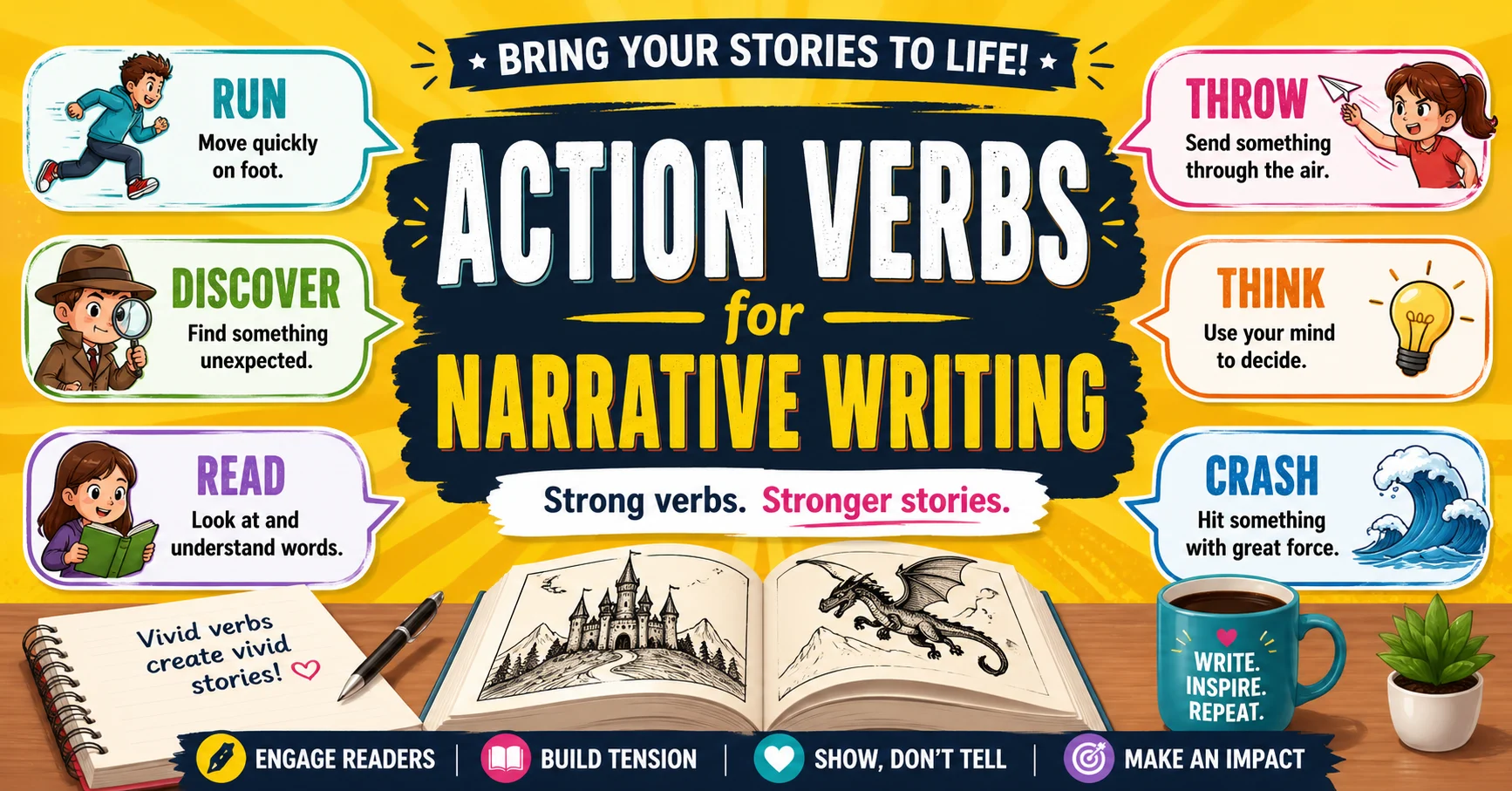
Using action verbs for narrative writing is the best way to make your stories exciting. When you choose action verbs for narrative writing, you show the reader what is happening instead of just telling them. Learning how to select strong action verbs for narrative writing will help you turn flat sentences into bright pictures. Many writers make the mistake of using weak verbs and heavy adverbs. By using simple and direct action words, you keep your readers hooked from the very first page.
A quiet cat sits on a wooden fence. Suddenly, a big dog barks from the yard next door. If you write that the cat “ran away quickly,” the scene feels very boring. But if you write that the cat “bolted” over the tall fence, the scene suddenly feels fast and dangerous. The word “bolted” is a strong action verb that makes the reader feel the rush of the moment. This simple change makes your writing much more fun to read.
“Strong verbs are the secret engine that drives every great story forward.”
“Do not tell your reader that a door closed loudly; say it slammed to make them jump.”
These action words are highly useful for many different people:
- Students: You can write high-quality essays that impress your teachers and get better grades.
- Bloggers: You can write exciting blog posts that keep people reading until the very end.
- Content Writers: You can describe products and tell stories that make people want to buy.
- Daily English Users: You can speak with more power and explain your day in a fun way to friends.
Linguistic Details of “Action Verbs for Narrative Writing”
To understand these terms deeply, let us look at their linguistics in a very simple way.
- Connotative Meaning: “Action verbs for narrative writing” carry feelings of energy, fast movement, loud sounds, and clear pictures. They feel alive, sharp, and strong.
- Etymology:
- Action comes from the Latin word actio, which means a doing, performing, or moving.
- Verbs comes from the Latin word verbum, which means a word.
- Narrative comes from the Latin word narrativus, which means telling a story.
- Writing comes from the Old English word writan, which means to score, draw, or make letters.
- Pronunciation:
- Action Verbs: US:
/ˈæk.ʃən vɝːbz/| UK:/ˈæk.ʃən vɜːbz/ - Narrative Writing: US:
/ˈnær.ə.t̬ɪv ˈraɪ.t̬ɪŋ/| UK:/ˈnær.ə.tɪv ˈraɪ.tɪŋ/
- Action Verbs: US:
- Syllables: ac-tion (2 syllables), verbs (1 syllable), nar-ra-tive (3 syllables), wri-ting (2 syllables).
- Affixation Pattern: Root words with common Latin and Germanic suffixes (such as -ion, -ive, and -ing).
Comparison Table
Here is a quick guide to help you choose the best type of word for your story.
| Keyword | Meaning | Usage Type | Context |
|---|---|---|---|
| Action Verbs | Words that show physical movement or active doing. | Emotional / Casual | Exciting chase scenes, fast actions, and sports |
| Stative Verbs | Words that show a state of being or a feeling. | Professional / Casual | Describing thoughts, facts, or quiet ownership |
| Passive Verbs | Words where the subject receives the action. | Professional / Formal | Scientific reports, slow moments, or quiet scenes |
| Weak Verbs | Common verbs that need helper words to sound strong. | Casual | Daily talk, quick drafts, and basic notes |
| Sensory Verbs | Words that connect directly to the five senses. | Emotional / Casual | Describing smells, sights, tastes, and soft sounds |
| Auxiliary Verbs | Helping verbs that show the time of an action. | Professional / Formal | Building grammar tenses in school essays and papers |
“A single strong verb can paint a picture that a thousand adverbs cannot match.”
50 Action Verbs for Narrative Writing
Here is the ultimate list of 50 action verbs you can use to bring your stories to life.
1. Sprint
- Pronunciation: US:
/sprɪnt/| UK:/sprɪnt/ - Meaning: To run very fast for a short distance.
- Examples:
- He had to sprint to catch the yellow school bus.
- She decided to sprint across the wet grass.
2. Whisper
- Pronunciation: US:
/ˈwɪs.pɚ/| UK:/ˈwɪs.pə(r)/ - Meaning: To speak in a very quiet voice so others cannot hear.
- Examples:
- Please whisper so you do not wake the baby.
- She leaned close to whisper a secret in his ear.
3. Shatter
- Pronunciation: US:
/ˈʃæt̬.ɚ/| UK:/ˈʃæt.ə(r)/ - Meaning: To break suddenly into many small pieces.
- Examples:
- The glass bowl fell and started to shatter on the floor.
- Loud rocks can shatter a thin window.
4. Creep
- Pronunciation: US:
/kriːp/| UK:/kriːp/ - Meaning: To move very slowly and quietly close to the ground.
- Examples:
- The cat tried to creep up on the small bird.
- I had to creep down the dark stairs at night.
5. Bellow
- Pronunciation: US:
/ˈbel.oʊ/| UK:/ˈbel.əʊ/ - Meaning: To shout in a deep, loud voice.
- Examples:
- The angry giant began to bellow at the travelers.
- He had to bellow over the sound of the wind.
6. Grab
- Pronunciation: US:
/ɡræb/| UK:/ɡræb/ - Meaning: To take hold of something suddenly or roughly.
- Examples:
- You should grab your warm coat before you leave.
- He reached out to grab the falling cup.
7. Hurl
- Pronunciation: US:
/hɝːl/| UK:/hɜːl/ - Meaning: To throw something with a lot of force.
- Examples:
- The strong boy tried to hurl the heavy rock into the lake.
- She watched him hurl the ball across the park.
8. Slither
- Pronunciation: US:
/ˈslɪð.ɚ/| UK:/ˈslɪð.ə(r)/ - Meaning: To slide smoothly along a surface like a snake.
- Examples:
- The green snake started to slither through the green grass.
- He watched the wet rope slither down the side of the boat.
9. Gaze
- Pronunciation: US:
/ɡeɪz/| UK:/ɡeɪz/ - Meaning: To look steadily at something for a long time.
- Examples:
- They love to gaze at the bright stars at night.
- She stood by the window to gaze at the rain.
10. Mutter
- Pronunciation: US:
/ˈmʌt̬.ɚ/| UK:/ˈmʌt.ə(r)/ - Meaning: To speak quietly and unclearly because you are unhappy.
- Examples:
- He began to mutter under his breath about the cold weather.
- Do not mutter when I ask you a question.
11. Dash
- Pronunciation: US:
/dæʃ/| UK:/dæʃ/ - Meaning: To run or move very quickly.
- Examples:
- The kids had to dash inside when the rain started.
- He will dash to the store to get some milk.
12. Leap
- Pronunciation: US:
/liːp/| UK:/liːp/ - Meaning: To jump high or a long distance.
- Examples:
- The deer can leap over the high wooden fence.
- He had to leap over a puddle of water.
13. Clutch
- Pronunciation: US:
/klʌtʃ/| UK:/klʌtʃ/ - Meaning: To hold something very tightly with your hands.
- Examples:
- The scared child tried to clutch his mother’s hand.
- She had to clutch her bag on the busy bus.
14. Flee
- Pronunciation: US:
/fliː/| UK:/fliː/ - Meaning: To run away from danger or a scary place.
- Examples:
- The little mice try to flee when the cat enters.
- They had to flee the burning house quickly.
15. Tremble
- Pronunciation: US:
/ˈtrem.bəl/| UK:/ˈtrem.bl̩/ - Meaning: To shake slightly because you are cold, afraid, or excited.
- Examples:
- The cold wind made her hands tremble.
- His voice began to tremble during the speech.
16. Prowl
- Pronunciation: US:
/praʊl/| UK:/praʊl/ - Meaning: To move around quietly while searching for something.
- Examples:
- Wild animals often prowl the forest at night.
- The hungry cat likes to prowl around the kitchen.
17. Stumble
- Pronunciation: US:
/ˈstʌm.bəl/| UK:/ˈstʌm.bl̩/ - Meaning: To hit your foot against something and almost fall.
- Examples:
- Be careful not to stumble over that big tree root.
- I saw him stumble on the uneven sidewalk.
18. Inhale
- Pronunciation: US:
/ɪnˈheɪl/| UK:/ɪnˈheɪl/ - Meaning: To breathe air or smoke into your lungs.
- Examples:
- Stand by the sea and inhale the fresh morning air.
- She stopped to inhale the sweet smell of the rose.
19. Glimpse
- Pronunciation: US:
/ɡlɪmps/| UK:/ɡlɪmps/ - Meaning: To see something for a very short moment.
- Examples:
- He managed to glimpse the fast car before it turned.
- She got a quick glimpse of the deer in the trees.
20. Shriek
- Pronunciation: US:
/ʃriːk/| UK:/ʃriːk/ - Meaning: To make a very loud, high-pitched scream.
- Examples:
- The scary movie made her shriek with fear.
- I heard a loud shriek from the dark playground.
21. Plunge
- Pronunciation: US:
/plʌndʒ/| UK:/plʌndʒ/ - Meaning: To fall or jump quickly into water or a deep place.
- Examples:
- They watched the diver plunge into the blue pool.
- The rocks began to plunge down the side of the hill.
22. Wander
- Pronunciation: US:
/ˈwɑːn.dɚ/| UK:/ˈwɒn.də(r)/ - Meaning: To walk around slowly without any clear direction.
- Examples:
- We love to wander through the quiet park.
- Do not let the young puppy wander too far.
23. Gulp
- Pronunciation: US:
/ɡʌlp/| UK:/ɡʌlp/ - Meaning: To swallow food or drink very quickly.
- Examples:
- He was so thirsty he had to gulp the cold water.
- She stopped to gulp some fresh air after the run.
24. Snatch
- Pronunciation: US:
/snætʃ/| UK:/snætʃ/ - Meaning: To take something away quickly and rudely.
- Examples:
- The monkey tried to snatch the banana from my hand.
- He wanted to snatch the book before she saw it.
25. Quiver
- Pronunciation: US:
/ˈkwɪv.ɚ/| UK:/ˈkwɪv.ə(r)/ - Meaning: To shake with a slight, rapid movement.
- Examples:
- The dry leaves started to quiver in the light breeze.
- Her lips began to quiver before she started to cry.
26. Flinch
- Pronunciation: US:
/flɪntʃ/| UK:/flɪntʃ/ - Meaning: To make a sudden movement because you expect pain or a scare.
- Examples:
- He did not even flinch when the loud ball went past.
- I saw her flinch at the sound of the thunder.
27. Stare
- Pronunciation: US:
/ster/| UK:/steə(r)/ - Meaning: To look at something for a long time with wide eyes.
- Examples:
- It is not polite to stare at other people.
- She could only stare at the beautiful painting.
28. Beckon
- Pronunciation: US:
/ˈbek.ən/| UK:/ˈbek.ən/ - Meaning: To make a hand movement to tell someone to come close.
- Examples:
- The teacher decided to beckon the quiet student to the front.
- He used his hand to beckon us into the room.
29. Cower
- Pronunciation: US:
/ˈkaʊ.ɚ/| UK:/ˈkaʊ.ə(r)/ - Meaning: To bend down and shake because you are very afraid.
- Examples:
- The little dog started to cower under the wooden desk.
- He saw the frightened children cower from the storm.
30. Collapse
- Pronunciation: US:
/kəˈlæps/| UK:/kəˈlæps/ - Meaning: To fall down suddenly because of weakness or damage.
- Examples:
- The old wooden tent will collapse if the wind gets too strong.
- He was so tired he felt he might collapse on the ground.
31. Scramble
- Pronunciation: US:
/ˈskræm.bəl/| UK:/ˈskræm.bl̩/ - Meaning: To move quickly using both your hands and your feet.
- Examples:
- The kids had to scramble up the steep dirt hill.
- He tried to scramble back onto the wet boat.
32. Lurk
- Pronunciation: US:
/lɝːk/| UK:/lɜːk/ - Meaning: To wait quietly in a hidden place, usually for a bad reason.
- Examples:
- Strange shadows seem to lurk in the deep forest.
- Do not let wild animals lurk near your camp.
33. Snicker
- Pronunciation: US:
/ˈsnɪk.ɚ/| UK:/ˈsnɪk.ə(r)/ - Meaning: To laugh quietly in a rude or disrespectful way.
- Examples:
- I heard the bad boys snicker at the back of the class.
- Try not to snicker when someone makes a simple mistake.
34. Drift
- Pronunciation: US:
/drɪft/| UK:/drɪft/ - Meaning: To slide or carry slowly along on water or in the air.
- Examples:
- The dry leaves began to drift down the quiet river.
- White clouds drift slowly across the bright blue sky.
35. Glide
- Pronunciation: US:
/ɡlaɪd/| UK:/ɡlaɪd/ - Meaning: To move smoothly and easily without any noise or effort.
- Examples:
- The large birds glide gracefully through the warm air.
- Watch the ice skater glide across the cold rink.
36. Smash
- Pronunciation: US:
/smæʃ/| UK:/smæʃ/ - Meaning: To break something with a lot of force and noise.
- Examples:
- The giant wave will smash the small toy boat.
- He had to smash the old wall with a big hammer.
37. Squeeze
- Pronunciation: US:
/skwiːz/| UK:/skwiːz/ - Meaning: To press something tightly from opposite sides.
- Examples:
- You must squeeze the lemon to get the fresh juice out.
- He tried to squeeze through the small gap in the gate.
38. Stalk
- Pronunciation: US:
/stɑːk/| UK:/stɔːk/ - Meaning: To follow a person or animal quietly and closely.
- Examples:
- The wild lions like to stalk their prey in the grass.
- He felt that a strange shadow started to stalk him.
39. Frown
- Pronunciation: US:
/fraʊn/| UK:/fraʊn/ - Meaning: To bring your eyebrows together because you are angry or worried.
- Examples:
- The difficult math problem made the boy frown.
- She began to frown when she read the bad letter.
40. Murmur
- Pronunciation: US:
/ˈmɝː.mɚ/| UK:/ˈmɜː.mə(r)/ - Meaning: To say something in a very soft and quiet voice.
- Examples:
- The waves murmur softly against the sandy beach.
- He turned to murmur a sweet goodbye to his friend.
41. Saunter
- Pronunciation: US:
/ˈsɑːn.t̬ɚ/| UK:/ˈsɔːn.tə(r)/ - Meaning: To walk in a slow, relaxed, and confident way.
- Examples:
- He liked to saunter down the street on sunny afternoons.
- She watched the cat saunter across the living room.
42. Hobble
- Pronunciation: US:
/ˈhɑː.bəl/| UK:/ˈhɒb.l̩/ - Meaning: To walk with difficulty because your feet or legs are hurt.
- Examples:
- The old man had to hobble with a wooden cane.
- I saw the hurt player hobble off the green field.
43. Trudge
- Pronunciation: US:
/trʌdʒ/| UK:/trʌdʒ/ - Meaning: To walk slowly and with a lot of effort through snow or mud.
- Examples:
- They had to trudge through the deep snow to reach home.
- We must trudge up the long dirt path.
44. Blunder
- Pronunciation: US:
/ˈblʌn.dɚ/| UK:/ˈblʌn.də(r)/ - Meaning: To move in an awkward, clumsy, or blind way.
- Examples:
- He tried to blunder through the dark room without a light.
- She watched the big bear blunder into the camp.
45. Peer
- Pronunciation: US:
/pɪr/| UK:/pɪə(r)/ - Meaning: To look very closely or carefully at something.
- Examples:
- He tried to peer through the small keyhole in the door.
- She had to peer into the dark night to find the road.
46. Gawk
- Pronunciation: US:
/ɡɑːk/| UK:/ɡɔːk/ - Meaning: To stare openly and stupidly at something or someone.
- Examples:
- Do not stand there and gawk at the car accident.
- They stopped to gawk at the tall glass towers.
47. Bolt
- Pronunciation: US:
/boʊlt/| UK:/bəʊlt/ - Meaning: To run away suddenly and very quickly because of a scare.
- Examples:
- The loud thunder made the horse bolt across the field.
- She saw the rabbit bolt into its deep hole.
48. Plod
- Pronunciation: US:
/plɑːd/| UK:/plɒd/ - Meaning: To walk slowly and heavily with tired steps.
- Examples:
- The tired workers plod back home after a long day.
- We had to plod along the sandy beach in the heat.
49. Slump
- Pronunciation: US:
/slʌmp/| UK:/slʌmp/ - Meaning: To sit or fall down heavily because you are tired or sad.
- Examples:
- He was so tired he had to slump into the soft armchair.
- She watched her brother slump against the brick wall.
50. Skulk
- Pronunciation: US:
/skʌlk/| UK:/skʌlk/ - Meaning: To hide or move around in a sneaky way so no one sees you.
- Examples:
- The fox likes to skulk around the small chicken coop.
- I saw a shadow skulk behind the large bushes.
Antonyms of “Action Verbs”
If you do not want your characters or actions to move or change, they might do the opposite. Here are the main antonyms for these action words:
- Stagnate: To stay completely still and not grow or move.
- Rest: To stop all physical work or movement to get your energy back.
- Pause: To stop doing something for a very short time before starting again.
- Idle: To spend time doing nothing useful or moving very slowly.
- Linger: To stay in a place longer than you really need to.
Prototype Meaning and Categorization
In the world of language, action verbs for narrative writing fit under the main category of Dynamic Expression.
- Core Meaning (Prototype): The direct mental and physical description of an active change, movement, or event to make a story clear.
- Semantic Category: Lexical Verbs / Dynamic Action Words.
- Cognitive Frame: A character (the actor) performs an action (the movement), which produces a visible change in the scene (the result).
FAQs
1. What are action verbs for narrative writing?
They are strong, specific verbs that show a clear physical action. They replace weak verbs and lazy adverbs to make your sentences lively.
2. Can I use action verbs in school essays?
Yes! Using strong verbs makes your school writing sound much more professional, smart, and clear to your teachers.
3. Why are action verbs better than adverbs?
Adverbs describe how an action is done, but they take up extra space. A single strong action verb does the same job with more power.
4. What is the difference between active and passive verbs?
Active verbs show the subject performing the action directly. Passive verbs show the subject receiving the action, which slows down the pace.
5. How do action verbs build tension in a story?
They speed up the pace of your sentences. Short words with sharp sounds make the reader feel like the action is happening right now.
6. Where can I find action verbs to practice?
You can find them by reading great storybooks, looking at lists like this one, and writing down new words you hear every day.
Conclusion
Learning to use different action verbs for narrative writing is a fantastic way to upgrade your writing. When you replace weak, boring words with active verbs, you capture the mind of your reader. Your stories will feel faster, look brighter, and read much better. This is highly true whether you are writing an essay for school, blogging online, speaking to a large crowd, or just chatting with your close friends.
We invite you to practice these active words every single day. Try writing one strong verb in your next email. Put a fresh action word in your school homework. Use them when you describe a movie to your family. You will quickly see that your English sounds much more natural, powerful, and professional!
“The words you choose have the power to turn a simple draft into an unforgettable journey.”
“Speak with action, write with force, and watch your words change the world.”
“A story without strong verbs is like a painting without color; choose your action words wisely.”

Michael Turner is a published fiction writer and creative writing tutor with over a decade of experience helping writers find the words that make their stories breathe ( Biography ).