Enhance your Communication with these Powerful Synonyms
The word “valid” use in daily speech and writing, particularly when discussing the authenticity or legality of something. Learning synonyms for “valid” helps improve clarity and expressiveness in both spoken and written English. In this article, you’ll discover simple alternatives that can make your communication more natural and effective.
Direct Answer
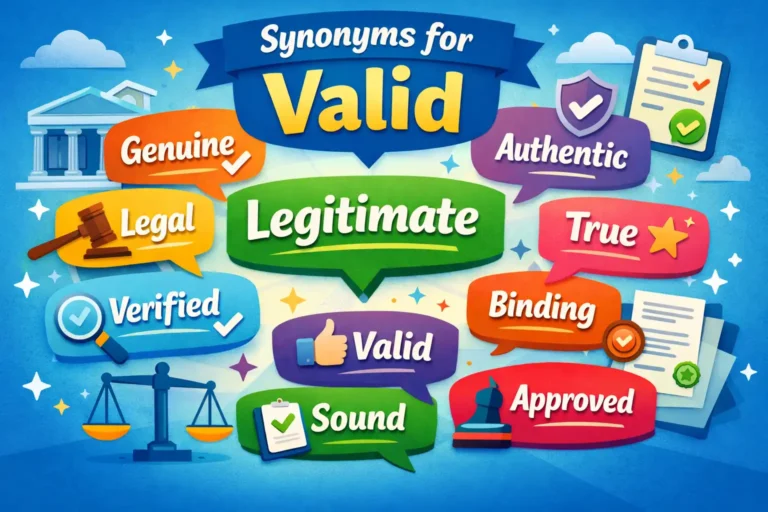
“Valid” means something that is acceptable, legitimate, or legally sound. Here are some common synonyms for “valid”:
- Legitimate
- Genuine
- Acceptable
- Official
- Authentic
- Reasonable
- Justifiable
- True
Meaning of “Valid”
“Valid” is used to describe something that is legally or logically sound, acceptable, or officially recognized. It is often used when referring to documents, arguments, or actions that meet the required standards or criteria.
Example sentence:
The contract is valid for one year from the signing date.
Categories of Synonyms
Synonyms for “valid” can be grouped into different categories based on their meaning:
- Physical or Legal Validity: These synonyms refer to something being legally sound or officially recognized.
- Logical or Reasonable Validity: These synonyms are used when describing something that is rational, justified, or acceptable.
- Authenticity or Truth: These synonyms refer to something being true, real, or genuine.
Synonyms Table
| Word | Simple Meaning | Example Sentence |
| Legitimate | Legally or officially acceptable | His claim to the throne was legitimate. |
| Genuine | Truly what it is claimed to be | This painting is genuine and valuable. |
| Acceptable | Allowed or suitable according to standards | Her explanation was acceptable in court. |
| Official | Authorized or sanctioned by an authority | The official report was released yesterday. |
| Authentic | Truly original and real | The authentic signature was confirmed. |
| Reasonable | Fair and sensible | It’s reasonable to expect a refund. |
| Justifiable | Able to be defended or explained as fair | His actions were justifiable under the law. |
| True | In accordance with fact or reality | The facts in the article were true. |
Master Synonyms List (Grouped by Level)
Beginner / Simple
- Acceptable: Something that meets the minimum standard.
Example: This is acceptable behavior at school. - True: Correct or in line with reality.
Example: Her statement was true.
Intermediate
- Legitimate: Officially recognized and allowed.
Example: Is his passport legitimate? - Reasonable: Fair or sensible, not extreme.
Example: It’s reasonable to expect more work.
Advanced / Formal
- Authentic: True and original.
Example: The museum has an authentic Mona Lisa. - Justifiable: Can be defended with reasons.
Example: His reasons for leaving were justifiable.
Formal vs Informal Synonyms
- Formal Synonyms: Words like “legitimate,” “authentic,” and “justifiable” are more commonly used in formal writing, such as academic papers, legal documents, or business communication. They are appropriate when you need to sound professional.
- Informal Synonyms: Words like “acceptable” and “true” are more suitable for everyday conversation or casual writing. They help maintain clarity while sounding natural.
Real-Life Usage Examples
Conversation
- “That’s a reasonable excuse for being late.”
Academic Writing
- “The author’s arguments were justifiable based on the data.”
Business Writing
- “Please ensure all documents are official before submission.”
Blogging
- “The source I used is genuine, so you can trust it.”
Emotional Expression
- “It’s acceptable to feel upset after such a situation.”
Similar Words Comparison
“Valid” vs “Legitimate”
- “Valid” refers to something that meets certain standards or is legally correct.
Example: The passport is valid for five years. - “Legitimate” focuses on whether something is lawful or official.
Example: The claim was found to be legitimate by the court.
“Valid” vs “Authentic”
- “Valid” refers to something recognized as correct or authorized.
Example: This is a valid reason for the delay. - “Authentic” means that something is genuine or true in origin.
Example: The museum displays authentic artifacts.
Example Sentences
- The ID card was valid for two years from the issue date.
- He presented a legitimate reason for his absence.
- This ticket is genuine and can be used for entry.
- Your answer is acceptable in this context.
- The professor gave an official statement about the grades.
- The signature was authentic, not a fake.
- It is reasonable to expect a response within a week.
- The decision was justifiable under the circumstances.
- She provided a true account of the event.
- The agreement remains valid until further notice.
- His credentials were legitimate after a thorough check.
- The authentic product was much more expensive.
- The contract was justifiable based on the company’s needs.
- The terms are reasonable, so we can proceed.
- Her argument was valid, and it convinced everyone.
Common Mistakes
- Using “Valid” too frequently: Avoid overuse in writing. Diversifying with synonyms like “legitimate” or “genuine” will improve readability.
- Confusing “Valid” with “True”: “Valid” refers to acceptance or legality, while “true” refers to accuracy or truth.
- Misapplying “Authentic”: “Authentic” is typically used for objects or qualities, not actions or decisions, unlike “valid.”
- Using “Reasonable” for everything: “Reasonable” refers to sensibility, not all “valid” scenarios. Use it where fairness or logic applies.
- Overusing formal synonyms: While words like “legitimate” or “justifiable” are formal, they should be used appropriately in academic or legal contexts, not casual conversations.
Tips / Best Practices
- Context: Always choose a synonym based on the context. For example, “justifiable” is perfect for defending actions, while “acceptable” works better for less formal situations.
- Tone: Match the synonym to the tone of your conversation or writing. Use “genuine” or “authentic” for a more natural feel, while “legitimate” fits formal writing.
- Clarity: Keep sentences clear and concise. Avoid stuffing your writing with too many synonyms for “valid.”
- Formality: Use “justifiable” or “legitimate” in formal writing, while “true” and “acceptable” are better for casual conversation.
When NOT to Use “Valid”
- In casual settings: Overuse of formal or complex synonyms like “legitimate” can make your speech sound unnatural.
- When it’s not the best fit: “Valid” isn’t suitable for describing emotional or personal experiences; use “authentic” or “true” instead.
Opposite Words (Antonyms)
- Invalid: Not legally or logically acceptable.
- Unacceptable: Not acceptable or suitable.
- Fake: Not genuine, counterfeit.
- Unjustifiable: Not able to be defended or explained.
FAQs Section
What does “valid” mean?
“Valid” means something that is legally or logically acceptable or official.
Is “valid” formal or informal?
“Valid” is formal and used in official contexts, but can also be used in casual conversations.
How can I use “valid” in conversation?
You can use “valid” to refer to reasons, contracts, or claims that are legally or logically correct.
What is the best synonym for “valid”?
The best synonym depends on context, but “legitimate” or “genuine” are strong alternatives.
Can “valid” be replaced with “genuine”?
Yes, “valid” can be replaced with “genuine” when referring to something being real or authentic, but not in legal contexts.
Conclusion
Understanding and using synonyms for “valid” helps improve your writing and speaking by offering more choices for clarity and variety. Try using 3 new synonyms in your next sentence and see how they enhance your communication!

Michael Turner creates simple synonym guides that help readers expand their vocabulary and choose the right word for the right context.