
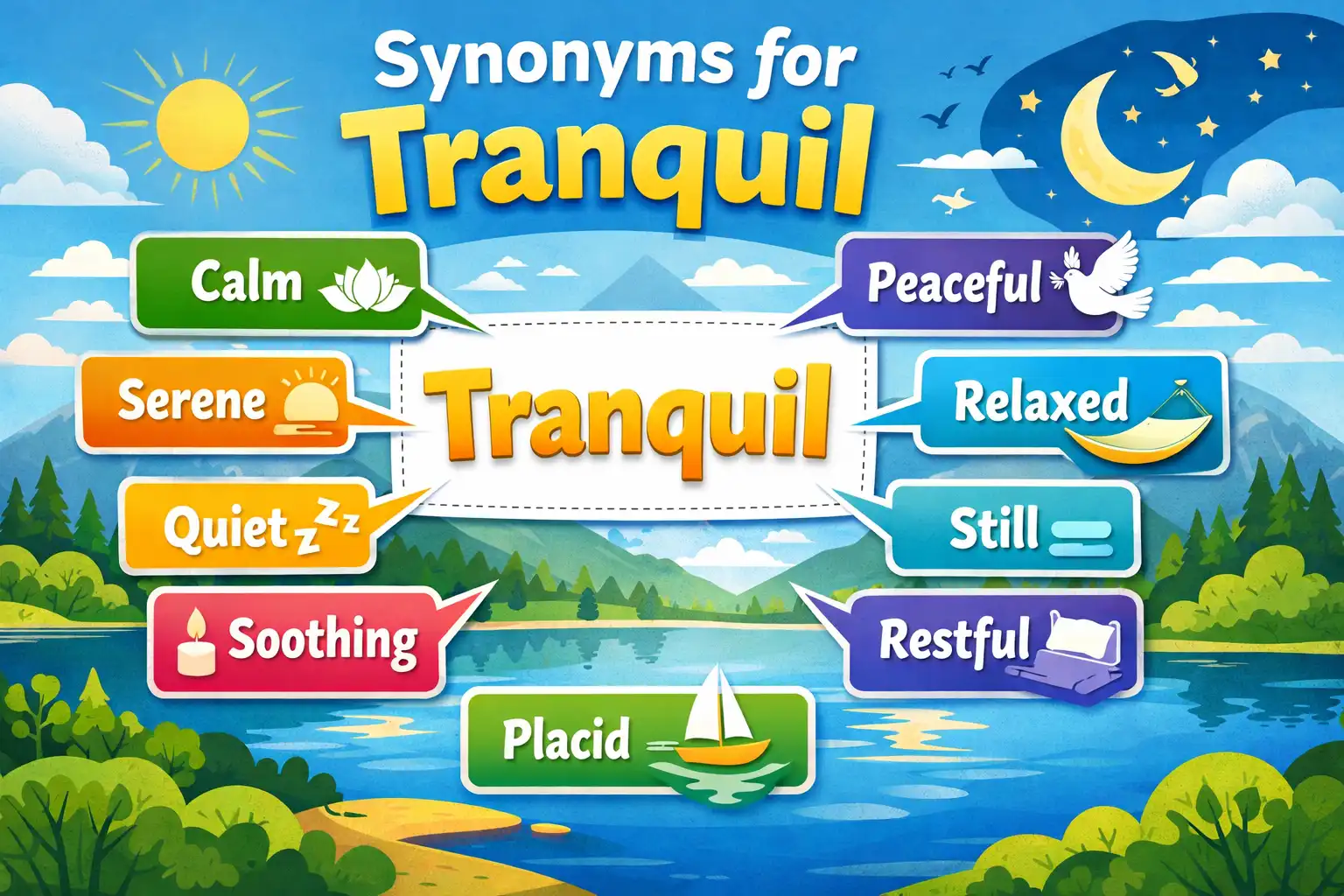
When you search for synonyms of tranquil, you discover words that describe quiet places and calm feelings. Finding synonyms of tranquil helps you write better, speak clearly, and explain peaceful moments. Learning the different synonyms of tranquil is the best way to make your English sound natural, smooth, and beautiful.
Imagine sitting by a perfectly silent lake at sunrise. The water is still, the wind is sleeping, and your mind feels completely at rest. To describe a beautiful moment like this, you need the right words. In simple English, tranquil means a state of being very quiet, still, and calm, where nothing is loud or moving fast.
This word is incredibly useful for everyone. Students can use it to write outstanding essays. Bloggers and content writers can use it to paint bright pictures in the minds of their readers. Daily English users can use it to describe their quiet weekend plans or a relaxing vacation. By learning these words, you can make your writing much more interesting.
“Tranquility is a beach where the waves of life gently kiss the shore of peace.”
“A quiet mind is a powerful engine of creativity and joy.”
Linguistic Profile of Tranquil
- Connotative Meaning: Safety, inner peace, relief from stress, mental clarity, and a lack of loud noise or chaos.
- Etymology:
- Origin: From the Latin word tranquillus, which means quiet, calm, or still.
- Old French: Adapted as tranquille in the 14th century.
- English: Entered Middle English to describe peaceful weather and calm human emotions.
- Pronunciation: US:
/ˈtræŋ.kwɪl/| UK:/ˈtræŋ.kwɪl/ - Syllables: Tran-quil (2 syllables)
- Affixation Pattern: Root word tranquil (adjective). Can take the suffix -ity to form the noun tranquility, or -ly to form the adverb tranquilly.
Quick Synonym Comparison Table
| Keyword | Meaning | Usage Type | Context |
|---|---|---|---|
| Tranquil | Free from disturbance or noise | Formal / Professional | Nature, mental states, environment |
| Calm | Not excited, angry, or anxious | Casual / Daily Use | Human behavior, weather, arguments |
| Serene | Extremely peaceful and clear | Emotional / Artistic | Skies, landscapes, deep facial expressions |
| Placid | Not easily upset or excited | Professional / Formal | Water surfaces, animal temperaments |
| Peaceful | Friendly and free from war or noise | Casual / Universal | Neighborhoods, sleep, relationships |
50 Synonyms of Tranquil
1. Peaceful
Pronunciation: US: /ˈpiːs.fəl/ | UK: /ˈpiːs.fəl/
Meaning: Free from any kind of noise, war, or worry.
Examples: * The small mountain village is very peaceful at night.
- I hope you have a peaceful sleep tonight.
2. Serene
Pronunciation: US: /səˈriːn/ | UK: /səˈriːn/
Meaning: Very calm, clear, and free of any trouble.
Examples: * She had a serene smile on her face while reading.
- The sky looked serene after the rain stopped.
3. Calm
Pronunciation: US: /kɑːm/ | UK: /kɑːm/
Meaning: Not excited, angry, nervous, or moving much.
Examples: * Please stay calm during the test.
- The sea is surprisingly calm today.
4. Placid
Pronunciation: US: /ˈplæs.ɪd/ | UK: /ˈplæs.ɪd/
Meaning: Quiet and not easily excited or upset.
Examples: * We took a boat out on the placid lake.
- My dog has a very placid nature.
5. Quiet
Pronunciation: US: /ˈkwaɪ.ət/ | UK: /ˈkwaɪ.ət/
Meaning: Making very little or no noise at all.
Examples: * The library is always quiet in the morning.
- He speaks in a quiet voice.
6. Still
Pronunciation: US: /stɪl/ | UK: /stɪl/
Meaning: Not moving or making any sound.
Examples: * Keep still while I take your photo.
- The air was completely still before the storm.
7. Untroubled
Pronunciation: US: /ʌnˈtrʌb.əld/ | UK: /ʌnˈtrʌb.əld/
Meaning: Not worried or bothered by any problems.
Examples: * She enjoyed an untroubled weekend in the countryside.
- He slept with an untroubled mind.
8. Restful
Pronunciation: US: /ˈrest.fəl/ | UK: /ˈrest.fəl/
Meaning: Giving you a feeling of quiet and relaxation.
Examples: * Green is a very restful color for your eyes.
- We had a restful vacation by the beach.
9. Relaxed
Pronunciation: US: /rɪˈlækst/ | UK: /rɪˈlækst/
Meaning: Free from tension, stress, or worry.
Examples: * He felt relaxed after taking a warm bath.
- The office has a very relaxed dress code.
10. Gentle
Pronunciation: US: /ˈdʒen.təl/ | UK: /ˈdʒen.təl/
Meaning: Mild, soft, and not rough or violent.
Examples: * A gentle breeze blew through the open window.
- She gave the baby a gentle hug.
11. Mild
Pronunciation: US: /maɪld/ | UK: /maɪld/
Meaning: Gentle and not harsh, severe, or strong.
Examples: * We are having very mild weather this winter.
- He has a mild personality and never shouts.
12. Smooth
Pronunciation: US: /smuːð/ | UK: /smuːð/
Meaning: Having an even surface without any bumps.
Examples: * The lake was as smooth as a mirror.
- We had a smooth ride on the new train.
13. Soft
Pronunciation: US: /sɒft/ | UK: /sɔːft/
Meaning: Not loud, harsh, or bright to the senses.
Examples: * The room was lit with soft candlelight.
- She played some soft music in the background.
14. Hushful
Pronunciation: US: /ˈhʌʃ.fəl/ | UK: /ˈhʌʃ.fəl/
Meaning: Filled with a quiet and peaceful silence.
Examples: * They walked through the hushful pine forest.
- A hushful atmosphere fell over the empty church.
15. Soundless
Pronunciation: US: /ˈsaʊnd.ləs/ | UK: /ˈsaʊnd.ləs/
Meaning: Making no sound or noise of any kind.
Examples: * The snow fell in a soundless blanket over the town.
- She made a soundless exit through the back door.
16. Noise-free
Pronunciation: US: /nɔɪz-friː/ | UK: /nɔɪz-friː/
Meaning: Completely empty of any unwanted sounds.
Examples: * I need a noise-free room to study for my exams.
- This park is a wonderful, noise-free escape.
17. Unruffled
Pronunciation: US: /ʌnˈrʌf.əld/ | UK: /ʌnˈrʌf.əld/
Meaning: Calm and smooth, not disturbed by anything.
Examples: * His calm face remained unruffled by the bad news.
- The surface of the pool was totally unruffled.
18. Unstirred
Pronunciation: US: /ʌnˈstɜːd/ | UK: /ʌnˈstɜːd/
Meaning: Not moving, shaking, or emotionally affected.
Examples: * The fallen leaves lay unstirred on the grass.
- He stood unstirred by their angry words.
19. Sedate
Pronunciation: US: /səˈdeɪt/ | UK: /səˈdeɪt/
Meaning: Slow, calm, quiet, and very polite.
Examples: * They took a sedate walk around the neighborhood.
- The town is quiet and sedate during the week.
20. Composed
Pronunciation: US: /kəmˈpoʊzd/ | UK: /kəmˈpəʊzd/
Meaning: Having full control of your feelings and actions.
Examples: * She looked calm and composed before her speech.
- He managed to stay composed during the emergency.
21. Collected
Pronunciation: US: /kəˈlek.tɪd/ | UK: /kəˈlek.tɪd/
Meaning: Calm and in control of your own mind.
Examples: * Even in a crisis, she remains cool and collected.
- His answers were very slow and collected.
22. Cool
Pronunciation: US: /kuːl/ | UK: /kuːl/
Meaning: Calm and not showing any anger or excitement.
Examples: * Try to keep a cool head during the game.
- He stayed cool when everyone else was panicking.
23. Easy
Pronunciation: US: /ˈiː.zi/ | UK: /ˈiː.zi/
Meaning: Free from pain, worry, or hard effort.
Examples: * She has an easy mind now that the work is done.
- They enjoyed an easy conversation by the fire.
24. Halcyon
Pronunciation: US: /ˈhæl.si.ən/ | UK: /ˈhæl.si.ən/
Meaning: Very calm, happy, and peaceful.
Examples: * She often dreams of the halcyon days of her youth.
- We spent a halcyon summer on the quiet island.
25. Pacific
Pronunciation: US: /pəˈsɪf.ɪk/ | UK: /pəˈsɪf.ɪk/
Meaning: Loving peace and refusing to fight or argue.
Examples: * The two countries reached a pacific agreement.
- He has a very pacific approach to solving problems.
“Silence is not empty; it is full of answers.”
26. Harmonious
Pronunciation: US: /hɑːrˈmoʊ.ni.əs/ | UK: /hɑːˈməʊ.ni.əs/
Meaning: Friendly, peaceful, and without any disagreements.
Examples: * The family live together in a harmonious home.
- We want to build a harmonious work team.
27. Undisturbed
Pronunciation: US: /ˌʌn.dɪˈstɜːbd/ | UK: /ˌʌn.dɪˈstɜːbd/
Meaning: Left alone and not changed or interrupted.
Examples: * I need three hours of undisturbed study time.
- The ancient forest remains completely undisturbed.
28. Mellow
Pronunciation: US: /ˈmel.oʊ/ | UK: /ˈmel.əʊ/
Meaning: Soft, sweet, and relaxed because of age.
Examples: * This room has a very mellow and warm light.
- He has become much more mellow as he gets older.
29. Low-key
Pronunciation: US: /ˌloʊˈkiː/ | UK: /ˌləʊˈkiː/
Meaning: Quiet, relaxed, and not attracting much attention.
Examples: * We are having a low-key dinner at home tonight.
- Their wedding was a very low-key event.
30. Easygoing
Pronunciation: US: /ˌiː.ziˈɡoʊ.ɪŋ/ | UK: /ˌiː.ziˈɡəʊ.ɪŋ/
Meaning: Relaxed and happy to accept things as they are.
Examples: * Our new teacher is very easygoing and kind.
- She has an easygoing attitude toward life.
31. Reposeful
Pronunciation: US: /rɪˈpoʊz.fəl/ | UK: /rɪˈpəʊz.fəl/
Meaning: Calm and calm enough to make you sleep.
Examples: * The bedroom was painted in reposeful shades of blue.
- Yoga puts me in a very reposeful state of mind.
32. Solitary
Pronunciation: US: /ˈsɑː.lə.ter.i/ | UK: /ˈsɒl.ɪ.tər.i/
Meaning: Done alone, away from other people and noise.
Examples: * He enjoys long, solitary walks in the forest.
- She lives a solitary but very happy life.
33. Secluded
Pronunciation: US: /səˈkluː.dɪd/ | UK: /səˈkluː.dɪd/
Meaning: Quiet and hidden away from busy places.
Examples: * We found a secluded beach far from the hotels.
- Their house is in a secluded spot in the woods.
34. Cozy
Pronunciation: US: /ˈkoʊ.zi/ | UK: /ˈkəʊ.zi/
Meaning: Warm, comfortable, quiet, and very safe.
Examples: * It feels so cozy to stay inside on a rainy day.
- We sat in a cozy corner of the little cafe.
35. Quieted
Pronunciation: US: /ˈkwaɪ.ət-əd/ | UK: /ˈkwaɪ.ət-əd/
Meaning: Made calm, quiet, or less active.
Examples: * The crying baby finally quieted down.
- The storm quieted as the night went on.
36. Soothing
Pronunciation: US: /ˈsuː.ðɪŋ/ | UK: /ˈsuː.ðɪŋ/
Meaning: Making you feel calm, warm, and less painful.
Examples: * She drank some soothing hot tea for her throat.
- The sound of falling rain is very soothing to me.
37. Balmy
Pronunciation: US: /ˈbɑː.mi/ | UK: /ˈbɑː.mi/
Meaning: Warm, gentle, and very pleasant.
Examples: * We enjoyed a balmy evening on the porch.
- The tropical island is famous for its balmy weather.
38. Dreamy
Pronunciation: US: /ˈdriː.mi/ | UK: /ˈdriː.mi/
Meaning: So quiet and beautiful that it feels like a dream.
Examples: * The painting had a dreamy, soft look to it.
- She listened to the dreamy sound of the harp.
39. Windless
Pronunciation: US: /ˈwɪnd.ləs/ | UK: /ˈwɪnd.ləs/
Meaning: Having absolutely no wind or moving air.
Examples: * The smoke rose straight up into the windless sky.
- It was a hot, windless day at the beach.
40. Waveless
Pronunciation: US: /ˈweɪv.ləs/ | UK: /ˈweɪv.ləs/
Meaning: Smooth and having no waves on the water.
Examples: * The boat sat still on the waveless ocean.
- We looked down into the perfectly waveless pond.
41. Unbothered
Pronunciation: US: /ʌnˈbɒð.əd/ | UK: /ʌnˈbɒð.əd/
Meaning: Not worried, upset, or concerned about anything.
Examples: * He remained unbothered by the loud construction outside.
- She is totally unbothered by what other people think.
42. Balanced
Pronunciation: US: /ˈbæl.ənst/ | UK: /ˈbæl.ənst/
Meaning: Calm and steady, with all parts in the right place.
Examples: * She lives a balanced life of work and play.
- A balanced mind helps you make great choices.
43. Zen
Pronunciation: US: /zen/ | UK: /zen/
Meaning: Feeling completely peaceful, relaxed, and mindful.
Examples: * My garden is my special Zen space.
- He is very Zen and never gets angry at work.
44. Equable
Pronunciation: US: /ˈek.wə.bəl/ | UK: /ˈek.wə.bəl/
Meaning: Staying calm and steady without sudden changes.
Examples: * She has an equable temper and rarely gets mad.
- This city enjoys an equable climate all year.
45. Imperturbable
Pronunciation: US: /ˌɪm.pɚˈtɝː.bə.bəl/ | UK: /ˌɪm.pəˈtɜː.bə.bəl/
Meaning: Impossible to make angry, excited, or worried.
Examples: * Our captain is imperturbable during tough matches.
- Her imperturbable calm kept the team focused.
46. Unexcited
Pronunciation: US: /ˌʌn.ɪkˈsaɪ.tɪd/ | UK: /ˌʌn.ɪkˈsaɪ.tɪd/
Meaning: Feeling or showing no excitement or worry.
Examples: * He gave a very flat and unexcited response.
- The cat looked completely unexcited by the new toy.
47. Soporific
Pronunciation: US: /ˌsɑː.pəˈrɪf.ɪk/ | UK: /ˌsɒp.əˈrɪf.ɪk/
Meaning: Making you feel very sleepy and relaxed.
Examples: * The sound of the ocean waves has a soporific effect.
- She fell asleep during the long, soporific speech.
48. Static
Pronunciation: US: /ˈstæt.ɪk/ | UK: /ˈstæt.ɪk/
Meaning: Not moving, changing, or active in any way.
Examples: * The oil prices remained static this month.
- He sat in a static position for an hour.
49. Unflappable
Pronunciation: US: /ʌnˈflæp.ə.bəl/ | UK: /ʌnˈflæp.ə.bəl/
Meaning: Staying calm and steady in a difficult situation.
Examples: * The pilot was completely unflappable during the storm.
- She is an unflappable leader who always knows what to do.
50. Seraphic
Pronunciation: US: /səˈræf.ɪk/ | UK: /səˈræf.ɪk/
Meaning: Beautiful, calm, and peaceful like a holy angel.
Examples: * The sleeping baby had a seraphic look on her face.
- She sang with a seraphic smile that moved everyone.
Antonyms of Tranquil
If a place or feeling is not tranquil, it is usually full of movement, noise, or trouble. Here are the most common opposite words:
- Chaotic: Full of total confusion and disorder.
- Noisy: Making a lot of loud, unpleasant sounds.
- Turbulent: Moving quickly and violently in different directions.
- Agitated: Feeling nervous, excited, or deeply troubled.
- Stormy: Rough and wild, like a bad weather system.
Prototype Meaning and Categorization of Tranquil
- Core Meaning: The absolute absence of disturbance. It represents a state where everything is in perfect, quiet order.
- Categorization:
- Environmental Stillness: Physical spaces with low sensory input (e.g., a quiet library, a windless forest, a smooth pond).
- Emotional/Mental Stillness: Human psychological states free from anxiety, anger, or stress (e.g., a calm mind, a relaxed posture, an unbothered attitude).
Frequently Asked Questions
1. What is the best synonym for tranquil when describing a person?
The word composed or serene is excellent for people. They show that a person is calm, steady, and completely in control of their emotions.
2. Is “quiet” the exact same thing as “tranquil”?
Not quite. “Quiet” simply means there is no sound. “Tranquil” goes deeper; it means there is no noise and everything is deeply peaceful, beautiful, and relaxed.
3. Can I use the word “placid” to describe a person’s mood?
Yes, you can! A placid person is someone who is gentle, quiet, and not easily bothered by problems or loud noises.
4. What is the noun form of the word tranquil?
The noun form is tranquility (also spelled tranquillity in UK English). It means the state of being quiet and peaceful.
5. Why is “halcyon” used as a synonym for tranquil?
“Halcyon” comes from an old Greek story about a bird that could calm the wild winter waves. Today, we use it to describe peaceful and happy times in the past.
Conclusion
Learning the many different synonyms of tranquil is a fantastic way to upgrade your communication skills. When you expand your vocabulary, your writing becomes much more colorful and engaging. Bloggers can use these terms to paint clearer pictures for readers, and students can use them to write highly impressive school papers. Even in everyday conversations and emails, choosing the perfect word helps you share your thoughts with clarity and confidence.
We encourage you to practice using these peaceful words this week. Try swapping out common words like “calm” or “quiet” for something richer like “serene,” “placid,” or “unruffled.” You will be amazed at how much stronger and more elegant your English will sound.
“Peace is the beauty of life; it is sunshine, a smile, and a gentle breeze.”
“The more tranquil a man becomes, the greater is his success, his influence, and his power for good.”

Michael Turner is a published fiction writer and creative writing tutor with over a decade of experience helping writers find the words that make their stories breathe ( Biography ).