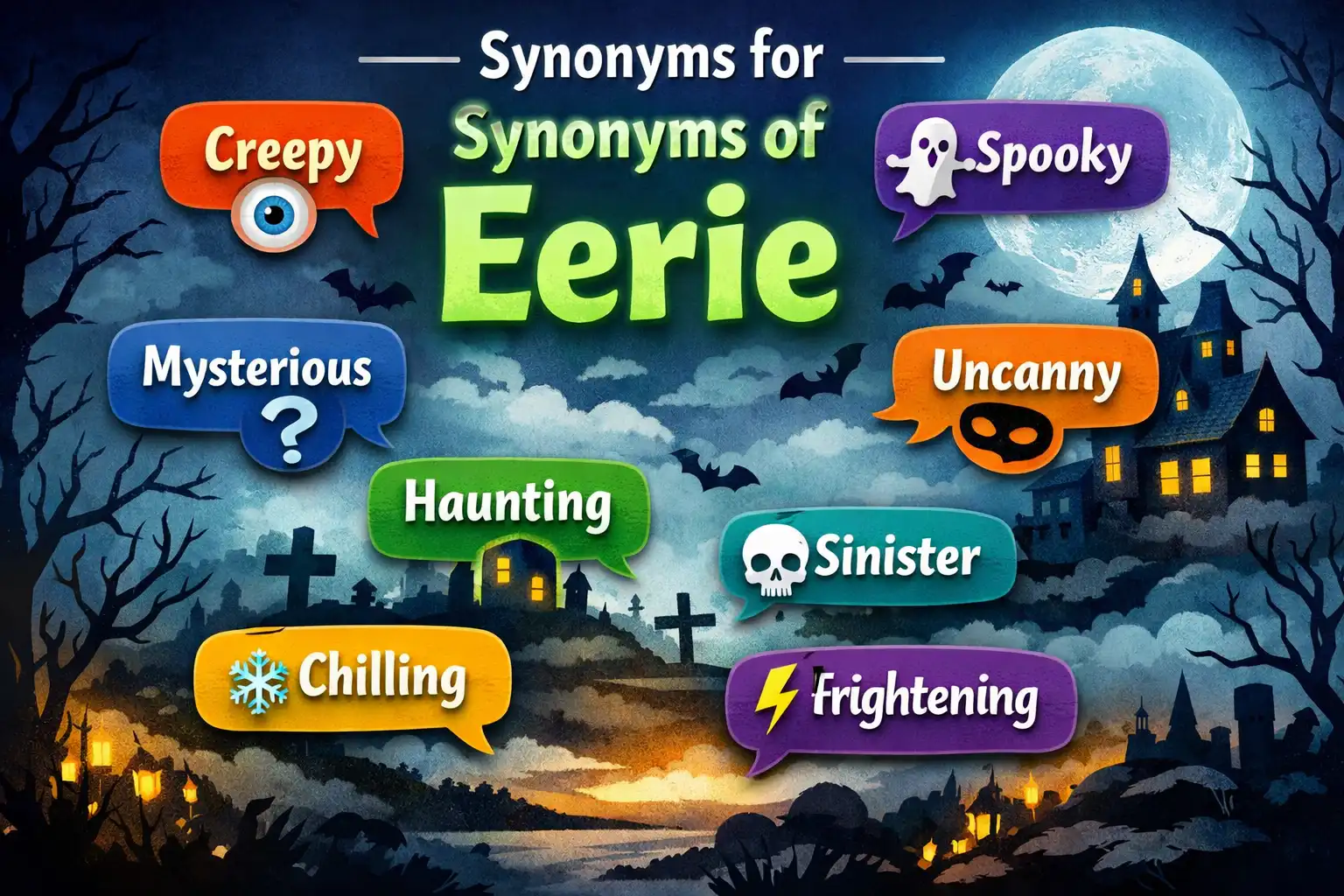
The word eerie means something that feels strange, mysterious, and slightly frightening — not in an obvious horror-movie way, but in a quiet, unsettling way. When something is eerie, it gives you a cold, uncomfortable feeling without a clear reason. The synonyms of eerie help writers, students, and speakers describe this exact feeling with more precision and variety.
Imagine walking through an empty street late at night. The lights flicker. No sound. No people. Just silence. That feeling — that quiet, creeping discomfort — is eerie. Learning the synonyms of eerie gives you the power to describe that moment perfectly, whether you are writing a story, a blog post, or just sending a message to a friend.
“The oldest and strongest emotion of mankind is fear, and the oldest and strongest kind of fear is fear of the unknown.” — H.P. Lovecraft
Language is the tool we use to capture these feelings. The more words you know, the better you can describe what you feel and see. That is why synonyms of eerie matter so much for anyone who wants to write with impact.
“Words are, of course, the most powerful drug used by mankind.” — Rudyard Kipling
Connotative Meaning of Eerie
Eerie carries a negative and unsettling connotation. It suggests mystery, discomfort, and the supernatural. It is not just “strange” — it is strange in a way that makes your skin crawl. The word often appears in horror writing, nature descriptions, and ghost stories. It feels atmospheric and emotionally heavy.
Etymology of Eerie
- Origin: Old English / Scottish dialect word eri or erig
- Early meaning: Timid, fearful, frightened
- Middle English use: Meaning shifted to “causing fear in others”
- Modern meaning: Strange and frightening in a quiet, mysterious way
- First recorded use: Around the 13th century in Northern English dialects
Pronunciation of Eerie
| Region | IPA | Sounds Like |
| US | /ˈɪr.i/ | “EER-ee” |
| UK | /ˈɪə.ri/ | “EER-ee” |
Syllables: 2 — eer · ie
Affixation Pattern: Root word only. Can form: eerily (adverb), eeriness (noun)
Comparison Table — Eerie vs Its Synonyms
| Keyword | Meaning | Usage Type | Tone | Best Context |
| Eerie | Strange and quietly frightening | Formal / Literary | Unsettling | Ghost stories, nature writing |
| Spooky | Mildly scary and mysterious | Casual / Informal | Playful-scary | Halloween, light horror |
| Creepy | Causing skin-crawling discomfort | Casual / Emotional | Negative/Dark | Describing people or places |
| Uncanny | Surprisingly strange beyond normal | Formal / Literary | Intellectual | Science fiction, psychology |
| Haunting | Staying in your mind, beautifully sad | Formal / Emotional | Melancholy | Music, memories, art |
| Sinister | Suggesting evil or danger | Formal / Strong | Dark / Threatening | Crime, thrillers, news |
| Mysterious | Full of unknown secrets | Neutral / Versatile | Curious | Everyday writing, stories |
| Ghostly | Like a ghost, faint and pale | Formal / Literary | Supernatural | Horror, poetry |
| Unsettling | Making you feel uneasy | Formal / Neutral | Anxious | Journalism, reviews |
| Ominous | Warning of something bad coming | Formal / Strong | Heavy/Foreboding | News, storytelling |
| Weird | Strange in an unusual way | Casual | Light | Everyday conversation |
| Bizarre | Very strange and unexpected | Neutral | Surprising | News, casual writing |
| Foreboding | A feeling of coming danger | Formal / Literary | Dread | Suspense writing |
| Chilling | Causing fear and coldness | Formal / Casual | Cold/Scary | Reviews, crime writing |
| Supernatural | Beyond the natural world | Formal / Technical | Mysterious | Religion, horror, sci-fi |
50 Synonyms of Eerie — Full List with Meanings and Examples
1. Spooky
Pronunciation: US /ˈspuː.ki/ · UK /ˈspuː.ki/
Meaning: Something that feels mildly scary and mysterious, like a haunted house.
Examples:
- The old barn at the edge of town looked spooky after dark.
- She told a spooky story that made all the children scream.
2. Creepy
Pronunciation: US /ˈkriː.pi/ · UK /ˈkriː.pi/
Meaning: Something that makes you feel deeply uncomfortable or disgusted.
Examples:
- The man in the corner kept staring, and it felt creepy.
- That abandoned hospital gave off a creepy feeling at midnight.
3. Uncanny
Pronunciation: US /ʌnˈkæn.i/ · UK /ʌnˈkæn.i/
Meaning: Strangely beyond what feels normal or natural.
Examples:
- The twins had an uncanny ability to finish each other’s sentences.
- There was an uncanny silence in the forest before the storm.
4. Haunting
Pronunciation: US /ˈhɔːn.tɪŋ/ · UK /ˈhɔːn.tɪŋ/
Meaning: Something beautiful or sad that stays in your mind long after.
Examples:
- The melody of that song was haunting and unforgettable.
- She had a haunting look in her eyes that no one could explain.
5. Sinister
Pronunciation: US /ˈsɪn.ɪ.stɚ/ · UK /ˈsɪn.ɪ.stə/
Meaning: Suggesting evil, danger, or harmful intent.
Examples:
- The villain gave a sinister smile before walking away.
- There was something sinister about the way he spoke so calmly.
6. Mysterious
Pronunciation: US /mɪˈstɪr.i.əs/ · UK /mɪˈstɪə.ri.əs/
Meaning: Full of secrets or unknown things that are hard to explain.
Examples:
- The mysterious stranger never told anyone where he came from.
- A mysterious light appeared over the lake every full moon.
7. Ghostly
Pronunciation: US /ˈɡoʊst.li/ · UK /ˈɡəʊst.li/
Meaning: Resembling a ghost; pale, faint, and supernatural.
Examples:
- A ghostly figure passed through the hallway in silence.
- The fog gave the village a ghostly appearance at dawn.
8. Unsettling
Pronunciation: US /ʌnˈset.əl.ɪŋ/ · UK /ʌnˈset.əl.ɪŋ/
Meaning: Making you feel uneasy or worried without a clear reason.
Examples:
- The news report was deeply unsettling to everyone who watched.
- There was an unsettling silence after the announcement.
9. Ominous
Pronunciation: US /ˈɑː.mɪ.nəs/ · UK /ˈɒm.ɪ.nəs/
Meaning: Giving a strong warning or sign that something bad is about to happen.
Examples:
- The dark clouds looked ominous before the tornado struck.
- His ominous tone suggested that things would not end well.
10. Chilling
Pronunciation: US /ˈtʃɪl.ɪŋ/ · UK /ˈtʃɪl.ɪŋ/
Meaning: Causing a cold feeling of fear or horror.
Examples:
- The detective shared a chilling account of the crime scene.
- Reading the letter sent a chilling feeling down her spine.
11. Supernatural
Pronunciation: US /ˌsuː.pɚˈnætʃ.ɚ.əl/ · UK /ˌsuː.pəˈnætʃ.ər.əl/
Meaning: Beyond the laws of nature; involving magic, ghosts, or spirits.
Examples:
- The villagers believed the old woman had supernatural powers.
- Scientists could not explain the supernatural events in the house.
12. Foreboding
Pronunciation: US /fɔːrˈboʊ.dɪŋ/ · UK /fɔːˈbəʊ.dɪŋ/
Meaning: A strong inner feeling that something bad or dangerous is coming.
Examples:
- She felt a deep foreboding before stepping into the building.
- The heavy silence filled him with foreboding.
13. Macabre
Pronunciation: US /məˈkɑː.brə/ · UK /məˈkɑː.brə/
Meaning: Disturbing and dealing with death or injury in an unpleasant way.
Examples:
- The artist was known for his macabre paintings of skeletons.
- The story took a macabre turn in the final chapter.
14. Otherworldly
Pronunciation: US /ˌʌð.ɚˈwɝːld.li/ · UK /ˌʌð.əˈwɜːld.li/
Meaning: Seeming to belong to a different, magical, or spiritual world.
Examples:
- The northern lights had an otherworldly beauty that left us speechless.
- Her voice had an otherworldly quality that no one could describe.
15. Weird
Pronunciation: US /wɪrd/ · UK /wɪəd/
Meaning: Strange or unusual in a way that is hard to explain.
Examples:
- It felt weird to return to the empty house after so many years.
- A weird noise came from the basement every night at 3 a.m.
16. Strange
Pronunciation: US /streɪndʒ/ · UK /streɪndʒ/
Meaning: Not normal or expected; unfamiliar.
Examples:
- There was a strange smell coming from the locked room.
- She gave him a strange look that he could not forget.
17. Bizarre
Pronunciation: US /bɪˈzɑːr/ · UK /bɪˈzɑː/
Meaning: Very strange and unexpected in a shocking way.
Examples:
- The bizarre events of that night were never fully explained.
- He wore a bizarre costume that confused everyone at the party.
18. Surreal
Pronunciation: US /səˈriːl/ · UK /səˈriːl/
Meaning: Feeling dreamlike, unreal, or impossible to believe.
Examples:
- Seeing your childhood home demolished feels completely surreal.
- The painting had a surreal quality that made people feel dizzy.
19. Frightening
Pronunciation: US /ˈfraɪt.ən.ɪŋ/ · UK /ˈfraɪt.ən.ɪŋ/
Meaning: Causing strong fear or terror.
Examples:
- The frightening scream echoed through the empty hallway.
- It was frightening to be lost alone in the dark forest.
20. Menacing
Pronunciation: US /ˈmen.ɪ.sɪŋ/ · UK /ˈmen.ɪ.sɪŋ/
Meaning: Suggesting danger or threat; feeling like harm is near.
Examples:
- The dog growled in a menacing way and refused to move.
- Dark clouds gathered in a menacing formation over the city.
21. Spine-chilling
Pronunciation: US /ˈspaɪn.tʃɪl.ɪŋ/ · UK /ˈspaɪn.tʃɪl.ɪŋ/
Meaning: So scary it makes your spine feel cold.
Examples:
- The final scene of the movie was absolutely spine-chilling.
- She heard a spine-chilling howl from deep in the woods.
22. Nightmarish
Pronunciation: US /ˈnaɪt.mer.ɪʃ/ · UK /ˈnaɪt.meər.ɪʃ/
Meaning: Resembling or feeling like a bad dream.
Examples:
- The traffic jam after the flood was nightmarish to deal with.
- He described the experience as nightmarish and traumatic.
23. Unearthly
Pronunciation: US /ʌnˈɜːrθ.li/ · UK /ʌnˈɜːθ.li/
Meaning: Not from this earth; strange and supernatural.
Examples:
- An unearthly glow lit up the field at midnight.
- The creature let out an unearthly cry that froze everyone.
24. Disquieting
Pronunciation: US /dɪsˈkwaɪ.ə.tɪŋ/ · UK /dɪsˈkwaɪ.ə.tɪŋ/
Meaning: Making you feel anxious and deeply uncomfortable.
Examples:
- The doctor’s silence was more disquieting than bad news.
- There was something disquieting about the way the child stared.
25. Threatening
Pronunciation: US /ˈθret.ən.ɪŋ/ · UK /ˈθret.ən.ɪŋ/
Meaning: Showing signs of coming danger or harm.
Examples:
- The sky turned a threatening shade of green before the storm.
- His body language was threatening and made others step back.
26. Mysterious
(See #6 above — use “enigmatic” as extended form)
26. Enigmatic
Pronunciation: US /ˌen.ɪɡˈmæt.ɪk/ · UK /ˌen.ɪɡˈmæt.ɪk/
Meaning: Mysterious and difficult to understand.
Examples:
- The enigmatic smile on the statue puzzled historians for years.
- He gave an enigmatic answer that raised more questions.
27. Preternatural
Pronunciation: US /ˌpriː.tɚˈnætʃ.ɚ.əl/ · UK /ˌpriː.təˈnætʃ.ər.əl/
Meaning: Beyond what is normal; seeming to exceed natural limits.
Examples:
- The child had a preternatural calm that unsettled the adults.
- Her preternatural memory allowed her to recall every detail.
28. Dark
Pronunciation: US /dɑːrk/ · UK /dɑːk/
Meaning: Relating to evil, mystery, or absence of light and hope.
Examples:
- The story took a very dark turn in the second half.
- There was a dark energy in the room that nobody could ignore.
29. Gloomy
Pronunciation: US /ˈɡluː.mi/ · UK /ˈɡluː.mi/
Meaning: Dark, sad, and without hope or brightness.
Examples:
- The gloomy weather matched her sad mood perfectly.
- The old castle looked especially gloomy under the grey sky.
30. Bleak
Pronunciation: US /bliːk/ · UK /bliːk/
Meaning: Cold, bare, and without comfort or hope.
Examples:
- The bleak landscape stretched for miles without a single tree.
- His future looked bleak after losing everything in the fire.
31. Shadowy
Pronunciation: US /ˈʃæd.oʊ.i/ · UK /ˈʃæd.əʊ.i/
Meaning: Full of shadows; mysterious and hard to see clearly.
Examples:
- A shadowy figure stood at the end of the corridor.
- The shadowy organization operated without leaving any trace.
32. Grim
Pronunciation: US /ɡrɪm/ · UK /ɡrɪm/
Meaning: Serious, harsh, and without any comfort or happiness.
Examples:
- The nurse wore a grim expression after reading the results.
- The grim reality of the situation became clear very quickly.
33. Spectral
Pronunciation: US /ˈspek.trəl/ · UK /ˈspek.trəl/
Meaning: Relating to ghosts or looking like a ghost; pale and faint.
Examples:
- A spectral light drifted slowly across the cemetery.
- The mist gave the lake a spectral and dreamlike appearance.
34. Hollow
Pronunciation: US /ˈhɑː.loʊ/ · UK /ˈhɒl.əʊ/
Meaning: Empty inside; producing an echoing sound that feels cold and eerie.
Examples:
- His hollow laugh echoed in the empty room.
- The hollow wind through the broken windows sounded ghostly.
35. Petrifying
Pronunciation: US /ˈpet.rɪ.faɪ.ɪŋ/ · UK /ˈpet.rɪ.faɪ.ɪŋ/
Meaning: So frightening it makes you unable to move.
Examples:
- The sudden scream was absolutely petrifying.
- It was petrifying to stand at the edge of the cliff alone.
36. Terrifying
Pronunciation: US /ˈter.ɪ.faɪ.ɪŋ/ · UK /ˈter.ɪ.faɪ.ɪŋ/
Meaning: Causing extreme terror and fear.
Examples:
- The terrifying experience changed her life forever.
- A terrifying scream came from behind the locked door.
37. Dreadful
Pronunciation: US /ˈdred.fəl/ · UK /ˈdred.fəl/
Meaning: Causing great fear, dread, or very unpleasant feelings.
Examples:
- The dreadful smell told us something was very wrong inside.
- It was a dreadful night that nobody in the village ever forgot.
38. Morbid
Pronunciation: US /ˈmɔːr.bɪd/ · UK /ˈmɔː.bɪd/
Meaning: Having too much interest in death or unpleasant things.
Examples:
- He had a morbid curiosity about old graveyards and ghost stories.
- The documentary had a morbid tone that disturbed many viewers.
39. Ghastly
Pronunciation: US /ˈɡæst.li/ · UK /ˈɡɑːst.li/
Meaning: Shocking, terrible, and extremely unpleasant to look at.
Examples:
- The ghastly scene in the basement shocked even the police.
- Her ghastly pale face told us she had seen something awful.
40. Fearsome
Pronunciation: US /ˈfɪr.səm/ · UK /ˈfɪə.səm/
Meaning: Causing great fear; powerful and intimidating.
Examples:
- The fearsome beast emerged from the dark forest at midnight.
- His fearsome reputation made other fighters avoid him.
41. Brooding
Pronunciation: US /ˈbruː.dɪŋ/ · UK /ˈbruː.dɪŋ/
Meaning: Deeply thoughtful in a dark, heavy, and atmospheric way.
Examples:
- The brooding sky before the storm made everyone nervous.
- He sat in brooding silence in the corner of the room.
42. Haunted
Pronunciation: US /ˈhɔːn.tɪd/ · UK /ˈhɔːn.tɪd/
Meaning: A place believed to be visited by ghosts; troubled by past memories.
Examples:
- The children dared each other to enter the haunted house.
- She carried a haunted look in her eyes after the accident.
43. Diabolic
Pronunciation: US /ˌdaɪ.əˈbɒl.ɪk/ · UK /ˌdaɪ.əˈbɒl.ɪk/
Meaning: Extremely wicked; relating to the devil.
Examples:
- The villain’s diabolic plan was finally revealed in the last act.
- His diabolic laughter echoed throughout the chamber.
44. Unnerving
Pronunciation: US /ʌnˈnɜːr.vɪŋ/ · UK /ʌnˈnɜː.vɪŋ/
Meaning: Making you lose confidence or feel very uncomfortable.
Examples:
- The staring statue had an unnerving effect on all the tourists.
- Her calm reaction to bad news was unnerving to everyone around.
45. Mystical
Pronunciation: US /ˈmɪs.tɪ.kəl/ · UK /ˈmɪs.tɪ.kəl/
Meaning: Relating to spiritual or magical forces beyond normal understanding.
Examples:
- The cave had a mystical atmosphere that attracted thousands of visitors.
- She believed the forest had mystical powers that healed the body.
46. Sepulchral
Pronunciation: US /sɪˈpʌl.krəl/ · UK /sɪˈpʌl.krəl/
Meaning: Relating to graves or death; deep and hollow-sounding.
Examples:
- His sepulchral voice echoed through the empty church.
- A sepulchral silence fell over the crowd when the news broke.
47. Eldritch
Pronunciation: US /ˈel.drɪtʃ/ · UK /ˈel.drɪtʃ/
Meaning: Weird and frightening, often suggesting something supernatural.
Examples:
- The eldritch sound from the cave kept everyone away at night.
- The old book contained eldritch symbols no one could translate.
48. Uncanny
(Extended use — see also #3)
48. Phantasmal
Pronunciation: US /fænˈtæz.məl/ · UK /fænˈtæz.məl/
Meaning: Relating to ghosts or illusions; dreamlike and unreal.
Examples:
- A phantasmal shape floated above the water in the mist.
- The entire event felt phantasmal, like something from a dream.
49. Disturbing
Pronunciation: US /dɪˈstɜːr.bɪŋ/ · UK /dɪˈstɜː.bɪŋ/
Meaning: Making you feel deeply troubled or upset.
Examples:
- The disturbing documentary stayed with her for weeks.
- He found the disturbing silence more frightening than any noise.
50. Grim
(Extended use — alternate: “Daunting”)
50. Daunting
Pronunciation: US /ˈdɔːn.tɪŋ/ · UK /ˈdɔːn.tɪŋ/
Meaning: Seeming very difficult or frightening in a way that makes you hesitate.
Examples:
- Standing at the door of the dark mansion felt daunting.
- The daunting silence of the empty city was hard to describe.
“There is something at work in my soul which I do not understand.” — Mary Shelley, Frankenstein
Antonyms of Eerie
| Antonym | Meaning |
| Comforting | Giving warmth and safety |
| Familiar | Well-known and easy to recognize |
| Pleasant | Enjoyable and agreeable |
| Ordinary | Normal and common |
| Cheerful | Full of happiness and brightness |
| Inviting | Warm and welcoming |
| Safe | Free from danger or fear |
| Reassuring | Removing doubt and fear |
Prototype Meaning and Categorization of Eerie
The prototype of eerie is something quiet, dark, and deeply strange — like an empty road at night or a phone ringing in an abandoned house. It fits into these categories:
- Emotional category: Fear, anxiety, unease
- Sensory category: Visual (pale, dark, shadowy), auditory (silence, echoes)
- Usage category: Literary, horror, nature writing, daily speech
- Degree: Mid-level intensity — stronger than “weird,” softer than “terrifying”
Frequently Asked Questions (FAQs)
Q1. What is the best synonym of eerie for creative writing?
The best synonyms for creative writing are haunting, uncanny, eldritch, and spectral. They carry strong atmosphere and depth.
Q2. What is the difference between eerie and spooky?
Eerie is more literary and deeply unsettling. Spooky is more casual and can even feel fun (like Halloween decorations). Eerie is quieter and more atmospheric.
Q3. Can eerie be used in a positive sentence?
Rarely, but yes. Example: “The eerie beauty of the fog-covered mountains left us speechless.” Here, eerie adds mystery without being negative.
Q4. Is eerie formal or informal?
Eerie works in both formal and informal writing. It is common in literature, journalism, and everyday speech.
Q5. What are some eerie synonyms suitable for professional writing?
For professional or formal writing, use: unsettling, disquieting, ominous, foreboding, or uncanny. These feel polished and controlled.
Q6. How do I use synonyms of eerie in emails or essays?
Pick the synonym that matches your tone. For essays: ominous, disquieting, or haunting. For informal writing: spooky, creepy, or weird.
Q7. How many syllables does eerie have?
Eerie has 2 syllables: eer · ie. Stress falls on the first syllable.
Conclusion
Learning the synonyms of eerie is one of the best things you can do for your writing, speaking, and communication skills. When you know 50 different ways to say the same feeling, you stop sounding repetitive. Your writing becomes sharper, deeper, and more powerful.
Whether you are a student writing an essay, a blogger crafting a story, or someone trying to describe a strange feeling to a friend — the right word changes everything. Instead of just saying “that place was eerie,” you can say it was spectral, haunting, disquieting, or eldritch — each one painting a slightly different picture in the reader’s mind.
Practice these words in your daily conversations. Use them in emails. Try them in your essays. The more you use them, the more natural they become.
“The limits of my language mean the limits of my world.” — Ludwig Wittgenstein
“A word after a word after a word is power.” — Margaret Atwood
“One must always be careful of books, and what is inside them, for words have the power to change us.” — Cassandra Clare
Start with 5 synonyms today. Use each one once. By the end of the week, these words will feel like your own — and your writing will never be the same again.

Michael Turner is a published fiction writer and creative writing tutor with over a decade of experience helping writers find the words that make their stories breathe ( Biography ).