
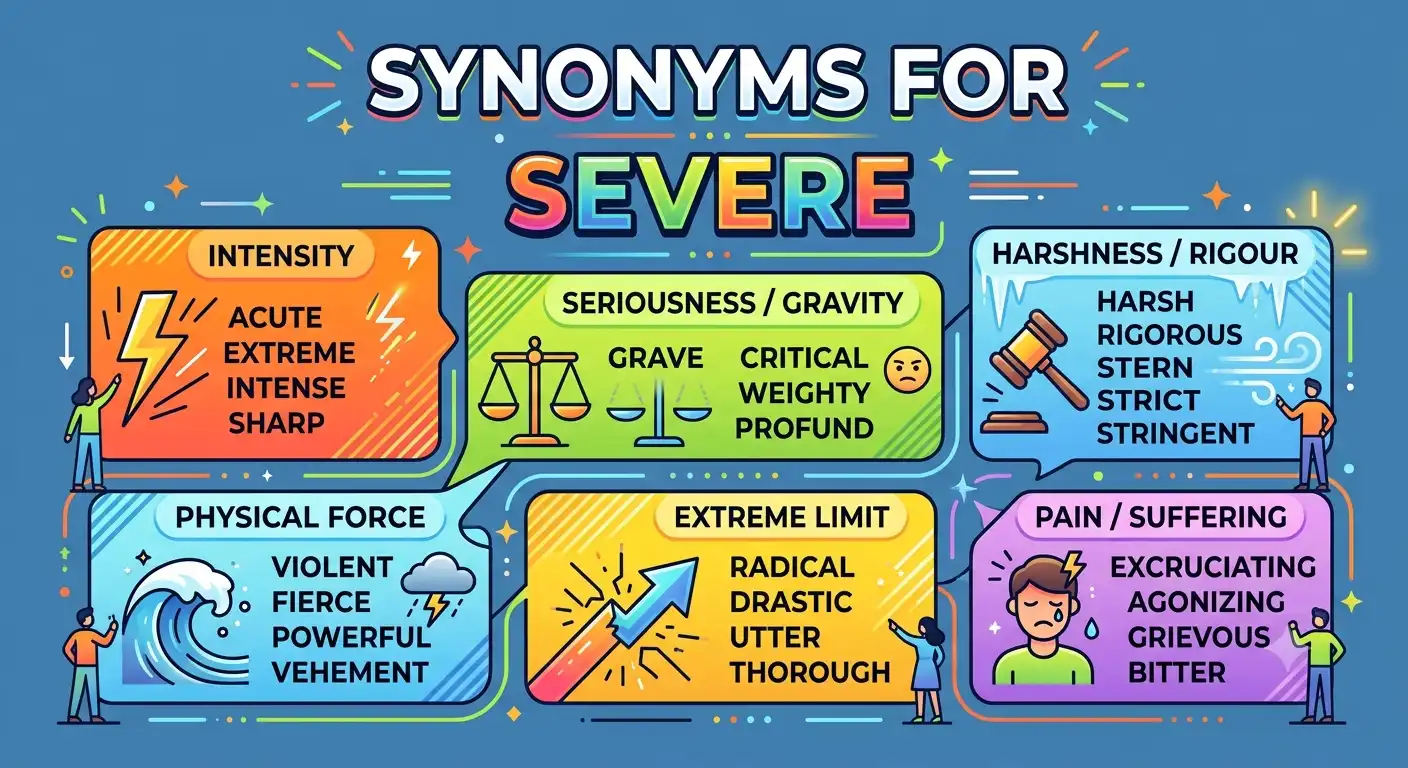
Finding clear synonyms for severe helps you pick exact words when writing about weather, rules, pain, or big problems. Learning synonyms for severe makes your writing stand out and helps you communicate with power. When you use varied synonyms for severe, your essays, blog posts, and daily talks become clear and interesting to everyone.
Picture a dark sky filled with heavy storm clouds, freezing wind, and heavy rain. You could just say the weather is severe, but choosing stronger synonyms for severe like harsh or inclement paints a much clearer picture. The word severe describes something very serious, strict, painful, or extreme.
Expanding your vocabulary around descriptive words helps in many ways:
- Students can write sharper essays for English and science classes.
- Bloggers can keep readers hooked with vivid descriptions.
- Content writers can craft clear articles that explain complex health or news topics easily.
- Daily English users can describe feelings, health issues, and weather with total accuracy.
“The right word at the right moment changes a simple sentence into a lasting message.”
“A precise word gives your thoughts the exact weight they deserve.”
Connotative Meaning of Severe
The word severe carries distinct emotional and situational tones:
- Positive Connotation: Precise, focused, clean, simple, or highly disciplined.
- Negative Connotation: Harsh, painful, cruel, dangerous, or unpleasantly strict.
- Neutral Connotation: Serious in degree, intense, or requiring urgent attention.
Etymology of Severe
- Origin: Middle French word sévère (strict or stern).
- Roots: Comes from Latin severus (serious, strict, or grave).
- Historical Context: First used in English during the 14th century to describe strict rules or stern teachers.
- Modern Evolution: Today, it describes harsh weather, serious illness, strict laws, or plain visual designs.
Pronunciation, Syllables, and Affixation Pattern
- US Pronunciation (IPA): /səˈvɪr/
- UK Pronunciation (IPA): /sɪˈvɪər/
- Syllable Count: 2 syllables (se-vere)
- Root Word: Severe
- Affixation Patterns:
- Prefixes: None on the root adjective; un- can form unsevere (uncommon).
- Suffixes:
- -ly (Severely – Adverb)
- -ity (Severity – Noun)
- -ness (Severeness – Noun)
Word Comparison Table
| Keyword | Meaning | Usage Type | Context |
| Severe | Very serious, harsh, or strict | General / Descriptive | Weather, medical conditions, strict rules |
| Acute | Sharp, sudden, and short-term | Medical / Technical | Health issues, sudden pain, sharp focus |
| Harsh | Unpleasantly rough or cruel | Casual / Descriptive | Climate, personal tone, strict discipline |
| Strict | Following rules very closely | Professional / Social | Parenting, school laws, work policies |
| Intense | Very strong or extreme | Emotional / Casual | Feelings, heat, exercise, colors |
| Grave | Extremely serious and alarming | Formal / Serious | Bad news, major danger, urgent events |
| Stern | Showing firm disapproval | Social / Personal | Expressions, teachers, parental feedback |
| Drastic | Likely to have a strong effect | Action / Planning | Big decisions, budget cuts, major changes |
50 Synonyms for Severe
1. Acute
- Pronunciation: US: /əˈkjuːt/ | UK: /əˈkjuːt/
- Meaning: A sharp or sudden issue that needs fast attention.
- Examples:
- She went to the hospital with acute stomach pain.
- The town faces an acute water shortage this summer.
2. Harsh
- Pronunciation: US: /hɑːrʃ/ | UK: /hɑːʃ/
- Meaning: Rough, cruel, or very uncomfortable to experience.
- Examples:
- The plants died during the harsh winter storm.
- He spoke in a harsh voice to stop the argument.
3. Strict
- Pronunciation: US: /strɪkt/ | UK: /strɪkt/
- Meaning: Demanding total obedience to rules without exception.
- Examples:
- Our library has strict rules about keeping quiet.
- The coach set a strict practice schedule for the team.
4. Intense
- Pronunciation: US: /ɪnˈtens/ | UK: /ɪnˈtens/
- Meaning: Extremely strong, deep, or powerful in feeling or force.
- Examples:
- Players felt intense heat during the afternoon match.
- She has an intense focus when solving math puzzles.
5. Serious
- Pronunciation: US: /ˈsɪr.i.əs/ | UK: /ˈsɪə.ri.əs/
- Meaning: Important, dangerous, or needing deep thought.
- Examples:
- A flat tire can cause a serious traffic delay.
- The doctor gave us serious advice about healthy food.
6. Grave
- Pronunciation: US: /ɡreɪv/ | UK: /ɡreɪv/
- Meaning: Full of danger or deeply worrying news.
- Examples:
- The leader faced a grave choice during the crisis.
- They spoke in grave tones about the storm damage.
7. Stern
- Pronunciation: US: /stɝːn/ | UK: /stɜːn/
- Meaning: Unsmiling and firm in discipline or attitude.
- Examples:
- The teacher gave the class a stern look.
- My father used a stern tone to warn us about safety.
8. Extreme
- Pronunciation: US: /ɪkˈstriːm/ | UK: /ɪkˈstriːm/
- Meaning: Very far beyond the normal level or limit.
- Examples:
- Runners must prepare carefully for extreme cold weather.
- The sports event tested their extreme physical strength.
9. Drastic
- Pronunciation: US: /ˈdræs.tɪk/ | UK: /ˈdræs.tɪk/
- Meaning: Taking strong or sudden action to solve a problem.
- Examples:
- The city made drastic changes to fix traffic jams.
- We took drastic steps to cut down energy bills.
10. Fierce
- Pronunciation: US: /fɪrs/ | UK: /fɪəs/
- Meaning: Powerful, wild, or showing great energy and force.
- Examples:
- A fierce wind blew leaves across the yard.
- The two teams fought a fierce battle for first place.
11. Heavy
- Pronunciation: US: /ˈhev.i/ | UK: /ˈhev.i/
- Meaning: Great in amount, force, weight, or seriousness.
- Examples:
- Drivers slowed down because of heavy snow on the road.
- The company suffered a heavy loss during the slow season.
12. Critical
- Pronunciation: US: /ˈkrɪt̬.ɪ.kəl/ | UK: /ˈkrɪt.ɪ.kəl/
- Meaning: At a dangerous turning point that requires immediate action.
- Examples:
- Doctors worked fast to help the patient in critical condition.
- Clean air is a critical need for every community.
13. Grievous
- Pronunciation: US: /ˈɡriː.vəs/ | UK: /ˈɡriː.vəs/
- Meaning: Causing great physical pain, sorrow, or damage.
- Examples:
- The accident caused grievous damage to both cars.
- They made a grievous error by ignoring the weather map.
14. Rigorous
- Pronunciation: US: /ˈrɪɡ.ɚ.əs/ | UK: /ˈrɪɡ.ər.əs/
- Meaning: Very thorough, precise, and demanding high standards.
- Examples:
- Pilots complete rigorous training before flying planes.
- Scientists perform rigorous tests on new medicines.
15. Unforgiving
- Pronunciation: US: /ˌʌn.fɚˈɡɪv.ɪŋ/ | UK: /ˌʌn.fəˈɡɪv.ɪŋ/
- Meaning: Offering no second chances or sympathy for mistakes.
- Examples:
- Desert lands present an unforgiving environment for travelers.
- The game is unforgiving if you drop your concentration.
16. Brutal
- Pronunciation: US: /ˈbruː.t̬əl/ | UK: /ˈbruː.təl/
- Meaning: Direct, harsh, and uncomfortable to endure.
- Examples:
- Marathon runners faced brutal summer heat today.
- His brutal honesty helped me fix my writing mistakes.
17. Savage
- Pronunciation: US: /ˈsæv.ɪdʒ/ | UK: /ˈsæv.ɪdʒ/
- Meaning: Wild, violent, and showing no gentle feelings.
- Examples:
- A savage storm destroyed the wooden fences.
- The wild waves made a savage attack on the beach.
18. Stringent
- Pronunciation: US: /ˈstrɪn.dʒənt/ | UK: /ˈstrɪn.dʒənt/
- Meaning: Extremely tight or strict, especially regarding safety rules.
- Examples:
- Food factories must follow stringent health standards.
- The government created stringent laws against dumping trash.
19. Austere
- Pronunciation: US: /ɑːˈstɪr/ | UK: /ɔːˈstɪər/
- Meaning: Plain, simple, and without any luxury or comfort.
- Examples:
- The monk lived a simple and austere life in the mountains.
- The bare room had an austere look with only one chair.
20. Inflexible
- Pronunciation: US: /ɪnˈflek.sə.bəl/ | UK: /ɪnˈflek.sə.bəl/
- Meaning: Unwilling to change or bend under any pressure.
- Examples:
- The manager remained inflexible about the deadline.
- Rules on airport safety stay inflexible for every passenger.
21. Grim
- Pronunciation: US: /ɡrɪm/ | UK: /ɡrɪm/
- Meaning: Unpleasant, dark, or showing little hope for good outcomes.
- Examples:
- News reports painted a grim picture of the flood zone.
- He wore a grim smile as he entered the tough meeting.
22. Profound
- Pronunciation: US: /prəˈfaʊnd/ | UK: /prəˈfaʊnd/
- Meaning: Very deep, strong, or felt with great intensity.
- Examples:
- The speaker had a profound effect on young students.
- She felt a profound sadness after her pet passed away.
23. Hard
- Pronunciation: US: /hɑːrd/ | UK: /hɑːd/
- Meaning: Difficult to bear, severe, or lacking softness.
- Examples:
- The family lived through a hard winter last year.
- Life on the frontier called for hard work every day.
24. Sharp
- Pronunciation: US: /ʃɑːrp/ | UK: /ʃɑːp/
- Meaning: Sudden, clear, piercing, or strong in effect.
- Examples:
- He felt a sharp pain in his knee after jumping.
- The city saw a sharp drop in temperatures overnight.
25. Bitter
- Pronunciation: US: /ˈbɪt̬.ɚ/ | UK: /ˈbɪt.ər/
- Meaning: Unpleasantly cold, angry, or painful to accept.
- Examples:
- Warm coats protected us from the bitter wind outside.
- The team felt bitter disappointment after losing the final.
26. Rough
- Pronunciation: US: /rʌf/ | UK: /rʌf/
- Meaning: Lacking gentleness, calm, or smoothness.
- Examples:
- Small boats struggled against rough ocean waves.
- We drove over a rough dirt road in the countryside.
27. Punishing
- Pronunciation: US: /ˈpʌn.ɪ.ʃɪŋ/ | UK: /ˈpʌn.ɪ.ʃɪŋ/
- Meaning: Extremely tiring, difficult, and physically demanding.
- Examples:
- Athletes completed a punishing workout before sunrise.
- The long hike up the mountain proved punishing for beginners.
28. Tough
- Pronunciation: US: /tʌf/ | UK: /tʌf/
- Meaning: Strong, difficult to deal with, or resistant to hardship.
- Examples:
- The boss had to make a tough business decision today.
- She showed a tough spirit during hard times.
29. Violent
- Pronunciation: US: /ˈvaɪ.ə.lənt/ | UK: /ˈvaɪ.ə.lənt/
- Meaning: Using or showing great force that can injure or break things.
- Examples:
- A violent storm knocked down electric power lines.
- The volcano erupted with violent explosions of ash.
30. Unsparing
- Pronunciation: US: /ʌnˈsper.ɪŋ/ | UK: /ʌnˈspeə.rɪŋ/
- Meaning: Giving no relief, mercy, or protection from harsh truth.
- Examples:
- The critic gave an unsparing review of the movie.
- The sun was unsparing on the shade-less desert trail.
“Choosing the perfect descriptive word brings your story to life for every reader.”
31. Solemn
- Pronunciation: US: /ˈsɑː.ləm/ | UK: /ˈsɒl.əm/
- Meaning: Very serious, quiet, and showing deep dignity.
- Examples:
- The crowd fell into solemn silence during the memorial.
- He made a solemn promise to help his family.
32. Rigid
- Pronunciation: US: /ˈrɪdʒ.ɪd/ | UK: /ˈrɪdʒ.ɪd/
- Meaning: Fixed in place and unwilling to flex or compromise.
- Examples:
- The school maintained a rigid dress code policy.
- Wooden beams provided a rigid frame for the roof.
33. Fiery
- Pronunciation: US: /ˈfaɪ.ɚ.i/ | UK: /ˈfaɪə.ri/
- Meaning: Full of strong emotion, heat, or burning speed.
- Examples:
- The lawyer made a fiery speech in defense of his client.
- We watched a fiery sunset paint the sky bright red.
34. Excessive
- Pronunciation: US: /ɪkˈses.ɪv/ | UK: /ɪkˈses.ɪv/
- Meaning: Way beyond what is normal, necessary, or proper.
- Examples:
- The machine broke due to excessive daily use.
- Drivers receive fines for excessive speed on highways.
35. Exacting
- Pronunciation: US: /ɪɡˈzæk.tɪŋ/ | UK: /ɪɡˈzæk.tɪŋ/
- Meaning: Requiring great care, skill, and effort to do right.
- Examples:
- Watchmaking is an exacting job that takes years to learn.
- The director has exacting standards for every scene.
36. Cutting
- Pronunciation: US: /ˈkʌt̬.ɪŋ/ | UK: /ˈkʌt.ɪŋ/
- Meaning: Hurtful, sharp, or piercing in effect or tone.
- Examples:
- She felt chilled by the cutting winter breeze.
- He regretted making a cutting remark to his friend.
37. Overwhelming
- Pronunciation: US: /ˌoʊ.vɚˈwel.mɪŋ/ | UK: /ˌəʊ.vəˈwel.mɪŋ/
- Meaning: So great or strong that it feels impossible to manage.
- Examples:
- The young team felt overwhelming joy after winning.
- Cleaning the huge house seemed like an overwhelming task.
38. Caustic
- Pronunciation: US: /ˈkɑː.stɪk/ | UK: /ˈkɔː.stɪk/
- Meaning: Burning, biting, or sharply critical in tone.
- Examples:
- His caustic humor hurt feelings during the meeting.
- Wear gloves to protect your hands from caustic chemicals.
39. Inclement
- Pronunciation: US: /ɪnˈklem.ənt/ | UK: /ɪnˈklem.ənt/
- Meaning: Cold, stormy, or unpleasantly bad weather conditions.
- Examples:
- Schools closed early due to inclement weather reports.
- The flight was delayed by inclement rain conditions.
40. Formidable
- Pronunciation: US: /ˈfɔːr.mɪ.də.bəl/ | UK: /fɔːˈmɪd.ə.bəl/
- Meaning: Inspiring fear or respect through being powerful or large.
- Examples:
- The champion faced a formidable challenger in the ring.
- Climbing Mount Everest remains a formidable task.
41. Devastating
- Pronunciation: US: /ˈdev.ə.steɪ.t̬ɪŋ/ | UK: /ˈdev.ə.steɪ.tɪŋ/
- Meaning: Causing total destruction, ruin, or massive emotional pain.
- Examples:
- The wildfire caused devastating damage to forest homes.
- They received devastating news about the cancelled flight.
42. Demanding
- Pronunciation: US: /dɪˈmæn.dɪŋ/ | UK: /dɪˈmɑːn.dɪŋ/
- Meaning: Needing a lot of time, energy, attention, or effort.
- Examples:
- Nursing is a demanding job that requires patience.
- The teacher assigned a demanding reading task for Friday.
43. Pitiless
- Pronunciation: US: /ˈpɪt̬.i.ləs/ | UK: /ˈpɪt.i.ləs/
- Meaning: Showing no sympathy, kindness, or mercy to others.
- Examples:
- Desert travelers struggled under the pitiless afternoon sun.
- The company showed a pitiless approach to budget cuts.
44. Relentless
- Pronunciation: US: /rɪˈlent.ləs/ | UK: /rɪˈlent.ləs/
- Meaning: Never stopping, slowing down, or yielding in effort.
- Examples:
- The rain was relentless for three whole days.
- Her relentless practice helped her win the music contest.
45. Intolerable
- Pronunciation: US: /ɪnˈtɑː.lər.ə.bəl/ | UK: /ɪnˈtɒl.ər.ə.bəl/
- Meaning: So bad, painful, or hard that it cannot be accepted.
- Examples:
- High noise levels created an intolerable work space.
- The toothache became intolerable during the night.
46. Uncompromising
- Pronunciation: US: /ʌnˈkɑːm.prə.maɪ.zɪŋ/ | UK: /ʌnˈkɒm.prə.maɪ.zɪŋ/
- Meaning: Unwilling to lower standards or yield to demands.
- Examples:
- The builder maintains uncompromising standards for safety.
- She showed an uncompromising attitude during negotiations.
47. Unyielding
- Pronunciation: US: /ʌnˈjiːl.dɪŋ/ | UK: /ʌnˈjiːl.dɪŋ/
- Meaning: Completely firm and impossible to bend or break.
- Examples:
- The fortress wall stood unyielding against heavy waves.
- He held an unyielding belief in honest work.
48. Painful
- Pronunciation: US: /ˈpeɪn.fəl/ | UK: /ˈpeɪn.fəl/
- Meaning: Causing physical hurt or deep emotional discomfort.
- Examples:
- Walking on a twisted ankle proved very painful.
- Saying goodbye to old friends is always a painful moment.
49. Dire
- Pronunciation: US: /ˈdaɪ.ɚ/ | UK: /ˈdaɪər/
- Meaning: Extremely serious, urgent, or terrible in nature.
- Examples:
- The drought created a dire need for fresh water.
- Ignoring safety warnings leads to dire results.
50. Urgent
- Pronunciation: US: /ˈɝː.dʒənt/ | UK: /ˈɜː.dʒənt/
- Meaning: Requiring immediate action or fast attention.
- Examples:
- The doctor sent an urgent message to the clinic.
- Firefighters responded to an urgent call downtown.
Antonyms of Severe
Learning opposite terms helps you show contrast clearly in descriptive writing:
- Mild: Gentle, moderate, or not severe in effect.
- Gentle: Soft, tender, and careful with others.
- Lenient: Easygoing and merciful when enforcing rules.
- Tolerable: Bearable or easy enough to endure.
- Slight: Very small in degree or amount.
- Forgiving: Allowing room for mistakes or easy to handle.
Prototype Meaning and Categorization of Severe
The core prototype meaning of severe is High Intensity, Extreme Strictness, Physical Pain, or Harsh Conditions.
Conceptual Categories:
- Weather & Environmental Conditions: Inclement, harsh, savage, bitter, brutal, rough.
- Rules, Laws & Standards: Strict, stringent, rigid, inflexible, uncompromising, exacting.
- Medical & Physical Conditions: Acute, critical, painful, grievous, intolerable, sharp.
- Tone & Human Demeanor: Stern, grave, solemn, unsparing, caustic, pitiless.
Frequently Asked Questions (FAQs)
1. What is the most common synonym for severe?
The most common everyday synonyms for severe are harsh, strict, serious, and intense.
2. What is the difference between “severe” and “acute”?
Severe describes high intensity or strictness in general. Acute specifically describes something sharp, critical, or fast-building, like sudden physical pain or an urgent emergency.
3. Which synonym for severe works best in professional or formal writing?
Words like stringent, exacting, critical, and grave fit best in academic papers, policy reports, and business documents.
4. Can “severe” describe a person’s appearance?
Yes! A severe look or style means plain, unadorned, simple, or stern-looking without extra details or warm expressions.
5. Why should writers learn different synonyms for severe?
Using varied synonyms for severe prevents boring repetition, clarifies your exact meaning, and helps readers picture the situation clearly.
6. Is “harsh” always identical to “severe”?
Not always. Harsh usually implies unpleasant roughness to the senses or feelings, while severe can also refer to clean, strict, or plain designs without negative intent.
Conclusion
Mastering a rich variety of synonyms for severe improves every sentence you write and speak. Swapping basic terms for precise words like inclement, stringent, acute, or exacting gives your language clarity and professional poise.
For students, using varied word choices creates persuasive essays that impress teachers in literature and social studies, bloggers and content writers, dynamic descriptive language captures reader attention, boosts search engine visibility, and keeps visitors reading longer, daily English users, building a strong vocabulary helps you describe medical symptoms, weather changes, and workplace standards with total ease.
Start practicing these descriptive words today:
- Use stringent or exacting in formal work reports and emails.
- Use inclement or bitter when writing weather updates or travel stories.
- Use acute or intense during daily talks to share exact feelings or health details.
“Clear and varied vocabulary unlocks better thinking and stronger human connection.”
“Every new word you master gives you another key to effective communication.”

Michael Turner is a published fiction writer and creative writing tutor with over a decade of experience helping writers find the words that make their stories breathe ( Biography ).