Finding clear synonyms for aura helps you pick exact words when describing someone’s personal energy, a room’s mood, or a special feeling. Learning synonyms for aura makes your writing stand out and helps you communicate with emotional clarity. When you use varied synonyms for aura, your essays, blog posts, and daily talks become lively and engaging for every reader.
Imagine walking into a quiet room and immediately feeling a warm, positive energy around a guest speaker. You could simply say they have a great aura, but choosing exact words like radiance or presence paints a much clearer picture. The word aura describes a special feeling, mood, or energy that surrounds a person, place, or thing.
Expanding your vocabulary around descriptive terms helps in many everyday ways:
- Students can write vivid essays for English and creative writing assignments.
- Bloggers can hook readers with rich descriptions of places and people.
- Content writers can craft memorable brand stories that connect with customers.
- Daily English users can describe feelings, social vibes, and personal style with confidence.
“The right word creates an instant connection between your mind and your reader.”
“Words carry energy, and choosing the right synonym gives that energy life.”
Connotative Meaning of Aura
The word aura carries several subtle emotional tones depending on how you use it:
- Positive Connotation: Charisma, warm energy, inner radiance, beauty, or magnetic appeal.
- Negative Connotation: A gloomy mood, cold distance, alarming vibe, or subtle sense of danger.
- Neutral Connotation: An atmosphere, general feeling, surrounding tone, or background mood.
Etymology of Aura
- Origin: Ancient Greek word aura (meaning breath, breeze, or gentle air).
- Latin Transition: Adopted into Latin as aura (meaning wind, gleam, or surrounding air).
- 18th–19th Century: Entered English to describe a distinct atmosphere surrounding a person or object.
- Modern Evolution: Today, it describes personal charm, spiritual energy, or social media confidence.
Pronunciation, Syllables, and Affixation Pattern
- US Pronunciation (IPA): /ˈɔːr.ə/
- UK Pronunciation (IPA): /ˈɔː.rə/
- Syllable Count: 2 syllables (au-ra)
- Root Word: Aura
- Affixation Patterns:
- Prefixes: None on the root noun.
- Suffixes:
- -ic (Auric – Adjective, relating to an aura)
- -less (Auraless – Slang, lacking personal energy or charm)
Word Comparison Table
| Keyword | Meaning | Usage Type | Context |
| Aura | A distinct quality or energy surrounding someone | General / Descriptive | Personal energy, places, spiritual feelings |
| Vibe | The emotional feeling a person or place gives | Casual / Modern | Social settings, friend groups, pop culture |
| Atmosphere | The general mood or feeling of a space | Descriptive / Formal | Rooms, events, nature, story settings |
| Presence | An impressive or noticeable personal quality | Professional / Social | Public speaking, leadership, stage performance |
| Radiance | A glowing quality of warmth, joy, or health | Emotional / Expressive | Smiles, healthy skin, happy personalities |
| Ambience | The background mood of a place | Formal / Commercial | Restaurants, hotels, music, design |
| Charisma | A special charm that attracts other people | Social / Professional | Leaders, actors, persuasive speakers |
| Mystique | A fascinating quality of mystery or secrets | Creative / Stylish | Fashion, mysterious characters, history |
50 Synonyms for Aura
1. Vibe
- Pronunciation: US: /vaɪb/ | UK: /vaɪb/
- Meaning: A simple emotional feeling that a person or place gives off.
- Examples:
- The new coffee shop has a warm and relaxed vibe.
- I picked up a friendly vibe from our new neighbor.
2. Atmosphere
- Pronunciation: US: /ˈæt.məs.fɪr/ | UK: /ˈæt.məs.fɪər/
- Meaning: The general mood or feeling inside a room or event.
- Examples:
- Soft music created a peaceful atmosphere in the restaurant.
- The stadium had an exciting atmosphere before the big game.
3. Presence
- Pronunciation: US: /ˈprez.əns/ | UK: /ˈprez.əns/
- Meaning: An impressive quality that makes people notice you right away.
- Examples:
- The teacher had a strong presence that kept the class quiet.
- Her calm presence made everyone feel safe during the storm.
4. Radiance
- Pronunciation: US: /ˈreɪ.di.əns/ | UK: /ˈreɪ.di.əns/
- Meaning: A bright glowing quality showing happiness, health, or beauty.
- Examples:
- The bride showed joyful radiance on her wedding day.
- Sunlight gave the garden a golden radiance in the morning.
5. Air
- Pronunciation: US: /er/ | UK: /eər/
- Meaning: A noticeable personal manner or mood that someone shows.
- Examples:
- He walked into the room with an air of total confidence.
- She carries a quiet air of kindness wherever she goes.
6. Ambience
- Pronunciation: US: /ˈæm.bi.əns/ | UK: /ˈæm.bi.əns/
- Meaning: The special tone, character, or background feel of a place.
- Examples:
- Dim lights gave the dinner party a cozy ambience.
- The hotel park offers a quiet ambience for resting.
7. Mood
- Pronunciation: US: /muːd/ | UK: /muːd/
- Meaning: The temporary feeling or emotional tone of a person or place.
- Examples:
- Bright colors put the whole office in a cheerful mood.
- Rainy weather set a quiet mood across the town.
8. Glow
- Pronunciation: US: /ɡloʊ/ | UK: /ɡləʊ/
- Meaning: A soft light or visible look of health, pride, or joy.
- Examples:
- Her face had a healthy glow after the long walk.
- Victory gave the young team a proud glow.
9. Charisma
- Pronunciation: US: /kəˈrɪz.mə/ | UK: /kəˈrɪz.mə/
- Meaning: A natural charm that attracts and inspires other people easily.
- Examples:
- The speaker used his charisma to win over the crowd.
- Her natural charisma helps her make friends quickly.
10. Energy
- Pronunciation: US: /ˈen.ɚ.dʒi/ | UK: /ˈen.ə.dʒi/
- Meaning: The active power or emotional feel coming from a person or group.
- Examples:
- Children brought bright energy into the quiet playground.
- I love the positive energy in this art class.
11. Spirit
- Pronunciation: US: /ˈspɪr.ət/ | UK: /ˈspɪr.ɪt/
- Meaning: The inner mood, attitude, or special feel of a person or place.
- Examples:
- The team played with great spirit until the final minute.
- Holiday decorations raised the festive spirit in our neighborhood.
12. Halo
- Pronunciation: US: /ˈheɪ.loʊ/ | UK: /ˈheɪ.ləʊ/
- Meaning: A circle of light or an impression of pure goodness around someone.
- Examples:
- Sunset clouds created a golden halo around the mountain peak.
- Her kind deeds gave her a halo of respect in town.
13. Tone
- Pronunciation: US: /toʊn/ | UK: /təʊn/
- Meaning: The general feeling, style, or main character of something.
- Examples:
- The manager set a professional tone for the business meeting.
- Bright paint colors gave the kitchen a happy tone.
14. Demeanor
- Pronunciation: US: /dɪˈmiː.nɚ/ | UK: /dɪˈmiː.nər/
- Meaning: The outward way a person behaves and presents themselves.
- Examples:
- The doctor kept a gentle demeanor while talking to patients.
- His polite demeanor made a good impression at work.
15. Feeling
- Pronunciation: US: /ˈfiː.lɪŋ/ | UK: /ˈfiː.lɪŋ/
- Meaning: An emotional impression created by a person, place, or event.
- Examples:
- The old house had a warm feeling of home.
- I got a strange feeling that someone was watching the door.
16. Impression
- Pronunciation: US: /ɪmˈpreʃ.ən/ | UK: /ɪmˈpreʃ.ən/
- Meaning: An idea or image left in the mind by a person or experience.
- Examples:
- Her clean speech made a strong impression on the judges.
- The quiet forest leaves a peaceful impression on visitors.
17. Character
- Pronunciation: US: /ˈker.ək.tɚ/ | UK: /ˈkær.ək.tər/
- Meaning: The distinctive nature or feel that belongs to a person or place.
- Examples:
- Stone streets give the old town its historic character.
- Honesty is an important part of her personal character.
18. Emanation
- Pronunciation: US: /ˌem.əˈneɪ.ʃən/ | UK: /ˌem.əˈneɪ.ʃən/
- Meaning: Something subtle, like a feeling or light, that flows out from a source.
- Examples:
- Warmth was a natural emanation from the wood stove.
- A sense of peace was an emanation from her quiet smile.
19. Resonance
- Pronunciation: US: /ˈrez.ən.əns/ | UK: /ˈrez.ən.əns/
- Meaning: A deep quality that evokes clear feelings or memories.
- Examples:
- The speech had a powerful resonance for every listener.
- Her story carried an emotional resonance that touched our hearts.
20. Charm
- Pronunciation: US: /tʃɑːrm/ | UK: /tʃɑːm/
- Meaning: A pleasing quality that delights and attracts other people.
- Examples:
- The small cottage has a lot of simple charm.
- His natural charm made the guests feel welcome.
21. Magnetism
- Pronunciation: US: /ˈmæɡ.nə.tɪ.zəm/ | UK: /ˈmæɡ.nə.tɪ.zəm/
- Meaning: A powerful personal appeal that draws people toward you.
- Examples:
- The actor used personal magnetism to hold audience attention.
- Her quiet magnetism made her a natural group leader.
22. Mystique
- Pronunciation: US: /mɪˈstiːk/ | UK: /mɪˈstiːk/
- Meaning: A special mystery or secret power surrounding a person or thing.
- Examples:
- The old castle holds an air of historical mystique.
- Masks gave the dancers an interesting mystique.
23. Bearing
- Pronunciation: US: /ˈber.ɪŋ/ | UK: /ˈbeə.rɪŋ/
- Meaning: The way a person stands, walks, and holds their body.
- Examples:
- The soldier showed a proud bearing during the ceremony.
- She carries a graceful bearing when she dances.
24. Climate
- Pronunciation: US: /ˈklaɪ.mət/ | UK: /ˈklaɪ.mət/
- Meaning: The general feeling, opinion, or mood in a group or place.
- Examples:
- Friendly talk created a positive climate in the classroom.
- Honest news builds a trusting climate in a town.
25. Vibrance
- Pronunciation: US: /ˈvaɪ.brəns/ | UK: /ˈvaɪ.brəns/
- Meaning: A lively quality full of energy, color, or excitement.
- Examples:
- Spring flowers brought vibrance back to the city park.
- Her speech showed the vibrance of young ideas.
26. Magic
- Pronunciation: US: /ˈmædʒ.ɪk/ | UK: /ˈmædʒ.ɪk/
- Meaning: A special power or charm that makes an event feel extraordinary.
- Examples:
- Sunset over the ocean created pure magic for travelers.
- Children loved the magic of holiday stories by the fire.
27. Luster
- Pronunciation: US: /ˈlʌs.tɚ/ | UK: /ˈlʌs.tər/
- Meaning: A soft shine or glow that makes something look bright and rich.
- Examples:
- Polishing brought back the shiny luster of the wood table.
- Good health adds a fresh luster to your hair.
28. Warmth
- Pronunciation: US: /wɔːrmθ/ | UK: /wɔːmθ/
- Meaning: A gentle feeling of friendliness, kindness, or affection.
- Examples:
- We felt the genuine warmth of their welcome.
- Her laughter added warmth to our family meal.
29. Persona
- Pronunciation: US: /pɚˈsoʊ.nə/ | UK: /pəˈsəʊ.nə/
- Meaning: The image or character a person presents to the public world.
- Examples:
- The performer created a joyful stage persona.
- He maintains a calm persona while handling tough work.
30. Prestige
- Pronunciation: US: /presˈtiːʒ/ | UK: /presˈtiːʒ/
- Meaning: High respect and admiration gained through status or success.
- Examples:
- Winning the prize added great prestige to her school.
- The old university carries high prestige across the country.
“Choosing precise descriptive words transforms simple thoughts into memorable stories.”
31. Mien
- Pronunciation: US: /miːn/ | UK: /miːn/
- Meaning: A person’s appearance or demeanor showing their mood or status.
- Examples:
- The judge maintained a dignified mien during court.
- He walked with a thoughtful mien down the hall.
32. Allure
- Pronunciation: US: /əˈlʊr/ | UK: /əˈljʊər/
- Meaning: A strong power of attraction or fascination.
- Examples:
- Big city lights hold an exciting allure for young artists.
- The mystery story has an irresistible allure for readers.
33. Essence
- Pronunciation: US: /ˈes.əns/ | UK: /ˈes.əns/
- Meaning: The basic, central quality that makes something what it is.
- Examples:
- Kindness is the true essence of her personality.
- Fresh flowers capture the true essence of spring.
34. Glamour
- Pronunciation: US: /ˈɡlæm.ɚ/ | UK: /ˈɡlæm.ər/
- Meaning: An attractive quality that makes someone or something seem special.
- Examples:
- The film festival brought movie glamour to our city.
- She loved the quiet glamour of vintage clothing.
35. Gravitas
- Pronunciation: US: /ˈɡræv.ə.tɑːs/ | UK: /ˈɡræv.ɪ.tæs/
- Meaning: A serious, dignified quality that commands deep respect.
- Examples:
- The leader spoke with natural gravitas during the news report.
- His deep voice added gravitas to the historical speech.
36. Vibration
- Pronunciation: US: /vaɪˈbreɪ.ʃən/ | UK: /vaɪˈbreɪ.ʃən/
- Meaning: A continuous emotional mood felt from a person or place.
- Examples:
- Happy music sent a good vibration through the room.
- Calm colors give the bedroom a peaceful vibration.
37. Intensity
- Pronunciation: US: /ɪnˈten.sə.t̬i/ | UK: /ɪnˈten.sə.ti/
- Meaning: A strong quality of deep focus, force, or passion.
- Examples:
- The athlete trained with great intensity before the race.
- Her eyes showed an impressive intensity during the debate.
38. Distinction
- Pronunciation: US: /dɪˈstɪŋk.ʃən/ | UK: /dɪˈstɪŋk.ʃən/
- Meaning: A special quality that makes someone stand out from others.
- Examples:
- He served the community with high honor and distinction.
- Unique windows give the building its special distinction.
39. Poise
- Pronunciation: US: /pɔɪz/ | UK: /pɔɪz/
- Meaning: A calm, controlled, and dignified way of moving or standing.
- Examples:
- The young dancer showed amazing poise on stage.
- She kept her poise under heavy questioning.
40. Dignity
- Pronunciation: US: /ˈdɪɡ.nə.t̬i/ | UK: /ˈdɪɡ.nə.ti/
- Meaning: A calm, serious manner that earns respect from other people.
- Examples:
- The elderly teacher treated everyone with calm dignity.
- They accepted the challenge with courage and dignity.
41. Spark
- Pronunciation: US: /spɑːrk/ | UK: /spɑːk/
- Meaning: A tiny, bright flash of energy, humor, or intelligence.
- Examples:
- Her quick joke added a fun spark to the lunch break.
- Curiosity lit a creative spark in the young student.
42. Scent
- Pronunciation: US: /sent/ | UK: /sent/
- Meaning: A subtle surrounding quality or trace left behind by something.
- Examples:
- Pine trees left a fresh scent across the mountain trail.
- Victory left a sweet scent of success over the team.
43. Sheen
- Pronunciation: US: /ʃiːn/ | UK: /ʃiːn/
- Meaning: A soft, smooth shine on a surface or appearance.
- Examples:
- Rain left a shiny sheen on the city streets tonight.
- Satin cloth has a smooth sheen under bright lights.
44. Touch
- Pronunciation: US: /tʌtʃ/ | UK: /tʌtʃ/
- Meaning: A small detail or subtle quality added to a situation.
- Examples:
- Fresh candles added a nice touch to the dinner table.
- A bit of humor gave his talk a warm touch.
45. Stature
- Pronunciation: US: /ˈstætʃ.ɚ/ | UK: /ˈstætʃ.ər/
- Meaning: High reputation or importance gained through ability or achievements.
- Examples:
- The scientist gained worldwide stature for her discovery.
- His professional stature made him a trusted mentor.
46. Coolness
- Pronunciation: US: /ˈkuːl.nəs/ | UK: /ˈkuːl.nəs/
- Meaning: A stylish, relaxed quality that seems effortless and popular.
- Examples:
- The musician plays guitar with effortless coolness.
- Modern designs bring a fresh coolness to the room.
47. Brightness
- Pronunciation: US: /ˈbraɪt.nəs/ | UK: /ˈbraɪt.nəs/
- Meaning: A clear, cheerful quality full of light or intelligence.
- Examples:
- Morning light brought brightness into the living room.
- Her quick mind adds brightness to group conversations.
48. Force
- Pronunciation: US: /fɔːrs/ | UK: /fɔːs/
- Meaning: A strong influence or noticeable power driving an effect.
- Examples:
- She is a positive force for good in our neighborhood.
- Teamwork was the main force behind our project success.
49. Stance
- Pronunciation: US: /stæns/ | UK: /stɑːns/
- Meaning: A clear attitude or posture taken toward a topic or situation.
- Examples:
- The school took a firm stance against playground bullying.
- His open stance showed he was ready to listen.
50. Airiness
- Pronunciation: US: /ˈer.i.nəs/ | UK: /ˈeə.ri.nəs/
- Meaning: A light, open, and delicate quality of space or mood.
- Examples:
- High ceilings give the new gallery a lovely airiness.
- Gentle music brought a feeling of airiness to the afternoon.
Antonyms of Aura
Learning opposite terms helps you highlight clear contrast when writing descriptions:
- Void: A complete lack of feeling, mood, or surrounding energy.
- Dullness: A flat, uninteresting state without charm or glow.
- Blandness: A boring quality that fails to leave any impression.
- Invisibility: The state of not being noticed or felt by others.
- Anonymity: Having no distinctive identity, charisma, or personal style.
- Lifelessness: Lacking spark, activity, movement, or emotional warmth.
Prototype Meaning and Categorization of Aura
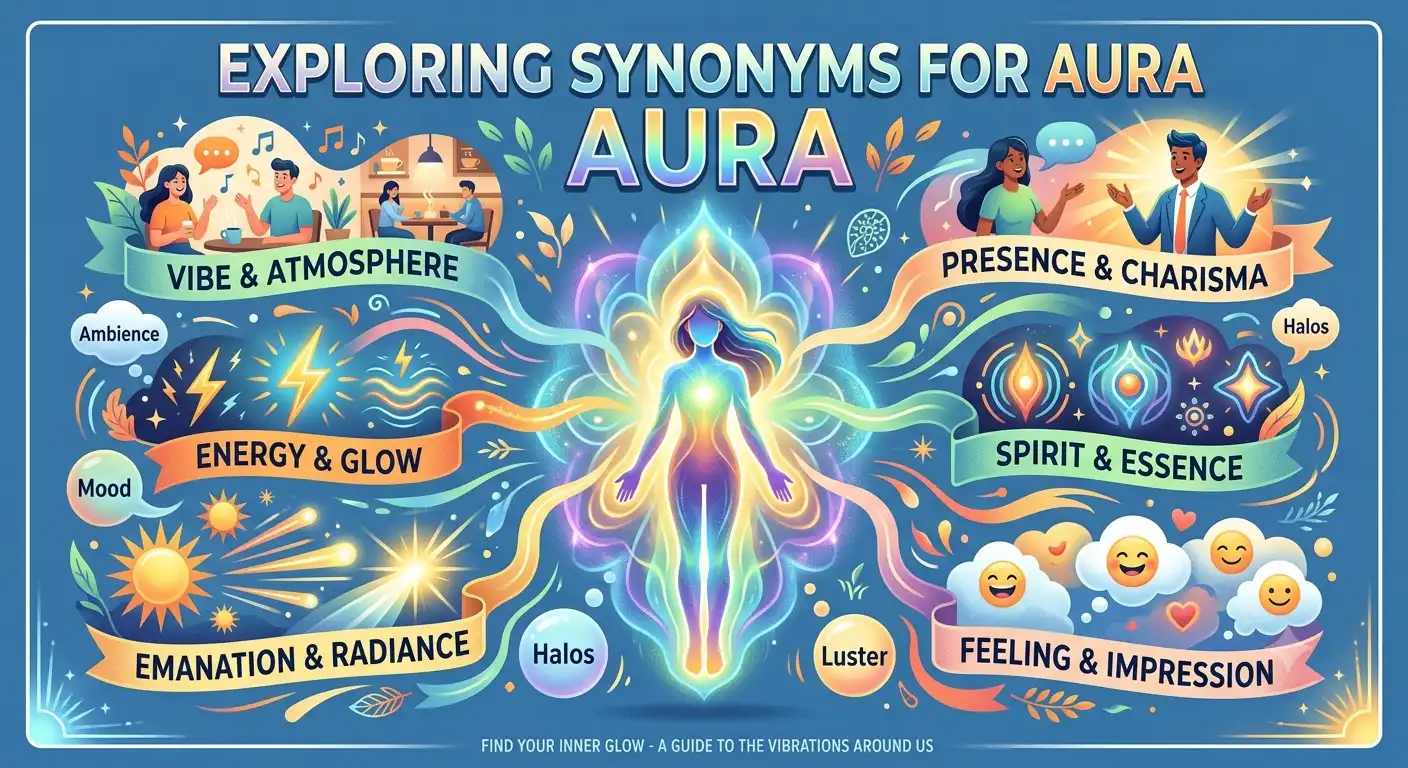
The core prototype meaning of aura is an invisible, distinctive quality or personal atmosphere that emanates from a person, place, or object.
Conceptual Categories:
- Personal Presence & Charisma: Presence, charisma, demeanor, poise, magnetism, persona, mien, gravitas.
- Environmental & Spatial Atmosphere: Atmosphere, ambience, vibe, mood, climate, tone, airiness.
- Mystical & Visual Energy: Radiance, glow, halo, luster, emanation, magic, mystique, sheen.
- Emotional Vibe & Feeling: Vibration, feeling, warmth, energy, spirit, resonance, allure, charm.
Frequently Asked Questions (FAQs)
1. What is the most common synonym for aura in daily speech?
The most popular casual synonyms for aura in daily speech are vibe, energy, mood, and presence.
2. Is “aura” used as modern slang?
Yes! In modern internet slang, aura refers to how cool, smooth, or impressive a person acts in social situations.
3. What is the difference between “aura” and “atmosphere”?
Aura usually describes the personal energy surrounding an individual. Atmosphere usually describes the collective feeling inside a physical room, location, or event.
4. Which synonym for aura works best in business or formal writing?
Words like presence, gravitas, demeanor, prestige, and stature fit best in business reports, resume summaries, and professional speeches.
5. Can a place have an aura?
Yes! Historic houses, serene gardens, ancient temples, and busy cities are often described as having a peaceful, eerie, or powerful aura.
6. Why should writers build a list of synonyms for aura?
Using different synonyms for aura helps you avoid repeating the same word, improves sentence flow, and paints vivid pictures for readers.
Conclusion
Mastering a rich set of synonyms for aura improves every sentence you write and speak. Swapping basic terms for precise words like radiance, ambience, presence, or mystique gives your language clarity, emotional depth, and polish.
For students, using varied vocabulary creates persuasive essays that impress English teachers and literature examiners, bloggers and content writers, descriptive words capture reader attention, build emotional connections, and keep visitors reading your articles longer, daily English users, expanding your word bank allows you to describe friends, workplaces, travel spots, and special moments with total ease.
Start using these descriptive words in your routine work:
- Use presence or gravitas in formal speeches and professional emails.
- Use ambience or vibe when writing travel posts or restaurant reviews.
- Use radiance or warmth in personal stories and casual conversations.
“A rich vocabulary gives you the power to describe the world exactly as you feel it.”
“Every new word you learn expands the horizon of your communication.”

Michael Turner is a published fiction writer and creative writing tutor with over a decade of experience helping writers find the words that make their stories breathe ( Biography ).