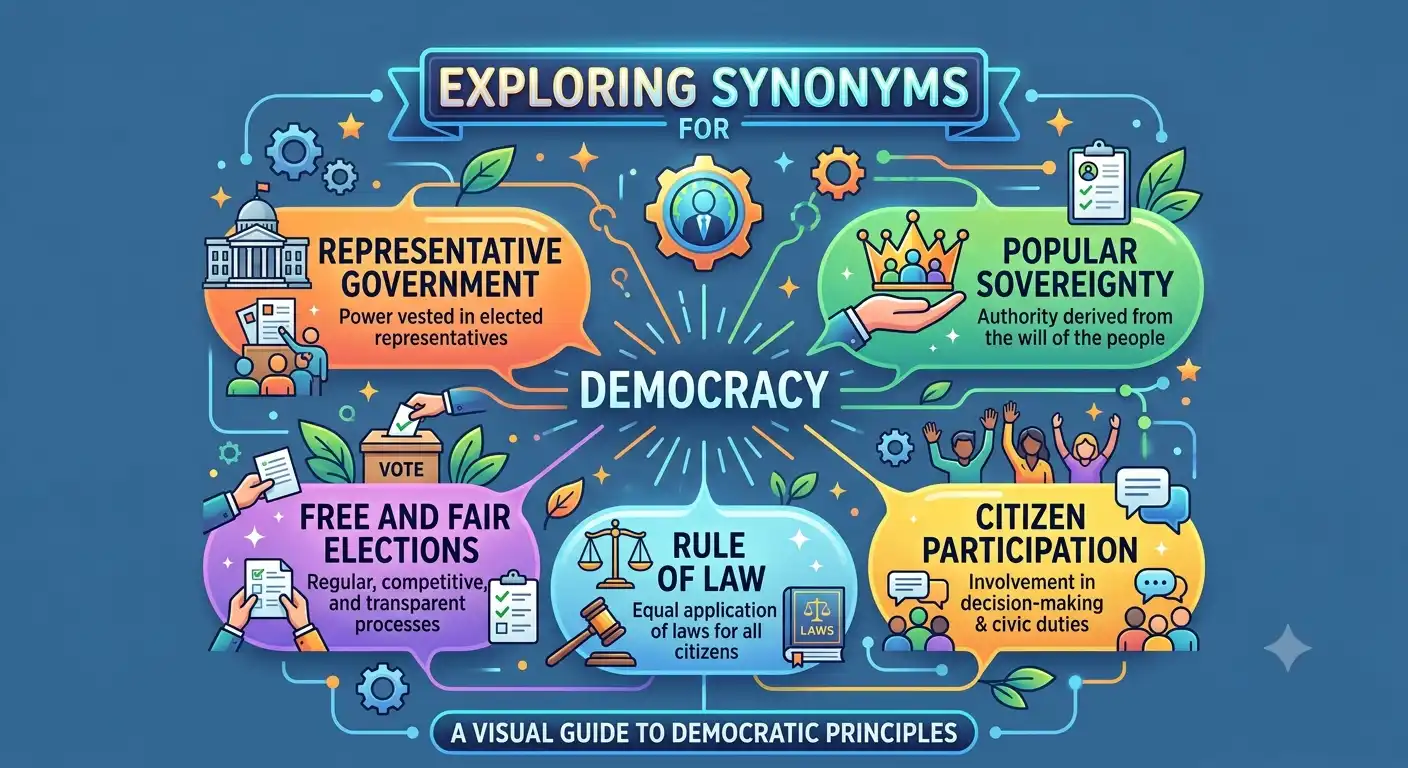
Finding synonyms for democracy helps you choose precise words when discussing freedom, government, and human rights. Using fresh synonyms for democracy makes your speeches, essays, and blog posts far more compelling and varied. Learning clear synonyms for democracy gives you the confidence to express important civic ideas with total clarity every day.
Imagine standing in a bustling town hall where citizens gather to cast their votes for local leaders. Everyone shares an equal voice, and every vote counts toward shaping the community’s future. That living system of equal power is what we call a democracy. A democracy is a system of government where power belongs to the people, either directly or through elected representatives.
Expanding your vocabulary around civic terms benefits many aspects of daily communication:
- Students can write strong social studies essays and earn top marks in political science classes.
- Bloggers can write engaging political commentaries that captivate readers from start to finish.
- Content writers can craft persuasive policy briefs and community articles that inspire positive action.
- Daily English users can speak clearly about current events and news topics during casual conversations.
“A strong vocabulary gives power and clarity to the voice of freedom.”
“Choosing the right word turns simple ideas into powerful movements.”
Connotative Meaning of Democracy
The word democracy carries deep social, political, and emotional meanings across different settings:
- Positive Connotation: Fairness, individual liberty, civil rights, justice, shared power, and equality.
- Negative Connotation: Slow decision-making, noisy debates, majoritarian pressure, or political conflict.
- Neutral Connotation: A standard system of voting, electoral governance, or constitutional framework.
Etymology of Democracy
- Origin: Middle French word démocratie (system of popular government).
- Roots: Derived from Late Latin democratia, coming from Greek demokratia (demos = people + kratos = rule/power).
- Historical Context: First used in ancient Athens around 500 BCE to describe direct voting by free citizens.
- Modern Evolution: Today, it describes free elections, human rights, civic participation, and representative republics.
Pronunciation, Syllables, and Affixation Pattern
- US Pronunciation (IPA): /dɪˈmɑː.krə.si/
- UK Pronunciation (IPA): /dɪˈmɒk.rə.si/
- Syllable Count: 4 syllables (de-moc-ra-cy)
- Root Word: Demo- (people) + -cracy (rule/government)
- Affixation Patterns:
- Prefixes: None on the root noun; non- can form non-democracy.
- Suffixes:
- -tic (Democratic – Adjective)
- -tically (Democratically – Adverb)
- -tize (Democratize – Verb)
- -tization (Democratization – Noun)
Word Comparison Table
| Keyword | Meaning | Usage Type | Context |
| Democracy | Rule by the people through voting | General / Civic | Elections, national governments, public rights |
| Republic | State led by elected representatives | Formal / Political | Constitutions, history books, nation-states |
| Self-government | Control of a group by its own members | Civic / Historical | Colonial history, local councils, community rules |
| Popular rule | Power held directly by the citizens | Political / Descriptive | Public debates, political science papers |
| Autonomy | The right of a group to govern itself | Formal / Academic | Regional governance, treaties, tribal lands |
| Egalitarianism | Believing all people deserve equal rights | Philosophical / Social | Human rights, social justice, ethics |
| Commonwealth | A state founded for the common good | Formal / Historical | State names, international unions, history |
| Pluralism | System where diverse groups share power | Academic / Political | Modern societies, policy discussions |
50 Synonyms for Democracy
1. Self-government
- Pronunciation: US: /ˌselfˈɡʌv.ɚn.mənt/ | UK: /ˌselfˈɡʌv.ən.mənt/
- Meaning: People making their own laws and choosing their own path without outside control.
- Examples:
- The island gained full self-government after years of hard work.
- Local citizens value their system of self-government.
2. Republic
- Pronunciation: US: /rɪˈpʌb.lɪk/ | UK: /rɪˈpʌb.lɪk/
- Meaning: A state ruled by elected representatives instead of a monarch.
- Examples:
- The nation became a peaceful republic after the big election.
- Our laws protect every citizen in this free republic.
3. Self-rule
- Pronunciation: US: /ˌselfˈruːl/ | UK: /ˌselfˈruːl/
- Meaning: Control of a country or region by its own citizens.
- Examples:
- The people celebrated their hard-won self-rule in the streets.
- True self-rule gives every person a real voice.
4. Popular sovereignty
- Pronunciation: US: /ˈpɑː.pjə.lɚ ˈsɑːv.rən.ti/ | UK: /ˈpɒp.jə.lər ˈsɒv.rɪn.ti/
- Meaning: The principle that ultimate power belongs to the voting public.
- Examples:
- The constitution protects popular sovereignty through free votes.
- Leaders must respect the core idea of popular sovereignty.
5. Popular rule
- Pronunciation: US: /ˈpɑː.pjə.lɚ ruːl/ | UK: /ˈpɒp.jə.lər ruːl/
- Meaning: Governance led directly by the wishes of the majority.
- Examples:
- The town operates under popular rule during annual meetings.
- History shows that popular rule brings stability.
6. Autonomy
- Pronunciation: US: /ɑːˈtɑː.nə.mi/ | UK: /ɔːˈtɒn.ə.mi/
- Meaning: The freedom of a community to manage its own affairs.
- Examples:
- The region requested greater autonomy over local tax funds.
- Teachers enjoy professional autonomy in their classrooms.
7. Representative government
- Pronunciation: US: /ˌrep.rɪˈzen.t̬ə.t̬ɪv ˈɡʌv.ɚn.mənt/ | UK: /ˌrep.rɪˈzen.tə.tɪv ˈɡʌv.ən.mənt/
- Meaning: A system where leaders are elected to make laws for everyone.
- Examples:
- A strong representative government relies on honest votes.
- We studied the history of representative government today.
8. Constitutional government
- Pronunciation: US: /ˌkɑːn.stəˈtuː.ʃən.əl ˈɡʌv.ɚn.mənt/ | UK: /ˌkɒn.stɪˈtjuː.ʃən.əl ˈɡʌv.ən.mənt/
- Meaning: Governance guided and limited by a written set of basic rules.
- Examples:
- Peace remains stable under a clear constitutional government.
- The courts guard the rules of our constitutional government.
9. Free state
- Pronunciation: US: /friː steɪt/ | UK: /friː steɪt/
- Meaning: An independent nation governed by choice and equal rights.
- Examples:
- Citizens take pride in living inside a free state.
- Every free state guards the open speech of its people.
10. Egalitarianism
- Pronunciation: US: /ɪˌɡæl.əˈter.i.ə.nɪz.əm/ | UK: /ɪˌɡæl.ɪˈteə.ri.ə.nɪz.əm/
- Meaning: The belief that all individuals deserve equal rights and status.
- Examples:
- The movement promotes egalitarianism across all workplaces.
- True egalitarianism creates fair options for young students.
11. Pluralism
- Pronunciation: US: /ˈplʊr.əl.ɪz.əm/ | UK: /ˈplʊə.rəl.ɪz.əm/
- Meaning: A society where diverse views and backgrounds exist together peacefully.
- Examples:
- Cultural pluralism enriches the spirit of our nation.
- The city thrives on open exchange and pluralism.
12. Commonwealth
- Pronunciation: US: /ˈkɑː.mən.welθ/ | UK: /ˈkɒm.ən.welθ/
- Meaning: An independent community organized for the common good of all.
- Examples:
- The leaders worked to strengthen the prosperity of the commonwealth.
- Citizens built new roads across the entire commonwealth.
13. Direct democracy
- Pronunciation: US: /dɪˈrekt dɪˈmɑː.krə.si/ | UK: /daɪˈrekt dɪˈmɒk.rə.si/
- Meaning: A system where citizens vote directly on laws rather than picking leaders.
- Examples:
- Ancient Athens practiced direct democracy in public squares.
- The town uses direct democracy to approve yearly budgets.
14. Liberal democracy
- Pronunciation: US: /ˈlɪb.ər.əl dɪˈmɑː.krə.si/ | UK: /ˈlɪb.ər.əl dɪˈmɒk.rə.si/
- Meaning: A government combining representative voting with personal rights protection.
- Examples:
- Free press remains a vital pillar of liberal democracy.
- Courts ensure that liberal democracy protects every group.
15. Participatory democracy
- Pronunciation: US: /pɑːrˌtɪs.ə.pəˈtɔːr.i dɪˈmɑː.krə.si/ | UK: /pɑːˈtɪs.ɪ.pə.tər.i dɪˈmɒk.rə.si/
- Meaning: A system encouraging direct civic action and public involvement.
- Examples:
- Community gardens thrive under participatory democracy.
- The city council opened a portal for participatory democracy.
16. Rule of the people
- Pronunciation: US: /ruːl ʌv ðə ˈpiː.pəl/ | UK: /ruːl ɒv ðə ˈpiː.pəl/
- Meaning: Governance driven by the collective choices of the public.
- Examples:
- Elections demonstrate the power of the rule of the people.
- True political freedom rests on the rule of the people.
17. Civil society
- Pronunciation: US: /ˈsɪv.əl səˈsaɪ.ə.t̬i/ | UK: /ˈsɪv.əl səˈsaɪ.ə.ti/
- Meaning: Organizations and public spaces operating outside government control.
- Examples:
- Active groups within civil society help solve local needs.
- A vibrant civil society keeps public leaders accountable.
18. Home rule
- Pronunciation: US: /hoʊm ruːl/ | UK: /həʊm ruːl/
- Meaning: Local control over local matters granted to a city or county.
- Examples:
- The state granted full home rule to the growing city.
- Residents voted for home rule to manage local parks.
“True freedom is found when every voice helps guide the path ahead.”
19. Open society
- Pronunciation: US: /ˈoʊ.pən səˈsaɪ.ə.t̬i/ | UK: /ˈəʊ.pən səˈsaɪ.ə.ti/
- Meaning: A community with free flow of information, rights, and open speech.
- Examples:
- An open society respects debate and fresh scientific ideas.
- Citizens protect their open society through honest dialogue.
20. Self-determination
- Pronunciation: US: /ˌself.dɪˌtɝː.məˈneɪ.ʃən/ | UK: /ˌself.dɪˌtɜː.mɪˈneɪ.ʃən/
- Meaning: The power of a nation to choose its own political status.
- Examples:
- The treaty honored the self-determination of all borders.
- Peaceful choices support national self-determination.
21. Majoritarianism
- Pronunciation: US: /məˌdʒɔːr.əˈter.i.ə.nɪz.əm/ | UK: /məˌdʒɒr.ɪˈteə.ri.ə.nɪz.əm/
- Meaning: Governance where decisions reflect the choice of the numerical majority.
- Examples:
- Fair laws balance majoritarianism with basic human rights.
- The committee voted under standard majoritarianism.
22. Enfranchisement
- Pronunciation: US: /ɪnˈfræn.tʃaɪz.mənt/ | UK: /ɪnˈfræn.tʃaɪz.mənt/
- Meaning: Giving people the legal right to vote in elections.
- Examples:
- Universal enfranchisement marked a huge leap in history.
- The law secured complete enfranchisement for all voters.
23. Suffrage
- Pronunciation: US: /ˈsʌf.rɪdʒ/ | UK: /ˈsʌf.rɪdʒ/
- Meaning: The constitutional right to cast a vote in public elections.
- Examples:
- Courageous activists fought tirelessly for women’s suffrage.
- Youth suffrage remains an important topic in politics.
24. Free governance
- Pronunciation: US: /friː ˈɡʌv.ɚ.nəns/ | UK: /friː ˈɡʌv.ə.nəns/
- Meaning: Leadership operating with openness, fairness, and public trust.
- Examples:
- Clear transparency remains essential for free governance.
- Towns prosper under steady and fair free governance.
25. Civic rule
- Pronunciation: US: /ˈsɪv.ɪk ruːl/ | UK: /ˈsɪv.ɪk ruːl/
- Meaning: Governance managed by civic duty and public cooperation.
- Examples:
- Respectful debates keep civic rule healthy and effective.
- Volunteers play a vital part in maintaining civic rule.
26. Voice of the people
- Pronunciation: US: /vɔɪs ʌv ðə ˈpiː.pəl/ | UK: /vɔɪs ɒv ðə ˈpiː.pəl/
- Meaning: The combined public opinion expressed through elections.
- Examples:
- Leaders must listen carefully to the voice of the people.
- The election outcome revealed the clear voice of the people.
27. Constitutional republic
- Pronunciation: US: /ˌkɑːn.stəˈtuː.ʃən.əl rɪˈpʌb.lɪk/ | UK: /ˌkɒn.stɪˈtjuː.ʃən.əl rɪˈpʌb.lɪk/
- Meaning: A republic where power is limited by official constitutional law.
- Examples:
- Our nation operates as a strong constitutional republic.
- Rights are protected inside a stable constitutional republic.
28. Public governance
- Pronunciation: US: /ˈpʌb.lɪk ˈɡʌv.ɚ.nəns/ | UK: /ˈpʌb.lɪk ˈɡʌv.ə.nəns/
- Meaning: The management of public affairs through open state institutions.
- Examples:
- Digital tools have updated modern public governance.
- Good public governance ensures clean water and safe roads.
29. Electoral system
- Pronunciation: US: /iˈlek.tɚ.əl ˈsɪs.təm/ | UK: /iˈlek.tər.əl ˈsɪs.təm/
- Meaning: The set of rules that structure how citizens cast votes.
- Examples:
- Reformers suggested updates to the national electoral system.
- Voters trust a secure and clear electoral system.
30. Democratic state
- Pronunciation: US: /ˌdem.əˈkræt̬.ɪk steɪt/ | UK: /ˌdem.əˈkræt.ɪk steɪt/
- Meaning: A nation defined by democratic institutions and individual freedoms.
- Examples:
- Freedom of speech thrives within every democratic state.
- Economic growth often increases inside a democratic state.
31. Popular control
- Pronunciation: US: /ˈpɑː.pjə.lɚ kənˈtroʊl/ | UK: /ˈpɒp.jə.lər kənˈtrəʊl/
- Meaning: Oversight of public leaders maintained by regular citizens.
- Examples:
- Regular elections maintain direct popular control of tax spending.
- Public audits preserve popular control over city projects.
32. Popular government
- Pronunciation: US: /ˈpɑː.pjə.lɚ ˈɡʌv.ɚn.mənt/ | UK: /ˈpɒp.jə.lər ˈɡʌv.ən.mənt/
- Meaning: Governance resting upon the approval and mandate of citizens.
- Examples:
- Peaceful societies thrive under steady popular government.
- The constitution guarantees a true popular government.
33. Open government
- Pronunciation: US: /ˈoʊ.pən ˈɡʌv.ɚn.mənt/ | UK: /ˈəʊ.pən ˈɡʌv.ən.mənt/
- Meaning: Governance where documents and decisions are transparent to all.
- Examples:
- The mayor supported open government by posting budget files online.
- Public trust increases under open government practices.
34. Decentralization
- Pronunciation: US: /diːˌsen.trə.ləˈzeɪ.ʃən/ | UK: /diːˌsen.trə.laɪˈzeɪ.ʃən/
- Meaning: Spreading authority away from one center out to local areas.
- Examples:
- Power decentralization helped regional towns build better schools.
- The state improved services through smart decentralization.
35. Inclusive rule
- Pronunciation: US: /ɪnˈkluː.sɪv ruːl/ | UK: /ɪnˈkluː.sɪv ruːl/
- Meaning: Governance that invites participation from every social group.
- Examples:
- The new board adopted inclusive rule for all members.
- Progress relies on inclusive rule in diverse cities.
36. Parliamentary rule
- Pronunciation: US: /ˌpɑːr.ləˈmen.t̬ɚ.i ruːl/ | UK: /ˌpɑː.lɪˈmen.tr.i ruːl/
- Meaning: Government led by an elected parliament and prime minister.
- Examples:
- The nation adopted parliamentary rule after gaining freedom.
- Laws are debated openly under parliamentary rule.
37. Federation
- Pronunciation: US: /ˌfed.əˈreɪ.ʃən/ | UK: /ˌfed.əˈreɪ.ʃən/
- Meaning: A group of states bound together under one shared government.
- Examples:
- The states formed a united federation to build defense lines.
- Trade expanded across every province in the federation.
38. Folkmoot
- Pronunciation: US: /ˈfoʊk.muːt/ | UK: /ˈfəʊk.muːt/
- Meaning: An ancient general assembly of citizens to make local laws.
- Examples:
- Elders gathered the villagers at the annual folkmoot.
- History records the early folkmoot as a root of voting.
39. Civic democracy
- Pronunciation: US: /ˈsɪv.ɪk dɪˈmɑː.krə.si/ | UK: /ˈsɪv.ɪk dɪˈmɒk.rə.si/
- Meaning: Participation based on civic rights and shared public duties.
- Examples:
- Voting in local elections is the heart of civic democracy.
- Schools teach students about the values of civic democracy.
40. Equalitarian rule
- Pronunciation: US: /iˌkwɑː.ləˈter.i.ən ruːl/ | UK: /iˌkwɒl.ɪˈteə.ri.ən ruːl/
- Meaning: System where every citizen enjoys identical legal power.
- Examples:
- The community operated under strict equalitarian rule.
- Fair courts are needed to maintain equalitarian rule.
41. Constitutionalism
- Pronunciation: US: /ˌkɑːn.stəˈtuː.ʃən.əl.ɪz.əm/ | UK: /ˌkɒn.stɪˈtjuː.ʃən.əl.ɪz.əm/
- Meaning: Adherence to constitutional principles over arbitrary authority.
- Examples:
- Legal scholars defend constitutionalism during political disputes.
- Stability grows when leaders honor true constitutionalism.
42. Majority rule
- Pronunciation: US: /məˈdʒɔːr.ə.t̬i ruːl/ | UK: /məˈdʒɒr.ə.ti ruːl/
- Meaning: A voting principle where the choice with most votes wins.
- Examples:
- The club agreed to pass motions by simple majority rule.
- Protecting minority rights remains crucial under majority rule.
43. Popular franchise
- Pronunciation: US: /ˈpɑː.pjə.lɚ ˈfræn.tʃaɪz/ | UK: /ˈpɒp.jə.lər ˈfræn.tʃaɪz/
- Meaning: The extension of voting privileges to the entire adult population.
- Examples:
- The reform expanded the popular franchise across the land.
- Every adult gains a voice through the popular franchise.
44. Social democracy
- Pronunciation: US: /ˈsoʊ.ʃəl dɪˈmɑː.krə.si/ | UK: /ˈsəʊ.ʃəl dɪˈmɒk.rə.si/
- Meaning: A policy model blending democratic rule with public welfare support.
- Examples:
- Nordic countries are famous for their model of social democracy.
- Free public healthcare is a key feature of social democracy.
45. Free society
- Pronunciation: US: /friː səˈsaɪ.ə.t̬i/ | UK: /friː səˈsaɪ.ə.ti/
- Meaning: A nation where individuals live with minimal government interference.
- Examples:
- Open dialogue defines life inside a free society.
- Citizens in a free society build innovative local projects.
46. Civic liberty
- Pronunciation: US: /ˈsɪv.ɪk ˈlɪb.ɚ.t̬i/ | UK: /ˈsɪv.ɪk ˈlɪb.ə.ti/
- Meaning: Personal rights secured against unlawful state overreach.
- Examples:
- The judge protected the civic liberty of the writer.
- Protecting civic liberty remains a top duty of courts.
47. Representative rule
- Pronunciation: US: /ˌrep.rɪˈzen.t̬ə.t̬ɪv ruːl/ | UK: /ˌrep.rɪˈzen.tə.tɪv ruːl/
- Meaning: Governance performed through delegates chosen by citizens.
- Examples:
- Our state laws are drafted through representative rule.
- Regular elections ensure that representative rule stays fair.
48. Democratic governance
- Pronunciation: US: /ˌdem.əˈkræt̬.ɪk ˈɡʌv.ɚ.nəns/ | UK: /ˌdem.əˈkræt.ɪk ˈɡʌv.ə.nəns/
- Meaning: Managing a state through democratic ethics and fair practices.
- Examples:
- International agencies support democratic governance globally.
- Clear public records strengthen democratic governance.
49. Public representation
- Pronunciation: US: /ˈpʌb.lɪk ˌrep.rɪ.zenˈteɪ.ʃən/ | UK: /ˈpɒb.lɪk ˌrep.rɪ.zenˈteɪ.ʃən/
- Meaning: The presence of delegates speaking for community interests.
- Examples:
- Rural towns asked for better public representation in congress.
- Fair district maps ensure proper public representation.
50. Self-governing state
- Pronunciation: US: /ˌself.ɡʌv.ɚ.nɪŋ steɪt/ | UK: /ˌself.ɡʌv.ə.nɪŋ steɪt/
- Meaning: A sovereign territory managing its laws without foreign rule.
- Examples:
- The territory declared itself an independent, self-governing state.
- People worked together to establish a stable self-governing state.
Antonyms of Democracy
Understanding opposite terms helps you highlight exact political contrasts in analytical writing:
- Autocracy: A system of government by one person with absolute power.
- Dictatorship: Rule by an un-elected leader who holds total authority.
- Totalitarianism: A government that controls every part of public and private life.
- Monarchy: Rule by a king, queen, or royal family line.
- Tyranny: Cruel, oppressive, or arbitrary exercise of power by a single ruler.
- Authoritarianism: A strict system favoring total obedience over individual freedom.
Prototype Meaning and Categorization of Democracy
The core prototype meaning of democracy is People-Power, Fair Elections, Equal Rights, and Civic Participation.
Conceptual Categories:
- Representative & Constitutional Frameworks: Republic, representative government, constitutional republic, parliamentary rule, constitutionalism.
- Direct & Popular Systems: Direct democracy, popular rule, self-government, self-rule, popular sovereignty, folkmoot.
- Values & Rights Foundations: Egalitarianism, pluralism, suffrage, enfranchisement, civic liberty, open society.
- Administrative & Regional Models: Autonomy, home rule, decentralization, federation, social democracy.
Frequently Asked Questions (FAQs)
1. What is the most common synonym for democracy?
The most common everyday synonyms for democracy are republic, self-government, popular rule, and self-rule.
2. Is a “republic” the exact same thing as a “democracy”?
Not strictly. A democracy means rule by the people, while a republic specifically means governance by elected representatives rather than a monarch. Most modern democratic countries are constitutional republics.
3. Which synonym for democracy works best in academic writing?
Words like representative government, popular sovereignty, constitutionalism, and pluralism work best in formal essays and academic papers.
4. How does “autonomy” differ from “democracy”?
Democracy refers to how decisions are made (by equal voting). Autonomy refers to a region or group having the freedom to govern itself independently.
5. Why should writers learn different synonyms for democracy?
Using varied synonyms for democracy prevents repetitive phrasing in political essays, keeps readers interested, and expresses exact nuances of governance.
6. Can “egalitarianism” be used as a synonym for democracy?
Yes, in social contexts! Egalitarianism focuses on the core moral principle of total human equality, which forms the ideological basis of any true democracy.
Conclusion
Mastering a diverse range of synonyms for democracy significantly strengthens your written and spoken expression. Replacing overused terms with sharp options like popular sovereignty, republic, civic liberty, or autonomy brings sharp clarity and professional elegance to your work.
For students, using varied vocabulary builds convincing essay arguments that impress teachers in civics and history classes, bloggers and content writers, fresh political terminology engages audience attention, builds authority, and increases time spent on your site, daily English users, expanding your word choices allows you to discuss news, rights, and world events with complete confidence.
Start applying these effective terms today:
- Use representative government or constitutional republic in academic papers and formal reports.
- Use self-rule or autonomy when crafting creative historical stories or opinion blogs.
- Use republic or popular vote during daily conversations, news debates, and civic discussions.
“Clear words illuminate the principles that preserve human freedom.”
“A rich vocabulary empowers citizens to speak truth with strength.”

Michael Turner is a published fiction writer and creative writing tutor with over a decade of experience helping writers find the words that make their stories breathe ( Biography ).