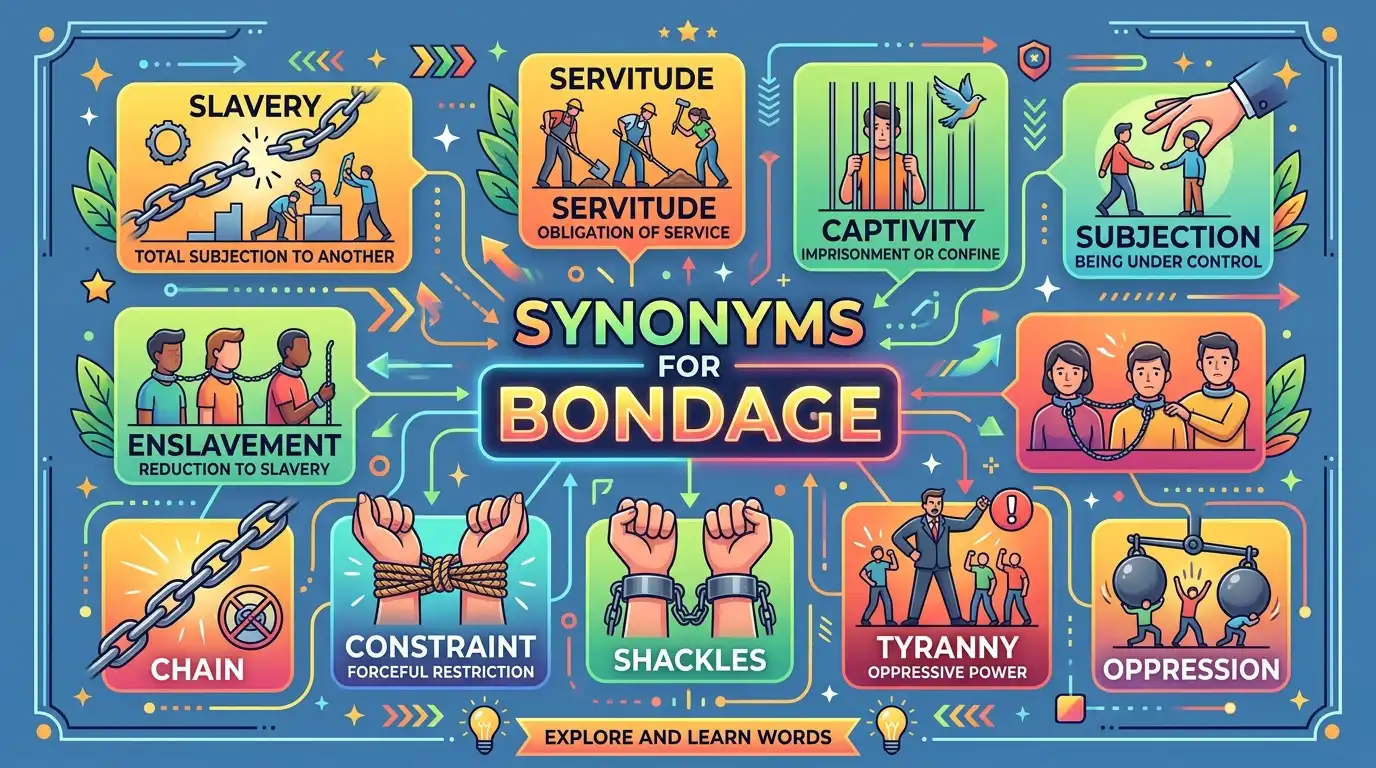
Learning synonyms for bondage helps you find the exact word for physical, emotional, historical, or legal restraint. Understanding synonyms for bondage improves your vocabulary so you can write clearer essays, stories, and articles. Exploring synonyms for bondage shows you how words carry different feelings, from total loss of freedom to voluntary contractual agreements.
Imagine reading a historical novel where every chapter uses the exact same word for captive state. The story quickly becomes repetitive and boring. By choosing precise words like servitude, restraint, or subjugation, you bring vivid picture clarity to your writing. A student writing a history paper on ancient civilizations needs precise terms like serfdom or thrall, while a modern legal blog writer might need terms like contractual obligation or indenture.
For students, learning these vocabulary variations improves test scores and reading comprehension. For bloggers and content writers, using varied semantic terms improves search rankings and reader engagement, daily English users, knowing these distinctions prevents awkward miscommunications in everyday speech.
“Words are the levers of power; using the exact term unlocks true clarity in human expression.”
“Freedom of mind begins with the freedom to choose the right words.”
Connotative Meaning, Etymology, and Phonetics of Bondage
Connotative Meaning
- Literal / Historical: Physical imprisonment, loss of freedom, slavery, chains, and physical restraints.
- Figurative / Psychological: Emotional weight, bad habits, oppressive fear, or heavy mental burdens.
- Legal / Historical Context: Unpaid labor agreements, indentured contracts, or legal debts.
- Modern Consensual Context: Voluntary adult restraint play or rope art (BDSM / Shibari).
Etymology (Origin)
- Root Word: Old English bonda (householder or tenant farmer, bound to the soil).
- Middle English Shift: Merged with bond (unfree worker, pledge, or physical tie).
- Suffix: -age (denoting a condition, state, or ongoing relation).
- Historical Evolution: Shifted from “holding land under contract” to “a state of involuntary slavery or complete restraint.”
Pronunciation (IPA)
- US IPA: /ˈbɑːn.dɪdʒ/
- UK IPA: /ˈbɒn.dɪdʒ/
Syllables and Affixation Pattern
- Syllables: 2 syllables (bon·dage).
- Base Form: Bond (verb/noun).
- Affixation: Root bond + Suffix -age (Noun-forming suffix indicating state or action).
Comparison Table of Key Synonyms for Bondage
| Keyword / Synonym | Meaning | Usage Type | Context |
| Slavery | Absolute ownership of one person by another | Historical / Formal | History, human rights, law |
| Servitude | The condition of being a slave or forced worker | Formal / Literary | Social studies, history |
| Captivity | The state of being trapped or held prisoner | General / Casual | Animals, war prisoners, stories |
| Restraint | A measure or device that keeps something under control | Professional / General | Medical, law, safety, modern adult |
| Subjugation | The act of bringing someone under total control | Academic / Political | War history, government control |
| Imprisonment | Being locked in a prison or enclosed space | Formal / Legal | Legal cases, justice system |
| Confinement | Being kept inside a limited space | General / Medical | Healthcare, home rest, isolation |
| Indenture | A legal agreement binding one person to work for another | Historical / Legal | Labor history, contracts |
| Oppression | Prolonged cruel or unjust treatment | Social / Political | Sociology, political speeches |
| Yoke | A heavy wooden bar put on working animals; a figurative burden | Literary / Figurative | Religion, metaphor, classic books |
50 Synonyms for Bondage
1. Slavery
- Pronunciation: US: /ˈsleɪ.vɚ.i/ | UK: /ˈsleɪ.vər.i/
- Meaning: The condition in which one person is owned by another person.
- Examples:
- The museum showed the painful history of human slavery.
- Millions of people fought together to abolish slavery.
2. Servitude
- Pronunciation: US: /ˈsɝː.və.tuːd/ | UK: /ˈsɜː.vɪ.tjuːd/
- Meaning: The state of being forced to work for someone else without pay or freedom.
- Examples:
- He escaped a life of forced domestic servitude.
- The ancient peasants lived in total servitude to the king.
3. Captivity
- Pronunciation: US: /kæpˈtɪv.ə.t̬i/ | UK: /kæpˈtɪv.ə.ti/
- Meaning: The state of being kept as a prisoner or held in a confined space.
- Examples:
- Wild animals often suffer when kept in long captivity.
- The soldiers were finally released from captivity after the war.
4. Enslavement
- Pronunciation: US: /ɪnˈsleɪv.mənt/ | UK: /ɪnˈsleɪv.mənt/
- Meaning: The act of making someone a slave or keeping them under total control.
- Examples:
- Human rights groups work hard to stop modern enslavement.
- The evil king forced entire villages into enslavement.
5. Subjugation
- Pronunciation: US: /ˌsʌb.dʒəˈɡeɪ.ʃən/ | UK: /ˌsʌb.dʒʊˈɡeɪ.ʃən/
- Meaning: The act of defeating people and taking away their freedom.
- Examples:
- The invading army caused the subjugation of the entire island.
- People fought bravely against political subjugation.
6. Restraint
- Pronunciation: US: /rɪˈstreɪnt/ | UK: /rɪˈstreɪnt/
- Meaning: Something that limits physical movement or keeps a person in check.
- Examples:
- The doctor used a soft physical restraint to keep the patient safe.
- Seat belts serve as a vital restraint during sudden car stops.
7. Imprisonment
- Pronunciation: US: /ɪmˈprɪz.ən.mənt/ | UK: /ɪmˈprɪz.n.mənt/
- Meaning: The act of locking someone in prison as punishment.
- Examples:
- The judge sentenced the guilty thief to five years of imprisonment.
- False imprisonment is a serious violation of human rights.
8. Confinement
- Pronunciation: US: /kənˈfaɪn.mənt/ | UK: /kənˈfaɪn.mənt/
- Meaning: The state of being forced to stay in a small or closed area.
- Examples:
- The sick animal needed short confinement in a clean cage.
- He spent weeks in solitary confinement after breaking the rules.
9. Chains
- Pronunciation: US: /tʃeɪnz/ | UK: /tʃeɪnz/
- Meaning: Metal rings joined together that are used to lock or hold people.
- Examples:
- The prisoner shook his heavy iron chains while walking.
- Love helped her break free from the chains of fear.
10. Fetters
- Pronunciation: US: /ˈfet̬.ɚz/ | UK: /ˈfet.əz/
- Meaning: Metal bands placed around a person’s feet to limit movement.
- Examples:
- The guards placed fetters on the prisoner’s ankles.
- Hard work helped him break the fetters of poverty.
11. Shackles
- Pronunciation: US: /ˈʃæk.əl z/ | UK: /ˈʃæk.əl z/
- Meaning: Metal rings joined by a chain that lock wrists or ankles together.
- Examples:
- The captive slipped his hands out of the heavy shackles.
- Education helps people break the shackles of ignorance.
12. Oppression
- Pronunciation: US: /əˈpreʃ.ən/ | UK: /əˈpreʃ.ən/
- Meaning: Unfair or cruel treatment of a weak group by a powerful one.
- Examples:
- Citizens marched in the streets to end government oppression.
- She wrote powerful poetry about escaping emotional oppression.
13. Thrall
- Pronunciation: US: /θrɑːl/ | UK: /θrɔːl/
- Meaning: The state of being completely under the power or control of someone else.
- Examples:
- The young wizard was under the spell and in total thrall to the king.
- He lived as a thrall on a distant farm centuries ago.
14. Indenture
- Pronunciation: US: /ɪnˈden.tʃɚ/ | UK: /ɪnˈden.tʃər/
- Meaning: A legal contract that forces someone to work for a fixed time.
- Examples:
- Many early settlers came to America under an indenture contract.
- He fulfilled his six-year indenture and earned his freedom.
15. Captiveness
- Pronunciation: US: /ˈkæp.tɪv.nəs/ | UK: /ˈkæp.tɪv.nəs/
- Meaning: The continuous condition of being held as a prisoner.
- Examples:
- She survived three long years of dark captiveness in the tower.
- The bird slowly adjusted to its long captiveness inside the cage.
16. Yoke
- Pronunciation: US: /joʊk/ | UK: /jəʊk/
- Meaning: A heavy wooden beam used on farm animals, or any heavy burden.
- Examples:
- The oxen pulled the heavy cart while wearing a wooden yoke.
- The small country finally threw off the yoke of foreign rule.
17. Manacles
- Pronunciation: US: /ˈmæn.ə.kəl z/ | UK: /ˈmæn.ə.kəl z/
- Meaning: Metal bands joined by a chain that lock wrists together.
- Examples:
- The police officer snapped the steel manacles onto the suspect.
- The key unlocked the rusty manacles easily.
18. Irons
- Pronunciation: US: /ˈaɪ.ɚnz/ | UK: /ˈaɪ.ənz/
- Meaning: Heavy metal chains or fetters used to lock a captive person.
- Examples:
- The pirate leader was bound in heavy iron chains below deck.
- Guards removed his irons before he entered the courtroom.
19. Restrictiveness
- Pronunciation: US: /rɪˈstrɪk.tɪv.nəs/ | UK: /rɪˈstrɪk.tɪv.nəs/
- Meaning: The quality of limiting someone’s freedom or choices.
- Examples:
- She disliked the extreme restrictiveness of her old boarding school.
- High taxes and strict laws created economic restrictiveness.
20. Entrapment
- Pronunciation: US: /ɪnˈtræp.mənt/ | UK: /ɪnˈtræp.mənt/
- Meaning: The state of being caught in a trap or forced situation.
- Examples:
- He felt a deep sense of entrapment in his dead-end job.
- The rabbit tried desperately to escape physical entrapment.
21. Bond
- Pronunciation: US: /bɑːnd/ | UK: /bɒnd/
- Meaning: Something that ties people together, such as a physical rope or legal duty.
- Examples:
- The thick rope served as a physical bond around the package.
- A shared history created a strong emotional bond between them.
22. Constraint
- Pronunciation: US: /kənˈstreɪnt/ | UK: /kənˈstreɪnt/
- Meaning: Something that controls what you can do or limits your movement.
- Examples:
- Time constraint forced us to finish the project quickly.
- The tight rope put a painful constraint on his movement.
“True understanding of language breaks down the invisible walls that separate human hearts.”
23. Custody
- Pronunciation: US: /ˈkʌs.tə.di/ | UK: /ˈkʌs.tə.di/
- Meaning: The state of being held or guarded by legal authorities.
- Examples:
- The suspect remained in police custody overnight.
- The court granted full legal custody of the child to the grandmother.
24. Detention
- Pronunciation: US: /dɪˈten.ʃən/ | UK: /dɪˈten.ʃən/
- Meaning: Being kept in a place like a prison, court, or school as a penalty.
- Examples:
- The student got two hours of after-school detention.
- Immigration officers kept the traveler in temporary detention.
25. Thralldom
- Pronunciation: US: /ˈθrɑːl.dəm/ | UK: /ˈθrɔːl.dəm/
- Meaning: The state of complete subjection or slavery to a master.
- Examples:
- The old kingdom suffered under the thralldom of a cruel tyrant.
- He spent years trying to break free from spiritual thralldom.
26. Vassalage
- Pronunciation: US: /ˈvæs.əl.ɪdʒ/ | UK: /ˈvæs.əl.ɪdʒ/
- Meaning: A position of serving a powerful lord in exchange for land or protection.
- Examples:
- Knights pledged their loyalty under medieval vassalage.
- The smaller country was forced into political vassalage.
27. Helotry
- Pronunciation: US: /ˈhel.ət.ri/ | UK: /ˈhel.ət.ri/
- Meaning: A system of forced labor or class subjection like ancient Sparta.
- Examples:
- Ancient Spartan society relied on rural helotry for farming.
- Historians study how economic helotry harms long-term growth.
28. Serfdom
- Pronunciation: US: /ˈsɝːf.dəm/ | UK: /ˈsɜːf.dəm/
- Meaning: A system where peasant workers are tied legally to a lord’s land.
- Examples:
- Tsar Alexander II abolished Russian serfdom in 1861.
- Peasant families lived in serfdom for many generations.
29. Domination
- Pronunciation: US: /ˌdɑː.məˈneɪ.ʃən/ | UK: /ˌdɒm.ɪˈneɪ.ʃən/
- Meaning: Control or power over another person or nation.
- Examples:
- The strong country sought military domination over the region.
- She refused to live under the mental domination of anyone.
30. Subjection
- Pronunciation: US: /səbˈdʒek.ʃən/ | UK: /səbˈdʒek.ʃən/
- Meaning: The state of being under the control or authority of someone else.
- Examples:
- The conquered citizens lived in complete subjection to the general.
- Equal rights laws ended legal subjection based on gender.
31. Incarceration
- Pronunciation: US: /ɪnˌkɑːr.səˈreɪ.ʃən/ | UK: /ɪnˌkɑː.sərˈeɪ.ʃən/
- Meaning: The act of putting someone in prison or keeping them locked away.
- Examples:
- Modern justice aims to reduce long incarceration rates.
- His incarceration ended after new evidence proved his innocence.
32. Restriction
- Pronunciation: US: /rɪˈstrɪk.ʃən/ | UK: /rɪˈstrɪk.ʃən/
- Meaning: An official rule or physical barrier that limits action.
- Examples:
- The park placed a strict restriction on building campfires.
- Tight bandages put a physical restriction on leg movement.
33. Attachment
- Pronunciation: US: /əˈtætʃ.mənt/ | UK: /əˈtætʃ.mənt/
- Meaning: A physical connection or strong emotional tie to something.
- Examples:
- The climber checked every safety rope attachment carefully.
- Healthy emotional attachment helps children feel safe and loved.
34. Binding
- Pronunciation: US: /ˈbaɪn.dɪŋ/ | UK: /ˈbaɪn.dɪŋ/
- Meaning: Something that ties, holds together, or imposes a legal duty.
- Examples:
- The lawyer made sure the contract was legally binding.
- Heavy rope binding kept the wooden logs securely together.
35. Tethering
- Pronunciation: US: /ˈteð.ɚ.ɪŋ/ | UK: /ˈteð.ər.ɪŋ/
- Meaning: Tying an animal or object to a fixed point with a rope or chain.
- Examples:
- Proper tethering kept the horse near the grazing post.
- Tying boats to the dock requires secure tethering.
36. Obligation
- Pronunciation: US: /ˌɑː.bləˈɡeɪ.ʃən/ | UK: /ˌɒb.lɪˈɡeɪ.ʃən/
- Meaning: Something that you must do because it is a law or duty.
- Examples:
- Parents have a legal obligation to care for young children.
- He fulfilled his financial obligation by paying off the loan.
37. Liableness
- Pronunciation: US: /ˈlaɪ.ə.bəl.nəs/ | UK: /ˈlaɪ.ə.bəl.nəs/
- Meaning: The state of being legally responsible or bound by law.
- Examples:
- Signing the form clear stated his financial liableness.
- Companies carefully review insurance policy liableness.
38. Burden
- Pronunciation: US: /ˈbɝː.dən/ | UK: /ˈbɜː.dən/
- Meaning: A heavy duty, worry, or physical weight that is hard to carry.
- Examples:
- Heavy debt is a heavy financial burden for young families.
- The donkey carried a heavy burden up the steep mountain.
39. Rope-work
- Pronunciation: US: /ˈroʊp.wɝːk/ | UK: /ˈrəʊp.wɜːk/
- Meaning: The skill or art of tying knots and wrapping ropes safely.
- Examples:
- Sailors learn intricate rope-work to manage ship sails.
- Artistic adult rope-work requires proper training and safety tools.
40. Tie-up
- Pronunciation: US: /ˈtaɪ.ʌp/ | UK: /ˈtaɪ.ʌp/
- Meaning: Tying something tightly, or a temporary delay/connection.
- Examples:
- The farmer completed a safe tie-up of the cargo boat.
- A traffic tie-up delayed our arrival at the airport.
41. Entanglement
- Pronunciation: US: /ɪnˈtæŋ.ɡəl.mənt/ | UK: /ɪnˈtæŋ.ɡəl.mənt/
- Meaning: Being twisted, wrapped, or caught in complicated strings or ties.
- Examples:
- The sea turtle escaped safe from net entanglement.
- He avoided political entanglement during the town election.
42. Handcuffing
- Pronunciation: US: /ˈhænd.kʌf.ɪŋ/ | UK: /ˈhænd.kʌf.ɪŋ/
- Meaning: The act of locking metal cuffs onto someone’s wrists.
- Examples:
- Police officers receive strict training on safe handcuffing.
- Handcuffing keeps dangerous suspects from running away.
43. Submissiveness
- Pronunciation: US: /səbˈmɪs.ɪv.nəs/ | UK: /səbˈmɪs.ɪv.nəs/
- Meaning: The willingness to obey or yield to another person’s control.
- Examples:
- The trained dog showed total submissiveness to its owner.
- Mutual consent is key when exploring submissiveness in relationships.
44. Deprivation of Liberty
- Pronunciation: US: /ˌdep.rəˈveɪ.ʃən ɑːv ˈlɪb.ɚ.t̬i/ | UK: /ˌdep.rɪˈveɪ.ʃən ɒv ˈlɪb.ə.ti/
- Meaning: Taking away a person’s free movement through legal or illegal means.
- Examples:
- The court declared that locking the employee was illegal deprivation of liberty.
- Human rights laws protect citizens against unlawful deprivation of liberty.
45. Internment
- Pronunciation: US: /ɪnˈtɝːn.mənt/ | UK: /ɪnˈtɜːn.mənt/
- Meaning: Putting people in political or military prisons during wartime.
- Examples:
- Many families suffered in internment camps during World War II.
- The government later apologized for the forced internment.
46. Duress
- Pronunciation: US: /dʊˈres/ | UK: /dʒʊˈres/
- Meaning: Threats or force used to compel someone to do something against their will.
- Examples:
- He signed the contract under extreme duress and fear.
- The court threw out confessions made under police duress.
47. Coercion
- Pronunciation: US: /koʊˈɝː.ʒən/ | UK: /kəʊˈɜː.ʃən/
- Meaning: The practice of persuading someone to do something using force or threats.
- Examples:
- Victims of coercion need safety and legal protection.
- True agreement cannot exist when coercion is present.
48. Captivation
- Pronunciation: US: /ˌkæp.təˈveɪ.ʃən/ | UK: /ˌkæp.tɪˈveɪ.ʃən/
- Meaning: Being held in figurative mental hold by beauty, magic, or deep interest.
- Examples:
- Her beautiful singing voice held the audience in total captivation.
- The magic show created a feeling of joyful captivation.
49. Bondage-Play
- Pronunciation: US: /ˈbɑːn.dɪdʒ pleɪ/ | UK: /ˈbɒn.dɪdʒ pleɪ/
- Meaning: Consensual, safe adult games involving ropes, ties, or mild physical restraint.
- Examples:
- Partners practicing bondage-play always set clear safety rules and signals.
- Safe bondage-play requires soft ropes, safe shears, and complete trust.
50. Hold
- Pronunciation: US: /hoʊld/ | UK: /həʊld/
- Meaning: Grasping, holding tightly, or keeping someone from moving away.
- Examples:
- The wrestler secured a firm hold on his opponent’s arms.
- She kept a gentle hold on her child’s hand while crossing the street.
Antonyms for Bondage
- Freedom: The power or right to act, speak, or think as one wants without hindrance.
- Liberty: The state of being free within society from oppressive restrictions imposed by authority.
- Emancipation: The process of being set free from legal, social, or political restrictions.
- Liberation: The act of setting someone free from imprisonment, slavery, or oppression.
- Independence: Freedom from control or influence by another country or person.
- Autonomy: The right or condition of self-government and personal choice.
Prototype Meaning and Categorization of Bondage
Understanding synonyms for bondage becomes much easier when you categorize the terms by semantic category and context:
1. Physical Restraint and Incarceration
Terms in this group describe physical objects or locations that lock or restrict human movement:
- Restraint, Chains, Fetters, Shackles, Manacles, Irons, Imprisonment, Confinement, Custody, Detention, Incarceration, Handcuffing, Deprivation of Liberty, Internment.
2. Historical Slavery and Social Subjugation
Terms in this group describe historical systems where individuals or social classes lacked human rights:
- Slavery, Servitude, Captivity, Enslavement, Subjugation, Thrall, Thralldom, Vassalage, Helotry, Serfdom, Oppression, Domination, Subjection.
3. Legal and Contractual Obligations
Terms in this group describe legal ties, debts, or mandatory binding agreements:
- Indenture, Bond, Constraint, Obligation, Liableness, Burden, Duress, Coercion.
4. Consensual Adult Restraint and Metaphorical Captivation
Terms in this group describe voluntary adult activities (BDSM/Shibari) or positive figurative mental holding:
- Rope-work, Tie-up, Submissiveness, Bondage-play, Captivation, Attachment, Tethering, Hold.
Frequently Asked Questions (FAQ)
What is the primary difference between slavery and bondage?
While both words refer to a loss of freedom, slavery usually implies total legal ownership of one human being by another. Bondage is a broader term that includes physical restraints, legal contracts (like indentured labor), emotional burdens, or voluntary adult restraint.
How do I choose the best synonym for bondage in formal writing?
For academic or historical essays, choose formal terms like servitude, subjugation, serfdom, or incarceration. For legal documents, use terms like indenture, obligation, or duress.
Is the word bondage used in modern medical or safety settings?
In medical and safety settings, professionals prefer words like restraint, confinement, or immobilization rather than bondage.
What are the main antonyms for bondage?
The direct antonyms for bondage are freedom, liberty, emancipation, liberation, and autonomy.
Why do writers use words like yoke or fetters figuratively?
Writers use yoke or fetters as powerful metaphors to describe invisible burdens, like heavy financial debt, bad habits, or crippling self-doubt.
Conclusion
Expanding your vocabulary with synonyms for bondage enhances your overall writing, blogging, public speaking, and daily communication skills. By choosing precise words like servitude, restraint, indenture, or liberation, you convey exact meanings without confusing your readers.
Practice incorporating these synonyms for bondage into your daily emails, academic essays, and creative stories. Using varied vocabulary keeps your content engaging, improves search engine visibility, and showcases your mastery of the English language.
“Precision in speech creates clarity in thought, transforming simple words into lasting understanding.”
“When you master vocabulary, you master the art of connecting human minds.”

Michael Turner is a published fiction writer and creative writing tutor with over a decade of experience helping writers find the words that make their stories breathe ( Biography ).