
Introduction
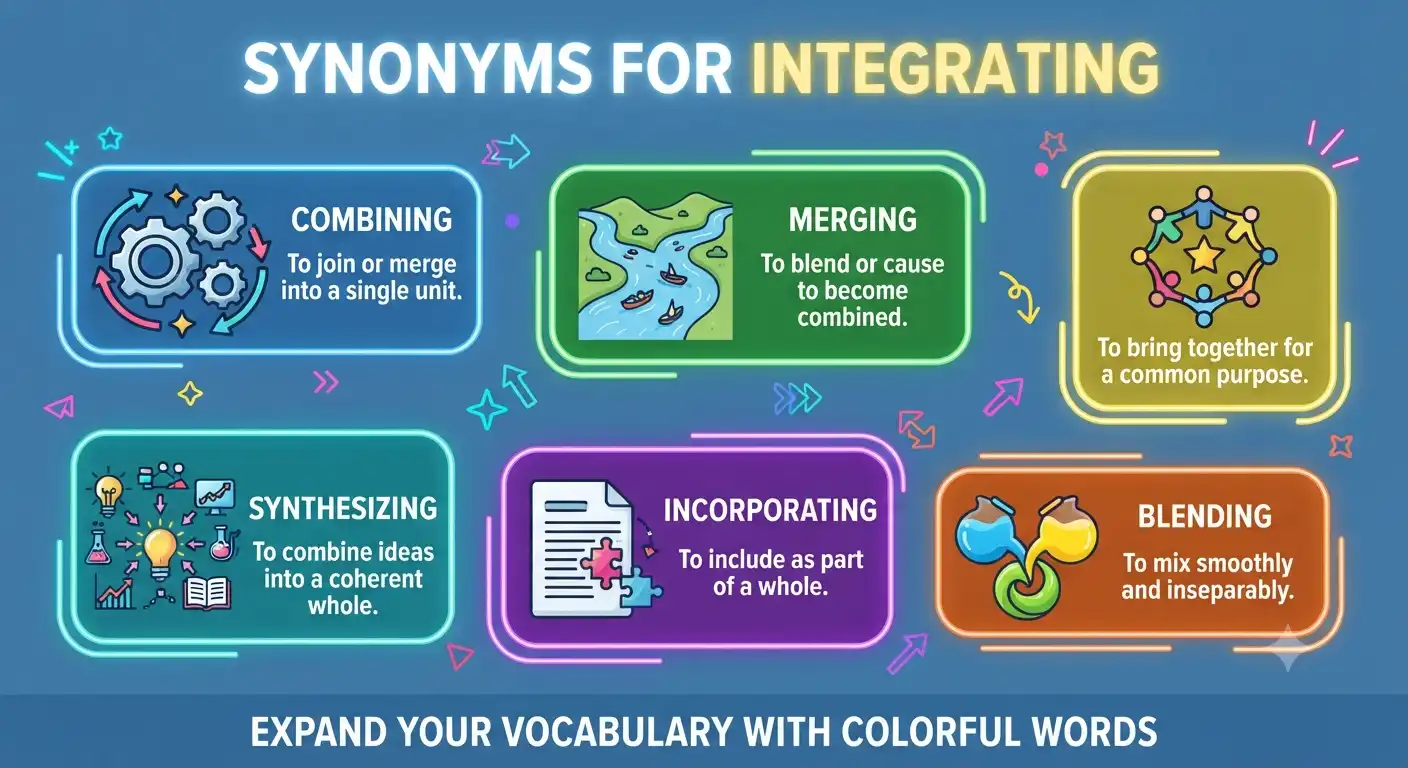
Synonyms for integrating are words that describe the act of joining two or more parts into one working whole. When you look for synonyms for integrating, you are searching for better, fresher ways to say that things are being combined, merged, or brought together. This guide gives you 50 real, usable synonyms for integrating so your writing never sounds repetitive again.
Picture a new employee walking into an office on her first day. She does not know anyone. By week two, she is chatting with the team, joining meetings, and using the same tools as everyone else. She is integrating into the company. Now imagine writing that sentence ten times in one article. It gets boring fast. That is exactly why strong word choice matters, whether you are writing an email, a school essay, or a blog post.
A simple real-life example: a new app that connects with your calendar, your email, and your notes is “integrating” all your daily tools into one screen. That single word carries a lot of meaning, and knowing its synonyms helps you express the same idea in fresh, natural ways.
In plain English, integrating means bringing separate things together so they work as one unit. This word is useful for students writing essays, bloggers building SEO content, content writers avoiding repetition, and daily English users who want to sound more natural and confident.
“Words are the only bridge we have from one soul to another, so choose them the way a builder chooses stone.”
Word Breakdown: Meaning, Origin & Pronunciation of “Integrating”
- Connotative Meaning: Integrating carries a positive, forward-moving feeling. It suggests progress, teamwork, and things fitting together smoothly, rather than forced or awkward combination.
- Etymology (short history):
- From Latin integrare, meaning “to make whole”
- Related to integer, meaning “whole” or “complete”
- Entered English usage in the 17th century through scientific and mathematical writing
- Later spread into business, technology, and everyday speech
- Pronunciation (US & UK – IPA):
- US: /ˈɪn.tɪ.ɡreɪ.tɪŋ/
- UK: /ˈɪn.tɪ.ɡreɪ.tɪŋ/
- Syllables: in-te-grat-ing (4 syllables)
- Affixation Pattern: integr(ate) + -ing (root “integrate” + present participle suffix “-ing”)
Comparison Table: Synonyms for Integrating at a Glance
| Keyword | Meaning | Usage Type | Context |
| Combining | Bringing two or more things together | Neutral | Daily use, cooking, business |
| Merging | Joining so parts become one | Formal/Professional | Companies, traffic, data |
| Unifying | Making separate things act as one | Formal | Politics, teams, ideas |
| Incorporating | Including something as part of a whole | Formal/Professional | Business, writing, law |
| Uniting | Bringing people or groups together | Emotional | Relationships, communities |
| Blending | Mixing smoothly without clear lines | Casual | Cooking, design, culture |
| Fusing | Joining tightly, often permanently | Formal | Science, technology, art |
| Amalgamating | Combining into a single organized unit | Formal | Business, finance |
| Consolidating | Making stronger by combining | Professional | Finance, management |
| Melding | Blending ideas or things smoothly | Casual/Emotional | Relationships, creativity |
Main List: 50 Synonyms for Integrating
Below is a complete list of synonyms for integrating, each with pronunciation, a simple meaning, and two example sentences you can use right away.
1. Combining
Pronunciation: US /kəmˈbaɪ.nɪŋ/ | UK /kəmˈbaɪ.nɪŋ/
Meaning: Combining means putting two or more things together to make one thing.
Examples:
- She is combining old photos with new designs for the album.
- The chef is combining fresh herbs with warm butter.
2. Merging
Pronunciation: US /ˈmɜr.dʒɪŋ/ | UK /ˈmɜː.dʒɪŋ/
Meaning: Merging means two things join together so smoothly that they become one.
Examples:
- The two small banks are merging into one large company.
- Cars are merging onto the highway during rush hour.
3. Unifying
Pronunciation: US /ˈjuː.nɪ.faɪ.ɪŋ/ | UK /ˈjuː.nɪ.faɪ.ɪŋ/
Meaning: Unifying means making different people or parts act as one strong group.
Examples:
- The coach is unifying the team before the big game.
- A shared goal is unifying the whole department.
4. Incorporating
Pronunciation: US /ɪnˈkɔːr.pə.reɪ.tɪŋ/ | UK /ɪnˈkɔː.pər.eɪ.tɪŋ/
Meaning: Incorporating means adding something so it becomes a real part of a bigger thing.
Examples:
- The teacher is incorporating games into her lessons.
- We are incorporating your feedback into the final design.
5. Uniting
Pronunciation: US /juˈnaɪ.tɪŋ/ | UK /juːˈnaɪ.tɪŋ/
Meaning: Uniting means bringing people together for one shared purpose.
Examples:
- The charity event is uniting neighbors across the city.
- Their love of music is uniting the whole class.
6. Blending
Pronunciation: US /ˈblɛn.dɪŋ/ | UK /ˈblen.dɪŋ/
Meaning: Blending means mixing things so well that you cannot see where one part ends.
Examples:
- She is blending two colors to get the perfect shade.
- The new employee is blending into the team quickly.
7. Fusing
Pronunciation: US /ˈfjuː.zɪŋ/ | UK /ˈfjuː.zɪŋ/
Meaning: Fusing means joining two things so tightly they become one solid thing.
Examples:
- The artist is fusing metal and glass in her sculpture.
- Modern chefs are fusing flavors from different countries.
8. Amalgamating
Pronunciation: US /əˈmæl.ɡə.meɪ.tɪŋ/ | UK /əˈmæl.ɡə.meɪ.tɪŋ/
Meaning: Amalgamating means combining several groups into one bigger, organized group.
Examples:
- The two departments are amalgamating next month.
- Small farms are amalgamating to save on costs.
9. Consolidating
Pronunciation: US /kənˈsɒl.ɪ.deɪ.tɪŋ/ | UK /kənˈsɒl.ɪ.deɪ.tɪŋ/
Meaning: Consolidating means combining things to make them stronger or simpler.
Examples:
- She is consolidating all her debts into one payment.
- The company is consolidating its offices into one building.
10. Melding
Pronunciation: US /ˈmɛl.dɪŋ/ | UK /ˈmel.dɪŋ/
Meaning: Melding means blending ideas or styles together in a smooth way.
Examples:
- The band is melding jazz with rock music.
- Her book is melding history with fiction.
11. Harmonizing
Pronunciation: US /ˈhɑːr.mə.naɪ.zɪŋ/ | UK /ˈhɑː.mə.naɪ.zɪŋ/
Meaning: Harmonizing means making different parts fit together in a pleasant, balanced way.
Examples:
- The two singers are harmonizing beautifully on stage.
- The new policy is harmonizing rules across every branch.
12. Assimilating
Pronunciation: US /əˈsɪm.ɪ.leɪ.tɪŋ/ | UK /əˈsɪm.ɪ.leɪ.tɪŋ/
Meaning: Assimilating means slowly becoming part of a group or a new culture.
Examples:
- The exchange student is assimilating into American life.
- New staff members are assimilating our company values fast.
13. Coordinating
Pronunciation: US /koʊˈɔːr.dɪ.neɪ.tɪŋ/ | UK /kəʊˈɔː.dɪ.neɪ.tɪŋ/
Meaning: Coordinating means organizing different parts so they work well together.
Examples:
- She is coordinating the schedules of five different teams.
- We are coordinating colors for the wedding decorations.
14. Synthesizing
Pronunciation: US /ˈsɪn.θə.saɪ.zɪŋ/ | UK /ˈsɪn.θə.saɪ.zɪŋ/
Meaning: Synthesizing means combining separate ideas or facts into one clear result.
Examples:
- The report is synthesizing data from three surveys.
- He is synthesizing feedback from every customer review.
15. Mixing
Pronunciation: US /ˈmɪk.sɪŋ/ | UK /ˈmɪk.sɪŋ/
Meaning: Mixing means putting different things together, often without a clear pattern.
Examples:
- She is mixing paint colors for the mural.
- The DJ is mixing two songs into one smooth track.
16. Networking
Pronunciation: US /ˈnɛt.wɜr.kɪŋ/ | UK /ˈnet.wɜː.kɪŋ/
Meaning: Networking means connecting people, computers, or systems so they can work together.
Examples:
- The IT team is networking all office computers this week.
- She is networking with other writers at the conference.
17. Linking
Pronunciation: US /ˈlɪŋ.kɪŋ/ | UK /ˈlɪŋ.kɪŋ/
Meaning: Linking means connecting two things so they relate to each other.
Examples:
- The article is linking to three helpful sources.
- Good sleep is linking to better focus at work.
18. Connecting
Pronunciation: US /kəˈnɛk.tɪŋ/ | UK /kəˈnek.tɪŋ/
Meaning: Connecting means joining two things so they can share something, like power or information.
Examples:
- The bridge is connecting the two sides of the town.
- This app is connecting your phone to your smart home.
19. Joining
Pronunciation: US /ˈdʒɔɪ.nɪŋ/ | UK /ˈdʒɔɪ.nɪŋ/
Meaning: Joining means becoming part of a group or attaching one thing to another.
Examples:
- She is joining the marketing team next Monday.
- The carpenter is joining two wood panels together.
20. Embedding
Pronunciation: US /ɪmˈbɛd.ɪŋ/ | UK /ɪmˈbed.ɪŋ/
Meaning: Embedding means fixing one thing firmly inside another.
Examples:
- The video is embedding directly into the blog post.
- The trainer is embedding safety habits into daily routines.
21. Weaving
Pronunciation: US /ˈwiː.vɪŋ/ | UK /ˈwiː.vɪŋ/
Meaning: Weaving means skillfully combining different ideas or threads into one pattern.
Examples:
- The author is weaving humor into a serious story.
- She is weaving colorful threads into a blanket.
22. Absorbing
Pronunciation: US /əbˈzɔːr.bɪŋ/ | UK /əbˈzɔː.bɪŋ/
Meaning: Absorbing means taking something in and making it part of the whole.
Examples:
- The sponge is absorbing all the spilled water.
- The larger company is absorbing the smaller startup.
23. Including
Pronunciation: US /ɪnˈkluː.dɪŋ/ | UK /ɪnˈkluː.dɪŋ/
Meaning: Including means adding something as one part of a bigger group.
Examples:
- The plan is including three new safety steps.
- Her speech is including stories from real customers.
24. Encompassing
Pronunciation: US /ɪnˈkʌm.pə.sɪŋ/ | UK /ɪnˈkʌm.pə.sɪŋ/
Meaning: Encompassing means covering or including many things at once.
Examples:
- The course is encompassing grammar, writing, and speaking.
- Her research is encompassing five different countries.
25. Accommodating
Pronunciation: US /əˈkɒm.ə.deɪ.tɪŋ/ | UK /əˈkɒm.ə.deɪ.tɪŋ/
Meaning: Accommodating means adjusting something so it can fit or include new needs.
Examples:
- The school is accommodating students with different learning styles.
- The hotel is accommodating a large family group.
“Great communication is not about using big words. It is about weaving simple words together with purpose.”
26. Adapting
Pronunciation: US /əˈdæp.tɪŋ/ | UK /əˈdæp.tɪŋ/
Meaning: Adapting means changing something so it fits well into a new system.
Examples:
- The team is adapting the old software to new devices.
- She is adapting quickly to her new job.
27. Homogenizing
Pronunciation: US /həˈmɒdʒ.ə.naɪ.zɪŋ/ | UK /hɒˈmɒdʒ.ə.naɪ.zɪŋ/
Meaning: Homogenizing means making different parts become similar or uniform.
Examples:
- The new policy is homogenizing pay across all branches.
- Global brands are homogenizing shopping habits worldwide.
28. Coalescing
Pronunciation: US /ˌkoʊ.əˈlɛs.ɪŋ/ | UK /ˌkəʊ.əˈles.ɪŋ/
Meaning: Coalescing means slowly coming together to form one thing.
Examples:
- The small groups are coalescing into one strong union.
- Ideas from the meeting are coalescing into a clear plan.
29. Interweaving
Pronunciation: US /ˌɪn.tərˈwiː.vɪŋ/ | UK /ˌɪn.təˈwiː.vɪŋ/
Meaning: Interweaving means mixing two or more things closely together, like threads.
Examples:
- The film is interweaving three different storylines.
- Her essay is interweaving facts with personal memories.
30. Interconnecting
Pronunciation: US /ˌɪn.tər.kəˈnɛk.tɪŋ/ | UK /ˌɪn.tə.kəˈnek.tɪŋ/
Meaning: Interconnecting means linking many parts so they all affect each other.
Examples:
- The new roads are interconnecting all the small towns.
- These apps are interconnecting your calendar and email.
31. Standardizing
Pronunciation: US /ˈstæn.dər.daɪ.zɪŋ/ | UK /ˈstæn.də.daɪ.zɪŋ/
Meaning: Standardizing means making different parts follow the same rules or format.
Examples:
- The company is standardizing its reports across every office.
- Teachers are standardizing grading rules this semester.
32. Streamlining
Pronunciation: US /ˈstriːm.laɪ.nɪŋ/ | UK /ˈstriːm.laɪ.nɪŋ/
Meaning: Streamlining means combining and simplifying steps so a process runs smoothly.
Examples:
- The factory is streamlining its production line.
- She is streamlining the checkout process on the website.
33. Aligning
Pronunciation: US /əˈlaɪ.nɪŋ/ | UK /əˈlaɪ.nɪŋ/
Meaning: Aligning means arranging things so they match or work toward the same goal.
Examples:
- The manager is aligning team goals with company strategy.
- She is aligning the photos in a neat row.
34. Reconciling
Pronunciation: US /ˈrɛk.ən.saɪ.lɪŋ/ | UK /ˈrek.ən.saɪ.lɪŋ/
Meaning: Reconciling means bringing two different things together so they no longer conflict.
Examples:
- The accountant is reconciling the two budget reports.
- They are reconciling their different opinions on the project.
35. Dovetailing
Pronunciation: US /ˈdʌv.teɪ.lɪŋ/ | UK /ˈdʌv.teɪ.lɪŋ/
Meaning: Dovetailing means fitting two plans or parts together perfectly.
Examples:
- Her schedule is dovetailing nicely with the new project.
- The two chapters are dovetailing into one clear message.
36. Interfacing
Pronunciation: US /ˈɪn.tər.feɪ.sɪŋ/ | UK /ˈɪn.tə.feɪ.sɪŋ/
Meaning: Interfacing means connecting two systems so they can communicate.
Examples:
- This software is interfacing with our old database.
- The two teams are interfacing daily on the new project.
37. Meshing
Pronunciation: US /ˈmɛʃ.ɪŋ/ | UK /ˈmeʃ.ɪŋ/
Meaning: Meshing means fitting well together, like gears in a machine.
Examples:
- Her ideas are meshing perfectly with the team’s plan.
- The two schedules are meshing without any conflict.
38. Bridging
Pronunciation: US /ˈbrɪdʒ.ɪŋ/ | UK /ˈbrɪdʒ.ɪŋ/
Meaning: Bridging means connecting two separate things or groups.
Examples:
- The workshop is bridging the gap between theory and practice.
- This program is bridging students from different countries.
39. Tying Together
Pronunciation: US /ˈtaɪ.ɪŋ təˈɡɛð.ər/ | UK /ˈtaɪ.ɪŋ təˈɡeð.ə/
Meaning: Tying together means linking separate ideas or parts into one clear point.
Examples:
- The final paragraph is tying together all her arguments.
- The manager is tying together feedback from every team.
40. Bringing Together
Pronunciation: US /ˈbrɪŋ.ɪŋ təˈɡɛð.ər/ | UK /ˈbrɪŋ.ɪŋ təˈɡeð.ə/
Meaning: Bringing together means gathering different people or things into one place.
Examples:
- The festival is bringing together artists from around the world.
- This meeting is bringing together every department head.
41. Wedding
Pronunciation: US /ˈwɛd.ɪŋ/ | UK /ˈwed.ɪŋ/
Meaning: Wedding (as a verb) means joining two ideas or things closely together.
Examples:
- The design is wedding classic style with modern comfort.
- Her thesis is wedding two theories into one strong idea.
42. Cementing
Pronunciation: US /sɪˈmɛn.tɪŋ/ | UK /sɪˈment.ɪŋ/
Meaning: Cementing means making a connection strong and permanent.
Examples:
- The deal is cementing a long partnership between both firms.
- Their teamwork is cementing trust across the whole office.
43. Pooling
Pronunciation: US /ˈpuː.lɪŋ/ | UK /ˈpuː.lɪŋ/
Meaning: Pooling means combining resources or efforts from different people.
Examples:
- The neighbors are pooling money for a shared garden.
- Students are pooling their notes before the exam.
44. Syncing
Pronunciation: US /ˈsɪŋ.kɪŋ/ | UK /ˈsɪŋ.kɪŋ/
Meaning: Syncing means making two systems match and update together.
Examples:
- Her phone is syncing photos with the cloud automatically.
- The two calendars are syncing every time she adds an event.
45. Adjoining
Pronunciation: US /əˈdʒɔɪ.nɪŋ/ | UK /əˈdʒɔɪ.nɪŋ/
Meaning: Adjoining means connecting or joining right next to something else.
Examples:
- The new hallway is adjoining the two office buildings.
- Her room is adjoining her sister’s room.
46. Compounding
Pronunciation: US /kəmˈpaʊn.dɪŋ/ | UK /kəmˈpaʊn.dɪŋ/
Meaning: Compounding means combining parts to form something bigger or stronger.
Examples:
- The pharmacist is compounding two medicines into one dose.
- Small daily habits are compounding into big results.
47. Fitting In
Pronunciation: US /ˈfɪt.ɪŋ ɪn/ | UK /ˈfɪt.ɪŋ ɪn/
Meaning: Fitting in means becoming a natural, comfortable part of a group.
Examples:
- The new intern is fitting in with the team already.
- This chapter is fitting in well with the rest of the book.
48. Folding In
Pronunciation: US /ˈfoʊl.dɪŋ ɪn/ | UK /ˈfəʊl.dɪŋ ɪn/
Meaning: Folding in means gently adding one part into a larger mix.
Examples:
- The baker is folding in the egg whites slowly.
- She is folding in new ideas without changing the main plan.
49. Bonding
Pronunciation: US /ˈbɒn.dɪŋ/ | UK /ˈbɒn.dɪŋ/
Meaning: Bonding means forming a close, strong connection between two things or people.
Examples:
- The two materials are bonding perfectly under heat.
- The new team members are bonding over lunch every day.
50. Rolling In
Pronunciation: US /ˈroʊ.lɪŋ ɪn/ | UK /ˈrəʊ.lɪŋ ɪn/
Meaning: Rolling in means smoothly adding something extra into an existing plan or system.
Examples:
- The manager is rolling in new safety rules this week.
- The company is rolling in customer feedback into version two.
Antonyms of Integrating
If integrating means bringing things together, these words mean the opposite — pulling things apart:
- Separating
- Dividing
- Isolating
- Disconnecting
- Splitting
- Excluding
- Segregating
- Detaching
Prototype Meaning and Categorization of Integrating
The prototype meaning of integrating is the clearest, most typical example people think of when they hear the word. For most English speakers, that prototype is combining separate parts into one working system, like merging two teams, connecting two apps, or blending two cultures.
Categorization:
- Part of speech: Verb (present participle of “integrate”)
- Category: Action verb describing a process, not a single moment
- Common fields: Business, technology, education, relationships, science
- Register: Neutral to formal; works well in both professional and everyday writing
FAQ: Synonyms for Integrating
1. What is the best synonym for integrating in business writing? “Incorporating” or “consolidating” work best in formal business writing because they sound professional and clear.
2. Is “merging” the same as “integrating”? They are close, but merging usually means two things become one, while integrating can mean adding a new part into an existing whole.
3. What is a casual synonym for integrating? “Mixing” or “blending” sound more casual and work well in everyday conversation.
4. Can I use “integrating” and “combining” in the same sentence? Yes, but it is better to pick one to avoid repeating the same idea twice.
5. What is the opposite of integrating? The opposite is separating, dividing, or isolating.
6. Which synonym works best for technology topics? “Syncing,” “interfacing,” and “networking” are the most natural choices for tech content.
7. Why do writers need synonyms for common words like integrating? Synonyms keep writing fresh, improve SEO, and help readers stay engaged instead of feeling bored by repetition.
Conclusion
Learning synonyms for integrating does more than expand your vocabulary. It improves your writing, sharpens your blogging, boosts your speaking, and makes every piece of communication feel more natural. When you have fifty ways to say the same idea, you never sound repetitive, and your reader stays interested from start to finish.
Try using a few of these words in your next email, essay, or daily conversation. Start small. Pick three or four synonyms from this list and use them this week. Notice how much more confident and polished your English starts to sound.
“Vocabulary is not about sounding fancy. It is about saying exactly what you mean, every single time.”
“The right word, used at the right moment, can turn an average sentence into a memorable one.”
Keep practicing, keep writing, and keep growing your word bank one synonym at a time.

Michael Turner is a published fiction writer and creative writing tutor with over a decade of experience helping writers find the words that make their stories breathe ( Biography ).