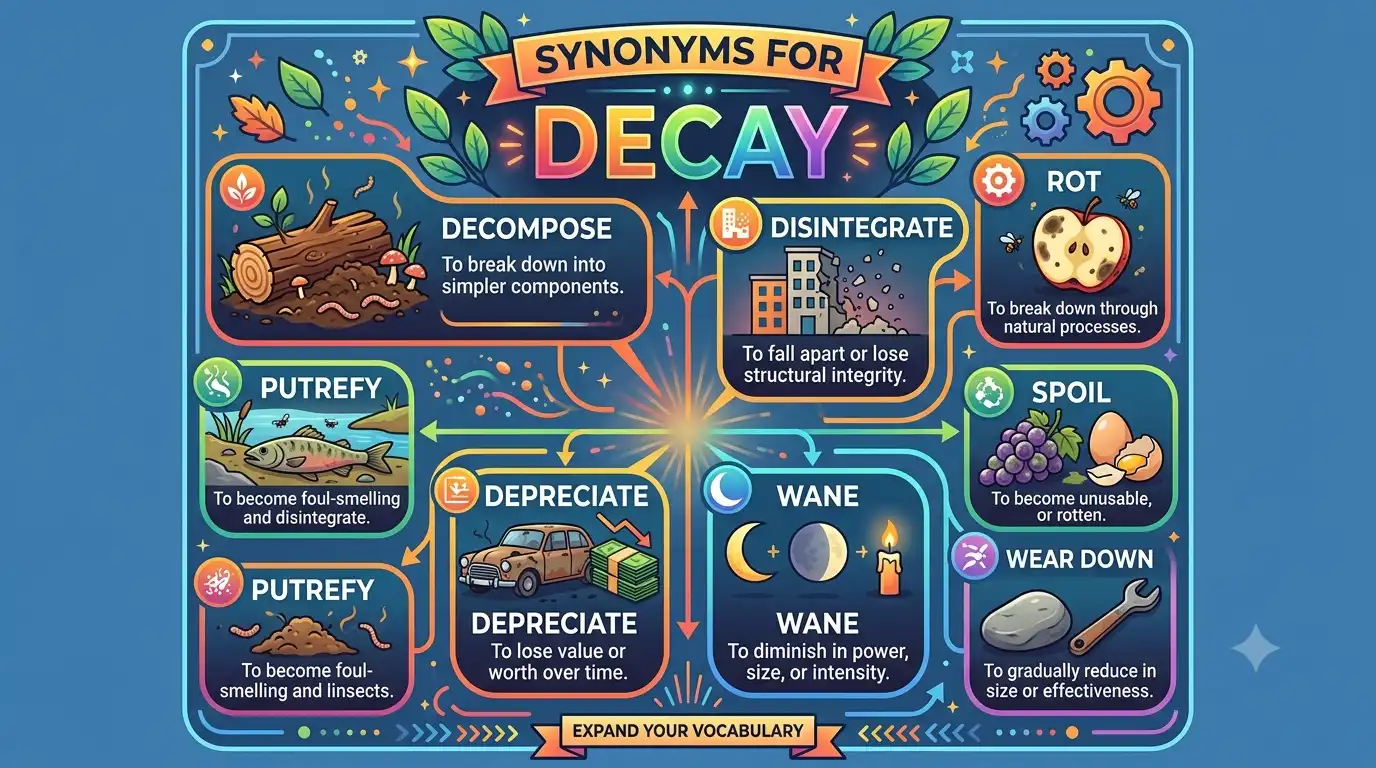
Finding the right synonyms for decay can make your writing clear, sharp, and natural. When you search for synonyms for decay, you want words that match your exact sentence context. Using different synonyms for decay helps you avoid repeating the same word and improves your vocabulary instantly.
Imagine opening your refrigerator and finding an old apple that turned brown and soft. You might say the fruit is rotting, spoiling, or breaking down. That natural process is what we call decay. In simple English, decay means something is slowly breaking down, getting worse, or falling apart over time.
Learning these word choices is extremely useful for everyone. Students can write stronger school essays. Bloggers can create fresh and exciting articles. Content writers can boost their SEO score with semantic words. Daily English users can express themselves with precision in conversations and emails.
“Words are the leaves of the tree of language; choosing the right one brings every sentence to life.”
“To express a single thought with precision is the true mark of clear thinking.”
Word Profile: Decay
Connotative Meaning of Decay
- Negative: Loss of quality, rot, death, neglect, or destruction.
- Neutral / Scientific: Natural biological breakdown and organic recycling in ecosystems.
- Abstract: Decline of power, morals, health, or civilization over time.
Etymology of Decay
- Origin: Old French (dechoir) and Vulgar Latin (decadere).
- Prefix: De- (meaning down or away).
- Root: Cadere (meaning to fall).
- Literal Historical Meaning: “To fall down or fall away from a good state.”
Pronunciation of Decay
- US (IPA): /dɪˈkeɪ/
- UK (IPA): /dɪˈkeɪ/
Word Analysis
- Syllables: 2 (de-cay)
- Primary Stress: Second syllable (cay)
- Affixation Pattern: Prefix (de-) + Root (cay)
Linguistic Prototype & Categorization
To pick the exact word you need, understand how decay is grouped in English:
| Category | Description | Primary Examples |
| Biological Rot | Natural breakdown of living matter | Rot, decomposition, putrefaction |
| Structural / Physical | Slow damage to buildings, metals, or teeth | Corrosion, erosion, dilapidation, rust |
| Social / Moral | Gradual loss of standards, power, or health | Degeneration, decadence, downfall |
| Gradual Decline | Slow drop in quality, energy, or numbers | Wane, drop, slump, fading |
Synonym Comparison Table
| Keyword | Meaning | Usage Type | Context |
| Rot | To spoil and become soft | Casual / General | Food, wood, organic items |
| Decomposition | Natural breakdown into basic parts | Formal / Scientific | Science, nature, biology |
| Deterioration | Process of becoming worse | Formal / Professional | Health, buildings, roads |
| Corrosion | Damage caused by chemicals or rust | Technical / Specific | Metals, pipes, machinery |
| Degeneration | Loss of good qualities or health | Professional / Medical | Body tissue, society, mind |
| Atrophy | Wasting away from lack of use | Scientific / Medical | Muscles, skills, habits |
| Dilapidation | State of disrepair from age | Formal / Descriptive | Old homes, structures, ruins |
| Blight | Something that spoils or damages | Emotional / Literary | Plants, neighborhoods, plans |
50 Synonyms for Decay
1. Rot
- Pronunciation: US /rɑːt/ | UK /rɒt/
- Meaning: Rot means food or wood breaks down and becomes bad or soft.
- Examples:
- The old wooden fence began to rot after the rain.
- Do not leave the fruit on the table or it will rot.
2. Spoilage
- Pronunciation: US /ˈspɔɪ.lɪdʒ/ | UK /ˈspɔɪ.lɪdʒ/
- Meaning: Spoilage is the process where food gets bad and cannot be eaten.
- Examples:
- Keep the milk cold to prevent early spoilage.
- Heat accelerates food spoilage in the summer.
3. Decomposition
- Pronunciation: US /ˌdiː.kɑːm.pəˈzɪʃ.ən/ | UK /ˌdiː.kɒm.pəˈzɪʃ.ən/
- Meaning: Decomposition is the natural way dead plants and animals break apart.
- Examples:
- Leaves turn into soil through biological decomposition.
- Heat speeds up the decomposition of organic waste.
4. Breakdown
- Pronunciation: US /ˈbreɪk.daʊn/ | UK /ˈbreɪk.daʊn/
- Meaning: Breakdown means something slowly falls apart or stops working properly.
- Examples:
- The breakdown of dead leaves enriches the forest soil.
- Stress causes a gradual breakdown in personal health.
5. Deterioration
- Pronunciation: US /dɪˌtɪr.i.əˈreɪ.ʃən/ | UK /dɪˌtɪə.ri.əˈreɪ.ʃən/
- Meaning: Deterioration means getting weaker, worse, or damaged over time.
- Examples:
- Rain caused the rapid deterioration of the old road.
- Doctors monitored the deterioration of his tooth enamel.
6. Decline
- Pronunciation: US /dɪˈklaɪn/ | UK /dɪˈklaɪn/
- Meaning: Decline means a continuous reduction in quality, strength, or amount.
- Examples:
- The small city saw a decline in its population.
- Regular practice prevents a decline in your language skills.
7. Collapse
- Pronunciation: US /kəˈlæps/ | UK /kəˈlæps/
- Meaning: Collapse means to fall down suddenly or lose all strength.
- Examples:
- Neglect led to the collapse of the empty bridge.
- Without care, the old shed will collapse under heavy snow.
8. Degeneration
- Pronunciation: US /dɪˌdʒen.əˈreɪ.ʃən/ | UK /dɪˌdʒen.əˈreɪ.ʃən/
- Meaning: Degeneration is the process of losing physical or moral health.
- Examples:
- Lack of exercise leads to muscle degeneration.
- The book describes the degeneration of an ancient kingdom.
9. Disintegration
- Pronunciation: US /dɪsˌɪn.təˈɡreɪ.ʃən/ | UK /dɪsˌɪn.tɪˈɡreɪ.ʃən/
- Meaning: Disintegration means breaking into small tiny pieces until nothing is left.
- Examples:
- Sun exposure causes the disintegration of plastic paper.
- The rock showed signs of disintegration from freezing weather.
10. Ruin
- Pronunciation: US /ˈruː.ɪn/ | UK /ˈruː.ɪn/
- Meaning: Ruin means a state of being completely destroyed or severely damaged.
- Examples:
- Water leaks caused the ruin of the basement walls.
- The old castle fell into total ruin over the centuries.
11. Corrosion
- Pronunciation: US /kəˈroʊ.ʒən/ | UK /kəˈrəʊ.ʒən/
- Meaning: Corrosion is slow damage to metal caused by water and air.
- Examples:
- Salt water speeds up corrosion on ship hulls.
- Check your car battery often to clean off corrosion.
12. Atrophy
- Pronunciation: US /ˈæt.rə.fi/ | UK /ˈæt.rə.fi/
- Meaning: Atrophy means shrinking or weakening because of lack of use.
- Examples:
- Sitting all day can cause muscle atrophy.
- Disuse will cause your memory skills to atrophy.
13. Perish
- Pronunciation: US /ˈper.ɪʃ/ | UK /ˈper.ɪʃ/
- Meaning: Perish means to rot away, die, or be destroyed completely.
- Examples:
- Fresh vegetables perish quickly without ice.
- Leather items perish if left in moist basements.
14. Mold
- Pronunciation: US /moʊld/ | UK /məʊld/
- Meaning: Mold is a fuzzy growth that forms on old moist things.
- Examples:
- Green mold grew on the forgotten loaf of bread.
- Clean the bathroom tiles to prevent dangerous black mold.
15. Putrefaction
- Pronunciation: US /ˌpjuː.trəˈfæk.ʃən/ | UK /ˌpjuː.trɪˈfæk.ʃən/
- Meaning: Putrefaction is the foul rotting process of dead organic matter.
- Examples:
- Cold temperatures slow down putrefaction in meat.
- The bad smell was caused by organic putrefaction.
16. Fading
- Pronunciation: US /ˈfeɪ.dɪŋ/ | UK /ˈfeɪ.dɪŋ/
- Meaning: Fading means slowly losing bright color, strength, or freshness.
- Examples:
- Sunlight led to the fading of the living room curtains.
- She watched the fading beauty of the autumn flowers.
17. Downfall
- Pronunciation: US /ˈdaʊn.fɑːl/ | UK /ˈdaʊn.fɔːl/
- Meaning: Downfall means a sudden loss of power, status, or success.
- Examples:
- Greed was the main cause of the empire’s downfall.
- Bad financial management led to the firm’s downfall.
18. Dilapidation
- Pronunciation: US /dɪˌlæp.əˈdeɪ.ʃən/ | UK /dɪˌlæp.ɪˈdeɪ.ʃən/
- Meaning: Dilapidation is damage to a building due to long age and neglect.
- Examples:
- The abandoned house was in a bad state of dilapidation.
- They fixed the roof to stop further dilapidation.
19. Wasting
- Pronunciation: US /ˈweɪ.stɪŋ/ | UK /ˈweɪ.stɪŋ/
- Meaning: Wasting means gradually becoming thin, weak, or useless over time.
- Examples:
- Ill health caused a visible wasting of his energy.
- Unused water pipes face slow wasting and damage.
20. Wear
- Pronunciation: US /wer/ | UK /weə/
- Meaning: Wear is damage caused by using something continuously for a long time.
- Examples:
- Daily driving causes natural wear on car tires.
- The steps showed heavy wear from years of visitors.
“Language grows and shifts just like nature; choosing fresh synonyms keeps your voice clear and dynamic.”
21. Erosion
- Pronunciation: US /ɪˈroʊ.ʒən/ | UK /ɪˈrəʊ.ʒən/
- Meaning: Erosion is the slow wearing away of earth, rock, or soil by wind and water.
- Examples:
- Ocean waves caused severe beach erosion along the coast.
- Tree roots protect hillsides against soil erosion.
22. Degradation
- Pronunciation: US /ˌdeɡ.rəˈdeɪ.ʃən/ | UK /ˌdeɡ.rəˈdeɪ.ʃən/
- Meaning: Degradation is the process of falling to a lower quality or condition.
- Examples:
- Plastic causes serious environmental degradation in oceans.
- Dirt causes rapid degradation of delicate engine parts.
23. Fall
- Pronunciation: US /fɑːl/ | UK /fɔːl/
- Meaning: Fall means a loss of power, position, or high quality.
- Examples:
- History books record the fall of ancient Rome.
- The fall of the old wall cleared space for a new park.
24. Slump
- Pronunciation: US /slʌmp/ | UK /slʌmp/
- Meaning: Slump is a sharp drop in performance, quality, or sales.
- Examples:
- The store experienced a temporary slump in winter sales.
- Rest and sleep helped him break out of his productivity slump.
25. Dissolution
- Pronunciation: US /ˌdɪs.əˈluː.ʃən/ | UK /ˌdɪs.əˈluː.ʃən/
- Meaning: Dissolution means the breaking up or ending of something solid.
- Examples:
- Moisture led to the dissolution of the paper box.
- The dissolution of the partnership took several months.
26. Rust
- Pronunciation: US /rʌst/ | UK /rʌst/
- Meaning: Rust is reddish-brown coating forming on iron exposed to moisture.
- Examples:
- Rain left red rust all over the old bicycle chain.
- Paint shields metal gates against heavy rust.
27. Crumbling
- Pronunciation: US /ˈkrʌm.blɪŋ/ | UK /ˈkrʌm.blɪŋ/
- Meaning: Crumbling means breaking apart easily into tiny soft pieces.
- Examples:
- The old brick wall was crumbling under light pressure.
- Dry bread crusts are prone to fast crumbling.
28. Blight
- Pronunciation: US /blaɪt/ | UK /blaɪt/
- Meaning: Blight is a plant disease that causes decay and death.
- Examples:
- A sudden crop blight ruined the potato harvest.
- Urban blight can be solved with clean public parks.
29. Canker
- Pronunciation: US /ˈkæŋ.kɚ/ | UK /ˈkæŋ.kər/
- Meaning: Canker is a spreading disease that decays plant bark or animal tissues.
- Examples:
- Tree bark can suffer from severe fungal canker.
- Left untreated, the wood rot acts like a canker on the frame.
30. Mildew
- Pronunciation: US /ˈmɪl.duː/ | UK /ˈmɪl.djuː/
- Meaning: Mildew is a white or gray fungus growing on damp surfaces.
- Examples:
- Damp towels left in bags soon collect smell and mildew.
- Use vinegar to remove mildew from garden chairs.
31. Putrescence
- Pronunciation: US /pjuːˈtres.əns/ | UK /pjuːˈtres.əns/
- Meaning: Putrescence is the state of undergoing stinking biological rot.
- Examples:
- The bin gave off a strong odor of putrescence.
- Clean waste regularly to prevent putrescence indoors.
32. Corruption
- Pronunciation: US /kəˈrʌp.ʃən/ | UK /kəˈrʌp.ʃən/
- Meaning: Corruption is the moral decay or change from good to bad.
- Examples:
- Dishonesty leads to total corruption of public trust.
- Computer file corruption makes data unreadable.
33. Sinking
- Pronunciation: US /ˈsɪŋ.kɪŋ/ | UK /ˈsɪŋ.kɪŋ/
- Meaning: Sinking means falling slowly to a lower level or condition.
- Examples:
- We noticed a gradual sinking in wall quality.
- His spirits felt a sinking feeling after bad news.
34. Wane
- Pronunciation: US /weɪn/ | UK /weɪn/
- Meaning: Wane means to decrease gradually in size, power, or brightness.
- Examples:
- Public interest in the game began to wane.
- The light started to wane as evening approached.
35. Drop
- Pronunciation: US /drɑːp/ | UK /drɒp/
- Meaning: Drop is a decline or movement down to a lower amount.
- Examples:
- We saw a sharp drop in fruit freshness this week.
- A sudden drop in air pressure brings rainy weather.
36. Waste
- Pronunciation: US /weɪst/ | UK /weɪst/
- Meaning: Waste is the slow loss of substance, strength, or value.
- Examples:
- Disuse causes machinery to fall into waste.
- Do not let good food turn into useless waste.
37. Desolation
- Pronunciation: US /ˌdes.əˈleɪ.ʃən/ | UK /ˌdes.əˈleɪ.ʃən/
- Meaning: Desolation is a state of complete emptiness, ruin, and neglect.
- Examples:
- The abandoned village was a scene of deep desolation.
- Years of storms left the island in desolation.
38. Devastation
- Pronunciation: US /ˌdev.əˈsteɪ.ʃən/ | UK /ˌdev.əˈsteɪ.ʃən/
- Meaning: Devastation is severe destruction and damage spread across an area.
- Examples:
- The storm caused wide devastation among coastal homes.
- Fire resulted in complete devastation of the wooden barn.
39. Wreckage
- Pronunciation: US /ˈrek.ɪdʒ/ | UK /ˈrek.ɪdʒ/
- Meaning: Wreckage is the broken remains of something destroyed or decayed.
- Examples:
- Workers cleared away the wreckage of the collapsed roof.
- Old car wreckage lay scattered in the field.
40. Loss
- Pronunciation: US /lɑːs/ | UK /lɒs/
- Meaning: Loss is the gradual reduction or total absence of something valuable.
- Examples:
- Poor care leads to a loss of wood quality.
- Tooth decay results in early bone loss.
41. Implosion
- Pronunciation: US /ɪmˈploʊ.ʒən/ | UK /ɪmˈpləʊ.ʒən/
- Meaning: Implosion is a sudden inward collapse or moral breakdown.
- Examples:
- Bad management led to the firm’s sudden implosion.
- Internal disputes caused the club’s implosion.
42. Ruination
- Pronunciation: US /ˌruː.əˈneɪ.ʃən/ | UK /ˌruː.ɪˈneɪ.ʃən/
- Meaning: Ruination is the act of destroying something or bringing it to ruin.
- Examples:
- Moisture was the main cause of the painting’s ruination.
- Constant neglect leads directly to building ruination.
43. Decadence
- Pronunciation: US /ˈdek.ə.dəns/ | UK /ˈdek.ə.dəns/
- Meaning: Decadence is low moral standards caused by excessive comfort.
- Examples:
- Historians study the decadence of wealthy ancient courts.
- The film shows the gradual decadence of the ruling family.
44. Impairment
- Pronunciation: US /ɪmˈper.mənt/ | UK /ɪmˈpeə.mənt/
- Meaning: Impairment is damage that makes something work less effectively.
- Examples:
- Tooth decay creates structural impairment in your smile.
- Rust causes severe physical impairment to iron beams.
45. Taint
- Pronunciation: US /teɪnt/ | UK /teɪnt/
- Meaning: Taint is a small amount of rot, spoilage, or bad quality.
- Examples:
- A single bad apple leaves a taint on the whole batch.
- Smoke left a dark taint on the kitchen wall.
46. Smut
- Pronunciation: US /smʌt/ | UK /smʌt/
- Meaning: Smut is a fungal disease that turns plant tissue into black powder.
- Examples:
- Corn smut damages cereal crops in wet fields.
- Farmers check wheat crops closely for black smut.
47. Disrepair
- Pronunciation: US /ˌdɪs.rɪˈper/ | UK /ˌdɪs.rɪˈpeə/
- Meaning: Disrepair is a poor condition because of neglect and lack of fix.
- Examples:
- The empty garage fell into total disrepair.
- Regular painting keeps your shed out of disrepair.
48. Mortification
- Pronunciation: US /ˌmɔːr.t̬ə.fəˈkeɪ.ʃən/ | UK /ˌmɔː.tɪ.fɪˈkeɪ.ʃən/
- Meaning: Mortification is the death and decay of living body tissue.
- Examples:
- Severe frostbite causes tissue mortification.
- Doctors worked fast to prevent skin mortification.
49. Senescence
- Pronunciation: US /səˈnes.əns/ | UK /səˈnes.əns/
- Meaning: Senescence is the natural aging process leading to breakdown in living cells.
- Examples:
- Autumn leaf color comes from plant senescence.
- Cell senescence is a normal biological phase.
50. Impoverishment
- Pronunciation: US /ɪmˈpɑː.vɚ.ɪʃ.mənt/ | UK /ɪmˈpɒv.ər.ɪʃ.mənt/
- Meaning: Impoverishment is the severe loss of quality, nutrients, or wealth.
- Examples:
- Over-farming causes rapid soil impoverishment.
- Lack of reading causes an impoverishment of vocabulary.
Antonyms of Decay
To fully grasp the meaning of decay, it helps to look at its opposite words:
- Growth: The process of growing, expanding, or improving.
- Development: Progress toward a stronger, more advanced state.
- Flourishing: Growing vigorously and staying healthy.
- Renewal: Becoming fresh, new, or strong again.
- Preservation: Keeping something safe and free from rot or decay.
Frequently Asked Questions (FAQs)
What is the most common synonym for decay in everyday speech?
The most common casual synonym for decay is rot when referring to food, wood, or teeth. For general situations, decline or breakdown are very popular.
What is the scientific word for decay?
In biology and chemistry, the precise term for natural decay is decomposition. For medical or structural terms, deterioration or atrophy are widely used.
How do I choose between rot, decompose, and deteriorate?
Use rot for everyday natural objects like fruit or timber, decompose in scientific contexts regarding organic matter breaking down into soil, deteriorate when describing health, roads, weather, or human relationships.
Can decay be used in a positive way?
Yes, in natural ecology, biological decay is essential. Without decomposition, dead plant matter would cover the earth, preventing new soil formation and plant growth.
What is the difference between decay and erosion?
Decay usually refers to organic breakdown or gradual loss of quality. Erosion specifically refers to physical wearing away of rock, soil, or land caused by natural forces like wind, water, or ice.
Conclusion
Mastering various synonyms for decay is one of the easiest ways to improve your English skills immediately. When you replace repetitive words with precise terms like decomposition, deterioration, corrosion, or dilapidation, your writing becomes clear and professional.
Using specific synonyms for decay helps you communicate exactly what you mean in every context. For instance, a student writing a science report can use decomposition to sound authoritative. A blogger writing about old architecture can choose dilapidation to paint a viviad mental picture. A business professional writing an email can use decline or impairment to describe trends accurately without sounding informal.
Start practicing these words today. Try swapping out the word “decay” in your next email, essay, or blog post. Small adjustments in your vocabulary build strong, expressive, and persuasive communication habits that last a lifetime.
“A rich vocabulary gives you the exact brushstrokes needed to paint clear pictures with your words.”
“Continuous learning is the key that unlocks confidence in every conversation and written piece.”

Michael Turner is a published fiction writer and creative writing tutor with over a decade of experience helping writers find the words that make their stories breathe ( Biography ).