Introduction
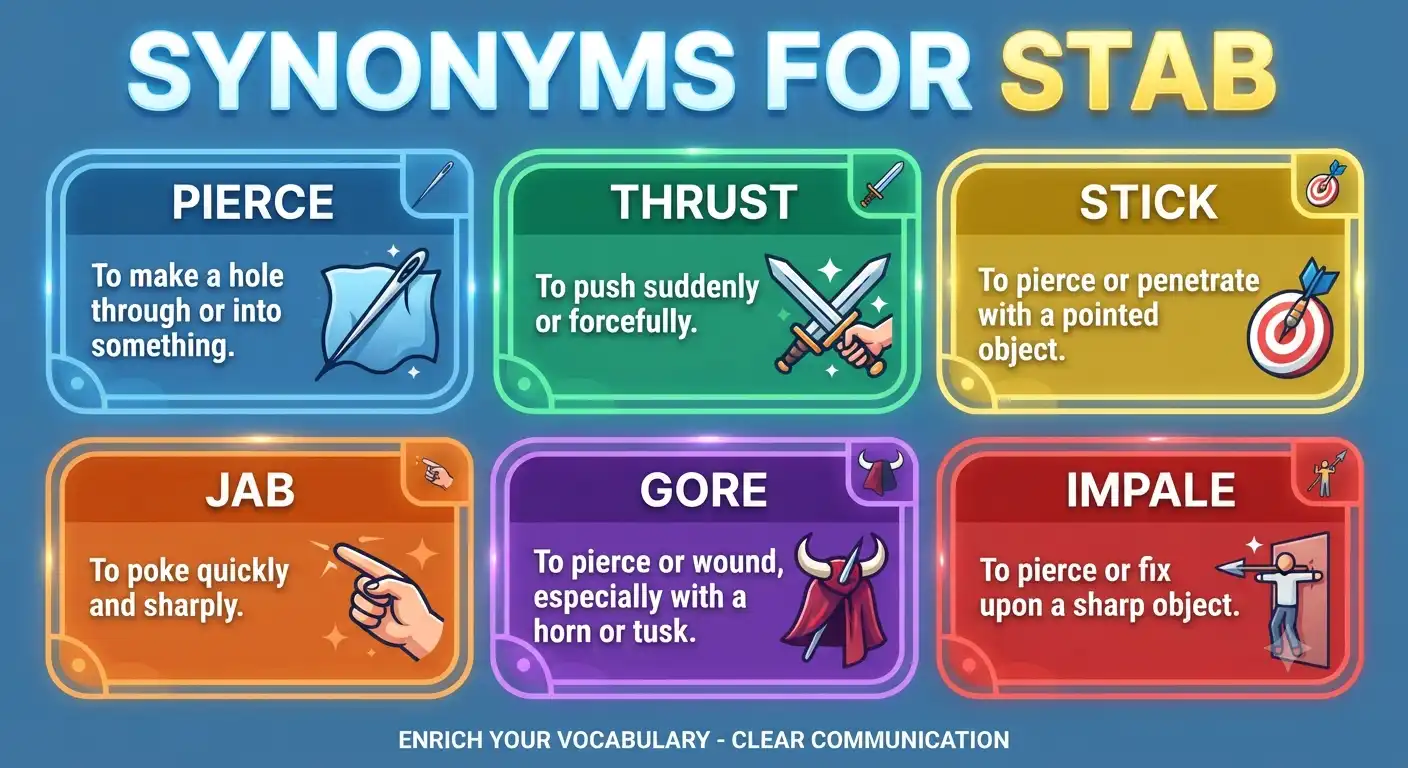
Synonyms for stab are words that describe the act of piercing something with a sharp, pointed object. When you search for synonyms for stab, you are looking for stronger, clearer, or more descriptive words to replace a simple verb. Writers often need synonyms for stab because the same word repeated again and again makes a story feel flat and boring.
Picture this: a crime writer is halfway through a thriller. The villain has already “stabbed” one character on page two. By page ten, he “stabs” again. By page twenty, the word has lost its power. The reader stops feeling the danger. This is exactly why strong vocabulary matters. A single fresh word can bring a scene back to life.
“The right word can turn a flat sentence into a sharp, living image.”
“Vocabulary is the writer’s weapon, and precision is the blade.”
Here is a real-life example. Instead of writing “He stabbed the tomato with a fork,” you could write “He skewered the tomato with a fork.” The second sentence feels more specific and visual.
In simple English, to stab means to push a sharp object, like a knife or needle, into something quickly and with force. It is a short, strong action word.
This word is useful for many people:
- Students need it for essays, stories, and grammar exercises.
- Bloggers need it to keep their writing fresh and avoid repeating the same verb.
- Content writers need it to match tone, whether formal, casual, or dramatic.
- Daily English users need it to describe injuries, accidents, or even feelings, like “a stab of pain” or “a stab of guilt.”
Word Breakdown: Stab
Connotative Meaning: The word “stab” often carries a feeling of suddenness, danger, or sharp pain. It can be literal (a knife wound) or figurative (a stab of jealousy, a stab of fear).
Etymology (Short History):
- Comes from the Middle English word stabbe, meaning a thrust or wound.
- Linked to the Scottish word stob, meaning a pointed stick.
- Related to old Germanic roots describing a sharp poke or jab.
- First widely used around the 1400s to describe piercing with a weapon.
Pronunciation:
- US: /stæb/
- UK: /stæb/
Syllables: stab (1 syllable)
Affixation Pattern: stab → stabs (verb, present) → stabbed (past tense) → stabbing (present participle) → stabber (noun, person who stabs)
Comparison Table: Stab and Its Closest Synonyms
| Keyword | Meaning | Usage Type | Context |
| Stab | To pierce quickly with a sharp object | Neutral/Violent | Crime, injury, emotion |
| Pierce | To make a hole through something | Formal | Medical, fashion, literary |
| Jab | To poke quickly and sharply | Casual | Sports, daily conversation |
| Skewer | To push a long, thin object through | Casual/Descriptive | Cooking, criticism |
| Puncture | To make a small hole with a point | Technical/Formal | Medical, mechanical (tires) |
| Impale | To pierce completely through with a stake | Dramatic/Literary | Horror, historical writing |
| Gash | To make a deep cut | Descriptive | Injury, accident |
| Prick | To make a tiny puncture | Casual | Sewing, minor pain |
| Slash | To cut with a sweeping motion | Violent/Dramatic | Action, crime |
| Wound | To injure by breaking the skin | Formal/Medical | Medical, emotional harm |
50 Synonyms for Stab
1. Pierce
Pronunciation: US: /pɪrs/ | UK: /pɪəs/
Meaning: To make a hole in something with a sharp point.
Examples:
- The needle can pierce the fabric easily.
- Her scream seemed to pierce the silence of the night.
2. Jab
Pronunciation: US: /dʒæb/ | UK: /dʒæb/
Meaning: To poke someone or something quickly and sharply.
Examples:
- He gave the door a quick jab with his elbow.
- The boxer landed a fast jab to his opponent’s chin.
3. Poke
Pronunciation: US: /poʊk/ | UK: /pəʊk/
Meaning: To push a finger or pointed object into something.
Examples:
- She poked the cake to see if it was done.
- The child poked the balloon with a pin.
4. Spear
Pronunciation: US: /spɪr/ | UK: /spɪə/
Meaning: To pierce something with a long, pointed weapon or tool.
Examples:
- The fisherman used a stick to spear the fish.
- He tried to spear a piece of meat with his fork.
5. Skewer
Pronunciation: US: /ˈskjuːər/ | UK: /ˈskjuːə/
Meaning: To push a thin, pointed object all the way through something.
Examples:
- She used a metal stick to skewer the vegetables.
- The chef will skewer the chicken before grilling it.
6. Puncture
Pronunciation: US: /ˈpʌŋktʃər/ | UK: /ˈpʌŋktʃə/
Meaning: To make a small hole using something sharp.
Examples:
- A nail can puncture a car tire in seconds.
- The thorn managed to puncture his skin.
7. Gore
Pronunciation: US: /ɡɔːr/ | UK: /ɡɔː/
Meaning: To wound someone deeply with a horn or a sharp point.
Examples:
- The bull tried to gore the matador.
- The rhino could gore anything that threatened its calf.
8. Knife
Pronunciation: US: /naɪf/ | UK: /naɪf/
Meaning: To cut or wound someone using a blade.
Examples:
- The report said the victim was knifed during the robbery.
- He tried to knife through the thick rope.
9. Lance
Pronunciation: US: /læns/ | UK: /lɑːns/
Meaning: To pierce something sharply, often used for wounds or boils.
Examples:
- The doctor had to lance the infected wound.
- The knight would lance his opponent during the joust.
10. Prick
Pronunciation: US: /prɪk/ | UK: /prɪk/
Meaning: To make a tiny hole with a sharp, thin point.
Examples:
- The nurse will prick your finger for the blood test.
- A rose thorn can prick your skin if you are not careful.
11. Impale
Pronunciation: US: /ɪmˈpeɪl/ | UK: /ɪmˈpeɪl/
Meaning: To pierce someone or something completely with a long, sharp object.
Examples:
- The fence post could impale anyone who fell on it.
- In old stories, warriors would impale their enemies with spears.
12. Thrust
Pronunciation: US: /θrʌst/ | UK: /θrʌst/
Meaning: To push something sharp forward with force.
Examples:
- He gave a quick thrust with his sword.
- The soldier had to thrust the bayonet forward in training.
13. Gash
Pronunciation: US: /ɡæʃ/ | UK: /ɡæʃ/
Meaning: To make a long, deep cut.
Examples:
- The broken glass left a deep gash on his arm.
- She fell and got a gash on her knee.
14. Spike
Pronunciation: US: /spaɪk/ | UK: /spaɪk/
Meaning: To pierce something with a sharp, pointed object.
Examples:
- The fence had metal points that could spike an intruder.
- Be careful, that branch could spike your foot.
15. Pin
Pronunciation: US: /pɪn/ | UK: /pɪn/
Meaning: To fasten or pierce something using a sharp, thin object.
Examples:
- She used a needle to pin the fabric together.
- The insect was pinned to the display board for study.
16. Transfix
Pronunciation: US: /trænsˈfɪks/ | UK: /trænsˈfɪks/
Meaning: To pierce something through with a sharp object, holding it in place.
Examples:
- The arrow seemed to transfix the target completely.
- The old sword could transfix a shield in one strike.
17. Bore
Pronunciation: US: /bɔːr/ | UK: /bɔː/
Meaning: To make a hole by pushing or drilling into something.
Examples:
- The worm can bore through soft wood.
- Workers used a machine to bore into the rock.
18. Perforate
Pronunciation: US: /ˈpɜːrfəreɪt/ | UK: /ˈpɜːfəreɪt/
Meaning: To make a series of small holes in something.
Examples:
- The machine will perforate the paper along the edge.
- Rust had begun to perforate the old metal sheet.
19. Wound
Pronunciation: US: /wuːnd/ | UK: /wuːnd/
Meaning: To injure someone by breaking the skin with force.
Examples:
- The attacker managed to wound the guard before running away.
- Words can wound just as deeply as a blade.
20. Slash
Pronunciation: US: /slæʃ/ | UK: /slæʃ/
Meaning: To cut with a fast, sweeping motion.
Examples:
- The thief tried to slash the bag’s strap.
- He had to slash through the tall grass with a machete.
21. Penetrate
Pronunciation: US: /ˈpenətreɪt/ | UK: /ˈpenɪtreɪt/
Meaning: To go into or through something using force.
Examples:
- The bullet could easily penetrate the thin wall.
- Sunlight struggled to penetrate the thick clouds.
22. Plunge
Pronunciation: US: /plʌndʒ/ | UK: /plʌndʒ/
Meaning: To push something sharp deep and fast into an object.
Examples:
- He watched the knife plunge into the wooden table.
- The diver made the blade plunge straight down.
23. Ram
Pronunciation: US: /ræm/ | UK: /ræm/
Meaning: To push or drive something forcefully into an object.
Examples:
- The soldiers used a heavy log to ram the gate.
- He tried to ram the stake into the frozen ground.
24. Sink (a blade)
Pronunciation: US: /sɪŋk/ | UK: /sɪŋk/
Meaning: To push a sharp object deeply into something.
Examples:
- The axe began to sink into the tree trunk.
- He watched the blade sink slowly into the wood.
25. Bayonet
Pronunciation: US: /ˈbeɪənet/ | UK: /ˈbeɪənɪt/
Meaning: To attack or pierce someone using a blade fixed to a rifle.
Examples:
- The soldier was trained to bayonet the target with precision.
- In old wars, troops would bayonet the enemy in close combat.
26. Punch (a hole)
Pronunciation: US: /pʌntʃ/ | UK: /pʌntʃ/
Meaning: To force a sharp tool through material to make an opening.
Examples:
- The worker used a tool to punch through the leather.
- She had to punch a hole in the paper for the file.
27. Cleave
Pronunciation: US: /kliːv/ | UK: /kliːv/
Meaning: To split or cut something sharply with force.
Examples:
- The axe could cleave the log in one swing.
- Lightning seemed to cleave the dark sky in half.
28. Rip
Pronunciation: US: /rɪp/ | UK: /rɪp/
Meaning: To tear or pierce something roughly and quickly.
Examples:
- The nail managed to rip through his jacket.
- She had to rip open the sealed envelope.
29. Tear
Pronunciation: US: /tɛr/ | UK: /teə/
Meaning: To pull apart or pierce material with force.
Examples:
- The broken glass could tear through soft skin.
- He watched the claw tear the fabric easily.
30. Hack
Pronunciation: US: /hæk/ | UK: /hæk/
Meaning: To cut roughly with heavy, sharp blows.
Examples:
- He used a machete to hack through the jungle path.
- The old sword could hack through thick branches.
31. Chop
Pronunciation: US: /tʃɒp/ | UK: /tʃɒp/
Meaning: To cut something with quick, sharp strikes.
Examples:
- She used a knife to chop the vegetables fast.
- The lumberjack began to chop the fallen tree.
32. Injure
Pronunciation: US: /ˈɪndʒər/ | UK: /ˈɪndʒə/
Meaning: To hurt or wound someone physically.
Examples:
- The broken bottle could injure anyone who steps on it.
- The fall managed to injure his shoulder badly.
33. Assail
Pronunciation: US: /əˈseɪl/ | UK: /əˈseɪl/
Meaning: To attack someone violently and suddenly.
Examples:
- The masked man tried to assail the shopkeeper with a knife.
- Doubts began to assail her mind before the exam.
34. Needle
Pronunciation: US: /ˈniːdl/ | UK: /ˈniːdl/
Meaning: To poke or annoy someone with a sharp, small point or with words.
Examples:
- The nurse will needle your arm for the vaccine.
- He liked to needle his brother during arguments.
35. Nick
Pronunciation: US: /nɪk/ | UK: /nɪk/
Meaning: To make a small, quick cut on the surface of something.
Examples:
- The razor managed to nick his chin while shaving.
- She let the scissors nick the edge of the paper.
36. Dig
Pronunciation: US: /dɪɡ/ | UK: /dɪɡ/
Meaning: To push a sharp object into something with force.
Examples:
- The cat likes to dig its claws into the sofa.
- He felt the thorn dig into his palm.
37. Drill
Pronunciation: US: /drɪl/ | UK: /drɪl/
Meaning: To make a hole by turning a sharp tool into something.
Examples:
- The worker used a machine to drill through the wall.
- The woodpecker will drill into the old tree trunk.
38. Stick (a blade)
Pronunciation: US: /stɪk/ | UK: /stɪk/
Meaning: To push a pointed object firmly into something.
Examples:
- He watched the fork stick into the soft bread.
- The dart managed to stick into the board.
39. Sting
Pronunciation: US: /stɪŋ/ | UK: /stɪŋ/
Meaning: To hurt someone with a sharp, quick pain, often from a small point.
Examples:
- The bee flew close and tried to sting his arm.
- Her harsh words seemed to sting more than a blade.
40. Cut
Pronunciation: US: /kʌt/ | UK: /kʌt/
Meaning: To open the skin or surface of something with a sharp edge.
Examples:
- The broken glass could cut his hand easily.
- She had to cut through the thick rope with scissors.
41. Run through
Pronunciation: US: /rʌn θruː/ | UK: /rʌn θruː/
Meaning: To pierce something completely from one side to the other.
Examples:
- The old story says the knight would run through his rival with a sword.
- The nail managed to run through the thin wooden board.
42. Impale upon
Pronunciation: US: /ɪmˈpeɪl əˈpɒn/ | UK: /ɪmˈpeɪl əˈpɒn/
Meaning: To pierce and hold something firmly on a sharp point.
Examples:
- The old fence could impale upon its metal spikes.
- The insect was accidentally impaled upon the pin.
43. Drive (a blade) into
Pronunciation: US: /draɪv ˈɪntuː/ | UK: /draɪv ˈɪntuː/
Meaning: To push a sharp object firmly and deeply into something.
Examples:
- He had to drive the stake into the hard ground.
- The carpenter began to drive the nail into the wood.
44. Puncture wound (verb use)
Pronunciation: US: /ˈpʌŋktʃər wuːnd/ | UK: /ˈpʌŋktʃə wuːnd/
Meaning: To create a small, deep injury with a sharp point.
Examples:
- The wire fence can puncture a tire quickly.
- A rusty nail may puncture the skin and cause infection.
45. Pierce through
Pronunciation: US: /pɪrs θruː/ | UK: /pɪəs θruː/
Meaning: To go completely through something using a sharp point.
Examples:
- The arrow managed to pierce through the wooden target.
- The cold wind seemed to pierce through his thin jacket.
46. Spear through
Pronunciation: US: /spɪr θruː/ | UK: /spɪə θruː/
Meaning: To push a long, pointed object completely through something.
Examples:
- The fisherman tried to spear through the large fish.
- The stick managed to spear through the fallen leaves.
47. Prod
Pronunciation: US: /prɒd/ | UK: /prɒd/
Meaning: To poke someone or something with a pointed object.
Examples:
- The farmer used a stick to prod the cattle forward.
- She had to prod him awake with her finger.
48. Jab at
Pronunciation: US: /dʒæb æt/ | UK: /dʒæb æt/
Meaning: To make quick, aggressive poking movements toward something.
Examples:
- The boxer began to jab at his opponent’s guard.
- The child would jab at the pillow during the pillow fight.
49. Lunge at
Pronunciation: US: /lʌndʒ æt/ | UK: /lʌndʒ æt/
Meaning: To move forward suddenly to attack with a sharp object.
Examples:
- The fencer began to lunge at his rival with the sword.
- The dog seemed to lunge at the fence in excitement.
50. Stick a knife into
Pronunciation: US: /stɪk ə naɪf ˈɪntuː/ | UK: /stɪk ə naɪf ˈɪntuː/
Meaning: To push a blade forcefully into something or someone.
Examples:
- The cook watched him stick a knife into the roast to check it.
- In the movie, the villain threatened to stick a knife into the tire.
“Every synonym carries its own shade of meaning. Choose wisely, and your writing will cut straight to the point.”
Antonyms of Stab
Words with the opposite meaning of “stab” describe actions that heal, protect, or avoid harm.
- Heal
- Mend
- Soothe
- Protect
- Shield
- Comfort
- Repair
- Guard
- Bandage
- Calm
Prototype Meaning and Categorization
The prototype meaning of “stab” is the clearest, most typical example people think of when they hear the word: pushing a knife or sharp object into a body or object with quick force. This is different from its extended or figurative uses.
Categorization:
- Literal category: Physical actions with a real blade or point (pierce, knife, gash, puncture).
- Figurative category: Emotional or abstract uses (a stab of guilt, a stab of pain, a stab in the dark).
- Formal category: Medical or technical terms (perforate, puncture, lance).
- Casual category: Everyday speech (jab, poke, prick).
FAQs About Synonyms for Stab
1. What is the best formal synonym for stab? “Puncture” or “penetrate” are the best formal choices, especially in medical or technical writing.
2. What is a casual way to say stab? “Poke” or “jab” work well in everyday, relaxed conversation.
3. Can stab be used for feelings, not just physical actions? Yes. Phrases like “a stab of pain” or “a stab of jealousy” describe sudden emotional feelings.
4. What is the past tense of stab? The past tense is “stabbed.”
5. Is “impale” the same as “stab”? “Impale” means to pierce something completely through, usually with a long object, while “stab” is often a quicker, shorter action.
6. What is a gentle synonym for stab used in cooking? “Skewer” or “poke” are common, gentle choices used in kitchen instructions.
7. Why should writers avoid repeating the word stab? Repeating the same word makes writing sound dull. Using synonyms keeps the reader interested and adds variety in tone.
Conclusion
Learning strong synonyms for stab does more than expand your vocabulary. It sharpens your writing, improves your blogging, and makes your speaking sound more natural. When you know several ways to describe the same action, your sentences become clearer and more interesting. Communication becomes easier because you can match the right word to the right tone, whether formal, casual, or emotional.
Try using these words in your daily life. Add one new synonym to an email this week. Use another one in your next essay. Practice a few during a casual conversation with a friend. The more you use these words, the more naturally they will come to you.
“A rich vocabulary is not about sounding smart. It is about being understood clearly.”
Small changes in word choice can make a big difference in how your writing feels. Keep this list close, and refer back to it whenever your sentences need more precision or power.
“Words are tools. The more tools you have, the better you can build your ideas.”

Michael Turner is a published fiction writer and creative writing tutor with over a decade of experience helping writers find the words that make their stories breathe ( Biography ).