You’ve written a scene where your character is upset—but “angry” just isn’t cutting it. Sound familiar? In storytelling, repeating the same emotion word weakens your narrative and flattens your characters. Readers want to feel the emotion, not just read it. That’s why mastering synonyms for angry in storytelling is essential if you want your writing to stand out.
In this guide, you’ll learn how to replace “angry” with more precise, vivid, and context-driven alternatives. Whether you’re writing a tense dialogue scene or building a slow emotional arc, choosing the right word can transform your storytelling. You’ll also see real examples, comparison tables, and practical tips drawn from years of teaching fiction writing. By the end, you’ll have a toolkit of expressive words—and the confidence to use them effectively.
Quick Answer:
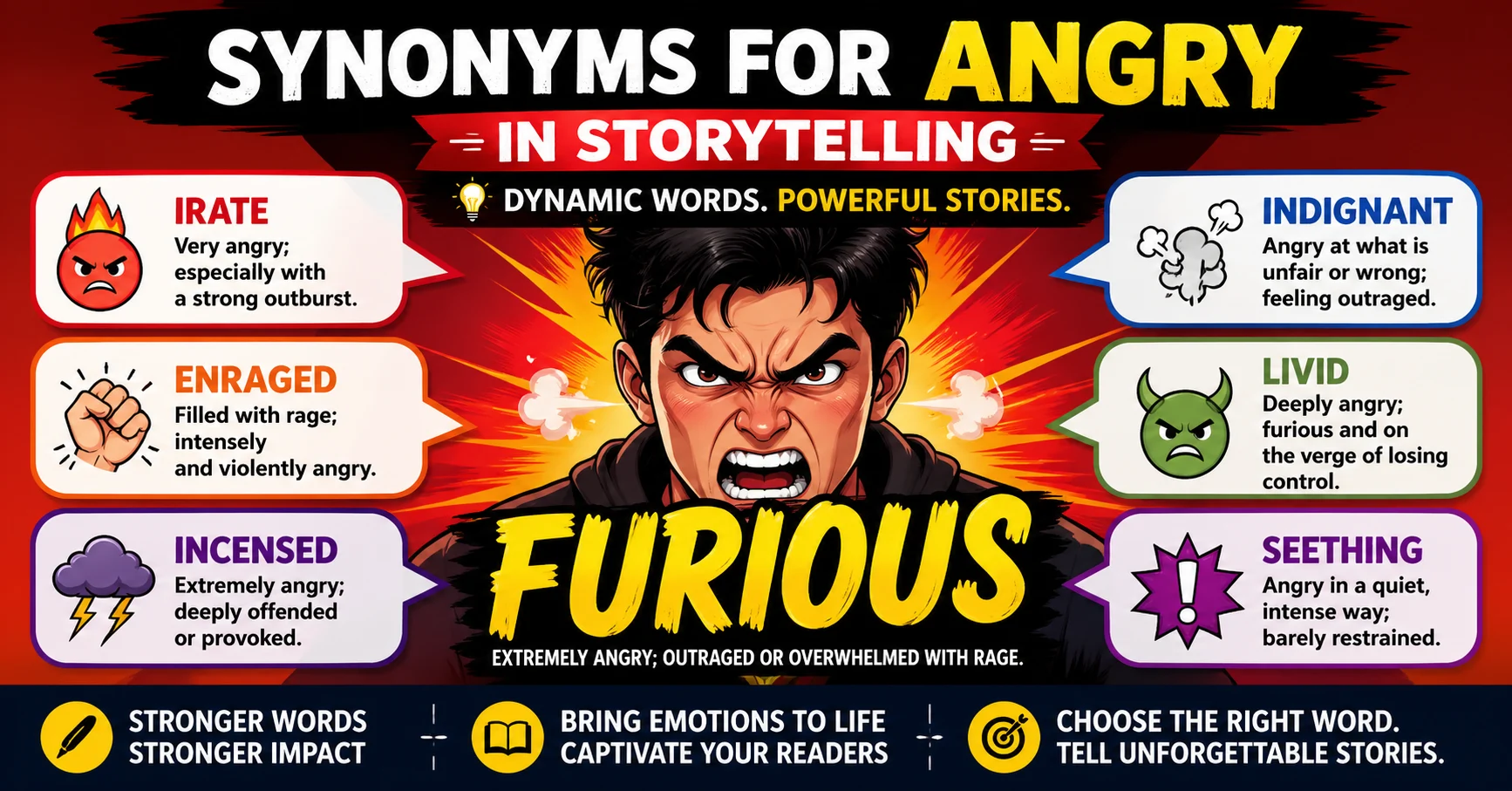
The best synonyms for angry in storytelling include words like furious, enraged, irritated, resentful, livid, and indignant. Each carries a different intensity and tone, helping you show specific emotions rather than repeating “angry.” Choosing the right synonym depends on your character’s personality, situation, and the emotional depth you want to convey.
What Does “Angry” Mean?
In storytelling, “angry” describes a strong feeling of displeasure, frustration, or hostility. It’s a broad term. Too broad, in fact.
For writers, this creates a problem. “Angry” doesn’t tell your reader:
- How intense the emotion is
- What caused it
- How it affects the character’s behavior
That’s why experienced writers rarely rely on this single word. Instead, they use more specific synonyms to create depth and realism.
Writer’s Tip: Instead of naming the emotion, combine a stronger synonym with action. For example, “She was furious” becomes “She slammed the door, her hands shaking with fury.”
Complete Synonyms List
Here are 15 powerful synonyms for angry in storytelling, grouped by intensity:
Mild Anger
- Irritated
- Annoyed
- Frustrated
Moderate Anger
- Agitated
- Resentful
- Indignant
- Cross
Strong Anger
- Furious
- Enraged
- Livid
- Outraged
- Seething
Controlled or Hidden Anger
- Bitter
- Smoldering
- Cold
These words are not interchangeable. Each adds a unique emotional shade to your writing.
Comparison Table
| Word | Simple Meaning | Best Used When | Avoid When |
| Irritated | Slightly annoyed | Minor conflict or everyday frustration | High-stakes emotional scenes |
| Frustrated | Blocked or stuck | Character faces obstacles | Sudden explosive reactions |
| Resentful | Holding long-term anger | Deep emotional tension | Quick arguments |
| Furious | Extremely angry | Intense confrontations | Calm or subtle scenes |
| Enraged | Violently angry | Loss of control | Light emotional moments |
| Livid | Explosively angry | Shock + anger combined | Gradual emotional build-up |
| Indignant | Angry at injustice | Moral or ethical conflict | Personal irritation |
| Bitter | Lingering resentment | Past trauma or grudges | Short-term anger |
| Seething | Quiet but intense anger | Suppressed emotion | Open confrontation |
| Outraged | Shocked and angry | Public or dramatic reactions | Private, internal thoughts |
Formal vs Informal Synonyms
| Formal Synonyms | Informal Synonyms |
| Indignant | Mad |
| Outraged | Ticked off |
| Resentful | Pissed (slang) |
| Incensed | Fed up |
| Irate | Worked up |
In storytelling, formal words suit narration or literary fiction, while informal ones fit dialogue and character voice.
Writer’s Tip: Match the word to your character. A teenager won’t say “indignant,” but a lawyer might.
Real Example Sentences
Here are 8 storytelling examples using different synonyms:
- She was irritated by the constant tapping on the window.
- He felt resentful after years of being ignored.
- Her voice turned sharp, indignant at the accusation.
- He was furious, his fists clenched at his sides.
- She stood there, livid, unable to speak.
- A seething anger simmered beneath his calm expression.
- He grew bitter, replaying the betrayal in his mind.
- She was outraged by the unfair decision.
Show-Don’t-Tell Example:
Instead of: “He was angry.”
Write: “He slammed the glass onto the table, eyes blazing.”
When to Use vs When NOT to Use
When to Use Synonyms for Angry
Use them when:
- You want to show emotional nuance
- Your character’s reaction needs clarity
- The scene demands intensity or realism
When NOT to Use Them
Avoid overusing synonyms when:
- Simplicity is more effective
- The emotion is already clear through action
- You risk sounding repetitive with “fancy” words
In our experience helping writers, overcomplicating emotion words often weakens storytelling. Precision beats complexity.
Common Mistakes Writers Make
Here are frequent errors:
1. Using Synonyms Interchangeably
“Furious” and “irritated” are not the same. Misusing them confuses readers.
2. Overloading the Text
Too many emotional words in one paragraph feels forced.
3. Ignoring Context
A quiet character suddenly becoming “enraged” without buildup feels unrealistic.
4. Telling Instead of Showing
Even strong synonyms need action to support them.
5. Repetition of Similar Synonyms
Switching between “furious,” “enraged,” and “livid” repeatedly doesn’t add variety—it adds noise.
Tips and Best Practices
1. Match Intensity to Scene
Use mild words for small conflicts, strong ones for climaxes.
2. Combine Words with Actions
Emotion + behavior = believable writing.
3. Consider Character Voice
Choose words your character would realistically use or feel.
4. Use Subtlety for Depth
Sometimes “seething” is more powerful than “furious.”
5. Build Emotional Progression
Let anger grow from irritation → frustration → rage.
Writer’s Tip:
Writers we work with often improve dramatically by mapping emotional escalation in scenes. Plan how anger evolves instead of jumping straight to extremes.
Frequently Asked Questions
Q1: What is the strongest synonym for angry in storytelling?
A: Words like enraged, furious, and livid are among the strongest. They show intense emotional reactions and often suggest loss of control. Use them in high-stakes scenes where the character’s anger drives action or conflict forward.
Q2: How do I choose the right synonym for angry?
A: Focus on intensity, context, and character personality. Ask yourself how strong the emotion is and why it exists. Then pick a word that matches both the situation and the character’s voice for natural storytelling.
Q3: Can I use informal synonyms in narration?
A: Yes, but only if it matches your narrative style. Informal words work well in first-person or casual storytelling. In formal or literary writing, they may feel out of place unless used intentionally for tone.
Q4: Is it better to show anger instead of using synonyms?
A: Yes, showing is often more effective. However, combining a precise synonym with action creates clarity and emotional depth. Balance both techniques to avoid flat or overly descriptive writing.
Q5: Why is “angry” considered weak in storytelling?
A: Because it’s too general. It doesn’t convey intensity, cause, or character nuance. Readers need more specific emotional cues to fully engage with the story and understand character motivations.
Q6: Are these synonyms useful for dialogue writing?
A: Absolutely. They help shape character voice and realism. However, in dialogue, it’s often better to show anger through tone and word choice rather than explicitly stating it with emotion labels.
CONCLUSION
Mastering synonyms for angry in storytelling helps you write with precision, depth, and emotional impact. Instead of relying on one generic word, you now have a range of options—from mild irritation to explosive rage. The key is choosing wisely and supporting your words with action and context.
You might also want to read our guide on synonyms for sad in storytelling to strengthen your emotional writing even further.
Keep practicing. The more you refine your word choices, the more your stories will resonate with readers.

Michael Turner is a published fiction writer and creative writing tutor with over a decade of experience helping writers find the words that make their stories breathe ( Biography ).