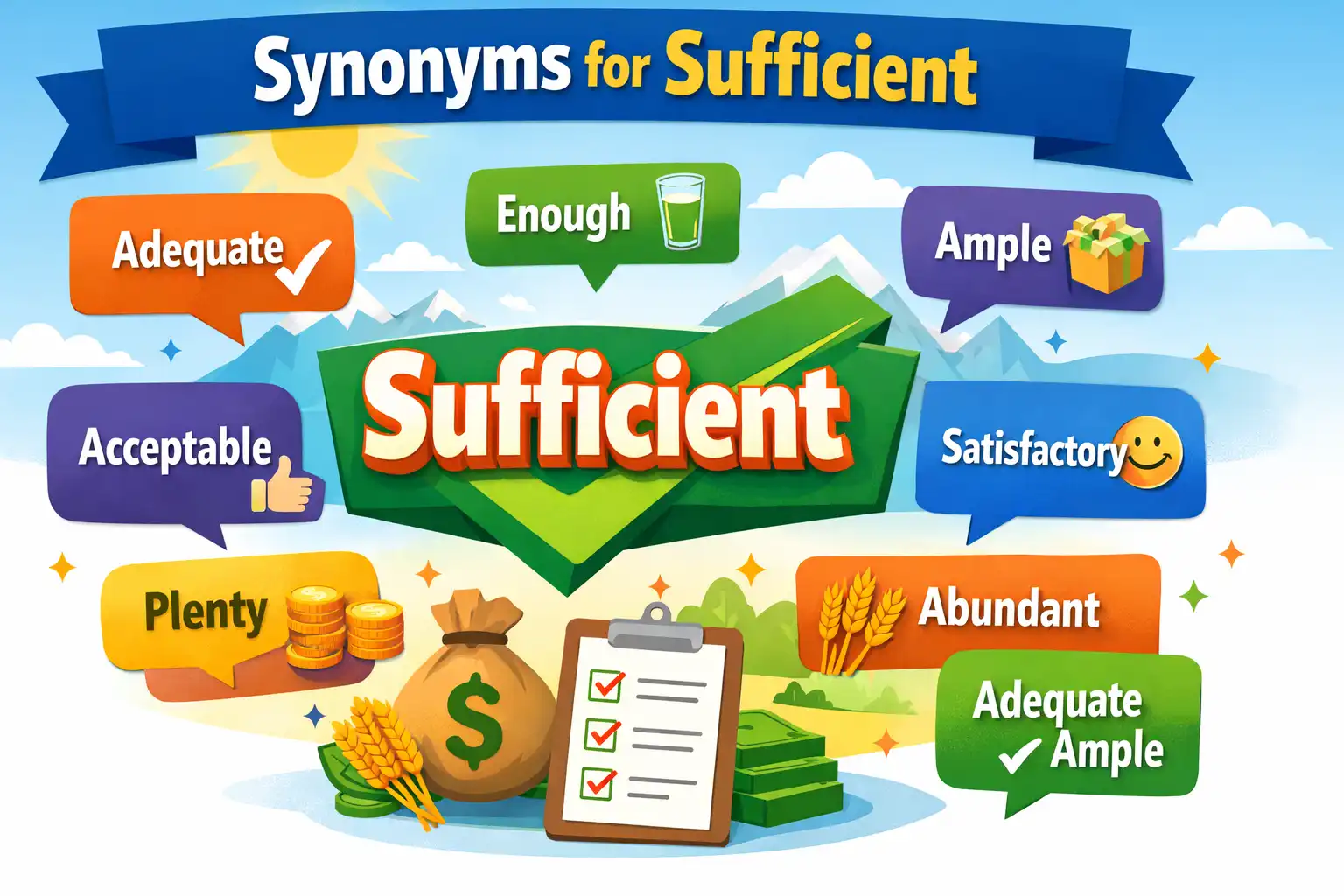
When you want to say you have enough of something, finding the right synonyms of sufficient can change everything. Using synonyms of sufficient helps you avoid repeating the same words over and over. By exploring synonyms of sufficient, you can make your sentences sound much more natural, professional, and precise.
Imagine you are baking a cake. You add just the right amount of sugar. It is not too sweet, and it is not bland. It is just right! That is exactly what we mean when we use the word “sufficient.” In simple terms, sufficient means having as much as you need of something. You do not need any more, and you are not left wanting. It is the perfect sweet spot for daily life.
Learning different words for “sufficient” is extremely helpful. For students, it makes essays sound smart and stops you from repeating the word “enough” ten times, For bloggers and content writers, it keeps readers hooked with fresh, active language that improves your search engine rankings. For daily English users, it helps you express your thoughts with perfect clarity. Keeping your sentences short, friendly, and conversational is the secret to great communication.
“Words have the power to change how we see the world, so choose them with care.”
“Precision in speech is the first step toward clarity of thought.”
Linguistic Profile of “Sufficient”
- Connotative Meaning: The word carries a neutral, objective, and practical tone. It implies that a requirement has been met perfectly, without excess or waste.
- Etymology:
- Derived from the Latin verb sufficere, which means “to put under, meet, or be adequate.”
- Passed into Middle English via the Old French word suffisant during the 14th century.
- Pronunciation (US & UK):
- US IPA:
/səˈfɪʃ.ənt/ - UK IPA:
/səˈfɪʃ.nt/
- US IPA:
- Syllables: suf-fi-cient (3 syllables)
- Affixation Pattern: Root word suffice + Adjective-forming suffix -ent.
Key Synonyms Comparison Table
| Keyword | Meaning | Usage Type | Context |
|---|---|---|---|
| Sufficient | Having enough of what is needed. | Professional / Formal | Workplace, science, academic writing |
| Enough | Equal to what is wanted or needed. | Casual / Neutral | Daily conversations, family life |
| Adequate | Good enough for a specific need. | Neutral | Business reviews, school grading |
| Ample | More than enough; plenty of space/time. | Professional / Expressive | Travel, hosting events, planning |
| Plentiful | Available in very large amounts. | Neutral / Casual | Nature, food, farming, resources |
| Satisfactory | Meeting demands or expectations. | Professional | Customer service, work performance |
“A single word can open a doorway to a thousand new ideas.”
50 Synonyms of Sufficient
1. Enough
- Pronunciation: US:
/ɪˈnʌf/, UK:/ɪˈnʌf/ - Meaning: Having as much of something as you want or need.
- Examples:
- We have enough milk for breakfast.
- She has enough time to finish her homework.
2. Adequate
- Pronunciation: US:
/ˈæd.ə.kwət/, UK:/ˈæd.ɪ.kwət/ - Meaning: Good enough for what you need to do.
- Examples:
- The old heater is adequate for this small room.
- Your school supplies are adequate for the year.
3. Ample
- Pronunciation: US:
/ˈæm.pəl/, UK:/ˈæm.pl/ - Meaning: Having plenty of something, with room to spare.
- Examples:
- There is ample parking behind the mall.
- We have ample time to catch our train.
4. Plentiful
- Pronunciation: US:
/ˈplen.tɪ.fəl/, UK:/ˈplen.tɪ.fl/ - Meaning: Available in large, healthy amounts.
- Examples:
- Fresh apples are plentiful in the autumn.
- There is a plentiful supply of clean water here.
5. Abundant
- Pronunciation: US:
/əˈbʌn.dənt/, UK:/əˈbʌn.dənt/ - Meaning: Existing in very large quantities.
- Examples:
- The jungle has abundant rain and sunlight.
- He has abundant energy even early in the morning.
6. Satisfactory
- Pronunciation: US:
/ˌsæt.ɪsˈfæk.tər.i/, UK:/ˌsæt.ɪsˈfæk.tər.i/ - Meaning: Meeting your needs or expectations in a good way.
- Examples:
- The service at the hotel was satisfactory.
- She gave a satisfactory answer to the question.
7. Decent
- Pronunciation: US:
/ˈdiː.sənt/, UK:/ˈdiː.snt/ - Meaning: Good enough to be acceptable.
- Examples:
- He earned a decent grade on his math test.
- They serve a decent cup of coffee here.
8. Acceptable
- Pronunciation: US:
/əkˈsep.tə.bəl/, UK:/əkˈsep.tə.bl/ - Meaning: Good enough that people are okay with it.
- Examples:
- Your behavior at the diner was acceptable.
- This price is acceptable for a new coat.
9. Tolerable
- Pronunciation: US:
/ˈtɑː.lɚ.ə.bəl/, UK:/ˈtɒl.ər.ə.bl/ - Meaning: Good enough to be borne or accepted, but not perfect.
- Examples:
- The noise from the street is tolerable today.
- The soup was warm and tolerable to eat.
10. Passable
- Pronunciation: US:
/ˈpæs.ə.bəl/, UK:/ˈpɑː.sə.bl/ - Meaning: Fairly good but not excellent.
- Examples:
- He speaks passable French when he travels.
- The dirt road is passable after the rain.
11. Fair
- Pronunciation: US:
/fer/, UK:/feər/ - Meaning: Moderately good or acceptable.
- Examples:
- There is a fair chance we will win today.
- She has a fair amount of work to do.
12. Satisfying
- Pronunciation: US:
/ˈsæt.ɪs.faɪ.ɪŋ/, UK:/ˈsæt.ɪs.faɪ.ɪŋ/ - Meaning: Giving you what you want or need to feel happy.
- Examples:
- A warm bowl of soup is satisfying on a cold day.
- He felt a satisfying end to his hard project.
13. Competent
- Pronunciation: US:
/ˈkɑːm.pə.t̬ənt/, UK:/ˈkɒm.pɪ.tənt/ - Meaning: Having enough skill to do a job well.
- Examples:
- She is a competent driver on busy roads.
- We need a competent mechanic to fix the truck.
14. Substantial
- Pronunciation: US:
/səbˈstæn.ʃəl/, UK:/səbˈstæn.ʃl/ - Meaning: Large or important enough to be quite valuable.
- Examples:
- He ate a substantial breakfast before his hike.
- They made substantial progress on the building.
15. Bountiful
- Pronunciation: US:
/ˈbaʊn.t̬ɪ.fəl/, UK:/ˈbaʊn.tɪ.fl/ - Meaning: Large in quantity and given generously.
- Examples:
- The farm had a bountiful harvest of corn.
- We enjoyed a bountiful feast at thanksgiving.
16. Copious
- Pronunciation: US:
/ˈkoʊ.pi.əs/, UK:/ˈkəʊ.pi.əs/ - Meaning: Existing in very large amounts.
- Examples:
- She took copious notes during the history class.
- The chef used copious amounts of fresh butter.
17. Generous
- Pronunciation: US:
/ˈdʒen.ər.əs/, UK:/ˈdʒen.ər.əs/ - Meaning: Larger than the usual size or amount.
- Examples:
- He gave a generous slice of pie to his sister.
- The room gets a generous amount of sunlight.
18. Proper
- Pronunciation: US:
/ˈprɑː.pɚ/, UK:/ˈprɒp.ər/ - Meaning: Correct, suitable, or right for a situation.
- Examples:
- You need the proper tools to build a doghouse.
- Please sit in the proper seat for the show.
19. Suitable
- Pronunciation: US:
/ˈsuː.t̬ə.bəl/, UK:/ˈsuː.tə.bl/ - Meaning: Right or appropriate for a particular purpose.
- Examples:
- This warm coat is suitable for winter weather.
- We must find a suitable time to meet.
20. Fit
- Pronunciation: US:
/fɪt/, UK:/fɪt/ - Meaning: Suitable or good enough for something.
- Examples:
- This fresh water is fit for drinking.
- The old boat is not fit for the sea.
21. Commensurate
- Pronunciation: US:
/kəˈmen.sjʊ.rət/, UK:/kəˈmen.ʃər.ət/ - Meaning: Matching in size, quality, or amount.
- Examples:
- His pay is commensurate with his hard work.
- The prize was commensurate with the difficult game.
22. Proportionate
- Pronunciation: US:
/prəˈpɔːr.ʃən.ət/, UK:/prəˈpɔː.ʃən.ət/ - Meaning: Increasing or decreasing in size to match something else.
- Examples:
- The punishment should be proportionate to the mistake.
- Your grade is proportionate to your study time.
23. Equal
- Pronunciation: US:
/ˈiː.kwəl/, UK:/ˈiː.kwəl/ - Meaning: Being the same in quantity, size, or value.
- Examples:
- Divide the cake into equal parts for everyone.
- They have equal skills in playing tennis.
24. Equivalent
- Pronunciation: US:
/ɪˈkwɪv.əl.ənt/, UK:/ɪˈkwɪv.əl.ənt/ - Meaning: Having the same value, use, or meaning.
- Examples:
- One cup of juice is equivalent to two oranges.
- A nod is equivalent to saying yes.
25. Right
- Pronunciation: US:
/raɪt/, UK:/raɪt/ - Meaning: Exactly what is needed or correct.
- Examples:
- He found the right key for the front door.
- This is the right amount of salt for the soup.
26. Appropriate
- Pronunciation: US:
/əˈproʊ.pri.ət/, UK:/əˈprəʊ.pri.ət/ - Meaning: Right or suitable for a certain time or place.
- Examples:
- Wear appropriate clothes for a job interview.
- His funny joke was not appropriate for church.
27. Reasonable
- Pronunciation: US:
/ˈriː.zən.ə.bəl/, UK:/ˈriː.zn.ə.bl/ - Meaning: Fair and not too expensive or too much.
- Examples:
- The store sells toys at a reasonable price.
- It is reasonable to expect rain in April.
28. Moderate
- Pronunciation: US:
/ˈmɑː.dɚ.ət/, UK:/ˈmɒd.ər.ət/ - Meaning: Neither too much nor too little.
- Examples:
- We had moderate success with our garden.
- He exercises a moderate amount each day.
29. Standard
- Pronunciation: US:
/ˈstæn.dɚd/, UK:/ˈstæn.dəd/ - Meaning: Regular, normal, and good enough for common use.
- Examples:
- The car comes with standard safety features.
- This is the standard size for a twin bed.
30. Full
- Pronunciation: US:
/fʊl/, UK:/fʊl/ - Meaning: Containing as much as possible, with no empty space.
- Examples:
- The glass is full of cool sweet tea.
- She gave a full report on the meeting.
31. Complete
- Pronunciation: US:
/kəmˈpliːt/, UK:/kəmˈpliːt/ - Meaning: Having all the parts that are needed.
- Examples:
- We have a complete set of clean dishes.
- His math homework is now complete.
32. Overflowing
- Pronunciation: US:
/ˌoʊ.vɚˈfloʊ.ɪŋ/, UK:/ˌəʊ.vəˈfləʊ.ɪŋ/ - Meaning: So full that things are falling out of it.
- Examples:
- Her laundry basket is overflowing with clothes.
- The lake is overflowing after the heavy storm.
33. Profuse
- Pronunciation: US:
/prəˈfjuːs/, UK:/prəˈfjuːs/ - Meaning: Given or produced in very large amounts.
- Examples:
- He offered profuse apologies for being late.
- The yard has a profuse growth of wild roses.
34. Liberal
- Pronunciation: US:
/ˈlɪb.ər.əl/, UK:/ˈlɪb.ər.əl/ - Meaning: Given in large, generous, or open amounts.
- Examples:
- She put a liberal amount of jam on her bread.
- He has a liberal attitude toward rules.
35. Plenteous
- Pronunciation: US:
/ˈplen.ti.əs/, UK:/ˈplen.ti.əs/ - Meaning: Available in large, rich quantities.
- Examples:
- They gathered a plenteous supply of firewood.
- The valley is known for its plenteous water.
36. Rich
- Pronunciation: US:
/rɪtʃ/, UK:/rɪtʃ/ - Meaning: Containing a large amount of good things.
- Examples:
- The soil here is very rich for farming.
- This chocolate cake has a rich sweet flavor.
37. Teeming
- Pronunciation: US:
/ˈtiː.mɪŋ/, UK:/ˈtiː.mɪŋ/ - Meaning: Full of things, especially living creatures.
- Examples:
- The pond is teeming with small gold fish.
- The city streets are teeming with tourists.
38. Capacious
- Pronunciation: US:
/kəˈpeɪ.ʃəs/, UK:/kəˈpeɪ.ʃəs/ - Meaning: Able to hold a lot of things inside.
- Examples:
- She carries a capacious bag for her school books.
- The van has a capacious trunk for luggage.
39. Efficient
- Pronunciation: US:
/ɪˈfɪʃ.ənt/, UK:/ɪˈfɪʃ.nt/ - Meaning: Working well without wasting time or energy.
- Examples:
- This new stove is efficient with fuel.
- She is an efficient worker in our office.
40. Effective
- Pronunciation: US:
/ɪˈfek.tɪv/, UK:/ɪˈfek.tɪv/ - Meaning: Producing the result that you want.
- Examples:
- This cold medicine is very effective.
- He came up with an effective study plan.
41. Workable
- Pronunciation: US:
/ˈwɝː.kə.bəl/, UK:/ˈwɜː.kə.bl/ - Meaning: Capable of being done or used successfully.
- Examples:
- We need a workable solution to this problem.
- The schedule they made is workable for us.
42. Functional
- Pronunciation: US:
/ˈfʌŋk.ʃən.əl/, UK:/ˈfʌŋk.ʃən.əl/ - Meaning: Designed to be useful rather than beautiful.
- Examples:
- The kitchen is small but very functional.
- These simple shoes are durable and functional.
43. Usable
- Pronunciation: US:
/ˈjuː.zə.bəl/, UK:/ˈjuː.zə.bl/ - Meaning: Safe, fit, or ready to be used.
- Examples:
- The old computer is still usable for writing.
- We have some usable scrap wood in the shed.
44. Applicable
- Pronunciation: US:
/əˈplɪk.ə.bəl/, UK:/əˈplɪk.ə.bl/ - Meaning: Right, correct, or suitable for a situation.
- Examples:
- This law is not applicable to children.
- Please fill out the applicable parts of the form.
45. Defensible
- Pronunciation: US:
/dɪˈfen.sə.bəl/, UK:/dɪˈfen.sə.bl/ - Meaning: Able to be protected or proven to be right.
- Examples:
- His decision to leave was defensible.
- They have a defensible position in the argument.
46. Valid
- Pronunciation: US:
/ˈvæl.ɪd/, UK:/ˈvæl.ɪd/ - Meaning: Based on truth, facts, or correct law.
- Examples:
- You need a valid ticket to board the train.
- He made a valid point during our discussion.
47. Sound
- Pronunciation: US:
/saʊnd/, UK:/saʊnd/ - Meaning: Solid, safe, and healthy in condition.
- Examples:
- The house has a sound roof and walls.
- He gave me some sound advice about money.
48. Solid
- Pronunciation: US:
/ˈsɑː.lɪd/, UK:/ˈsɒl.ɪd/ - Meaning: Reliable, strong, and of good quality.
- Examples:
- She has a solid understanding of basic science.
- The company has a solid reputation in town.
49. Good
- Pronunciation: US:
/ɡʊd/, UK:/ɡʊd/ - Meaning: High in quality or standard.
- Examples:
- Reading is a good habit to build.
- We had a good amount of rain last week.
50. Conclusive
- Pronunciation: US:
/kənˈkluː.sɪv/, UK:/kənˈkluː.sɪv/ - Meaning: Proving something beyond any doubt.
- Examples:
- The police found conclusive proof of his guilt.
- We have conclusive results from the medical test.
Antonyms of Sufficient
- Insufficient: Not enough to meet a need.
- Inadequate: Too small or poor in quality.
- Deficient: Lacking an essential quality or element.
- Scarce: Hard to find and very limited.
- Meager: Very small, thin, or poor.
- Lacking: Not having something that is needed.
- Short: Not reaching the needed amount or level.
- Wanting: Missing or not good enough.
Prototype Meaning and Categorization of “Sufficient”
The prototype meaning of sufficient is the basic idea of meeting a specific line or standard. It means you have exactly what is required to get a job done. It does not mean you have a huge surplus, but it guarantees you will not fail due to a lack of resources.
Categorization:
- Grammatical Category: Adjective.
- Semantic Category: Quantity, Suitability, and Adequacy.
- Contextual Category: Professional, Academic, and Technical communication.
Frequently Asked Questions
1. What is the main difference between “sufficient” and “enough”?
“Sufficient” is a more formal, academic word. “Enough” is used in everyday, casual conversations with friends and family. Both mean that you have what you need.
2. Can “sufficient” be used in casual conversations?
Yes, but it might sound a bit stiff or formal. Saying “I have enough food” is much more natural at a dinner table than saying “I have sufficient food.”
3. Is “adequate” a positive or negative synonym of sufficient?
“Adequate” is neutral. It means something is just good enough to get by. It is not excellent, but it is not bad either.
4. What is the adverb form of sufficient?
The adverb form is sufficiently. For example: “The water was sufficiently warm for swimming.”
5. How do you use “sufficient” in a professional email?
You can use it to talk about files, data, or time. For example: “Please ensure we have sufficient data before the meeting starts.”
6. What is the origin of the word “sufficient”?
It comes from the Latin word sufficere, which means “to meet a need” or “to be enough.” It entered the English language hundreds of years ago.
Conclusion
Expanding your range of vocabulary by studying synonyms of sufficient is one of the best ways to grow as a communicator. Learning these different words elevates your writing, makes your blogging much more engaging, and gives your speaking a natural boost. Instead of relying on the same simple words, you can match your tone exactly to your audience. Whether you are crafting professional work emails, polishing school essays, or enjoying daily conversations, choosing the right word builds instant confidence. Start practicing these terms today and watch your skills shine!
“To improve your language is to expand the boundaries of your world.”
“Your voice is your tool, and words are the colors you paint with.”

Michael Turner is a published fiction writer and creative writing tutor with over a decade of experience helping writers find the words that make their stories breathe ( Biography ).