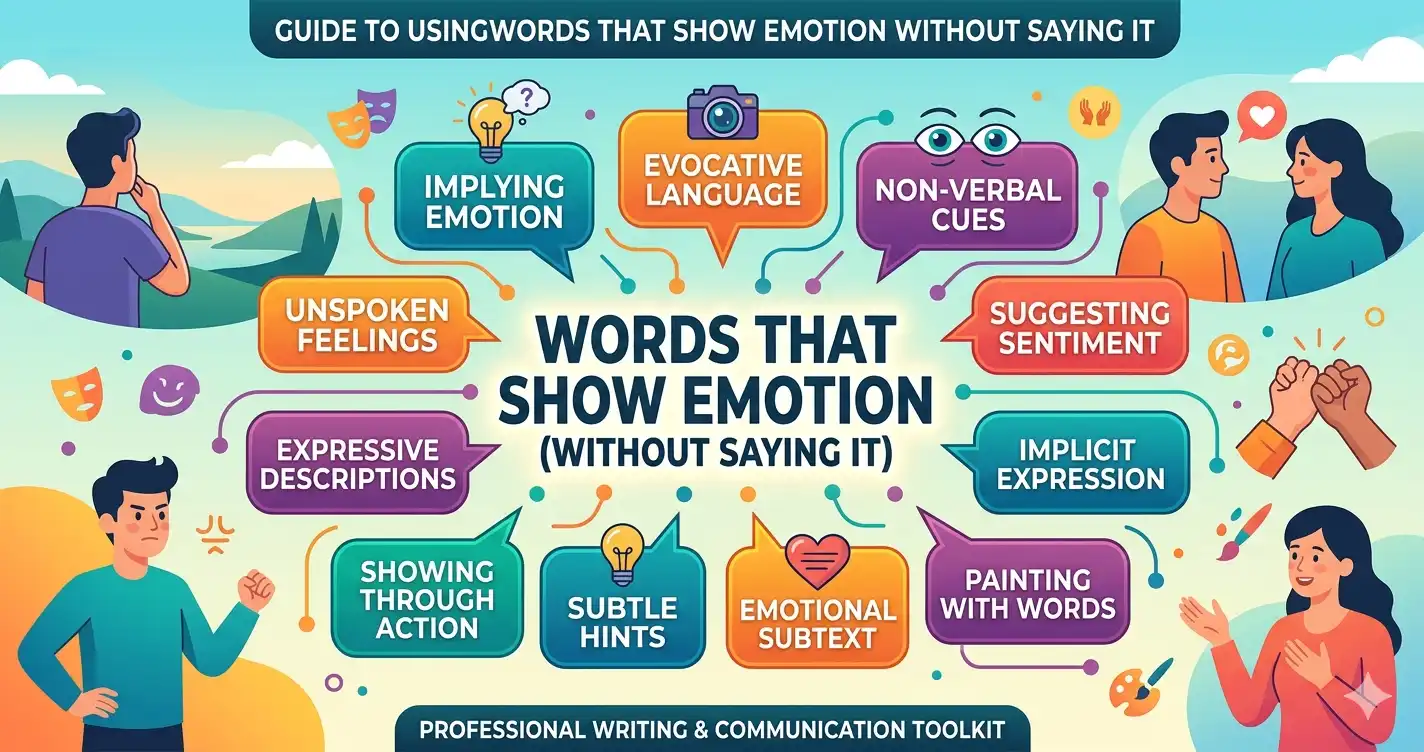
Every great writer knows one golden rule: don’t tell your reader how a character feels — show them Words That Show Emotion Without Saying It . But knowing the rule and actually doing it are two very different things. If you’ve ever written “she was nervous” or “he felt angry” and then stared at the screen wondering how to make it feel real — this guide is for you.
The secret lies in specific words, actions, and physical reactions that communicate emotion so clearly that your reader feels it without you ever naming it. When done right, your reader’s heart races alongside your character. They clench their jaw. They hold their breath.
That’s the power of showing emotion without saying it.
In this guide, you’ll find over 80 words, phrases, and action-based descriptions organized by emotion — plus real before-and-after examples so you can put them to use immediately.
Why You Should Never Just “Name” an Emotion
The biggest mistake beginner writers make is writing something like:
“She was heartbroken.” “He was furious.” “They were terrified.”
These sentences tell the reader what to feel — but they don’t let the reader experience anything. They are labels, not experiences.
When you show emotion through action, body language, and physical sensation, the reader’s brain does something remarkable: it mirrors the character’s experience. This is called neural coupling — the phenomenon where a reader’s brain activity actually synchronizes with the emotions described in vivid writing.
In short: showing emotion is not just a stylistic choice. It is neuroscience.
The “Show, Don’t Tell” Rule Explained Simply
“Show, don’t tell” means replacing emotion labels with:
- Physical sensations (a tight chest, trembling hands)
- Body language (avoiding eye contact, clenched jaw)
- Actions (slamming a door, laughing too loudly)
- Dialogue subtext (saying “I’m fine” while walking out)
- Strong, specific verbs (she bolted, not she ran quickly)
The emotion itself is never named. The reader infers it — and that inference creates emotional connection.
Words That Show Anger Without Saying “Angry”
Anger is one of the most commonly told emotions in writing. Here’s how to show it instead.
Body Language and Actions That Show Anger
- Jaw tightened
- Nostrils flared
- Fists clenched at his sides
- Knuckles turned white
- She set the glass down harder than necessary
- He laughed — but it didn’t reach his eyes
- Muscles along his neck went rigid
- She turned away before he could see her expression
- Veins visible at the temple
- Teeth pressed together behind sealed lips
- He cut her off mid-sentence
Strong Verbs That Show Anger
Slammed, snapped, barked, glared, stormed, shoved, seethed, snarled, spat (words), gritted
Before: He was very angry when she said that.
After: He set the phone face-down on the table without a word. His jaw worked silently. When he finally spoke, his voice came out flat — the kind of flat that meant everything underneath was being held back by a thread.
Words That Show Sadness Without Saying “Sad”
Physical Signs That Reveal Sadness
- Eyes shining (but not sparkling)
- Throat tight, swallowing hard
- She stared at the ceiling instead of answering
- He smiled, but it looked like it cost him something
- She laughed a little too quickly, then went quiet
- His shoulders curved inward
- Dragging footsteps, heavy and slow
- Pressing lips together until they went pale
- Looking away whenever a particular name came up
- Letting long silences sit without filling them
Actions That Reveal Sadness
- Picking up an old photograph and putting it back without comment
- Pouring coffee and forgetting to drink it
- Laughing at something that isn’t funny, then stopping suddenly
- Fiddling with a ring, a bracelet, a hem — anything to keep hands busy
Before: She was sad about her mother’s death.
After: She kept finding herself in the kitchen at odd hours, boiling water for tea she never made. The chair at the end of the table still had her mother’s cardigan draped over it. She hadn’t moved it. She didn’t know why.
Words That Show Fear Without Saying “Afraid”
Physical Words That Communicate Fear
- Heart lurching
- Stomach dropping
- Skin prickling at the back of the neck
- Breath caught in the throat
- Hands gone suddenly cold
- A sharp intake of breath
- Her body went still — the kind of still that comes before running
- He pressed himself against the wall without knowing he’d moved
- Pulse visible at the throat
- Pupils dilating
- The urge to look behind her every few seconds
Action Words That Reveal Fear
Froze, recoiled, flinched, retreated, stumbled backward, scanned (the room), gripped (the doorframe), whispered (when there was no reason to whisper)
Before: He was scared of what might happen next.
After: He didn’t move. His eyes went to the door — one second, two — and then back. His fingers found the edge of the counter and stayed there.
H2: Words That Show Happiness or Joy Without Saying “Happy”
Joy is the emotion most writers accidentally over-tell. Here’s how to show it with precision.
Physical Signs of Joy and Happiness
- Shoulders dropping — the kind of relaxing that happens when you didn’t realize you were tense
- Breathing coming easier
- A laugh that arrived before she expected it
- Cheeks aching from a smile held too long
- Eyes crinkling at the corners
- She moved faster, lighter
- He talked with his hands more than usual
- She kept starting sentences she didn’t finish because her thoughts ran ahead of her words
- He whistled — soft and almost unconscious
Words and Verbs That Convey Joy
Beamed, bounded, hummed, glowed, bubbled (over), sparkled (used specifically for eyes), radiated, grinned (distinct from smiled — wider, less controlled)
Before: She was so happy she could barely contain herself.
After: She laughed at something that wasn’t quite funny, then covered her mouth with both hands, eyes wide — like the joy had surprised even her.
Words That Show Love Without Saying “In Love”
Actions That Show Love Without Naming It
- Noticing things no one else notices — the way she tilts her head, the rhythm of her laugh
- Remembering exactly what she ordered at a restaurant three months ago
- Making space for them in a crowd without thinking about it
- Staying quiet just to keep them talking
- Watching them when they’re not watching back
- Rearranging plans without mentioning it
- Finding reasons to stay in the same room
- The specific softness that enters his voice only for her
- She asked how his day went — and then actually listened
Before: He had fallen in love with her.
After: He found himself checking his phone less when she was in the room. He couldn’t explain it exactly. Things were just quieter. Like a noise he’d been hearing so long he’d forgotten it was there had finally stopped.
Words That Show Nervousness and Anxiety Without Saying It
Physical Signs of Nervousness in Writing
- Hands clasped too tightly in the lap
- Checking the clock, then checking it again thirty seconds later
- Rehearsing sentences in her head before speaking them
- Saying “anyway” or “so” to fill a silence she couldn’t stand
- Laughing at the wrong moment
- Picking at a cuticle, a loose thread, a pen cap
- Shoulders inching toward ears
- A voice pitched slightly higher than usual
- Taking a breath before starting a sentence — every sentence
Strong Verbs That Show Anxiety
Fidgeted, stammered, hesitated, stumbled (over words), paced, glanced (repeatedly), trailed off, rushed
Before: She was nervous before her presentation.
After: She went over the first sentence in her head for the fourth time. Her notes were in order. She knew they were in order. She checked anyway.
Power Verbs That Show Emotion Without Naming It
The single fastest way to upgrade your emotional writing is to replace weak verb + adverb combinations with one strong verb.
| Weak Version | Strong Verb That Shows Emotion |
| Walked quickly (anger) | Stormed, marched, barreled |
| Said loudly (excitement) | Burst out, exclaimed, gushed |
| Looked sadly | Gazed, stared, lingered |
| Ran away (fear) | Bolted, fled, scrambled |
| Smiled happily | Beamed, grinned, lit up |
| Cried a little (grief) | Crumpled, broke, dissolved |
| Spoke quietly (guilt) | Murmured, confessed, admitted |
| Touched gently (love) | Caressed, brushed, cradled |
Dialogue Subtext — Showing Emotion Through What Characters Don’t Say
Real people rarely say exactly what they feel. Characters shouldn’t either.
Subtext means the emotion lives underneath the words — in what is avoided, shortened, or left hanging.
| What’s Said | What It Shows |
| “I’m fine.” | They are not fine. |
| “Whatever you think is best.” | Resignation, possibly resentment |
| “No, it’s — it’s nothing.” | It is very much something. |
| “Good for you.” (flat) | Envy or bitterness |
| “Sure.” (pause) “Sure.” | Uncertainty masked as agreement |
| Silence after a direct question | The answer is painful to say |
| Changing the subject | Avoidance of something unbearable |
Frequently Asked Questions
What are words that show emotion without naming it called?
In writing craft, this technique is called “showing” or “Show, Don’t Tell.” The words and phrases used are called emotional body language cues, action beats, or physical emotion descriptors.
How do you show sadness in writing without saying sad?
Show sadness through physical responses (throat tightening, eyes shining, heavy posture), actions (ignoring food, going quiet, laughing at wrong moments), and subtext (short answers, long silences, avoiding specific topics).
What is a word for a feeling you can’t describe?
The word ineffable means a feeling too great or extreme to be expressed in words. Other related words include indescribable, nameless, and unspeakable. Languages like German (Weltschmerz, Schadenfreude) and Japanese (mono no aware) also have untranslatable emotion words.
How do you write anger without using the word angry?
Use physical cues: clenched jaw, rigid posture, controlled voice, short sentences, deliberate movements. Strong action verbs like slammed, snapped, glared, stormed, and barked also convey anger without naming it.
What is the difference between showing and telling emotion?
Telling: “He was nervous.” Showing: “He answered before she finished her question, then immediately regretted it.” Showing places the reader inside the experience. Telling hands them a label from the outside.
Final Takeaway — The 3-Step Rule for Showing Any Emotion
Whenever you catch yourself writing a named emotion — sad, angry, scared, happy — pause and ask three questions:
1. What does this emotion do to the body? (Heart pounds, hands shake, shoulders drop, stomach drops)
2. What does this emotion make the person do or avoid doing? (Slam a door, go quiet, laugh too loud, refuse to make eye contact)
3. What would this person say — and what would they leave unsaid? (Short answers, changed subjects, sentences that trail off)
Answer those three questions, and you will never need to name the emotion again. Your reader will feel it — which is always more powerful than being told.

Michael Turner is a published fiction writer and creative writing tutor with over a decade of experience helping writers find the words that make their stories breathe ( Biography ).