
Introduction
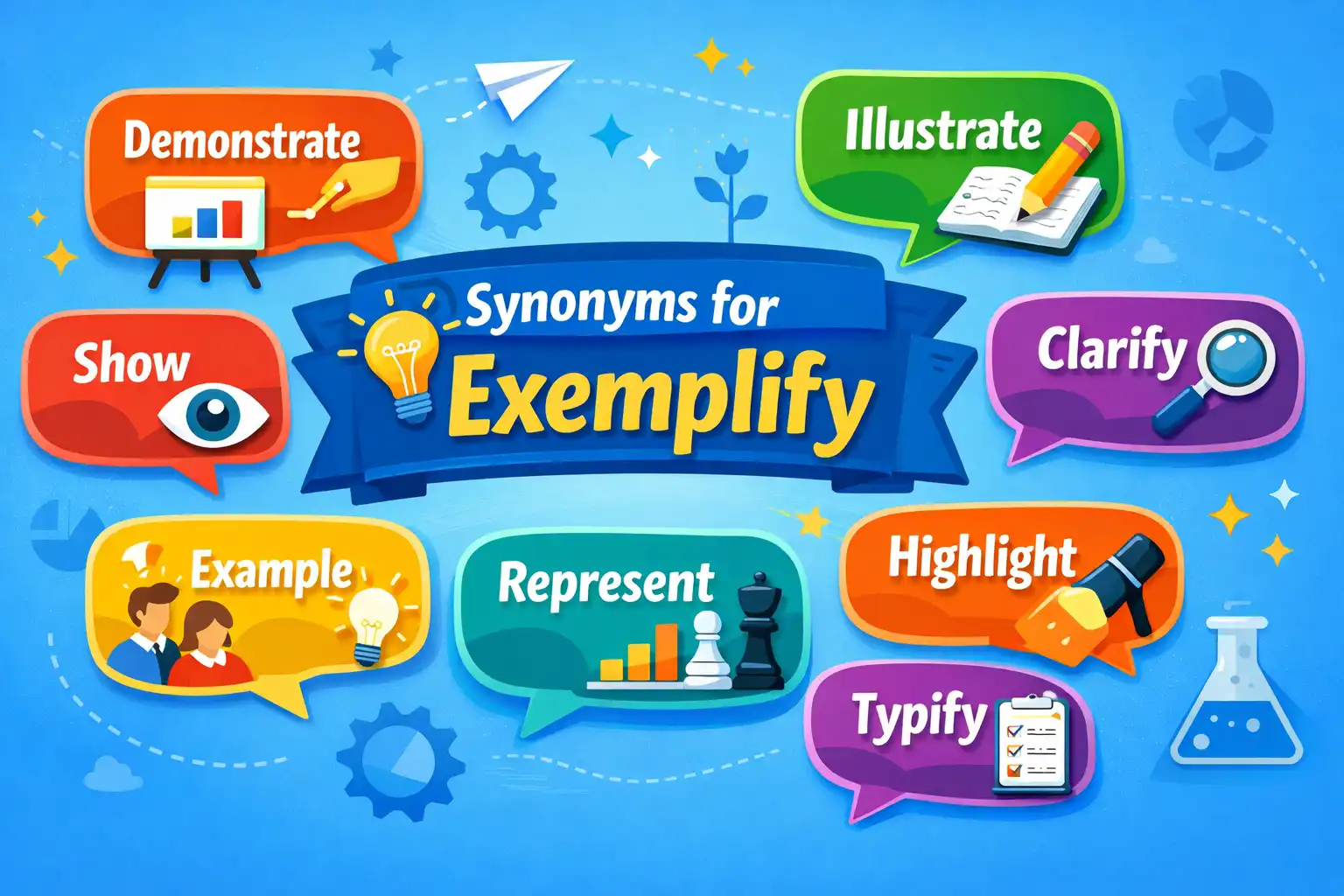
Using synonyms for exemplify is the easiest way to make your language sound strong. When you choose synonyms for exemplify, you show your ideas instead of just explaining them. Learning how to select proper synonyms for exemplify will help you turn dry, repetitive writing into clear and lively sentences. Many writers make the mistake of using the exact same words over and over. By using simple, fresh, and direct terms, you keep your audience focused on your message from start to finish.
Imagine you are trying to explain how a loyal dog behaves. If you say that the dog’s actions “exemplify” loyalty, your sentence is correct but a bit stiff. But if you write that the dog’s actions “embody” loyalty, the scene feels much warmer and more natural. The word “embody” is a strong choice that helps the reader feel the physical reality of the behavior. This simple shift in your word choice makes your ideas stand out.
“The right word is a powerful tool that turns simple ideas into lasting memories.”
“Do not merely state your truth; choose words that paint it clearly on the page.”
These action-oriented vocabulary options are highly useful for many different people:
- Students: You can write high-quality essays that impress your teachers, satisfy exam rubrics, and help you get top grades.
- Bloggers: You can write exciting blog posts that keep your readers scrolling and sharing your content.
- Content Writers: You can describe products, services, and brand values in a way that makes customers want to buy.
- Daily English Users: You can speak with more confidence and explain your thoughts clearly to friends and coworkers.
Linguistic Details of “Synonyms for Exemplify”
Let us look closely at the linguistics of this focus word in a very simple and clear way.
- Connotative Meaning: “Exemplify” carries a professional and clear feeling. It brings to mind images of perfect models, clear proof, teaching, and showing high standards.
- Etymology:
- Exemplify comes from the Medieval Latin word exemplificare, which means to illustrate by examples.
- This comes from exemplum (an example) and facere (to make or do).
- Pronunciation:
- Exemplify: US:
/ɪɡˈzem.plə.faɪ/| UK:/ɪɡˈzem.plɪ.faɪ/
- Exemplify: US:
- Syllables: ex-em-pli-fy (4 syllables).
- Affixation Pattern: Root word exemplar with the common Latin suffix -ify (which means to make or become).
Comparison Table
Here is a quick guide to help you choose the best word for your specific writing context.
| Keyword | Meaning | Usage Type | Context |
|---|---|---|---|
| Exemplify | To serve as a perfect example of something. | Professional / Formal | Academic essays, official business reports, and legal writing |
| Embody | To give a physical form or clear shape to an idea. | Emotional / Casual | Creative storytelling, personal brand descriptions, and daily talk |
| Illustrate | To make something clear by using examples or pictures. | Professional / Casual | Teaching, blog posts, explaining complex charts, and manuals |
| Represent | To speak or act on behalf of a group or concept. | Professional / Formal | Public speeches, political debates, and formal legal cases |
| Epitomize | To be a perfect, typical example of a quality. | Professional / Formal | Literary reviews, high-end branding, and character descriptions |
| Show | To let something be seen clearly by others. | Casual | Daily conversations, quick notes, and simple explanations |
“A single precise word can explain a concept better than a long paragraph of fluff.”
50 Synonyms for Exemplify
Here is the ultimate list of 50 synonyms you can use to bring your stories and essays to life.
1. Illustrate
- Pronunciation: US:
/ˈɪl.ə.streɪt/| UK:/ˈɪl.ə.streɪt/ - Meaning: To make something clear by giving a visual or written example.
- Examples:
- Let me draw a simple chart to illustrate this point.
- He used a funny story to illustrate his main idea.
2. Embody
- Pronunciation: US:
/ɪmˈbɑː.di/| UK:/ɪmˈbɒd.i/ - Meaning: To represent a quality or an idea in a clear, physical way.
- Examples:
- The brave soldier seemed to embody true courage.
- Our new school rules embody respect for everyone.
3. Epitomize
- Pronunciation: US:
/ɪˈpɪt̬.ə.maɪz/| UK:/ɪˈpɪt.ə.maɪz/ - Meaning: To be a perfect or typical example of something.
- Examples:
- These clean streets epitomize the pride of our town.
- His hard work and kind heart epitomize a good leader.
4. Represent
- Pronunciation: US:
/ˌrep.rɪˈzent/| UK:/ˌrep.rɪˈzent/ - Meaning: To stand for or be a sign of something else.
- Examples:
- The five bright stars represent the five team members.
- Green trees usually represent life and fresh growth.
5. Demonstrate
- Pronunciation: US:
/ˈdem.ən.streɪt/| UK:/ˈdem.ən.streɪt/ - Meaning: To show clearly that something is true by using proof or action.
- Examples:
- She will demonstrate how to cook the sweet apple pie.
- His high test scores demonstrate his love for learning.
6. Depict
- Pronunciation: US:
/dɪˈpɪkt/| UK:/dɪˈpɪkt/ - Meaning: To show someone or something in a picture, painting, or story.
- Examples:
- The old books depict life in a quiet country village.
- He tried to depict his deep sadness in the poem.
7. Manifest
- Pronunciation: US:
/ˈmæn.ə.fest/| UK:/ˈmæn.ɪ.fest/ - Meaning: To show a quality or feeling clearly through your actions.
- Examples:
- Fear began to manifest as a shake in his hands.
- She tried to manifest her joy by smiling at everyone.
8. Mirror
- Pronunciation: US:
/ˈmɪr.ɚ/| UK:/ˈmɪr.ə(r)/ - Meaning: To be very similar to something else or show it clearly.
- Examples:
- The child’s happy face seemed to mirror his father’s smile.
- These new sales figures mirror our success this year.
9. Typify
- Pronunciation: US:
/ˈtɪp.ə.faɪ/| UK:/ˈtɪp.ɪ.faɪ/ - Meaning: To be a very typical feature or example of something.
- Examples:
- These red brick houses typify the old city style.
- High waves typify the dangerous winter storms here.
10. Symbolize
- Pronunciation: US:
/ˈsɪm.bə.laɪz/| UK:/ˈsɪm.bə.laɪz/ - Meaning: To represent something by using a special image or sign.
- Examples:
- White doves symbolize peace and love around the world.
- The ring is used to symbolize their long marriage.
11. Display
- Pronunciation: US:
/dɪˈspleɪ/| UK:/dɪˈspleɪ/ - Meaning: To put something in a place where people can see it easily.
- Examples:
- The local museum will display his beautiful art.
- He did not display any fear during the scary storm.
12. Clarify
- Pronunciation: US:
/ˈklær.ə.faɪ/| UK:/ˈklær.ɪ.faɪ/ - Meaning: To make something clear and easy for others to understand.
- Examples:
- Please clarify what you mean by that comment.
- She wrote a quick note to clarify the task rules.
13. Prove
- Pronunciation: US:
/pruːv/| UK:/pruːv/ - Meaning: To show that something is true by using facts or evidence.
- Examples:
- You must prove that you can do the job well.
- These heavy footprints prove that a bear was here.
14. Detail
- Pronunciation: US:
/dɪˈteɪl/| UK:/ˈdiː.teɪl/ - Meaning: To describe something fully by listing all its parts.
- Examples:
- The report will detail the cost of the new building.
- She began to detail her plans for the summer trip.
15. Evince
- Pronunciation: US:
/ɪˈvɪns/| UK:/ɪˈvɪns/ - Meaning: To show a feeling or a quality clearly in your behavior.
- Examples:
- The young boy did not evince any interest in the game.
- Her dark eyes evince a deep and quiet wisdom.
16. Portray
- Pronunciation: US:
/pɔːrˈtreɪ/| UK:/pɔːˈtreɪ/ - Meaning: To describe or show a person or thing in a specific way.
- Examples:
- The news articles portray the leader as a kind man.
- He wanted to portray the beauty of the wild forest.
17. Exhibit
- Pronunciation: US:
/ɪɡˈzɪb.ɪt/| UK:/ɪɡˈzɪb.ɪt/ - Meaning: To show a quality, sign, or feeling so that it is noticed.
- Examples:
- Patients may exhibit a mild fever with this cold.
- The young dog started to exhibit signs of training.
18. Highlight
- Pronunciation: US:
/ˈhaɪ.laɪt/| UK:/ˈhaɪ.laɪt/ - Meaning: To attract attention to an important part of something.
- Examples:
- I want to highlight the main points on this page.
- The teacher used a yellow pen to highlight my mistakes.
19. Characterize
- Pronunciation: US:
/ˈkær.ək.tə.raɪz/| UK:/ˈkær.ək.tə.raɪz/ - Meaning: To describe the most typical qualities of something.
- Examples:
- Bright colors characterize the art of this sunny country.
- Heavy rains characterize the weather during this season.
20. Personify
- Pronunciation: US:
/pɚˈsɑː.nə.faɪ/| UK:/pəˈsɒn.ɪ.faɪ/ - Meaning: To be a perfect example of a human quality or trait.
- Examples:
- She seemed to personify kindness in everything she did.
- The ancient tales personify the wind as a fast runner.
21. Elucidate
- Pronunciation: US:
/iˈluː.sə.deɪt/| UK:/iˈluː.sɪ.deɪt/ - Meaning: To make something very clear by explaining it in detail.
- Examples:
- He will write a long paper to elucidate this theory.
- Can you please elucidate your plans for the new project?
22. Describe
- Pronunciation: US:
/dɪˈskraɪb/| UK:/dɪˈskraɪb/ - Meaning: To say or write what someone or something is like.
- Examples:
- Please describe the lost dog so we can find him.
- It is hard to describe the beauty of the mountains.
23. Suggest
- Pronunciation: US:
/səˈdʒest/| UK:/səˈdʒest/ - Meaning: To show that something is likely or true in an indirect way.
- Examples:
- These dark grey clouds suggest that rain is coming soon.
- His quiet tone of voice may suggest that he is sad.
24. Indicate
- Pronunciation: US:
/ˈɪn.də.keɪt/| UK:/ˈɪn.dɪ.keɪt/ - Meaning: To point out or show something clearly to others.
- Examples:
- Red signs on the road indicate that you must stop.
- Research results indicate that exercise is good for you.
25. Externalize
- Pronunciation: US:
/ɪkˈstɝː.nə.laɪz/| UK:/ekˈstɜː.nə.laɪz/ - Meaning: To show your inner feelings through your outward behavior.
- Examples:
- It is healthier to externalize your anger than hide it.
- Children often externalize their fears through loud play.
26. Objectify
- Pronunciation: US:
/əbˈdʒek.tə.faɪ/| UK:/əbˈdʒek.tɪ.faɪ/ - Meaning: To express an abstract idea in a physical or concrete form.
- Examples:
- The artist tried to objectify his dreams using clay.
- Writers often objectify feelings by describing real items.
27. Model
- Pronunciation: US:
/ˈmɑː.dəl/| UK:/ˈmɒd.əl/ - Meaning: To design or do something by copying a good example.
- Examples:
- You should model your behavior on your kind parents.
- We will model our new store after the successful one.
28. Standardize
- Pronunciation: US:
/ˈstæn.dɚ.daɪz/| UK:/ˈstæn.də.daɪz/ - Meaning: To make things fit a set standard or example.
- Examples:
- The school wants to standardize the test rules for all.
- They need to standardize the sizes of the food boxes.
29. Instanciate
- Pronunciation: US:
/ɪnˈstæn.ʃi.eɪt/| UK:/ɪnˈstæn.ʃi.eɪt/ - Meaning: To represent an abstract concept with a concrete case.
- Examples:
- We can instanciate this rule by looking at his case.
- The lawyer tried to instanciate the law with real facts.
30. Define
- Pronunciation: US:
/dɪˈfaɪn/| UK:/dɪˈfaɪn/ - Meaning: To explain the exact meaning of a word or idea.
- Examples:
- The dictionary will define the meaning of the word.
- Clear goals help to define your path to success.
31. Explain
- Pronunciation: US:
/ɪkˈspleɪn/| UK:/ɪkˈspleɪn/ - Meaning: To make something clear by giving reasons or details.
- Examples:
- Let me explain why the window is broken.
- He tried to explain the math problem to his sister.
32. Outline
- Pronunciation: US:
/ˈaʊt.laɪn/| UK:/ˈaʊt.laɪn/ - Meaning: To give a short description of the main parts of something.
- Examples:
- She wrote a quick draft to outline her essay ideas.
- The boss will outline the project goals tomorrow.
33. Emblematize
- Pronunciation: US:
/ˈem.blə.mə.taɪz/| UK:/ˈem.blə.mə.taɪz/ - Meaning: To serve as an emblem or a special symbol of something.
- Examples:
- These historic ruins emblematize the old empire.
- The yellow rose is used to emblematize true friendship.
34. Cite
- Pronunciation: US:
/saɪt/| UK:/saɪt/ - Meaning: To write or speak words from a book as an example.
- Examples:
- You must cite your sources in your school essay.
- He loved to cite lines from his favorite movie.
35. Reveal
- Pronunciation: US:
/rɪˈviːl/| UK:/rɪˈviːl/ - Meaning: To let something secret or hidden be seen by others.
- Examples:
- He pulled back the curtain to reveal the painting.
- She did not reveal the secret to her best friend.
36. Showcase
- Pronunciation: US:
/ˈʃoʊ.keɪs/| UK:/ˈʃəʊ.keɪs/ - Meaning: To display the best qualities of something in an attractive way.
- Examples:
- The fair is a great way to showcase our local food.
- She wanted to showcase her talent at the talent show.
37. Express
- Pronunciation: US:
/ɪkˈspres/| UK:/ɪkˈspres/ - Meaning: To show a feeling or opinion by using words or actions.
- Examples:
- He used a warm hug to express his thanks.
- She found it easy to express her ideas in writing.
38. Evidentiate
- Pronunciation: US:
/ev.ɪˈden.ʃi.eɪt/| UK:/ev.ɪˈden.ʃi.eɪt/ - Meaning: To make something clear by presenting direct evidence.
- Examples:
- The documents help to evidentiate his claim to the land.
- She used photos to evidentiate her story about the trip.
39. Emphasize
- Pronunciation: US:
/ˈem.fə.saɪz/| UK:/ˈem.fə.saɪz/ - Meaning: To show that something is very important or needs attention.
- Examples:
- The teacher wanted to emphasize the need for quiet.
- He raised his voice to emphasize the key word.
40. Introduce
- Pronunciation: US:
/ˌɪn.trəˈduːs/| UK:/ˌɪn.trəˈdʒuːs/ - Meaning: To present a person, thing, or idea for the first time.
- Examples:
- Let me introduce my brother to the group.
- The school will introduce a new computer class.
41. Expose
- Pronunciation: US:
/ɪkˈspoʊz/| UK:/ɪkˈspəʊz/ - Meaning: To show something hidden or secret by removing its cover.
- Examples:
- The dry weather will expose the rocks in the river.
- They wanted to expose the truth about the bad company.
42. Feature
- Pronunciation: US:
/ˈfiː.tʃɚ/| UK:/ˈfiː.tʃə(r)/ - Meaning: To include someone or something as an important part.
- Examples:
- The new show will feature famous singers.
- The local menu does feature fresh mountain water.
43. Document
- Pronunciation: US:
/ˈdɑː.kjə.ment/| UK:/ˈdɒk.jə.ment/ - Meaning: To record the details of an event with pictures or writing.
- Examples:
- He used a camera to document his long walk.
- She started to document the growth of her plants.
44. Establish
- Pronunciation: US:
/ɪˈstæb.lɪʃ/| UK:/ɪˈstæb.lɪʃ/ - Meaning: To show that something is true or accepted by using facts.
- Examples:
- We must establish the facts before we make a choice.
- They used old letters to establish the family history.
45. Display
- Pronunciation: US:
/dɪˈspleɪ/| UK:/dɪˈspleɪ/ - Meaning: To show a quality, feeling, or behavior clearly.
- Examples:
- The children display great joy when they play.
- He did display excellent manners during dinner.
46. Concrete
- Pronunciation: US:
/ˈkɑːn.kriːt/| UK:/ˈkɒn.kriːt/ - Meaning: To make an abstract idea clear, real, and specific.
- Examples:
- We need to concrete our plans with real dates.
- She used real objects to concrete her teaching.
47. Emblazon
- Pronunciation: US:
/ɪmˈbleɪ.zən/| UK:/ɪmˈbleɪ.zən/ - Meaning: To display a design or symbol very clearly and brightly.
- Examples:
- They will emblazon the team name on the blue shirts.
- Gold stars emblazon the ceiling of the old church.
48. Mark
- Pronunciation: US:
/mɑːrk/| UK:/mɑːk/ - Meaning: To be a clear sign or indicator of an event or quality.
- Examples:
- These grey hairs mark the passage of many years.
- Let us mark this special day with a big party.
49. Signify
- Pronunciation: US:
/ˈsɪɡ.nə.faɪ/| UK:/ˈsɪɡ.nɪ.faɪ/ - Meaning: To be a sign of or show a specific meaning.
- Examples:
- A red light does signify that you must wait.
- Her nod of the head seemed to signify agreement.
50. Exemplar
- Pronunciation: US:
/ɪɡˈzem.plɑːr/| UK:/ɪɡˈzem.plɑː(r)/ - Meaning: To act as a perfect model or copy for other things.
- Examples:
- His actions exemplar the best values of our group.
- We must exemplar good behavior for the children.
Antonyms of “Exemplify”
If you do not want to show, prove, or act as a clear example of an idea, you might do the opposite. Here are the main antonyms for this focus word:
- Conceal: To hide something completely so that others cannot see or know it.
- Obscure: To make something unclear, dark, or difficult for people to understand.
- Confuse: To mix up facts or ideas so that they do not make sense.
- Distort: To change the shape or truth of something in a bad way.
- Hide: To put something in a secret place where it cannot be found.
Prototype Meaning and Categorization
In the study of grammar and language, synonyms for exemplify fit under the main category of Representational Showing.
- Core Meaning (Prototype): The act of serving as a clear, visible, and perfect model of an idea so that others can understand it instantly.
- Semantic Category: Lexical Verbs / Demonstrative Action Words.
- Cognitive Frame: An object or action (the model) displays a clear quality (the trait), which makes an abstract idea simple and real for the observer (the understanding).
“To choose the perfect word is to give your thoughts a physical presence in the world.”
FAQs
1. What does the word exemplify mean in simple terms?
It means to be a perfect example of a quality or idea. When you do something that shows a trait clearly, you exemplify that trait.
2. Why should I use synonyms for exemplify in my essays?
Using different words keeps your writing interesting. It stops you from repeating the same word, which makes your essays sound more professional and intelligent.
3. Is the word exemplify formal or casual?
It is a formal word. It is used most often in school essays, business reports, and news articles rather than daily casual talk.
4. What is the difference between exemplify and embody?
Exemplify means to act as a clear example of a concept. Embody means to give that concept a physical body or shape in the real world.
5. Can a person exemplify a trait?
Yes. A person can exemplify a trait like kindness or bravery by acting in a way that shows those traits perfectly to other people.
6. How do strong synonyms improve search engine optimization (SEO)?
They help search engines understand the theme of your article. By using natural keyword variations, you can match different search queries without stuffing the text.
7. What is a good casual alternative to exemplify?
The word “show” is the best casual alternative. It is short, simple, and understood by everyone in daily conversations.
Conclusion
Learning to use different synonyms for exemplify is a fantastic way to upgrade your communication skills. When you replace repetitive words with active, specific verbs, you capture the minds of your audience. Your writing will feel faster, look brighter, and read much better. This is highly true whether you are writing an essay for school, blogging online, speaking to a large crowd, or just chatting with your close friends.
We invite you to practice these active words every single day. Try writing one strong verb in your next email. Put a fresh action word in your school homework. Use them when you describe a movie to your family. You will quickly see that your English sounds much more natural, powerful, and professional!
“The words you choose have the power to turn a simple draft into an unforgettable journey.”
“Speak with action, write with force, and watch your words change the world.”
“A story without strong verbs is like a painting without color; choose your action words wisely.”

Michael Turner is a published fiction writer and creative writing tutor with over a decade of experience helping writers find the words that make their stories breathe ( Biography ).