
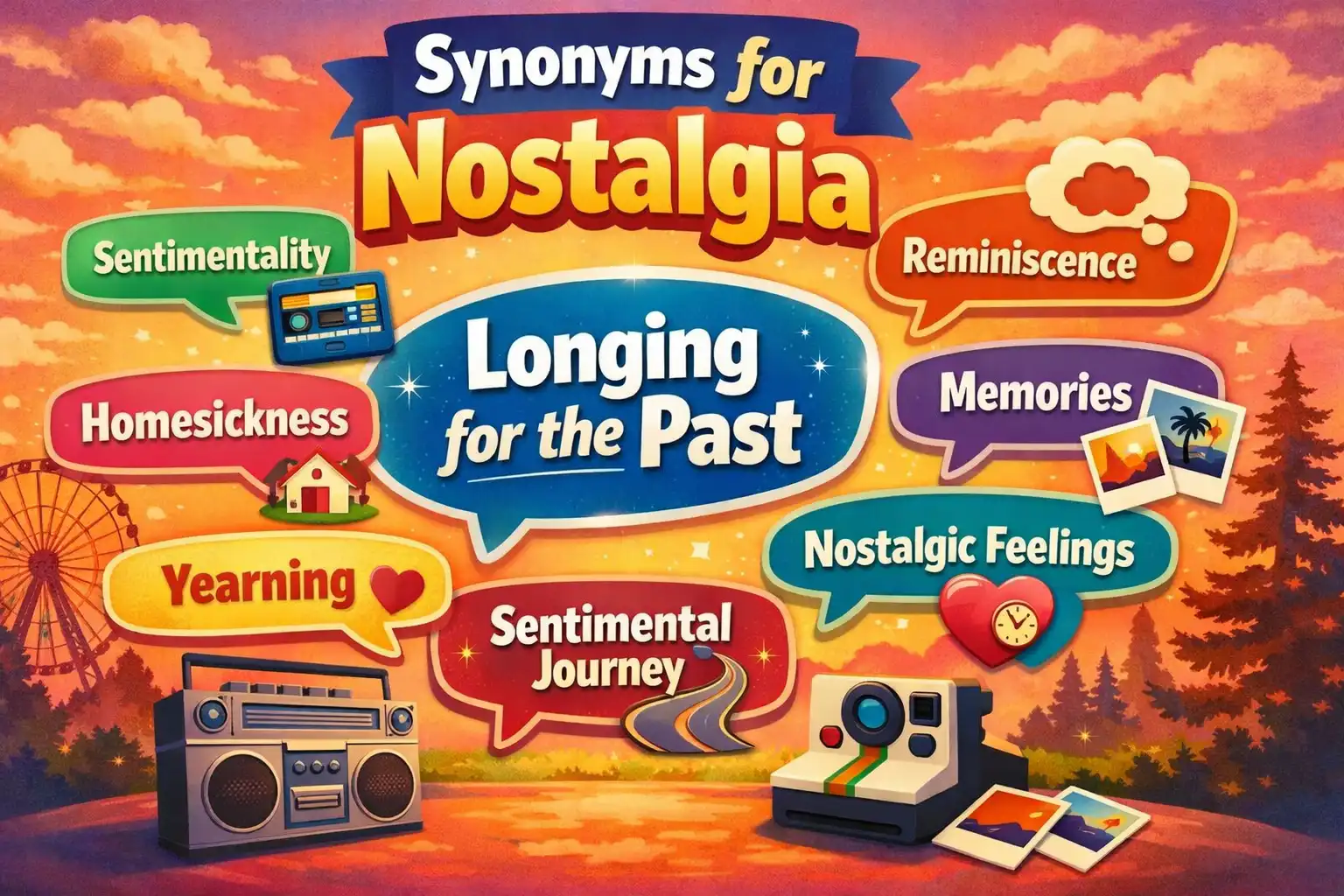
Nostalgia is a warm, bittersweet feeling we get when we look back at the happy times of our past. When writing, finding the perfect synonyms of nostalgia helps you express this emotion clearly. Learning these synonyms of nostalgia makes your descriptions richer and more relatable to readers who love to reminisce.
Imagine opening an old wooden box in your attic. Inside, you find a dusty, yellowed photograph of your childhood summer camp. Suddenly, your heart swells with a sweet, aching sadness. You can almost smell the pine trees and hear the campfire songs. This is a classic example of nostalgia in everyday life.
We feel this way because our minds love to visit happy memories when life gets busy. For students, learning these words makes essays more vivid and emotionally strong. For bloggers and content writers, using a variety of terms helps you connect with your readers on a deep, personal level. Daily English users can use these words to share their favorite life moments with family and friends in a more colorful way.
“Nostalgia is a file that removes the rough edges from the good old days.” — Doug Larson
“We took a ride in a time machine made of old songs and dusty photographs.” — Unknown
Linguistic Profile of Nostalgia
Connotative Meaning
The word nostalgia carries a warm, emotional, and comforting tone. It is not just about remembering facts. It is about feeling a sweet, soft sadness because you miss a beautiful time that is now gone.
Etymology
- Origin: Coined in 1688 by a Swiss medical student named Johannes Hofer.
- Greek Roots: * Nostos (meaning “homecoming” or “returning home”).
- Algos (meaning “pain”, “ache”, or “grief”).
- Original Use: It was first used as a medical term for severe homesickness among soldiers.
Pronunciation (US & UK – IPA)
- US IPA: /nɑˈstældʒə/ or /nəˈstældʒə/
- UK IPA: /nɒˈstældʒə/
Syllables
- Count: 3 Syllables
- Division: nos-tal-gia
Affixation Pattern
- Base Noun: Nostalgia
- Adjective Form: Nostalgic (Suffix: -ic)
- Adverb Form: Nostalgically (Suffix: -ally)
- Verb Form: Nostalgize (Suffix: -ize)
Nostalgia vs. Key Synonyms Comparison
| Keyword | Meaning | Usage Type | Context |
|---|---|---|---|
| Nostalgia | Warm, sad longing for past happy times | Emotional / Daily Use | Personal memories, music, old movies |
| Reminiscence | The act of sharing or writing about past events | Formal / Professional | Memoirs, history books, family reunions |
| Wistfulness | A quiet, sad longing for something you cannot have | Emotional / Creative | Romantic writing, poetry, quiet thoughts |
| Homesickness | Sadness caused by being away from home | Casual / Daily Use | Travel, moving to a new city, college life |
| Yearning | A very strong, deep wish for someone or something | Deeply Emotional | Relationships, long-lost friendships |
| Saudade | Deep longing for an absent person, place, or thing | Poetic / Cultural | Fado music, artistic expressions of grief |
50 Synonyms of Nostalgia
1. Reminiscence
- Pronunciation: US: /ˌrɛmɪˈnɪsəns/ | UK: /ˌrɛmɪˈnɪsəns/
- Meaning: This word means the act of remembering and talking about the good old days.
- Examples:
- My grandfather loved the reminiscence of his school days.
- The book was filled with sweet reminiscence about country life.
2. Wistfulness
- Pronunciation: US: /ˈwɪstfəlnəs/ | UK: /ˈwɪstfəlnəs/
- Meaning: A quiet, sad feeling of wanting something from the past that you cannot have right now.
- Examples:
- She looked at her old toys with a quiet sense of wistfulness.
- There was a soft wistfulness in his voice when he spoke of his old home.
3. Homesickness
- Pronunciation: US: /ˈhoʊmsɪknəs/ | UK: /ˈhəʊmsɪknəs/
- Meaning: A sad feeling you get because you miss your home and family very much.
- Examples:
- The young boy cried from homesickness during his first week at camp.
- Eating hot soup always helped cure her evening homesickness.
4. Yearning
- Pronunciation: US: /ˈjɜːrnɪŋ/ | UK: /ˈjɜːnɪŋ/
- Meaning: A very strong and deep desire for something you used to have.
- Examples:
- He felt a sudden yearning to walk down the streets of his home town.
- Her heart was full of yearning for the quiet summer nights of her youth.
5. Longing
- Pronunciation: US: /ˈlɔːŋɪŋ/ | UK: /ˈlɒŋɪŋ/
- Meaning: A strong feeling of wanting someone or something that is far away or gone.
- Examples:
- I looked at the old photo album with a deep longing in my heart.
- Her letter was filled with longing for her family back home.
6. Sentimentality
- Pronunciation: US: /ˌsɛntɪmɛnˈtælɪti/ | UK: /ˌsɛntɪmɛnˈtælɪti/
- Meaning: Having very gentle, warm, and soft feelings about things from the past.
- Examples:
- She kept the old movie ticket stub out of pure sentimentality.
- His speech was full of sweet sentimentality about their long friendship.
7. Melancholy
- Pronunciation: US: /ˈmɛlənkɑːli/ | UK: /ˈmɛlənkəli/
- Meaning: A gentle, quiet sadness that can sometimes feel pleasant or peaceful.
- Examples:
- The rainy afternoon filled her room with a soft melancholy.
- He listened to the slow music with a feeling of deep melancholy.
8. Retrospection
- Pronunciation: US: /ˌrɛtrəˈspɛkʃən/ | UK: /ˌrɛtrəˈspɛkʃən/
- Meaning: The act of looking back at your past life and thinking about it.
- Examples:
- On his fiftieth birthday, he spent the day in quiet retrospection.
- The old diary was a beautiful work of personal retrospection.
9. Remembrance
- Pronunciation: US: /rɪˈmɛmbrəns/ | UK: /rɪˈmɛmbrəns/
- Meaning: The act of keeping a memory of someone or something in your mind.
- Examples:
- We held a special dinner in sweet remembrance of our grandmother.
- She wore the silver ring as a remembrance of her best friend.
10. Saudade
- Pronunciation: US: /saʊˈdɑːdə/ | UK: /saʊˈdɑːdə/
- Meaning: A Portuguese word for a deep, beautiful longing for someone or something you love and lost.
- Examples:
- The sad song filled her soul with a heavy sense of saudade.
- He felt a deep saudade for the ocean waves of his childhood home.
11. Sehnsucht
- Pronunciation: US: /ˈzeɪnˌzʊxt/ | UK: /ˈzeɪnˌzʊxt/
- Meaning: A German word for a deep, painful longing for a perfect home or life you cannot reach.
- Examples:
- Her poems were always filled with a mystical, quiet sehnsucht.
- He stared out at the foggy hills, feeling an old sehnsucht stir inside him.
12. Reverie
- Pronunciation: US: /ˈrɛvəri/ | UK: /ˈrɛvəri/
- Meaning: A pleasant state of being lost in your own thoughts and sweet memories.
- Examples:
- She was shaken out of her happy reverie by a sudden loud knock at the door.
- He spent the rainy Sunday morning in a warm, peaceful reverie.
13. Pining
- Pronunciation: US: /ˈpaɪnɪŋ/ | UK: /ˈpaɪnɪŋ/
- Meaning: Feeling very sad because you miss someone you love very much.
- Examples:
- The loyal dog sat by the front door, pining for his owner to return.
- She spent the long winter months pining for the warm summer sun.
14. Hankering
- Pronunciation: US: /ˈhæŋkərɪŋ/ | UK: /ˈhæŋkərɪŋ/
- Meaning: A strong desire or wish to do or have something again.
- Examples:
- He had a sudden hankering to visit the old candy store from his youth.
- She felt a strong hankering for the simple, quiet life of the countryside.
15. Regretfulness
- Pronunciation: US: /rɪˈɡrɛtfəlnəs/ | UK: /rɪˈɡrɛtfəlnəs/
- Meaning: A sad feeling of wishing you could change something that happened in the past.
- Examples:
- There was a hint of soft regretfulness in her eyes as she looked at old photos.
- He spoke of his youth with a gentle, quiet regretfulness.
16. Recollection
- Pronunciation: US: /ˌrɛkəˈlɛkʃən/ | UK: /ˌrɛkəˈlɛkʃən/
- Meaning: A memory of something that happened to you in the past.
- Examples:
- Her recollection of that summer holiday was still bright and clear.
- I have no clear recollection of where we parked the car that night.
17. Ruefulness
- Pronunciation: US: /ˈruːfəlnəs/ | UK: /ˈruːfəlnəs/
- Meaning: A feeling of mild, sweet regret mixed with a bit of humor.
- Examples:
- He shook his head with a touch of ruefulness when looking at his old haircut.
- Her smile was full of ruefulness as she remembered her clumsy first dance.
18. Heartache
- Pronunciation: US: /ˈhɑːrtˌeɪk/ | UK: /ˈhɑːtˌeɪk/
- Meaning: A deep, burning emotional pain or sorrow caused by missing someone.
- Examples:
- Saying goodbye at the train station left her with a heavy heartache.
- The old love letters brought back both joy and a little heartache.
19. Hiraeth
- Pronunciation: US: /ˈhɪəraɪθ/ | UK: /ˈhɪəraɪθ/
- Meaning: A Welsh word for a deep homesickness for a home that you can never go back to.
- Examples:
- The old traveler felt a strong hiraeth for the lost valley of his youth.
- Her paintings of the misty mountains were inspired by a deep hiraeth.
20. Desiderium
- Pronunciation: US: /ˌdɛsɪˈdɪəriəm/ | UK: /ˌdɛsɪˈdɪəriəm/
- Meaning: An intense longing for something that is lost and gone forever.
- Examples:
- The museum was filled with a sense of desiderium for ancient times.
- He lived in a state of quiet desiderium after his old school was torn down.
21. Pathos
- Pronunciation: US: /ˈpeɪθɑːs/ | UK: /ˈpeɪθɒs/
- Meaning: A quality in life or art that makes you feel deep pity, sadness, or sweet longing.
- Examples:
- There was a beautiful pathos in the old man’s stories about his youth.
- The simple song was filled with a gentle, moving pathos.
22. Poignancy
- Pronunciation: US: /ˈpɔɪnjənsi/ | UK: /ˈpɔɪnjənsi/
- Meaning: A quality of being deeply moving and causing a sharp, sweet feeling of sadness.
- Examples:
- The poignancy of the final scene in the movie made everyone cry.
- He felt the sweet poignancy of watching his children grow up so fast.
23. Dreaminess
- Pronunciation: US: /ˈdriːminəs/ | UK: /ˈdriːminəs/
- Meaning: A state of quiet, peaceful thought that makes you forget your present surroundings.
- Examples:
- The quiet acoustic music added a beautiful dreaminess to the cozy room.
- She stared out the classroom window with a look of pure dreaminess.
24. Lonesomeness
- Pronunciation: US: /ˈloʊnsəmnəs/ | UK: /ˈləʊnsəmnəs/
- Meaning: A sad feeling of being alone and wishing for the comfort of home or friends.
- Examples:
- The dark, empty house filled him with a sudden, cold lonesomeness.
- She listened to the wind outside to drive away her evening lonesomeness.
25. Retrospect
- Pronunciation: US: /ˈrɛtrəspɛkt/ | UK: /ˈrɛtrəspɛkt/
- Meaning: Thinking about a past event or situation from a new point of view.
- Examples:
- In retrospect, that difficult summer was actually the best time of my life.
- The choices she made seem very wise when viewed in retrospect.
“The past is a foreign country; they do things differently there.” — L.P. Hartley
26. Nostalgicness
- Pronunciation: US: /nəˈstældʒɪknəs/ | UK: /nɒˈstældʒɪknəs/
- Meaning: The state or quality of being full of memories and longing for the past.
- Examples:
- The old-fashioned diner was designed with a heavy dose of nostalgicness.
- We loved the sweet nostalgicness of watching classic family home videos.
27. Warmheartedness
- Pronunciation: US: /ˌwɔːrmˈhɑːrtɪdnəs/ | UK: /ˌwɔːmˈhɑːtɪdnəs/
- Meaning: A kind, loving, and friendly feeling that makes you think of sweet times.
- Examples:
- Her grandmother welcomed everyone to the table with true warmheartedness.
- He remembered the old neighborhood for its simple warmheartedness.
28. Fondness
- Pronunciation: US: /ˈfɑːndnəs/ | UK: /ˈfɒndnəs/
- Meaning: A warm feeling of love, liking, or friendship for someone or something.
- Examples:
- She spoke of her primary school teachers with great fondness.
- His fondness for old jazz music came from his father’s record collection.
29. Reflection
- Pronunciation: US: /rɪˈflɛkʃən/ | UK: /rɪˈflɛkʃən/
- Meaning: Serious, quiet thought about your past choices, events, and actions.
- Examples:
- After a moment of quiet reflection, he decided to write an apology letter.
- The quiet lakeside cabin was a perfect place for deep personal reflection.
30. Contemplation
- Pronunciation: US: /ˌkɑːntəmˈpleɪʃən/ | UK: /ˌkɒntəmˈpleɪʃən/
- Meaning: The act of looking at or thinking about something quietly for a long time.
- Examples:
- He sat on the park bench in deep contemplation of the autumn leaves.
- The old monk spent his life in quiet prayer and peaceful contemplation.
31. Tenderheartedness
- Pronunciation: US: /ˌtɛndərˈhɑːrtɪdnəs/ | UK: /ˌtɛndəˈhɑːtɪdnəs/
- Meaning: Having a very kind, soft, and easily moved heart that feels emotions deeply.
- Examples:
- Her tenderheartedness made her cry whenever she saw old war movies.
- He was loved by all his friends for his gentle tenderheartedness.
32. Softness
- Pronunciation: US: /ˈsɔːftnəs/ | UK: /ˈsɒftnəs/
- Meaning: A gentle, kind, and loving quality that is free from harshness or anger.
- Examples:
- A gentle softness came over her face when she held her old teddy bear.
- He remembered the quiet softness of his mother’s lullabies.
33. Melancholia
- Pronunciation: US: /ˌmɛlənˈkoʊliə/ | UK: /ˌmɛlənˈkəʊliə/
- Meaning: A long-lasting, deep feeling of sadness or quiet serious thought.
- Examples:
- He lived in a quiet world of melancholia after his best friend moved away.
- The classical piano piece captured a beautiful, haunting sense of melancholia.
34. Sentiment
- Pronunciation: US: /ˈsɛntɪmənt/ | UK: /ˈsɛntɪmənt/
- Meaning: A tender feeling or opinion about something, often based on emotions.
- Examples:
- The public sentiment was in favor of saving the historic town hall.
- She kept the old handwritten card because of the sweet sentiment inside.
35. Craving
- Pronunciation: US: /ˈkreɪvɪŋ/ | UK: /ˈkreɪvɪŋ/
- Meaning: A very strong, urgent desire for a person, place, or feeling.
- Examples:
- He felt a deep craving for the comfort of his mother’s kitchen.
- Her soul had a constant craving for the peace of the wild forest.
36. Sweet Sorrow
- Pronunciation: US: /swiːt ˈsɑːroʊ/ | UK: /swiːt ˈsɒrəʊ/
- Meaning: A mixture of sadness and happiness, especially when saying goodbye to loved ones.
- Examples:
- Parting at the end of summer was a moment of pure sweet sorrow.
- They said their farewells with a gentle smile and a touch of sweet sorrow.
37. Sadness
- Pronunciation: US: /ˈsædnəs/ | UK: /ˈsædnəs/
- Meaning: The normal human feeling of being unhappy, sorrowful, or down in spirits.
- Examples:
- A wave of quiet sadness washed over him as he saw the old playground closed.
- She tried to hide her deep sadness with a bright, quick smile.
38. Soul-searching
- Pronunciation: US: /ˈsoʊlˌsɜːrtʃɪŋ/ | UK: /ˈsəʊlˌsɜːtʃɪŋ/
- Meaning: Honest and deep thinking about your own values, feelings, and past actions.
- Examples:
- He did a lot of soul-searching before choosing to leave his job.
- The long solo hike was a beautiful journey of quiet soul-searching.
39. Blue-devils
- Pronunciation: US: /bluː ˈdɛvəlz/ | UK: /bluː ˈdɛvlz/
- Meaning: An old-fashioned term for a state of low spirits, mild depression, or sad longing.
- Examples:
- The cold, grey winter mornings always gave him a touch of the blue-devils.
- She played a lively tune on the piano to drive away the blue-devils.
40. Backward-looking
- Pronunciation: US: /ˈbækwərd-ˈlʊkɪŋ/ | UK: /ˈbækwəd-ˈlʊkɪŋ/
- Meaning: Thinking too much about past times instead of focusing on the present or future.
- Examples:
- The director was criticized for his backward-looking approach to the new film.
- We must avoid a backward-looking attitude if we want to grow.
41. Memory Lane
- Pronunciation: US: /ˈmɛməri leɪn/ | UK: /ˈmɛməri leɪn/
- Meaning: A path of sweet remembering, usually talked about as a place you visit in your mind.
- Examples:
- Walking through our old high school felt like a trip down memory lane.
- We took a lovely walk down memory lane while looking at old school yearbooks.
42. Evocation
- Pronunciation: US: /ˌiːvoʊˈkeɪʃən/ | UK: /ˌiːvəʊˈkeɪʃən/
- Meaning: The act of bringing a memory, image, or feeling into your conscious mind.
- Examples:
- The smell of sea salt was a powerful evocation of his childhood holidays.
- Her poetry was a brilliant evocation of life in the early nineties.
43. Weltschmerz
- Pronunciation: US: /ˈvɛltˌʃmɛrts/ | UK: /ˈvɛltˌʃmɛts/
- Meaning: A German word for a sad feeling caused by comparing the actual world with an ideal world.
- Examples:
- The young writer’s diaries were full of romantic, quiet weltschmerz.
- He stared at the busy city streets, feeling a deep, heavy weltschmerz.
44. Mono No Aware
- Pronunciation: US: /ˈmoʊnoʊ noʊ ɑːˈwɑːreɪ/ | UK: /ˈmɒnəʊ nəʊ æˈwɑːreɪ/
- Meaning: A Japanese term for a sweet, sad feeling about how beautiful things do not last forever.
- Examples:
- Watching the pink cherry blossoms fall to the ground filled her with mono no aware.
- There is a deep sense of mono no aware in the quiet change of autumn leaves.
45. Yearningness
- Pronunciation: US: /ˈjɜːrnɪŋnəs/ | UK: /ˈjɜːnɪŋnəs/
- Meaning: The state of having a strong, constant, and deep wish for something.
- Examples:
- The quiet yearningness of her singing voice brought tears to my eyes.
- He wrote about his home country with a beautiful, soft yearningness.
46. Mind-wandering
- Pronunciation: US: /ˈmaɪnd-ˌwɑːndərɪŋ/ | UK: /ˈmaɪnd-ˌwɒndərɪŋ/
- Meaning: Letting your thoughts drift away from what you are doing to focus on past memories.
- Examples:
- His constant mind-wandering made it very hard to finish his schoolwork.
- She enjoyed a few minutes of quiet mind-wandering during her coffee break.
47. Heartsickness
- Pronunciation: US: /ˈhɑːrtˌsɪknəs/ | UK: /ˈhɑːtˌsɪknəs/
- Meaning: Deep sadness, grief, or worry, often caused by missing someone you love.
- Examples:
- She suffered from a quiet heartsickness during her first long year abroad.
- His letters home were filled with a gentle, painful heartsickness.
48. Remembering
- Pronunciation: US: rɪˈmɛmbərɪŋ / | UK: / rɪˈmɛmbərɪŋ /
- Meaning: The basic mental act of bringing a past image, person, or event back into your mind.
- Examples:
- She sat by the warm fireplace, silently remembering her childhood friends.
- Remembering his grandmother’s warm hugs always brought a smile to his face.
49. Retrospective View
- Pronunciation: US: /ˌrɛtrəˈspɛktɪv vjuː/ | UK: /ˌrɛtrəˈspɛktɪv vjuː/
- Meaning: Looking at past events with the knowledge and understanding you have today.
- Examples:
- The book offers a detailed retrospective view of the artist’s early paintings.
- From a retrospective view, we can see that our hard work was worth it.
50. Fond Memories
- Pronunciation: US: /fɑːnd ˈmɛməriz/ | UK: /fɒnd ˈmɛməriz/
- Meaning: Happy, warm, and loving thoughts about past people, events, or places.
- Examples:
- We still have so many fond memories of our summer trips to the lake.
- She kept a scrapbook to hold all her fond memories of university life.
Antonyms of Nostalgia
To understand nostalgia even better, it helps to look at its opposite words. Here are some key antonyms:
- Anticipation: A feeling of excitement about something happy that is going to happen in the future.
- Forward-looking: Focusing on the future and planning ahead rather than thinking about the past.
- Indifference: Not caring at all about past memories, places, or emotional experiences.
- Oblivion: A state of completely forgetting past events or being totally forgotten by others.
- Disregard: Choosing to ignore past experiences, traditions, or lessons.
Prototype Meaning and Categorization of Nostalgia
Cognitive Prototype
The core idea or “prototype” of nostalgia is the image of a person looking at an old family photo, listening to a song from high school, or smelling a childhood dish. It is a highly social emotion. It almost always involves loved ones, safe places, and key life events (like birthdays, holidays, or summers).
[Past Event / Memory] ➔ [Warm Emotional Connection] ➔ [Sense of Loss/Change] = NOSTALGIA
Categorization
- Emotional Category: It is a complex (or secondary) emotion because it blends two simple feelings: joy (for the happy memory) and sadness (because the time is gone).
- Psychological Category: It is a self-relevant social emotion. It helps people feel connected to their own history and to the people they love.
Frequently Asked Questions
Q1: What is the main difference between nostalgia and homesickness?
Nostalgia is a broad, bittersweet feeling about any happy past time, event, or object. Homesickness is narrower. It is a sad, painful feeling specifically caused by being away from your current home, family, and familiar surroundings.
Q2: Is nostalgia a positive or negative emotion?
Nostalgia is a mix of both, but psychologists find that it is mostly positive. Even though it has a hint of sadness, it usually makes people feel happy, loved, comforted, and more hopeful about the future.
Q3: How do you use the word nostalgia in a sentence?
You can use it as a noun to describe a feeling. For example: “The sight of the old swings filled her with a wave of childhood nostalgia.”
Q4: Why do we feel nostalgia?
We feel nostalgia to help us cope with change, loneliness, or stress. Looking back at warm memories reminds us of our identity, comforts us during hard times, and helps us feel connected to others.
Q5: Can nostalgia be a physical feeling?
Yes. When people feel nostalgia, they often experience a physical sensation. This can include a warm feeling in the chest, a gentle tightening in the throat, or a soft smile on their face.
Q6: What is a simple synonym of nostalgia for daily conversation?
The simplest daily terms are fond memories or reminiscing. You can say, “I was looking at old photos and reminiscing about our school days.”
Conclusion
Learning a wide variety of synonyms of nostalgia is a wonderful way to improve your writing, blogging, speaking, and daily communication. When you use precise words, you can make your readers feel exactly what you feel. Instead of using the same word over and over, you can choose a term like wistfulness to show a quiet, soft longing, or reminiscence to show a happy sharing of stories.
We encourage you to practice using these beautiful words in your daily life. Try using them in your next personal email to an old friend, in school essays, or during casual dinner conversations with your family. Expanding your vocabulary helps you share your unique human experiences with more beauty and clarity.
“We don’t realize we are making memories, we just know we are having fun.” — Winnie the Pooh
“Nostalgia is the heart’s way of keeping what it loves forever.” — Unknown
8

Michael Turner is a published fiction writer and creative writing tutor with over a decade of experience helping writers find the words that make their stories breathe ( Biography ).