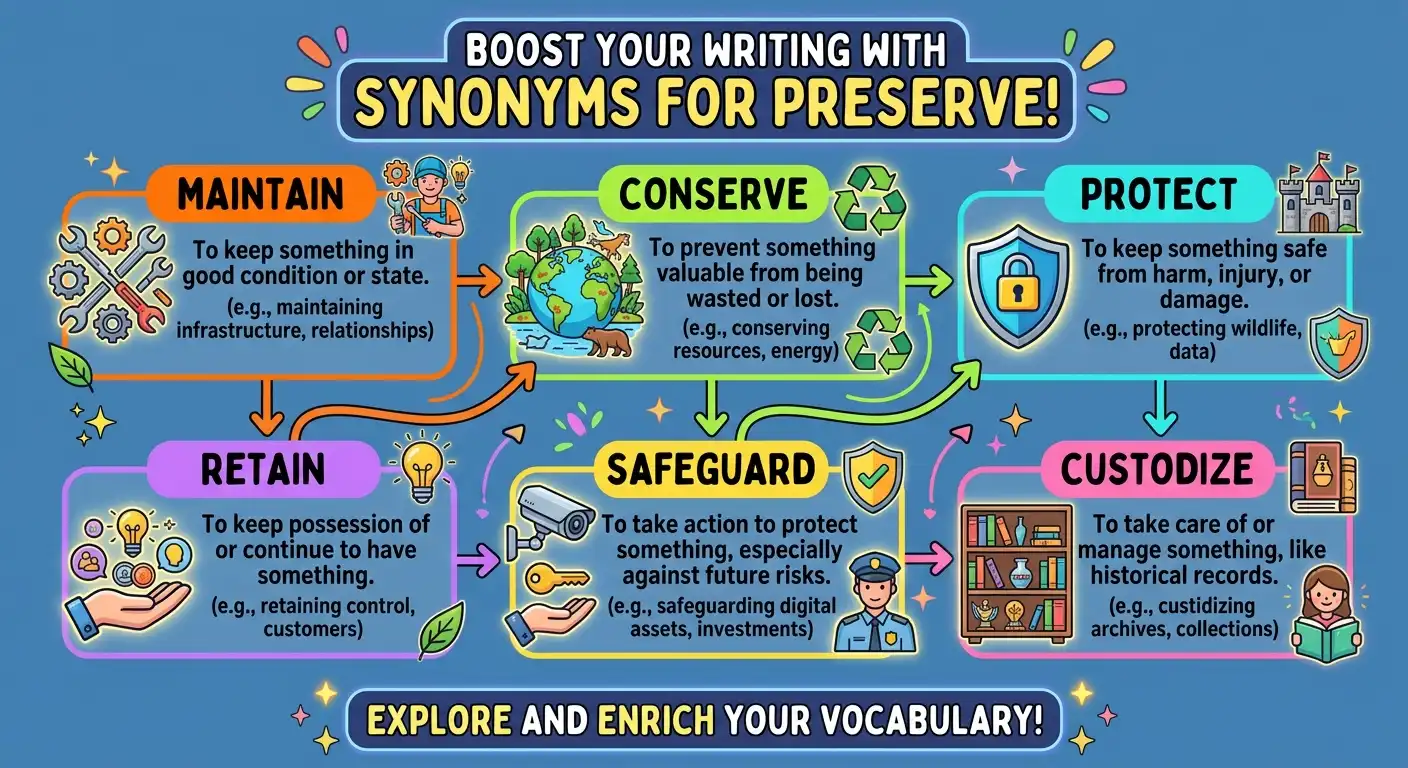
Learning synonyms for preserve helps you choose the exact right word for your writing. When you search for synonyms for preserve, you discover ways to express keeping something safe, fresh, or unharmed. Understanding synonyms for preserve improves your vocabulary and makes your writing clear and interesting.
Picture opening an old wooden box in your attic and finding a clear picture of your great-grandparents. The picture looks brand new because your family took care of it. That careful action is what it means to preserve something.
In everyday life, you might preserve fruit by making jam, or preserve an old house so people can visit it later. In simple words, to preserve means to keep something safe from harm, decay, or loss.
Knowing different words for preserve is very helpful:
- Students can avoid repeating the same word in essays.
- Bloggers can write catchy headlines and clear stories.
- Content writers can choose words that match the right mood.
- Daily English users can speak with confidence in work or casual chats.
“Words are the leaves on the tree of language; choosing the right one keeps your meaning fresh.”
“To save a word is to save a thought for future generations.”
Word Profile: Preserve
Connotative Meaning
The word preserve carries a positive and protective feel. It suggests care, value, responsibility, and respect for something important so it lasts a long time.
Etymology (Origin)
- Origin: Middle English (preserven)
- Latin Roots: From Latin praeservare
- Prefix: prae- (meaning “before”)
- Root: servare (meaning “to keep, guard, or save”)
Pronunciation
- US IPA: /prɪˈzɜːrv/
- UK IPA: /prɪˈzɜːv/
Syllables
- Count: 2 Syllables
- Breakdown: Pre–serve
Affixation Pattern
- Prefix: Pre– (before)
- Base Word: Serve (from Latin servare to guard)
- Common Derivatives: Preservation (noun), Preservative (noun/adjective), Preserved (verb/adjective)
Synonyms for Preserve: Quick Comparison Table
| Word | Meaning | Usage Type | Context |
| Conserve | To save resources carefully | Formal / Professional | Nature, energy, money |
| Protect | To keep safe from harm | General / Daily Use | Family, items, health |
| Maintain | To keep in good condition | Professional / Workplace | Buildings, cars, habits |
| Safeguard | To defend against danger | Formal / Legal | Rights, secrets, safety |
| Sustain | To keep something going | Professional / Academic | Life, effort, growth |
| Retain | To hold onto something | Professional / Business | Jobs, memory, control |
| Shield | To cover and guard | Casual / Emotional | People, feelings, eyes |
| Defend | To protect against attacks | Formal / Daily Use | Arguments, team, home |
Prototype Meaning and Categorization
The word preserve fits into four main categories based on real-life use:
- Environmental & Nature Care: Keeping trees, water, and wildlife safe from harm (conserve, protect).
- Food & Physical Goods: Keeping food fresh or keeping old objects unbroken (store, save, freeze).
- History & Culture: Keeping old traditions, stories, and buildings alive (uphold, retain, maintain).
- Safety & Security: Keeping people, rights, and relationships safe (safeguard, defend, shield).
15 Best Synonyms for Preserve
1. Conserve
- Pronunciation: US: /kənˈsɜːrv/ | UK: /kənˈsɜːv/
- Meaning: To save something carefully so it does not waste away.
- Examples:
- We must conserve clean water every day.
- Turn off the lights to conserve power.
2. Protect
- Pronunciation: US: /prəˈtekt/ | UK: /prəˈtekt/
- Meaning: To keep a person or object safe from harm.
- Examples:
- Wear a coat to protect yourself from the cold.
- Strong walls protect the small house.
3. Maintain
- Pronunciation: US: /meɪnˈteɪn/ | UK: /meɪnˈteɪn/
- Meaning: To keep something working in good condition.
- Examples:
- He works hard to maintain his car.
- Eating good food helps maintain your health.
4. Safeguard
- Pronunciation: US: /ˈseɪf.ɡɑːrd/ | UK: /ˈseɪf.ɡɑːd/
- Meaning: To defend something valuable from danger or loss.
- Examples:
- Password rules safeguard your private data.
- We need laws to safeguard young children.
5. Sustain
- Pronunciation: US: /səˈsteɪn/ | UK: /səˈsteɪn/
- Meaning: To keep something going for a long time without stopping.
- Examples:
- Good food gives you energy to sustain hard work.
- Hope helps us sustain our effort.
6. Retain
- Pronunciation: US: /rɪˈteɪn/ | UK: /rɪˈteɪn/
- Meaning: To continue to hold or keep something.
- Examples:
- Try to retain key facts for your test.
- The soil helps retain water for plants.
7. Shield
- Pronunciation: US: /ʃiːld/ | UK: /ʃiːld/
- Meaning: To cover someone or something to block harm.
- Examples:
- Sunglasses shield your eyes from bright light.
- Trees shield our house from strong wind.
8. Defend
- Pronunciation: US: /dɪˈfend/ | UK: /dɪˈfend/
- Meaning: To stand up for someone or keep something safe from attack.
- Examples:
- Dogs defend their owners from danger.
- Speak clearly to defend your main idea.
9. Keep
- Pronunciation: US: /kiːp/ | UK: /kiːp/
- Meaning: To hold onto something and not let it go.
- Examples:
- You can keep this old book.
- Please keep the room clean and tidy.
10. Secure
- Pronunciation: US: /səˈkjʊr/ | UK: /sɪˈkjʊə/
- Meaning: To lock or fix something so it stays safe.
- Examples:
- Secure the door before you go to sleep.
- He worked hard to secure a good job.
11. Uphold
- Pronunciation: US: /ʌpˈhoʊld/ | UK: /ʌpˈhəʊld/
- Meaning: To support and maintain a rule, law, or promise.
- Examples:
- Judges work to uphold justice for everyone.
- We should uphold good family traditions.
12. Save
- Pronunciation: US: /seɪv/ | UK: /seɪv/
- Meaning: To stop something from being hurt, lost, or wasted.
- Examples:
- Put money in the bank to save for later.
- The doctor helped save the sick puppy.
13. Guard
- Pronunciation: US: /ɡɑːrd/ | UK: /ɡɑːd/
- Meaning: To watch over something carefully to keep it safe.
- Examples:
- A fierce dog can guard the farm.
- Soldiers guard the town gate.
14. Store
- Pronunciation: US: /stɔːr/ | UK: /stɔː/
- Meaning: To put things away in a safe spot for future use.
- Examples:
- Store fresh apples in a cool room.
- We store winter coats in the big closet.
15. Nurture
- Pronunciation: US: /ˈnɜːr.tʃɚ/ | UK: /ˈnɜː.tʃə/
- Meaning: To care for something as it grows and develops.
- Examples:
- Parents nurture their young kids with love.
- Teachers nurture new ideas in the classroom.
“Language thrives when we choose words that protect the truth of our ideas.”
Antonyms of Preserve
Knowing words with opposite meanings helps you understand preserve even better:
- Destroy: To ruin something completely.
- Waste: To use up something carelessly.
- Neglect: To fail to take care of something.
- Damage: To harm or break something.
- Abandon: To leave something behind forever.
Frequently Asked Questions (FAQ)
What is the most common synonym for preserve?
The most common synonym for preserve is protect. Both words mean keeping something safe from harm or loss.
What is the difference between preserve and conserve?
Preserve means keeping something in its original state without change. Conserve means using a resource wisely so it does not run out.
Can preserve be used for food?
Yes! In food preparation, preserve means keeping food fresh by canning, pickling, or freezing.
How do I use synonyms for preserve in business writing?
In business writing, words like maintain, retain, and safeguard sound professional. For example, you can write “safeguard customer data” instead of “preserve customer data”.
What is a simple synonym for preserve for elementary students?
Simple synonyms for young students include keep, save, and guard.
Conclusion
Learning synonyms for preserve makes you a stronger communicator. When you build your vocabulary, your writing becomes more expressive, your blogging reaches more readers, your speaking sounds natural, and your daily communication grows clearer.
Instead of using the same word again and again, you can pick the exact word you need. Use conserve when talking about nature, maintain when talking about work, and protect when talking about family.
Start practicing these new words today. Try using one or two synonyms in your next work email, school essay, or daily conversation with friends. Small changes in your word choice lead to big improvements in how you speak and write.
“Careful words build clear thoughts, just as careful action builds lasting peace.”
“Expand your words today, and your speech will shape tomorrow.”

Michael Turner is a published fiction writer and creative writing tutor with over a decade of experience helping writers find the words that make their stories breathe ( Biography ).