
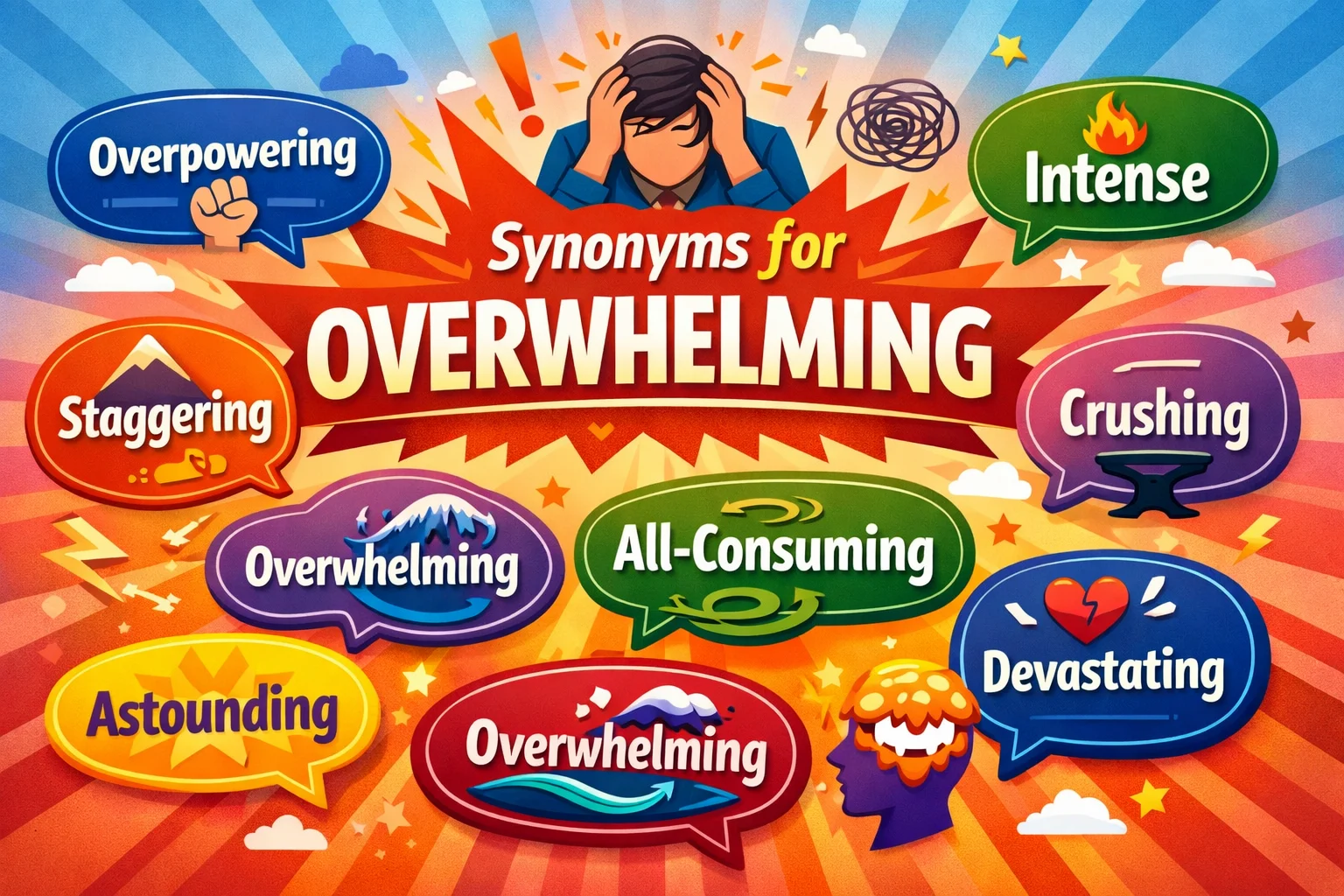
When we experience a situation that feels too big or too hard to handle, we often search for synonyms for overwhelming. Finding alternative synonyms for overwhelming helps us explain exactly how we feel when life gets too busy. Using different synonyms for overwhelming can make our daily communication much clearer and more interesting.
Imagine standing in the middle of a busy street with cars honking, lights flashing, and a long list of chores waiting at home. Your mind feels completely full, like a cup spilling over with water. This is a common situation where things feel too much to handle.
In simple English, overwhelming means something is so strong or so big that you cannot easily deal with it. This word is incredibly useful for different people:
- Students can use it to write better essays and avoid repeating the same words.
- Bloggers can use it to describe deep emotions and capture their readers’ attention.
- Content writers can use it to create highly engaging and persuasive copy.
- Daily English users can use it to express their feelings clearly to friends and family.
“Words have the power to paint a thousand emotions, transforming a simple feeling into a vivid landscape.”
“When our vocabulary expands, our world expands along with it.”
Linguistic Profile of “Overwhelming”
To fully understand this powerful word, let us look at its linguistic details:
- Connotative Meaning: It carries a strong emotional weight. It can mean negative stress (like too much work) or positive amazement (like a surprise party).
- Etymology:
- Root: From the Middle English word whelmen, which means to turn upside down or submerge.
- Prefix: Over- (meaning excessively or too much).
- Suffix: -ing (forming an adjective).
- Pronunciation (US & UK):
- US IPA: /ˌoʊvərˈwɛlmɪŋ/
- UK IPA: /ˌəʊvəˈwɛlmɪŋ/
- Syllables: Four syllables (o-ver-whelm-ing).
- Affixation Pattern: Prefix (over-) + Root (whelm) + Suffix (-ing).
Keyword Comparison Table
This comparison table shows how different words compare to the main keyword in tone and usage context.
| Keyword | Meaning | Usage Type | Context |
|---|---|---|---|
| Overwhelming | Too great or too large to handle | Emotional / Professional | Daily life, workplace, mental state |
| Daunting | Making you feel slightly afraid or worried | Formal | Big goals, difficult tasks, new jobs |
| Staggering | So amazing or large that it is shocking | Casual / Professional | Data, success, shocking news |
| Oppressive | Heavy, cruel, or hard to bear | Formal / Emotional | Weather, governments, sad feelings |
| Breath-taking | So beautiful or amazing that you gasp | Casual / Emotional | Nature, art, beautiful sights |
| Devastating | Causing extreme grief, pain, or damage | Formal / Emotional | Disasters, terrible news, deep sadness |
“Language is the key that unlocks the door to deep human connection.”
50 Synonyms for Overwhelming
Here is the complete list of 50 synonyms to help you expand your vocabulary.
1. Daunting
- Pronunciation: US: /ˈdɔntɪŋ/ | UK: /ˈdɔːntɪŋ/
- Meaning: This word describes something that makes you feel a little scared or nervous about doing it.
- Examples:
- Climbing that huge mountain looks like a daunting task.
- Starting a brand new school can feel very daunting at first.
2. Staggering
- Pronunciation: US: /ˈstæɡərɪŋ/ | UK: /ˈstæɡərɪŋ/
- Meaning: This word describes something so huge or surprising that it makes you walk unsteadily or feel shocked.
- Examples:
- The cost of repairing the old bridge was staggering.
- She won the race by a staggering distance.
3. Oppressive
- Pronunciation: US: /əˈprɛsɪv/ | UK: /əˈpresɪv/
- Meaning: This word describes a feeling that is heavy, uncomfortable, and hard to bear.
- Examples:
- The summer heat in the small room was oppressive.
- There was an oppressive silence in the dark forest.
4. Mind-boggling
- Pronunciation: US: /ˈmaɪndˌbɑɡlɪŋ/ | UK: /ˈmaɪndˌbɒɡlɪŋ/
- Meaning: This word describes something that is too strange or complex for your mind to easily understand.
- Examples:
- The size of the universe is truly mind-boggling.
- He solved the math puzzle with mind-boggling speed.
5. Astounding
- Pronunciation: US: /əˈstaʊndɪŋ/ | UK: /əˈstaʊndɪŋ/
- Meaning: This word describes something that causes great surprise or wonder.
- Examples:
- The young magician showed us some astounding tricks.
- She made an astounding recovery after her accident.
6. Formidable
- Pronunciation: US: /ˈfɔrmədəbəl/ | UK: /ˈfɔːmɪdəbəl/
- Meaning: This word describes a challenge or opponent that is very strong, large, and hard to beat.
- Examples:
- The champion boxer faced a formidable opponent tonight.
- We have a formidable amount of work to finish today.
7. Breath-taking
- Pronunciation: US: /ˈbrɛθˌteɪkɪŋ/ | UK: /ˈbreθˌteɪkɪŋ/
- Meaning: This word describes something so beautiful or amazing that it feels like you cannot breathe.
- Examples:
- The view from the top of the cliff was breath-taking.
- She wore a breath-taking dress to the party.
8. Devastating
- Pronunciation: US: /ˈdɛvəˌsteɪtɪŋ/ | UK: /ˈdevəsteɪtɪŋ/
- Meaning: This word describes something that causes a massive amount of shock, pain, or physical destruction.
- Examples:
- The town suffered devastating damage from the storm.
- It was devastating news when the family pet went missing.
9. Intimidating
- Pronunciation: US: /ɪnˈtɪməˌdeɪtɪŋ/ | UK: /ɪnˈtɪmɪdeɪtɪŋ/
- Meaning: This word describes something that makes you feel timid, shy, or afraid.
- Examples:
- The tall teacher had an intimidating voice.
- Walking into the large courtroom was very intimidating.
10. Crushing
- Pronunciation: US: /ˈkrʌʃɪŋ/ | UK: /ˈkrʌʃɪŋ/
- Meaning: This word describes a blow or defeat that completely breaks your spirit or strength.
- Examples:
- The soccer team suffered a crushing defeat on Saturday.
- He felt a crushing weight of disappointment.
11. Shattering
- Pronunciation: US: /ˈʃætərɪŋ/ | UK: /ˈʃætərɪŋ/
- Meaning: This word describes an event that breaks your mind, energy, or feelings into tiny pieces.
- Examples:
- Losing his job was a shattering blow to his confidence.
- The loud explosion made a shattering noise in the street.
12. Swamping
- Pronunciation: US: /ˈswɑmpɪŋ/ | UK: /ˈswɒmpɪŋ/
- Meaning: This word describes a situation where too many things arrive at once and cover you completely.
- Examples:
- A wave of emails is swamping my inbox today.
- Customers are swamping the store for the holiday sale.
13. Inundating
- Pronunciation: US: /ˈɪnənˌdeɪtɪŋ/ | UK: /ˈɪnʌndeɪtɪŋ/
- Meaning: This word describes being flooded with a massive amount of things or water.
- Examples:
- Fans are inundating the singer with kind letters.
- The heavy rain is inundating the low streets.
14. Paralyzing
- Pronunciation: US: /ˈpærəˌlaɪzɪŋ/ | UK: /ˈpærəlaɪzɪŋ/
- Meaning: This word describes fear or shock so great that you cannot move or think.
- Examples:
- She felt a paralyzing fear when she saw the snake.
- The city was hit by a paralyzing snowstorm.
15. Suffocating
- Pronunciation: US: /ˈsʌfəˌkeɪtɪŋ/ | UK: /ˈsʌfəkeɪtɪŋ/
- Meaning: This word describes a space or situation where you feel like you do not have enough air.
- Examples:
- The air inside the crowded bus was suffocating.
- He felt trapped in a suffocating office job.
16. Overpowering
- Pronunciation: US: /ˌoʊvərˈpaʊərɪŋ/ | UK: /ˌəʊvəˈpaʊərɪŋ/
- Meaning: This word describes a smell, feeling, or force that is too strong to resist.
- Examples:
- There was an overpowering smell of fresh paint in the hall.
- She had an overpowering urge to sit down and rest.
17. Extreme
- Pronunciation: US: /ɪkˈstrim/ | UK: /ɪkˈstriːm/
- Meaning: This word describes something that is way past the normal limit.
- Examples:
- The athletes competed in conditions of extreme cold.
- He takes extreme care when driving in the rain.
18. Intense
- Pronunciation: US: /ɪnˈtɛns/ | UK: /ɪnˈtens/
- Meaning: This word describes a feeling or force that is highly concentrated and very strong.
- Examples:
- The bright light from the sun was very intense.
- They worked under intense pressure to finish the project.
19. Excessive
- Pronunciation: US: /ɪkˈsɛsɪv/ | UK: /ɪkˈsesɪv/
- Meaning: This word describes an amount of something that is much more than what is safe or normal.
- Examples:
- The dog made an excessive amount of noise last night.
- Avoid using excessive sugar when you bake cookies.
20. Monumental
- Pronunciation: US: /ˌmɑnjəˈmɛntəl/ | UK: /ˌmɒnjʊˈmentəl/
- Meaning: This word describes a task, event, or structure that is historically large and important.
- Examples:
- Building the great pyramids was a monumental task.
- The scientists made a monumental discovery this week.
21. Colossal
- Pronunciation: US: /kəˈlɑsəl/ | UK: /kəˈlɒsəl/
- Meaning: This word describes something that is incredibly huge in physical size or scale.
- Examples:
- They carved a colossal statue out of solid stone.
- The company suffered a colossal waste of money.
22. Prodigious
- Pronunciation: US: /prəˈdɪdʒəs/ | UK: /prəˈdɪdʒəs/
- Meaning: This word describes an amount or skill that is surprisingly large and impressive.
- Examples:
- The young boy has a prodigious talent for playing piano.
- She consumed a prodigious amount of water after the run.
23. Tremendous
- Pronunciation: US: /trəˈmɛndəs/ | UK: /trɪˈmendəs/
- Meaning: This word describes something that is very great in size, amount, or strength.
- Examples:
- The crowd made a tremendous noise when the band played.
- He has shown tremendous progress in his reading.
24. Immense
- Pronunciation: US: /ɪˈmɛns/ | UK: /ɪˈmens/
- Meaning: This word describes a physical space or feeling that is extremely vast and large.
- Examples:
- The ocean looked like an immense blue sheet.
- They felt immense joy when their baby was born.
25. Overbearing
- Pronunciation: US: /ˌoʊvərˈbɛrɪŋ/ | UK: /ˌəʊvəˈbeərɪŋ/
- Meaning: This word describes a person who tries to control others in a heavy, annoying way.
- Examples:
- Nobody liked working with the overbearing manager.
- Her overbearing personality made it hard to make friends.
26. Crippling
- Pronunciation: US: /ˈkrɪplɪŋ/ | UK: /ˈkrɪplɪŋ/
- Meaning: This word describes something that causes severe damage, making a system or body unable to work.
- Examples:
- The country faced crippling debts after the war.
- She suffered a crippling injury during the game.
27. Smothering
- Pronunciation: US: /ˈsmʌðərɪŋ/ | UK: /ˈsmʌðərɪŋ/
- Meaning: This word describes a feeling of being covered so closely that you cannot move or breathe freely.
- Examples:
- The thick, warm blanket felt smothering in the summer.
- He escaped from his mother’s smothering attention.
28. Drowning
- Pronunciation: US: /ˈdraʊnɪŋ/ | UK: /ˈdraʊnɪŋ/
- Meaning: This word describes being completely submerged or lost under a heavy pile of things.
- Examples:
- I am currently drowning in homework this school term.
- The small office is drowning in paperwork.
29. Flooding
- Pronunciation: US: /ˈflʌdɪŋ/ | UK: /ˈflʌdɪŋ/
- Meaning: This word describes a massive stream of things coming in all at once like a river.
- Examples:
- Warm memories came flooding back to her mind.
- Orders are flooding into our online store today.
30. Massive
- Pronunciation: US: /ˈmæsɪv/ | UK: /ˈmæsɪv/
- Meaning: This word describes something that is very heavy, solid, and large.
- Examples:
- They built a massive wall to block the wind.
- He suffered a massive headache after the long test.
31. Gigantic
- Pronunciation: US: /dʒaɪˈɡæntɪk/ | UK: /dʒaɪˈɡæntɪk/
- Meaning: This word describes something that looks like a giant because of its size.
- Examples:
- A gigantic ship pulled into the harbor today.
- We saw a gigantic balloon floating in the sky.
32. Humongous
- Pronunciation: US: /hjuːˈmʌŋɡəs/ | UK: /hjuːˈmʌŋɡəs/
- Meaning: This is a friendly, casual word for something that is extremely huge.
- Examples:
- My brother ordered a humongous burger for lunch.
- There was a humongous puddle in the middle of the yard.
33. Vast
- Pronunciation: US: /væst/ | UK: /vɑːst/
- Meaning: This word describes an area or amount that is extremely wide, open, and large.
- Examples:
- The desert is a vast place with very few plants.
- He has a vast knowledge of ancient history.
34. Irresistible
- Pronunciation: US: /ˌɪrɪˈzɪstəbəl/ | UK: /ˌɪrɪˈzɪstəbəl/
- Meaning: This word describes something so attractive or strong that you cannot say no to it.
- Examples:
- The warm chocolate cake was completely irresistible.
- She felt an irresistible urge to laugh out loud.
35. Unstoppable
- Pronunciation: US: /ʌnˈstɑpəbəl/ | UK: /ʌnˈstɒpəbəl/
- Meaning: This word describes a force or trend that cannot be blocked or slowed down.
- Examples:
- The team was unstoppable on their way to the finals.
- He had an unstoppable desire to win the race.
36. Overriding
- Pronunciation: US: /ˌoʊvərˈraɪdɪŋ/ | UK: /ˌəʊvəˈraɪdɪŋ/
- Meaning: This word describes the most important rule, feeling, or factor in a situation.
- Examples:
- Our overriding concern is the safety of the children.
- The overriding theme of the book is love.
37. Compelling
- Pronunciation: US: /kəmˈpɛlɪŋ/ | UK: /kəmˈpelɪŋ/
- Meaning: This word describes an argument or reason that is so strong you must believe it.
- Examples:
- The lawyer gave a compelling reason for his client’s innocence.
- She told a very compelling story that kept us quiet.
38. Striking
- Pronunciation: US: /ˈstraɪkɪŋ/ | UK: /ˈstraɪkɪŋ/
- Meaning: This word describes something very unusual or beautiful that immediately catches your eye.
- Examples:
- There is a striking difference between the two twins.
- She has striking blue eyes that shine in the light.
39. Shocking
- Pronunciation: US: /ˈʃɑkɪŋ/ | UK: /ˈʃɒkɪŋ/
- Meaning: This word describes an event that is very surprising, upsetting, or bad.
- Examples:
- The news of the sudden accident was shocking.
- He showed a shocking lack of manners at dinner.
40. Flabbergasting
- Pronunciation: US: /ˈflæbərˌɡæstɪŋ/ | UK: /ˈflæbəɡɑːstɪŋ/
- Meaning: This word describes something so surprising that it leaves you speechless and confused.
- Examples:
- The price of the simple shoes was flabbergasting.
- It was flabbergasting to see how fast he grew up.
41. Astonishing
- Pronunciation: US: /əˈstɑnɪʃɪŋ/ | UK: /əˈstɒnɪʃɪŋ/
- Meaning: This word describes something that is very surprising and hard to believe.
- Examples:
- The little girl showed astonishing skills in chess.
- We saw an astonishing sunset over the ocean.
42. Bewildering
- Pronunciation: US: /bɪˈwɪldərɪŋ/ | UK: /bɪˈwɪldərɪŋ/
- Meaning: This word describes a situation that is very confusing and hard to figure out.
- Examples:
- The city street map was a bewildering mess of lines.
- He faced a bewildering choice of paths in the forest.
43. Perplexing
- Pronunciation: US: /pərˈplɛksɪŋ/ | UK: /pəˈpleksɪŋ/
- Meaning: This word describes a problem or puzzle that is very confusing and difficult to solve.
- Examples:
- The detective tried to solve a perplexing mystery.
- She asked a perplexing question that made us think.
44. Confusing
- Pronunciation: US: /kənˈfjuːzɪŋ/ | UK: /kənˈfjuːzɪŋ/
- Meaning: This word describes something that is not clear and makes you make mistakes.
- Examples:
- The instructions for the toy were very confusing.
- I got lost because of the confusing road signs.
45. Exhausting
- Pronunciation: US: /ɪɡˈzɔstɪŋ/ | UK: /ɪɡˈzɔːstɪŋ/
- Meaning: This word describes an activity that takes away all of your physical energy.
- Examples:
- Cleaning the whole house was an exhausting job.
- Running five miles in the heat is exhausting.
46. Draining
- Pronunciation: US: /ˈdreɪnɪŋ/ | UK: /ˈdreɪnɪŋ/
- Meaning: This word describes a situation that slowly pulls all the energy or emotion out of you.
- Examples:
- Arguing with people all day is very draining.
- It was a long, draining week at the office.
47. Wearisome
- Pronunciation: US: /ˈwɪrisəm/ | UK: /ˈwɪərɪsəm/
- Meaning: This word describes something that is boring, long, and makes you tired.
- Examples:
- Listening to the long speech became very wearisome.
- Doing the same task every day is wearisome.
48. Mind-blowing
- Pronunciation: US: /ˈmaɪndˌbloʊɪŋ/ | UK: /ˈmaɪndˌbləʊɪŋ/
- Meaning: This word describes something so amazing or shocking that it completely surprises you.
- Examples:
- The special effects in the new movie were mind-blowing.
- She gave a mind-blowing performance on stage tonight.
49. Heavy
- Pronunciation: US: /ˈhɛvi/ | UK: /ˈhevi/
- Meaning: This word describes a feeling or situation that is serious, sad, or hard to carry.
- Examples:
- There was a heavy feeling of sadness in the room.
- He has a heavy load of classes this semester.
50. Towering
- Pronunciation: US: /ˈtaʊərɪŋ/ | UK: /ˈtaʊərɪŋ/
- Meaning: This word describes something very tall, great, or strong that stands above everything else.
- Examples:
- The towering waves crashed against the stone wall.
- He was a towering figure in the world of science.
Antonyms of “Overwhelming”
To help you understand the scale of this word, here are some common antonyms that mean the exact opposite:
- Manageable (easy to control or do).
- Mild (gentle, not strong or severe).
- Insignificant (small, not important).
- Trivial (of very little value or importance).
- Calming (making you feel quiet, relaxed, and peaceful).
Prototype Meaning and Categorization
The word overwhelming belongs to the linguistic category of intensifiers and experiential descriptors.
- Archetype: The basic prototype of this word is the image of a giant wave of water crashing down on a small boat. This represents a force that is far greater than the object experiencing it.
- Categorization: It falls under words that describe excessive quantity (too much of something) and extreme emotional state (feeling flooded by emotions).
Frequently Asked Questions (FAQ)
1. Is “overwhelming” always a negative word?
No, it is not always negative. While it often describes stress, it can also describe wonderful events, such as an overwhelming amount of support or love from friends.
2. Can I use “daunting” instead of “overwhelming” in a business meeting?
Yes. Daunting is a great, professional choice. It tells your team that a task is very large and challenging without making you sound completely defeated.
3. What is the difference between “staggering” and “overwhelming”?
Staggering focuses on the shock or surprise value of a size or number. Overwhelming focuses on how that size makes you feel inside.
4. How do you pronounce “overwhelming” in UK English?
In UK English, it is pronounced as /ˌəʊvəˈwɛlmɪŋ/. The major difference is the softer, more rounded vowel sound at the start.
5. Why do writers use synonyms for overwhelming?
Writers use these synonyms to avoid repeating themselves. Using diverse words keeps the text fresh, exciting, and highly engaging for readers.
Conclusion
Learning a wide variety of synonyms for overwhelming is a fantastic way to upgrade your communication. When you write blogs, speak in public, or create content, having a rich vocabulary allows you to paint clear pictures for your audience. Instead of using the same words over and over, you can choose the exact word that fits your feeling.
We encourage you to practice using these words in your daily emails, school essays, and friendly conversations. Start small by replacing just one word today, and watch your confidence grow!
“To write well is to think clearly, and to think clearly is to choose your words with absolute care.”
“Practice is the quiet bridge that carries knowledge into everyday mastery.”

Michael Turner is a published fiction writer and creative writing tutor with over a decade of experience helping writers find the words that make their stories breathe ( Biography ).