Introduction
Common sense means the basic ability to think clearly and make good choices in everyday life. Common sense is not book knowledge — it is plain, practical wisdom that helps you solve real problems. When people say someone has common sense, they mean that person can judge a situation well without needing special training.
Picture this: your friend forgets his umbrella on a cloudy day, then acts surprised when it rains. You shake your head and think, that’s just a lack of common sense. We all know that feeling. It’s the small, quiet skill that guides us through daily decisions — crossing the street safely, knowing not to touch a hot stove, or reading a room before speaking.
This simple word carries a lot of weight in the English language. But if you use it in every sentence, your writing starts to sound flat and repetitive. That’s where synonyms come in handy.
“Common sense is not a gift, it’s a punishment, because you have to deal with everyone who doesn’t have it.” — this joke floats around the internet, and it hits home for a reason.
Learning strong alternatives to this word makes your writing sharper and more colorful. This skill helps students who write essays, bloggers who want fresh vocabulary, content writers who need variety for SEO, and daily English users who want to sound more natural in conversation.
“Common sense is genius dressed in its working clothes.” — Ralph Waldo Emerson
Below, you’ll find fifty useful words and phrases, along with their meaning, pronunciation, and real examples.
Linguistic Breakdown of Common Sense
Connotative Meaning: The phrase carries a positive, down-to-earth feeling. It suggests practicality, reliability, and street-level wisdom rather than fancy or academic intelligence.
Etymology (Short History):
- The term comes from the Latin phrase sensus communis.
- Aristotle first used the idea to describe a shared human sense that connects the five physical senses.
- In medieval philosophy, it meant a general mental faculty shared by all people.
- By the 1700s, English writers used it to mean plain, practical judgment.
- Thomas Paine’s 1776 pamphlet Common Sense made the phrase widely popular in everyday English.
Pronunciation (Keyword):
- US: /ˈkɑmən sɛns/
- UK: /ˈkɒmən sɛns/
Syllables: com-mon sense (3 syllables total)
Affixation Pattern: “Common” comes from Latin communis + the English suffix pattern -on; “sense” is a root word with no prefix or suffix attached. Together, they form a fixed noun phrase rather than a single derived word.
Comparison Table: Common Sense vs Its Closest Synonyms
| Keyword | Meaning | Usage Type | Context |
| Common sense | Basic practical judgment | Casual/Neutral | Daily life, advice |
| Horse sense | Simple, down-to-earth wisdom | Casual | Rural or folksy speech |
| Practical wisdom | Wisdom applied to real problems | Formal | Business, philosophy |
| Good judgment | Ability to make wise choices | Neutral | Workplace, parenting |
| Prudence | Careful, cautious thinking | Formal | Legal, financial writing |
| Sagacity | Deep wisdom and sharp judgment | Formal/Literary | Academic writing |
| Savvy | Practical know-how in a field | Casual/Professional | Business, marketing |
| Street smarts | Wisdom gained from real-life experience | Casual | Urban, informal talk |
| Discernment | Skill in judging situations well | Formal | Spiritual, professional |
| Acumen | Sharp, quick judgment in a specific area | Professional | Business, finance |
Main Content: 50 Synonyms for Common Sense
1. Horse Sense
Pronunciation: US /hɔrs sɛns/ | UK /hɔːs sɛns/ Meaning: Horse sense is plain, practical thinking that comes from real life, not school. Examples:
- My grandfather never went to college, but he has real horse sense.
- Use your horse sense before you sign that contract.
2. Practical Wisdom
Pronunciation: US /ˈpræktɪkəl ˈwɪzdəm/ | UK /ˈpræktɪkəl ˈwɪzdəm/ Meaning: Practical wisdom is the skill of using knowledge to solve real problems. Examples:
- Her practical wisdom helped the team avoid a costly mistake.
- Years on the job gave him deep practical wisdom.
3. Good Judgment
Pronunciation: US /gʊd ˈdʒʌdʒmənt/ | UK /gʊd ˈdʒʌdʒmənt/ Meaning: Good judgment means making smart, careful decisions. Examples:
- The manager showed good judgment during the crisis.
- Trust your good judgment when picking a college.
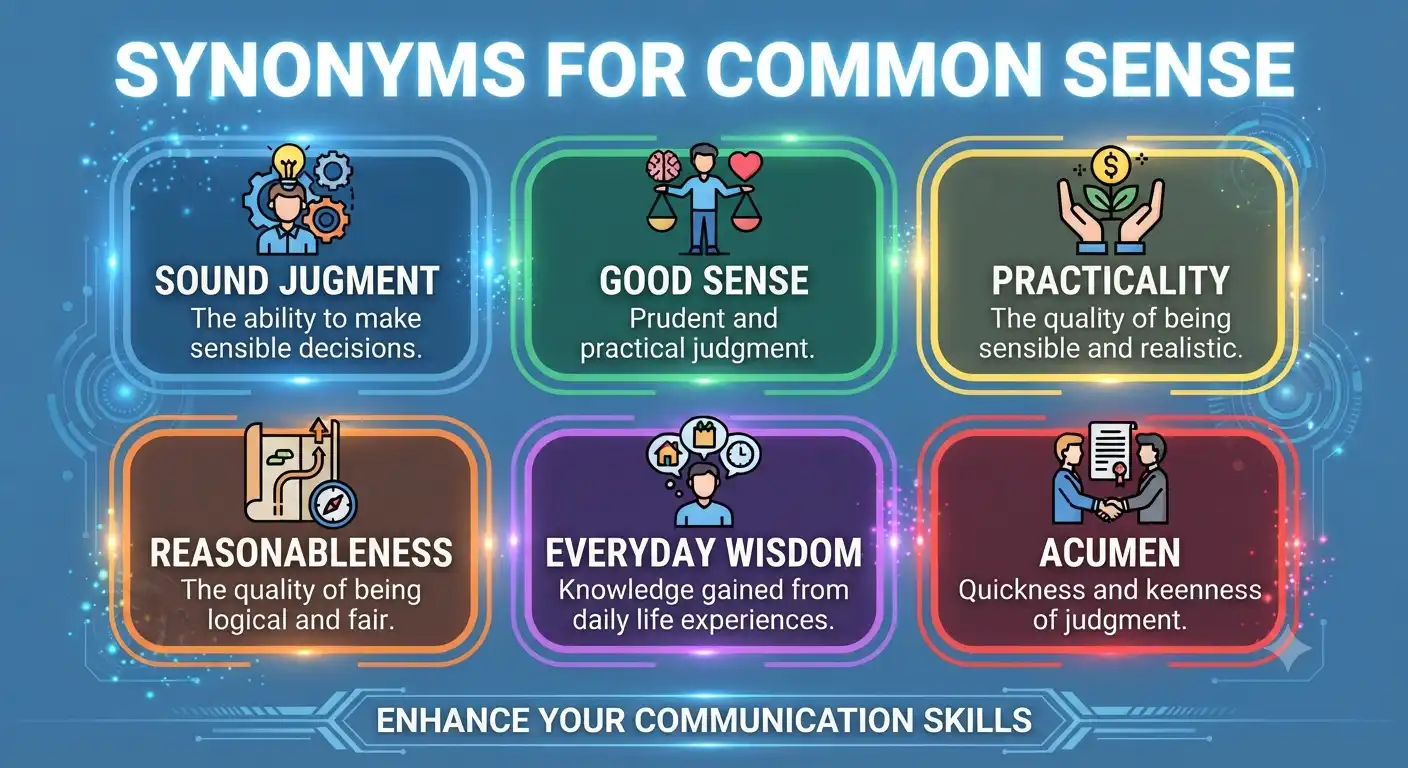
4. Sound Judgment
Pronunciation: US /saʊnd ˈdʒʌdʒmənt/ | UK /saʊnd ˈdʒʌdʒmənt/ Meaning: Sound judgment means a decision that is solid, wise, and well thought out. Examples:
- The judge is known for sound judgment in tough cases.
- She used sound judgment when choosing a business partner.
5. Prudence
Pronunciation: US /ˈprudəns/ | UK /ˈpruːdəns/ Meaning: Prudence is careful thinking before you act, especially about risk. Examples:
- Financial prudence helped them save enough for a house.
- He showed prudence by reading the fine print first.
6. Wisdom
Pronunciation: US /ˈwɪzdəm/ | UK /ˈwɪzdəm/ Meaning: Wisdom is the deep understanding that comes from experience and learning. Examples:
- Her wisdom guided the whole family through hard times.
- True wisdom often comes with age.
7. Sagacity
Pronunciation: US /səˈgæsəti/ | UK /səˈgæsəti/ Meaning: Sagacity is sharp, wise judgment about people and situations. Examples:
- The old teacher was known for his sagacity.
- Investors respected her sagacity in reading the market.
8. Discernment
Pronunciation: US /dɪˈsɜrnmənt/ | UK /dɪˈsɜːnmənt/ Meaning: Discernment is the skill of noticing small details and judging them correctly. Examples:
- He used discernment to spot the flaw in the plan.
- Good discernment helps you choose the right friends.
9. Savvy
Pronunciation: US /ˈsævi/ | UK /ˈsævi/ Meaning: Savvy means having practical knowledge and street-smart skill in a topic. Examples:
- Her marketing savvy grew the small shop fast.
- You need tech savvy to fix that yourself.
10. Street Smarts
Pronunciation: US /strit smɑrts/ | UK /striːt smɑːts/ Meaning: Street smarts is practical knowledge learned from real-world experience, not school. Examples:
- Growing up in the city gave him strong street smarts.
- Street smarts helped her avoid the scam call.
11. Practical Sense
Pronunciation: US /ˈpræktɪkəl sɛns/ | UK /ˈpræktɪkəl sɛns/ Meaning: Practical sense is the ability to handle everyday problems in a simple, useful way. Examples:
- His practical sense fixed the leaky pipe in minutes.
- Use practical sense when packing for a trip.
12. Level-Headedness
Pronunciation: US /ˈlɛvəl ˈhɛdɪdnəs/ | UK /ˈlɛvəl ˈhɛdɪdnəs/ Meaning: Level-headedness means staying calm and thinking clearly under pressure. Examples:
- Her level-headedness kept the team calm during the storm.
- Pilots need level-headedness in an emergency.
13. Rationality
Pronunciation: US /ˌræʃəˈnæləti/ | UK /ˌræʃəˈnælɪti/ Meaning: Rationality means thinking based on logic and facts rather than emotion. Examples:
- His rationality helped solve the budget dispute.
- Rationality is key when reading news headlines.
14. Reason
Pronunciation: US /ˈrizən/ | UK /ˈriːzn/ Meaning: Reason is the power to think clearly and make sense of things. Examples:
- Use reason, not anger, to settle the argument.
- Her reason told her to double-check the numbers.
15. Sensibility
Pronunciation: US /ˌsɛnsəˈbɪləti/ | UK /ˌsɛnsɪˈbɪlɪti/ Meaning: Sensibility is the ability to make wise, balanced choices. Examples:
- Her sensibility kept the budget under control.
- He handled the breakup with real sensibility.
16. Judiciousness
Pronunciation: US /dʒuˈdɪʃəsnəs/ | UK /dʒuːˈdɪʃəsnəs/ Meaning: Judiciousness means being careful and fair when making decisions. Examples:
- The board praised her judiciousness during the merger.
- Judiciousness in spending saved the company money.
17. Shrewdness
Pronunciation: US /ˈʃrudnəs/ | UK /ˈʃruːdnəs/ Meaning: Shrewdness is sharp, clever thinking that spots the best option quickly. Examples:
- Her shrewdness helped her win the negotiation.
- The shopkeeper’s shrewdness kept the business alive for decades.
18. Astuteness
Pronunciation: US /əˈstutnəs/ | UK /əˈstjuːtnəs/ Meaning: Astuteness is the skill of noticing things quickly and judging them well. Examples:
- His astuteness caught the error before it cost them money.
- Astuteness in reading people made her a great manager.
19. Perceptiveness
Pronunciation: US /pərˈsɛptɪvnəs/ | UK /pəˈsɛptɪvnəs/ Meaning: Perceptiveness means noticing things others often miss. Examples:
- Her perceptiveness picked up on the client’s real concern.
- The detective’s perceptiveness solved the case fast.
20. Insight
Pronunciation: US /ˈɪnsaɪt/ | UK /ˈɪnsaɪt/ Meaning: Insight is a clear and deep understanding of a situation. Examples:
- His insight into the market saved the company money.
- Reading gave her insight into different cultures.
21. Acumen
Pronunciation: US /əˈkjumən/ | UK /ˈækjʊmən/ Meaning: Acumen is sharp skill in judging and handling a specific type of problem. Examples:
- Her business acumen doubled the company’s profit.
- Sharp political acumen helped him win the debate.
22. Cleverness
Pronunciation: US /ˈklɛvərnəs/ | UK /ˈklɛvənəs/ Meaning: Cleverness means being quick and smart at solving problems. Examples:
- His cleverness fixed the broken machine with simple tools.
- The plan showed real cleverness under pressure.
23. Wit
Pronunciation: US /wɪt/ | UK /wɪt/ Meaning: Wit is quick, sharp thinking, often shown through clever remarks. Examples:
- Her wit helped her think fast during the interview.
- He used his wit to calm an angry customer.
24. Intuition
Pronunciation: US /ˌɪntuˈɪʃən/ | UK /ˌɪntjuːˈɪʃən/ Meaning: Intuition is the ability to understand something instantly, without needing proof. Examples:
- Her intuition told her the deal was risky.
- Trust your intuition when something feels wrong.
25. Gumption
Pronunciation: US /ˈgʌmpʃən/ | UK /ˈgʌmpʃən/ Meaning: Gumption is a mix of courage and practical sense to get things done. Examples:
- It took gumption to start a business with no savings.
- Her gumption helped her fix the car alone.
26. Nous
Pronunciation: US /nuːs/ | UK /naʊs/ Meaning: Nous is British slang for practical intelligence and common sense. Examples:
- He’s got the nous to spot a bad deal instantly.
- Use your nous before signing anything.
27. Mother Wit
Pronunciation: US /ˈmʌðər wɪt/ | UK /ˈmʌðə wɪt/ Meaning: Mother wit is natural, inborn common sense that no one taught you. Examples:
- Her mother wit helped her handle the tricky customer.
- He relies on mother wit more than formal training.
28. Native Intelligence
Pronunciation: US /ˈneɪtɪv ɪnˈtɛlədʒəns/ | UK /ˈneɪtɪv ɪnˈtɛlɪdʒəns/ Meaning: Native intelligence is natural smartness a person is born with. Examples:
- His native intelligence made up for his lack of schooling.
- She solved the puzzle fast, using pure native intelligence.
29. Practical Knowledge
Pronunciation: US /ˈpræktɪkəl ˈnɑlɪdʒ/ | UK /ˈpræktɪkəl ˈnɒlɪdʒ/ Meaning: Practical knowledge is know-how gained from doing, not just reading. Examples:
- Years of farming gave him deep practical knowledge.
- Her practical knowledge of tools helped fix the fence quickly.
30. Practicality
Pronunciation: US /ˌpræktɪˈkæləti/ | UK /ˌpræktɪˈkælɪti/ Meaning: Practicality means choosing what actually works in real life. Examples:
- Practicality guided her choice of a small, reliable car.
- The plan lacked practicality and quickly failed.
31. Logic
Pronunciation: US /ˈlɑdʒɪk/ | UK /ˈlɒdʒɪk/ Meaning: Logic is clear, step-by-step thinking that leads to a correct answer. Examples:
- Simple logic told him the shortcut was faster.
- Her logic solved the math riddle instantly.
32. Reasonableness
Pronunciation: US /ˈrizənəbəlnəs/ | UK /ˈriːzənəblnəs/ Meaning: Reasonableness means being fair and sensible in thought or action. Examples:
- His reasonableness helped settle the family dispute.
- The landlord showed reasonableness about the late rent.
33. Perspicacity
Pronunciation: US /ˌpɜrspɪˈkæsəti/ | UK /ˌpɜːspɪˈkæsɪti/ Meaning: Perspicacity is a sharp ability to understand things clearly and quickly. Examples:
- Her perspicacity spotted the hidden fee in the contract.
- The lawyer’s perspicacity won the tricky case.
34. Sapience
Pronunciation: US /ˈseɪpiəns/ | UK /ˈseɪpiəns/ Meaning: Sapience is deep, wise understanding, often used in a formal or literary way. Examples:
- The old monk spoke with quiet sapience.
- Human sapience sets us apart from other animals.
35. Prudent Judgment
Pronunciation: US /ˈprudənt ˈdʒʌdʒmənt/ | UK /ˈpruːdənt ˈdʒʌdʒmənt/ Meaning: Prudent judgment means a careful, wise decision that avoids unnecessary risk. Examples:
- Prudent judgment kept the company out of debt.
- She used prudent judgment before investing her savings.
36. Discretion
Pronunciation: US /dɪˈskrɛʃən/ | UK /dɪˈskrɛʃən/ Meaning: Discretion is the careful use of good judgment, especially about what to say or do. Examples:
- Use discretion when sharing personal information online.
- Her discretion kept the secret safe for years.
37. Sober Judgment
Pronunciation: US /ˈsoʊbər ˈdʒʌdʒmənt/ | UK /ˈsəʊbə ˈdʒʌdʒmənt/ Meaning: Sober judgment means a calm, serious, and realistic decision. Examples:
- Sober judgment stopped him from making a rash purchase.
- The board relied on sober judgment during the crisis.
38. Balanced Thinking
Pronunciation: US /ˈbælənst ˈθɪŋkɪŋ/ | UK /ˈbælənst ˈθɪŋkɪŋ/ Meaning: Balanced thinking means weighing both sides fairly before deciding. Examples:
- Balanced thinking helped her choose a fair solution.
- The teacher praised his balanced thinking in the debate.
39. Clear Thinking
Pronunciation: US /klɪr ˈθɪŋkɪŋ/ | UK /klɪə ˈθɪŋkɪŋ/ Meaning: Clear thinking means understanding a problem simply, without confusion. Examples:
- Clear thinking helped her solve the puzzle fast.
- He needed clear thinking to fix the broken engine.
40. Realism
Pronunciation: US /ˈriəlɪzəm/ | UK /ˈrɪəlɪzəm/ Meaning: Realism means seeing things as they truly are, not how you wish they were. Examples:
- Realism told her the plan needed more time.
- His realism kept the team’s goals achievable.
41. Common Wisdom
Pronunciation: US /ˈkɑmən ˈwɪzdəm/ | UK /ˈkɒmən ˈwɪzdəm/ Meaning: Common wisdom is the shared, practical knowledge most people agree on. Examples:
- Common wisdom says to save before you spend.
- She followed common wisdom and packed an umbrella.
42. Down-to-Earth Thinking
Pronunciation: US /ˌdaʊntəˈɜrθ ˈθɪŋkɪŋ/ | UK /ˌdaʊntʊˈɜːθ ˈθɪŋkɪŋ/ Meaning: Down-to-earth thinking means simple, honest, and realistic reasoning. Examples:
- His down-to-earth thinking kept the plan simple and cheap.
- She’s known for down-to-earth thinking at work.
43. Plain Sense
Pronunciation: US /pleɪn sɛns/ | UK /pleɪn sɛns/ Meaning: Plain sense is simple, honest judgment without any complex theory. Examples:
- Plain sense told him not to trust the offer.
- Use plain sense before making a big purchase.
44. Good Sense
Pronunciation: US /gʊd sɛns/ | UK /gʊd sɛns/ Meaning: Good sense means the natural skill to make smart, safe choices. Examples:
- She showed good sense by locking the doors at night.
- Good sense told him to check the weather first.
45. Everyday Wisdom
Pronunciation: US /ˈɛvriˌdeɪ ˈwɪzdəm/ | UK /ˈɛvrɪˌdeɪ ˈwɪzdəm/ Meaning: Everyday wisdom is practical advice that helps with normal daily life. Examples:
- Everyday wisdom says to measure twice before you cut.
- Her grandmother passed down years of everyday wisdom.
46. Sound Reasoning
Pronunciation: US /saʊnd ˈrizənɪŋ/ | UK /saʊnd ˈriːzənɪŋ/ Meaning: Sound reasoning means a logical, well-supported way of thinking. Examples:
- Sound reasoning led the jury to the right verdict.
- His sound reasoning made the report easy to trust.
47. Practical Intelligence
Pronunciation: US /ˈpræktɪkəl ɪnˈtɛlədʒəns/ | UK /ˈpræktɪkəl ɪnˈtɛlɪdʒəns/ Meaning: Practical intelligence is the skill of solving real, everyday problems well. Examples:
- Practical intelligence helped her repair the roof herself.
- His practical intelligence saved the trip when the car broke down.
48. Business Sense
Pronunciation: US /ˈbɪznəs sɛns/ | UK /ˈbɪznɪs sɛns/ Meaning: Business sense is the skill of making smart choices about money and trade. Examples:
- Her business sense grew the shop into a small chain.
- He used business sense to avoid a bad partnership.
49. Life Skills
Pronunciation: US /laɪf skɪlz/ | UK /laɪf skɪlz/ Meaning: Life skills are the practical abilities people need to manage daily living. Examples:
- Cooking and budgeting are important life skills.
- Schools should teach more basic life skills.
50. Street Sense
Pronunciation: US /strit sɛns/ | UK /striːt sɛns/ Meaning: Street sense is the practical awareness needed to stay safe and smart in real situations. Examples:
- Street sense told her to avoid the dark alley.
- His street sense helped him spot the scam right away.
Antonyms of Common Sense
- Foolishness
- Stupidity
- Ignorance
- Naivety
- Recklessness
- Absurdity
- Thoughtlessness
Prototype Meaning and Categorization
The prototype meaning of common sense centers on one clear image: a plain, practical person making a sound decision without special training. It sits inside the broader category of cognitive ability words, alongside intelligence, wisdom, and judgment. Within that category, common sense holds a unique spot — it is always practical, always everyday, and never tied to formal education. Words like sagacity or acumen lean more formal, while street smarts and horse sense lean more casual, showing how the same core idea shifts in tone across contexts.
FAQs About Synonyms for Common Sense
1. What is the closest synonym to common sense? Good judgment and practical wisdom are the closest matches in everyday English.
2. Is horse sense the same as common sense? Yes, horse sense is an informal American synonym with the same basic meaning.
3. What is a formal synonym for common sense? Sagacity, prudence, and discernment work well in formal or academic writing.
4. What is the British slang word for common sense? Nous is a common British slang term for practical common sense.
5. Can street smarts replace common sense in writing? Yes, but street smarts leans more casual and suggests city or real-world experience.
6. Why should writers use synonyms instead of repeating common sense? Synonyms keep writing fresh, improve readability, and avoid boring, repetitive text.
7. What is the opposite of common sense? Foolishness, stupidity, and recklessness are the most common opposites.
Conclusion
Learning synonyms for common sense does more than fill your vocabulary — it sharpens your entire writing style. A strong vocabulary improves your writing, gives your blogging more variety, boosts your speaking confidence, and smooths out everyday communication. When you know ten ways to say the same idea, your sentences stop sounding repetitive and start sounding polished.
Try using a few of these words in your next email at work, your next school essay, or even a casual daily conversation with friends. Small changes like swapping “common sense” for “sound judgment” or “practical wisdom” instantly make your language feel more mature and thoughtful.
“Common sense is the collection of prejudices acquired by the age of eighteen.” — Albert Einstein
Keep practicing, keep reading, and keep testing new words in real sentences. That’s how vocabulary truly sticks.
“Knowing is not enough; we must apply. Willing is not enough; we must do.” — Johann Wolfgang von Goethe
“Wisdom begins in wonder.” — Socrates

Michael Turner is a published fiction writer and creative writing tutor with over a decade of experience helping writers find the words that make their stories breathe ( Biography ).