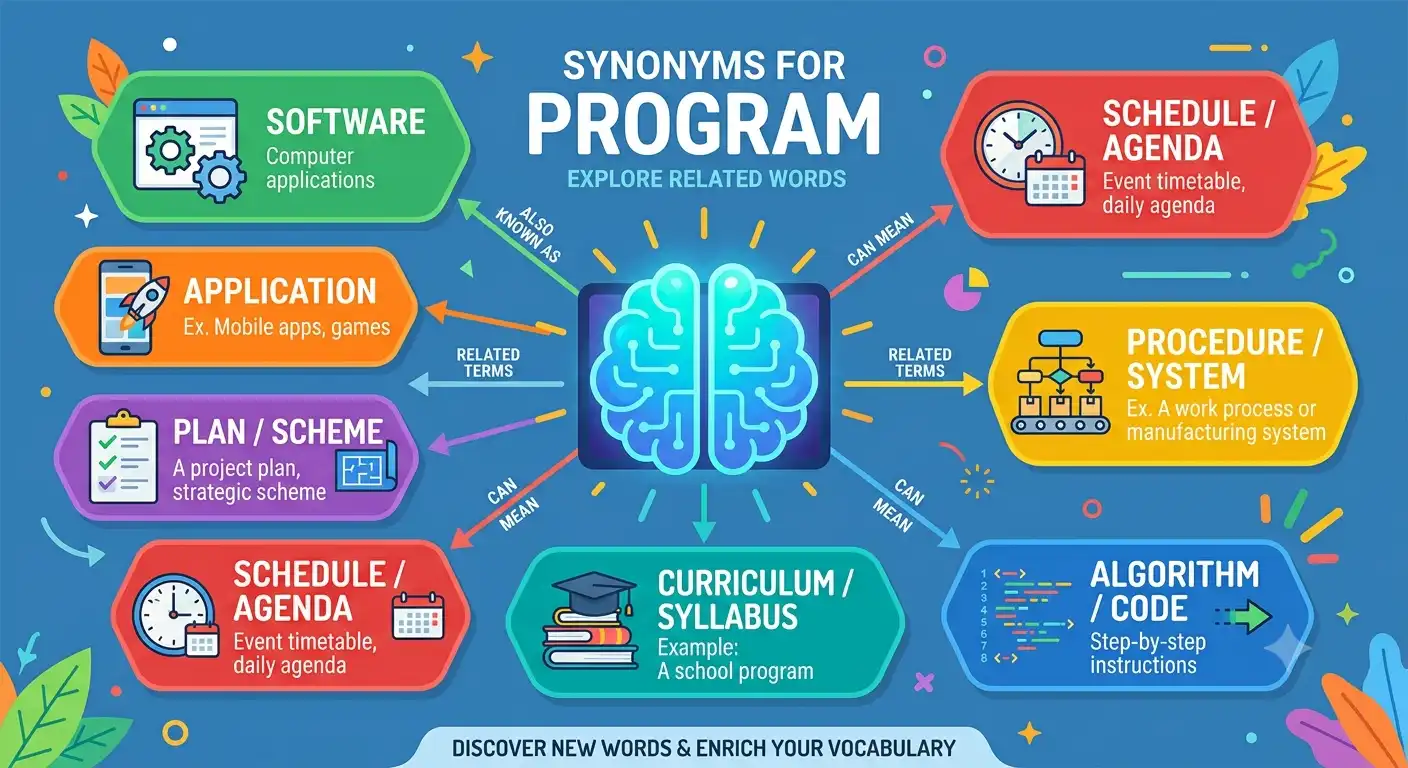
Finding accurate synonyms for program helps you select the exact word to express plans, software, schedules, and projects. Exploring synonyms for program allows your academic essays, tech blogs, business emails, and daily conversations to sound clear, professional, and engaging. Using dynamic word choices instead of repeating the same noun keeps your audience interested and makes your writing stand out.
Imagine planning a fun weekend trip with your family or building a new app on your laptop. You can call it a program, but words like plan, schedule, application, project, or agenda show the exact picture of what you mean. To use a program means to follow a set plan of action, run computer software, or organize an event step by step.
Learning these useful words brings clear daily benefits:
- Students can write better essays, describe school courses, and organize study routines.
- Bloggers can write clear tech guides and event updates that attract readers.
- Content writers can build clear project guides and explain software features smoothly.
- Daily English users can discuss work tasks, daily schedules, and hobbies with ease.
“Choosing the right word for your plan makes every idea clear.”
“Using precise words transforms simple thoughts into structured success.”
Connotative Meaning of Program
The word program carries different emotional tones depending on the context:
- Positive Connotation: Organization, progress, structured growth, and technological innovation (e.g., initiative, flourishing strategy, curriculum).
- Negative Connotation: Rigid routines, heavy bureaucracy, or forced schedules (e.g., regimen, strict scheme).
- Neutral Connotation: Standard routines, general software, or basic lists of events (e.g., application, schedule, agenda).
Etymology of Program
- Prefix / Root Origin: Greek programma (from pro- “before” + graphein “to write”).
- Historical Evolution: Passed through Late Latin programma and French programme, originally meaning a public written notice or printed announcement.
- Modern Usage: Evolved in the 19th century to mean a list of events or playbill, and in the 20th century to include computer instructions and organizational plans.
Pronunciation, Syllables, and Affixation Pattern
- US Pronunciation (IPA): /ˈproʊ.ɡræm/
- UK Pronunciation (IPA): /ˈprəʊ.ɡræm/
- Syllable Count: 2 syllables (pro-gram)
- Root Word: Program
- Affixation Pattern:
- Prefix: pro- (derivational prefix meaning “before” or “forward”)
- Root: gram (meaning “thing written or drawn”)
- Derivatives: programmer (noun), programming (noun/adjective), programmatic (adjective)
Word Comparison Table
| Keyword | Meaning | Usage Type | Context |
| Program | A structured plan, software tool, or list of events | General / Neutral | Work plans, technology, education, daily talk |
| Plan | An intended set of actions to achieve a goal | Casual / Expressive | Daily tasks, travel, personal projects |
| Application (App) | A computer software program designed for users | Tech / Casual | Smartphones, computers, software guides |
| Agenda | A list of topics or items to be discussed at a meeting | Formal / Professional | Business meetings, office work, planning |
| Curriculum | The set of courses offered by a school or college | Academic / Formal | Schools, universities, education guides |
| Initiative | A new plan or strategy to solve a specific problem | Formal / Strategic | Business strategies, government projects |
| Regimen | A strict system or plan of daily habits or health | Technical / Rigid | Health, fitness routines, medical plans |
50 Synonyms for Program
1. Plan
- Pronunciation: US: /plæn/ | UK: /plæn/
- Meaning: A thought-out set of steps to reach a specific goal.
- Examples:
- We have a clear plan for our weekend study session.
- Her financial plan helped her save money quickly.
2. Software
- Pronunciation: US: /ˈsɑːft.wer/ | UK: /ˈsɒft.weər/
- Meaning: The computer programs and operating information used by computers.
- Examples:
- This new software makes photo editing fast and fun.
- The company updated its security software yesterday.
3. Application
- Pronunciation: US: /ˌæp.ləˈkeɪ.ʃən/ | UK: /ˌæp.lɪˈkeɪ.ʃən/
- Meaning: A computer program built to perform a specific user task.
- Examples:
- You can download this map application on your phone.
- The web application helps students track their homework.
4. Schedule
- Pronunciation: US: /ˈskedʒ.uːl/ | UK: /ˈʃed.juːl/
- Meaning: A list of planned activities and the times they will happen.
- Examples:
- Check the daily schedule before you attend the meeting.
- The bus schedule changed for the winter season.
5. Agenda
- Pronunciation: US: /əˈdʒen.də/ | UK: /əˈdʒen.də/
- Meaning: A list of items to be discussed or acted upon.
- Examples:
- The team reviewed the meeting agenda before starting.
- Climate protection is top on their political agenda.
6. Itinerary
- Pronunciation: US: /aɪˈtɪn.ə.rer.i/ | UK: /aɪˈtɪn.ər.ər.i/
- Meaning: A planned route or detailed journey list for a trip.
- Examples:
- The travel agent sent our vacation itinerary today.
- Our tour itinerary includes visiting three famous museums.
7. Project
- Pronunciation: US: /ˈprɑː.dʒekt/ | UK: /ˈprɒdʒ.ekt/
- Meaning: A planned piece of work that takes time to complete.
- Examples:
- The class started a science project about plants.
- Our team finished the web design project early.
8. Scheme
- Pronunciation: US: /skiːm/ | UK: /skiːm/
- Meaning: A large organized plan for doing or getting something.
- Examples:
- The city launched a recycling scheme for clean streets.
- They created a new training scheme for new staff.
9. Course
- Pronunciation: US: /kɔːrs/ | UK: /kɔːs/
- Meaning: A series of lessons or lectures on a specific subject.
- Examples:
- I joined an online course to learn basic coding.
- The history course covers major events of the past.
10. Curriculum
- Pronunciation: US: /kəˈrɪk.jə.ləm/ | UK: /kəˈrɪk.jə.ləm/
- Meaning: The total group of subjects studied in a school or college.
- Examples:
- The school added computer science to its curriculum.
- Teachers follow a strict curriculum each school term.
11. Syllabus
- Pronunciation: US: /ˈsɪl.ə.bəs/ | UK: /ˈsɪl.ə.bəs/
- Meaning: An outline of the topics covered in an educational course.
- Examples:
- The professor handed out the class syllabus today.
- Read the syllabus to know your exam dates.
12. Broadcast
- Pronunciation: US: /ˈbrɑːd.kæst/ | UK: /ˈbrɔːd.kɑːst/
- Meaning: A radio or television show sent out to the public.
- Examples:
- The evening news broadcast begins at six o’clock.
- Millions of viewers watched the live sports broadcast.
13. Show
- Pronunciation: US: /ʃoʊ/ | UK: /ʃəʊ/
- Meaning: A performance or display given on stage, TV, or radio.
- Examples:
- We watched a fun comedy show last night.
- The art show featured painting by local students.
14. Platform
- Pronunciation: US: /ˈplæt.fɔːrm/ | UK: /ˈplæt.fɔːm/
- Meaning: A system or base operating environment for software.
- Examples:
- The learning platform lets students upload homework easily.
- This social platform connects creators across the world.
15. Strategy
- Pronunciation: US: /ˈstræt̬.ə.dʒi/ | UK: /ˈstræt.ə.dʒi/
- Meaning: A detailed plan designed to achieve a long-term goal.
- Examples:
- Our sales strategy boosted customer visits this month.
- Good study strategy helps you score high on tests.
16. Initiative
- Pronunciation: US: /ɪˈnɪʃ.ə.t̬ɪv/ | UK: /ɪˈnɪʃ.ə.tɪv/
- Meaning: An important new plan intended to solve a problem.
- Examples:
- The green city initiative promotes planting small trees.
- Teachers started a new reading initiative for young kids.
17. Design
- Pronunciation: US: /dɪˈzaɪn/ | UK: /dɪˈzaɪn/
- Meaning: A detailed layout or plan showing how something works.
- Examples:
- The builder showed us the house design yesterday.
- Smart design makes this handheld tool easy to use.
18. Routine
- Pronunciation: US: /ruːˈtiːn/ | UK: /ruːˈtiːn/
- Meaning: A regular, fixed pattern of doing things step by step.
- Examples:
- A daily morning routine keeps your spirit refreshed.
- Exercise should be part of your daily healthy routine.
19. Procedure
- Pronunciation: US: /prəˈsiː.dʒɚ/ | UK: /prəˈsiː.dʒər/
- Meaning: An established or official way of doing something step by step.
- Examples:
- Follow the safety procedure during an emergency drill.
- The lab technician explained the testing procedure clearly.
20. Method
- Pronunciation: US: /ˈmeθ.əd/ | UK: /ˈmeθ.əd/
- Meaning: A particular way of doing something systematic and organized.
- Examples:
- This teaching method helps students solve math problems fast.
- Use a simple method to keep your study desk organized.
21. Code
- Pronunciation: US: /koʊd/ | UK: /kəʊd/
- Meaning: System instructions written for a computer program to run.
- Examples:
- The developer wrote clean computer code for the app.
- Check the source code to fix the software bug.
22. Script
- Pronunciation: US: /skrɪpt/ | UK: /skrɪpt/
- Meaning: A small computer program that automates simple digital tasks.
- Examples:
- He wrote an automated script to organize data files.
- The web script loads image galleries very quickly.
23. Utility
- Pronunciation: US: /juːˈtɪl.ə.t̬i/ | UK: /juːˈtɪl.ə.ti/
- Meaning: A small computer system program designed for maintenance tasks.
- Examples:
- Run the disk cleaner utility to free up memory.
- This system utility checks network speed every hour.
24. Enterprise
- Pronunciation: US: /ˈen.t̬ɚ.praɪz/ | UK: /ˈen.tə.praɪz/
- Meaning: A large project or plan that requires effort and organization.
- Examples:
- Building the new bridge was a massive national enterprise.
- Their business enterprise expanded into three new cities.
25. Undertaking
- Pronunciation: US: /ˌʌn.dɚˈteɪ.kɪŋ/ | UK: /ˌʌn.dəˈteɪ.kɪŋ/
- Meaning: A task or project that someone agrees to perform.
- Examples:
- Writing an encyclopedia is a massive research undertaking.
- Renovating the old library was a challenging undertaking.
26. Arrangement
- Pronunciation: US: /əˈreɪndʒ.mənt/ | UK: /əˈreɪndʒ.mənt/
- Meaning: Plans and preparations made for an event to happen.
- Examples:
- We made travel arrangement details for our summer trip.
- Seating arrangement plans were fixed for all guests.
27. Blueprint
- Pronunciation: US: /ˈbluː.prɪnt/ | UK: /ˈbluː.prɪnt/
- Meaning: A detailed guide or technical drawing for a building or plan.
- Examples:
- Engineers studied the building blueprint carefully today.
- This report is a clear blueprint for future growth.
28. Campaign
- Pronunciation: US: /kæmˈpeɪn/ | UK: /kæmˈpeɪn/
- Meaning: A planned series of actions intended to achieve a goal.
- Examples:
- The health campaign teaches people to eat fresh fruit.
- They launched an online campaign to support local parks.
29. Setup
- Pronunciation: US: /ˈset.ʌp/ | UK: /ˈset.ʌp/
- Meaning: The way something is structured, organized, or configured.
- Examples:
- Our computer setup allows easy remote working online.
- The studio setup includes bright lights and microphones.
30. Operation
- Pronunciation: US: /ˌɑː.pəˈreɪ.ʃən/ | UK: /ˌɒp.ərˈeɪ.ʃən/
- Meaning: An organized activity involving many moving parts or people.
- Examples:
- The rescue operation saved citizens stranded by floods.
- Daily business operation resumes at eight every morning.
31. Policy
- Pronunciation: US: /ˈpɑː.lə.si/ | UK: /ˈpɒl.ə.si/
- Meaning: An agreed plan or rule used by organizations or teams.
- Examples:
- The store updated its return policy for electronic goods.
- Honesty is the best policy in workplace discussions.
32. App
- Pronunciation: US: /æp/ | UK: /æp/
- Meaning: Short for application; a software tool installed on devices.
- Examples:
- This fitness app counts your daily steps automatically.
- Open the weather app to see if rain is expected.
33. Module
- Pronunciation: US: /ˈmɑː.dʒuːl/ | UK: /ˈmɒd.juːl/
- Meaning: A distinct unit or section of a larger course or system.
- Examples:
- We finished the first training module in our class.
- The software module processes payments safely online.
34. Series
- Pronunciation: US: /ˈsɪr.iːz/ | UK: /ˈsɪə.riːz/
- Meaning: A set of related television programs or sequential events.
- Examples:
- I am watching a document series about ocean life.
- The school hosted a series of educational lectures.
35. Production
- Pronunciation: US: /prəˈdʌk.ʃən/ | UK: /prəˈdʌk.ʃən/
- Meaning: A total show, play, or movie created for public viewing.
- Examples:
- The drama club put on a wonderful theatrical production.
- Movie production wrapped up ahead of schedule today.
36. Exercise
- Pronunciation: US: /ˈek.sɚ.saɪz/ | UK: /ˈek.sə.saɪz/
- Meaning: A structured activity designed to build skills or health.
- Examples:
- Morning physical exercise boosts your daily energy levels.
- Try this grammar exercise to test your word power.
37. Regimen
- Pronunciation: US: /ˈredʒ.ə.mən/ | UK: /ˈredʒ.ɪ.mən/
- Meaning: A strict set of daily rules for diet, exercise, or health.
- Examples:
- He follows a strict daily workout regimen every morning.
- The doctor prescribed a healthy diet regimen for recovery.
38. Proposal
- Pronunciation: US: /prəˈpoʊ.zəl/ | UK: /prəˈpəʊ.zəl/
- Meaning: A formal plan or suggestion presented for consideration.
- Examples:
- The team submitted a project proposal to the board.
- Read the budget proposal before giving your approval.
39. Layout
- Pronunciation: US: /ˈleɪ.aʊt/ | UK: /ˈleɪ.aʊt/
- Meaning: The structured arrangement of parts within a plan or page.
- Examples:
- The website layout is clean and easy to navigate.
- Architects changed the room layout for better lighting.
40. Outline
- Pronunciation: US: /ˈaʊt.laɪn/ | UK: /ˈaʊt.laɪn/
- Meaning: A general plan giving essential features without small details.
- Examples:
- Write a clear essay outline before writing your draft.
- The manager gave a brief outline of next week’s tasks.
41. Schedule of events
- Pronunciation: US: /ˈskedʒ.uːl ʌv ɪˈvents/ | UK: /ˈʃed.juːl ɒv ɪˈvents/
- Meaning: A list of activities set to take place at specific times.
- Examples:
- The wedding schedule of events begins with afternoon photos.
- Guests received the schedule of events at registration.
42. Course of action
- Pronunciation: US: /kɔːrs ʌv ˈæk.ʃən/ | UK: /kɔːs ɒv ˈæk.ʃən/
- Meaning: A chosen procedure or plan to handle a specific situation.
- Examples:
- Staying calm is the best course of action during trouble.
- We decided on our course of action after deep discussion.
43. Task
- Pronunciation: US: /tæsk/ | UK: /tɑːsk/
- Meaning: A piece of work to be done as part of a routine plan.
- Examples:
- Completing this homework task took thirty minutes total.
- Assign each task to the right team member quickly.
44. Protocol
- Pronunciation: US: /ˈproʊ.t̬ə.kɑːl/ | UK: /ˈprəʊ.tə.kɒl/
- Meaning: A system of fixed rules and procedures for formal situations.
- Examples:
- Hospital staff follow a strict health protocol daily.
- Network security protocol protects your sensitive data.
45. Function
- Pronunciation: US: /ˈfʌŋk.ʃən/ | UK: /ˈfʌŋk.ʃən/
- Meaning: A formal event or routine operation within a program tool.
- Examples:
- The software search function works very quickly now.
- Our school held an annual award function last night.
46. Activity
- Pronunciation: US: /ækˈtɪv.ə.t̬i/ | UK: /ækˈtɪv.ə.ti/
- Meaning: An organized event or exercise done by individuals or groups.
- Examples:
- Outdoor sports activity helps students stay active.
- The teacher planned a fun group activity for class.
47. Timetable
- Pronunciation: US: /ˈtaɪmˌteɪ.bəl/ | UK: /ˈtaɪmˌteɪ.bəl/
- Meaning: A chart showing dates and times when events will happen.
- Examples:
- The train timetable shows departures every twenty minutes.
- Check your examination timetable on the student portal.
48. Framework
- Pronunciation: US: /ˈfreɪm.wɝːk/ | UK: /ˈfreɪm.wɜːk/
- Meaning: A basic structure underlying a system, concept, or text plan.
- Examples:
- Developers built the app using a robust software framework.
- The agreement forms a strong framework for future peace.
49. Systematization
- Pronunciation: US: /ˌsɪs.tə.mə.t̬əˈzeɪ.ʃən/ | UK: /ˌsɪs.tə.mə.taɪˈzeɪ.ʃən/
- Meaning: The act of organizing things into an orderly system or plan.
- Examples:
- Workplace systematization reduced daily processing errors.
- Data systematization helps us locate records with ease.
50. System
- Pronunciation: US: /ˈsɪs.təm/ | UK: /ˈsɪs.təm/
- Meaning: A group of interacting parts forming a unified whole.
- Examples:
- Our solar system has eight major planets orbiting the sun.
- The company installed a modern computer system today.
Antonyms of Program
Knowing opposite words allows you to highlight clear contrasts when writing:
- Disorganization: Complete lack of order or systematic planning.
- Chaos: A state of utter confusion and absence of structure.
- Improv: Acting or speaking without any prepared plan or script.
- Haphazardness: Random action done without order or deliberate thought.
- Disorder: Failure of structured arrangement or systemic rules.
- Neglect: Leaving tasks or systems unattended without guidance.
Prototype Meaning and Categorization of Program
The core prototype meaning of program is a structured system, set of instructions, or planned sequence of events designed to achieve a specific outcome.
“Every structured action gains power when named with precision.”
Conceptual Categories:
- Software & Tech Systems: Application, app, software, code, script, utility, platform, module, framework.
- Schedules & Timelines: Schedule, agenda, itinerary, timetable, schedule of events, routine.
- Education & Courses: Curriculum, syllabus, course, module, exercise.
- Strategic Plans & Initiatives: Plan, strategy, initiative, scheme, blueprint, proposal, project, enterprise, undertaking, campaign.
- Rules & Procedures: Procedure, protocol, method, system, operation, layout, outline, policy, systematization, function.
- Media & Performances: Broadcast, show, series, production, activity.
Frequently Asked Questions (FAQs)
1. What is the most common synonym for program in technology?
The words software and application (or app) are the most popular tech synonyms for “program.” They describe computer code designed for user tasks across computers, phones, and tablets.
2. How are program and plan different?
A plan is a general idea or goal outlining steps to take. A program usually refers to an organized, formal, or recurring system of activities or software instructions.
3. Which synonym for program is best for formal business writing?
In formal business writing, terms like initiative, agenda, strategy, proposal, or framework sound professional and precise.
4. Can program refer to television shows and broadcasts?
Yes! In media and entertainment, program means a broadcasted show, drama series, or radio performance (e.g., a television program).
5. What makes choosing the right synonym for program important?
Using specific words gives your reader a clear picture. Words like curriculum highlight education, while script points directly to computer code or drama text.
6. Is program spelled differently in British English?
Yes! In British English, the general word for a plan or show is spelled programme, while the computer software term is spelled program worldwide.
Conclusion
Expanding your vocabulary with varied synonyms for program boosts your writing, blogging, public speaking, and daily communication. Swapping repetitive terms for vivid options like application, initiative, curriculum, or agenda gives your thoughts clarity and professional strength.
For students, using precise vocabulary sharpens essays, study schedules, and academic reports, bloggers and content writers, dynamic terms grab reader attention and make technical guides easy to follow, daily English users, learning these words helps you talk about daily tasks, tech tools, and travel plans with complete confidence.
Try incorporating these words into your daily writing routine:
- Use initiative or strategy in professional emails and resume summaries.
- Use curriculum or framework in academic papers and research outlines.
- Use app or itinerary in casual text messages and friendly travel talks.
“Mastering new vocabulary opens clear paths for every message you share.”
“Clear words help us build better plans and stronger connections every day.”

Michael Turner is a published fiction writer and creative writing tutor with over a decade of experience helping writers find the words that make their stories breathe ( Biography ).