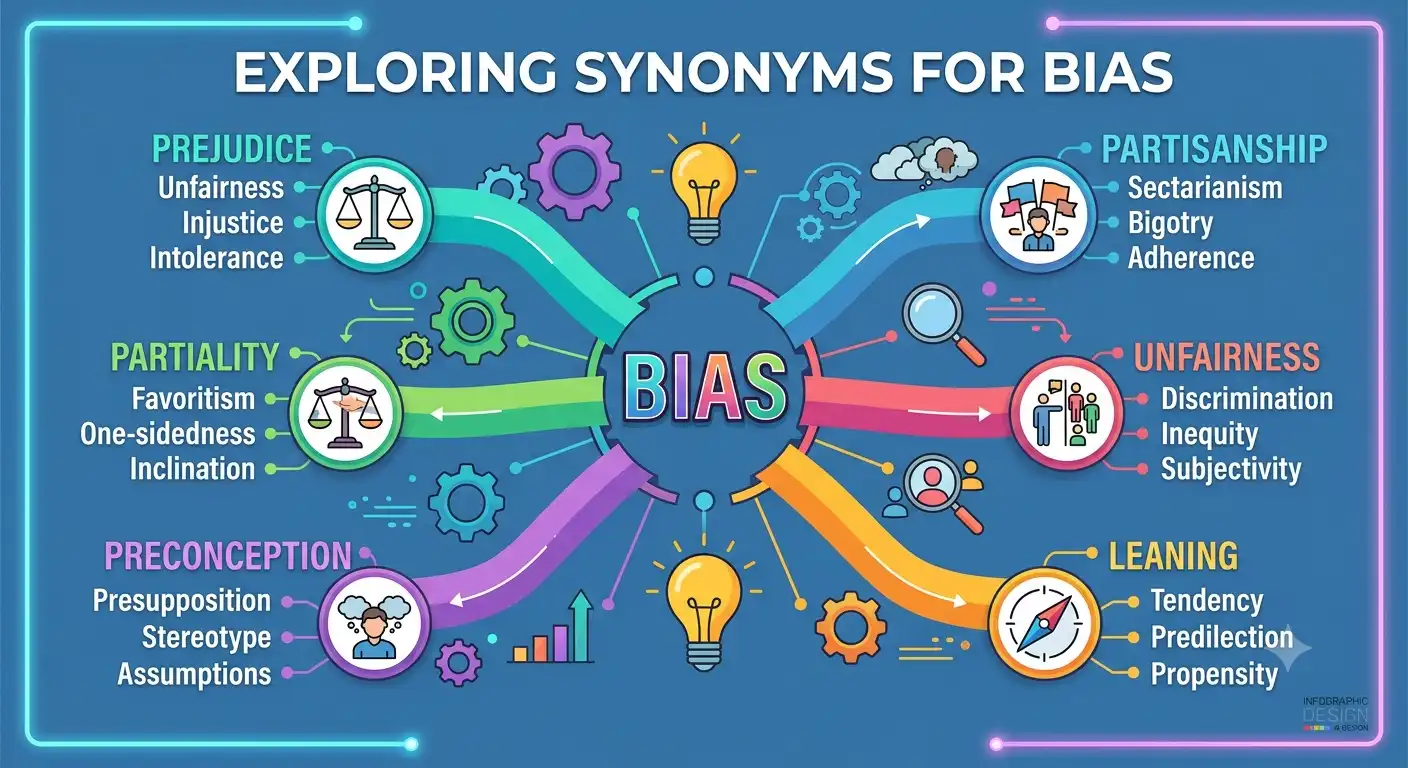
Finding the right synonyms for bias helps you express opinions, choices, and unfair views clearly. Exploring synonyms for bias allows you to describe personal preferences, slanted reports, and workplace favoritism accurately. Learning varied synonyms for bias will sharpen your writing and improve your daily communication.
Imagine a coach selecting their own child for a team even though another player scored more goals. That natural leaning or unfair preference is what we call bias. We see this every day when people pick sides without looking at all the facts.
Understanding these words brings clear daily benefits:
- Students can write balanced essays, analyze history, and explain research results.
- Bloggers can write fair product reviews and engaging opinion articles.
- Content writers can craft precise news updates and professional reports.
- Daily English users can discuss opinions, news, and choices with total clarity.
“Recognizing different words for unfairness helps us speak with total clarity.”
“Choosing precise words turns simple thoughts into clear and powerful messages.”
Connotative Meaning of Bias
The word bias carries different emotional tones depending on the context:
- Positive Connotation: Warm preference, natural affection, or helpful focus (e.g., affinity, liking, fondness).
- Negative Connotation: Unfair judgment, hatred, or systemic injustice (e.g., prejudice, bigotry, nepotism).
- Neutral Connotation: Natural human direction, technical deviation, or simple perspective (e.g., inclination, tendency, slant).
Etymology of Bias
- Prefix / Root Origin: Old French biais (meaning “slant,” “slope,” or “oblique line”).
- Historical Evolution: Passed from Provencal biays into Middle English, originally describing a diagonal line in fabric or lawn bowling.
- Modern Usage: Evolved in the 16th century to mean a mental inclination or personal slant toward one side.
Pronunciation, Syllables, and Affixation Pattern
- US Pronunciation (IPA): /ˈbaɪ.əs/
- UK Pronunciation (IPA): /ˈbaɪ.əs/
- Syllable Count: 2 syllables (bi-as)
- Root Word: Bias
- Affixation Pattern:
- Root: Bias (noun/verb/adjective)
- Derivatives: Biased (adjective), Biasing (verb), Unbiased (adjective – with prefix un- meaning “not”)
Word Comparison Table
| Keyword | Meaning | Usage Type | Context |
| Bias | A strong feeling in favor of or against something | Neutral / General | Everyday life, news, science, work |
| Prejudice | An unfair opinion formed without reason or knowledge | Emotional / Negative | Social issues, personal views, law |
| Favoritism | Giving unfair support or treats to one person | Informal / Negative | Family, school, workplace |
| Slant | A particular point of view or presentation angle | Professional / Neutral | Journalism, media, writing |
| Inclination | A natural tendency to feel or act a certain way | Casual / Mild | Personal habits, choices, daily talk |
| Nepotism | Giving work or favors to family members unfairly | Formal / Heavy | Business, politics, governance |
| Predilection | A special liking or preference for something | Formal / Positive | Hobbies, art, personal taste |
50 Synonyms for Bias
1. Partiality
- Pronunciation: US: /ˌpɑːr.ʃiˈæl.ə.t̬i/ | UK: /ˌpɑː.ʃiˈæl.ə.ti/
- Meaning: A feeling of favoring one side or person over another.
- Examples:
- The judge showed no partiality during the contest.
- Her partiality for sweet food made her order cake.
2. Prejudice
- Pronunciation: US: /ˈpredʒ.ə.dɪs/ | UK: /ˈpredʒ.ə.dɪs/
- Meaning: An unfair dislike or opinion formed without any good reason.
- Examples:
- We must work to eliminate prejudice in our community.
- Her harsh prejudice kept her from making new friends.
3. Favoritism
- Pronunciation: US: /ˈfeɪ.vɚ.ə.tɪ.zəm/ | UK: /ˈfeɪ.vər.ɪ.tɪ.zəm/
- Meaning: Giving unfair treatment or special rewards to a favorite person.
- Examples:
- The teacher avoided favoritism when picking class leaders.
- Employees complained about favoritism in the office.
4. Slant
- Pronunciation: US: /slænt/ | UK: /slɑːnt/
- Meaning: A personal view or presentation that leans to one side.
- Examples:
- The newspaper article had a strong political slant.
- She presented the story with a positive slant.
5. Leaning
- Pronunciation: US: /ˈliː.nɪŋ/ | UK: /ˈliː.nɪŋ/
- Meaning: A clear personal trend or preference toward an idea.
- Examples:
- He has a strong leaning toward science subjects.
- Their political leaning was obvious in the discussion.
6. Inclination
- Pronunciation: US: /ˌɪn.kləˈneɪ.ʃən/ | UK: /ˌɪn.klɪˈneɪ.ʃən/
- Meaning: A natural feeling that makes you want to do something.
- Examples:
- I have an inclination to sleep early today.
- My natural inclination is to help people in need.
7. Preference
- Pronunciation: US: /ˈpref.ər.əns/ | UK: /ˈpref.ər.əns/
- Meaning: Liking one item or person better than another.
- Examples:
- She expressed a clear preference for outdoor games.
- Tell the chef your preference for tea or coffee.
8. Tendency
- Pronunciation: US: /ˈten.dən.si/ | UK: /ˈten.dən.si/
- Meaning: A likely way of acting or thinking repeatedly.
- Examples:
- Cold weather brings a tendency to stay indoors.
- He has a tendency to speak very fast when nervous.
9. Unfairness
- Pronunciation: US: /ʌnˈfer.nəs/ | UK: /ʌnˈfeə.nəs/
- Meaning: The state of not treating people equally or correctly.
- Examples:
- The students complained about the unfairness of the test.
- She fought against unfairness in the workplace.
10. Bigotry
- Pronunciation: US: /ˈbɪɡ.ə.tri/ | UK: /ˈbɪɡ.ə.tri/
- Meaning: Strong and unfair beliefs against people who are different.
- Examples:
- Education helps stop bigotry in society.
- He spoke out against all forms of bigotry.
11. Stance
- Pronunciation: US: /stæns/ | UK: /stɑːns/
- Meaning: A particular way of thinking about a specific topic.
- Examples:
- The mayor took a strong stance on public safety.
- What is your stance on the new park project?
12. Nepotism
- Pronunciation: US: /ˈnep.ə.tɪ.zəm/ | UK: /ˈnep.ə.tɪ.zəm/
- Meaning: Giving jobs to relatives instead of people with better skills.
- Examples:
- Hiring his cousin looked like simple nepotism.
- Company rules strictly ban nepotism in management.
13. Partisanship
- Pronunciation: US: /ˈpɑːr.t̬ə.zən.ʃɪp/ | UK: /ˈpɑː.tɪ.zæn.ʃɪp/
- Meaning: Strong and blind support for a single group or party.
- Examples:
- High partisanship stopped the committee from passing laws.
- News channels should avoid heavy partisanship.
14. One-sidedness
- Pronunciation: US: /ˌwʌnˈsaɪ.dɪd.nəs/ | UK: /ˌwʌnˈsaɪ.dɪd.nəs/
- Meaning: Looking at a situation from only one point of view.
- Examples:
- The one-sidedness of the debate annoyed the audience.
- Her report suffered from clear one-sidedness.
15. Predilection
- Pronunciation: US: /ˌpred.əlˈek.ʃən/ | UK: /ˌpriː.dɪˈlek.ʃən/
- Meaning: A strong natural liking for something specific.
- Examples:
- She has a predilection for classical piano music.
- His predilection for spicy food is well known.
16. Penchant
- Pronunciation: US: /ˈpen.tʃənt/ | UK: /ˈpɒ̃.ʃɒ̃/
- Meaning: A special habit or liking for doing something.
- Examples:
- He has a penchant for adopting stray cats.
- Her penchant for reading keeps her busy all day.
17. Bent
- Pronunciation: US: /bent/ | UK: /bent/
- Meaning: A natural talent or personal leaning toward a skill.
- Examples:
- She showed an artistic bent at a very young age.
- He has a mathematical bent for solving complex puzzles.
18. Distortion
- Pronunciation: US: /dɪˈstɔːr.ʃən/ | UK: /dɪˈstɔː.ʃən/
- Meaning: A change that makes facts false or unclear.
- Examples:
- That story is a complete distortion of truth.
- Camera tricks caused a slight distortion of the image.
19. Inequity
- Pronunciation: US: /ɪnˈek.wə.t̬i/ | UK: /ɪnˈek.wɪ.ti/
- Meaning: A lack of fairness or equal treatment for everyone.
- Examples:
- The leaders discussed social inequity in the town.
- They want to fix financial inequity in schools.
20. Discrimination
- Pronunciation: US: /dɪˌskrɪm.əˈneɪ.ʃən/ | UK: /dɪˌskrɪm.ɪˈneɪ.ʃən/
- Meaning: Unfair treatment of people based on who they are.
- Examples:
- Laws protect workers from job discrimination.
- The school preaches unity and bans all discrimination.
21. Chauvinism
- Pronunciation: US: /ˈʃoʊ.və.nɪ.zəm/ | UK: /ˈʃəʊ.vɪ.nɪ.zəm/
- Meaning: Believing your own group is far superior to others.
- Examples:
- His blind chauvinism made him ignore foreign ideas.
- National chauvinism can hurt international relations.
22. Subjectivity
- Pronunciation: US: /ˌsʌb.dʒekˈtɪv.ə.t̬i/ | UK: /ˌsʌb.dʒekˈtɪv.ə.ti/
- Meaning: Judgment based on personal feelings rather than facts.
- Examples:
- Art grading often involves some subjectivity.
- Try to remove subjectivity when scoring math tests.
23. Mindset
- Pronunciation: US: /ˈmaɪnd.set/ | UK: /ˈmaɪnd.set/
- Meaning: A set of opinions and habits that shape your thinking.
- Examples:
- A positive mindset helps you overcome tough challenges.
- Old mindset habits can slow down progress.
24. Propensity
- Pronunciation: US: /prəˈpen.sə.t̬i/ | UK: /prəˈpen.sə.ti/
- Meaning: A natural tendency to behave in a particular way.
- Examples:
- He has a propensity to lose his keys often.
- Kids show a propensity to learn languages fast.
25. Proclivity
- Pronunciation: US: /prəˈklɪv.ə.t̬i/ | UK: /prəˈklɪv.ə.ti/
- Meaning: A natural habit or liking to do something regularly.
- Examples:
- Her proclivity for hard work earned her a reward.
- He has a proclivity for sleeping late on weekends.
26. Liking
- Pronunciation: US: /ˈlaɪ.kɪŋ/ | UK: /ˈlaɪ.kɪŋ/
- Meaning: A feeling of pleasure or affection for something.
- Examples:
- She has a strong liking for fresh lemon ice cream.
- The dog took an instant liking to the visitor.
27. Orientation
- Pronunciation: US: /ˌɔːr.i.enˈteɪ.ʃən/ | UK: /ˌɔː.ri.enˈteɪ.ʃən/
- Meaning: The general direction of your interest or belief.
- Examples:
- The course has a practical business orientation.
- New students attended an orientation meeting today.
28. Predisposition
- Pronunciation: US: /ˌpriː.dɪs.pəˈzɪʃ.ən/ | UK: /ˌpriː.dɪs.pəˈzɪʃ.ən/
- Meaning: Being likely to act or think in a certain way in advance.
- Examples:
- She has a predisposition toward creative writing.
- A healthy diet lowers your predisposition to illness.
29. Intolerance
- Pronunciation: US: /ɪnˈtɑː.lər.əns/ | UK: /ɪnˈtɒl.ər.əns/
- Meaning: Refusal to accept views or behaviors different from your own.
- Examples:
- We must show zero tolerance for social intolerance.
- Food intolerance makes him avoid milk products.
30. Narrow-mindedness
- Pronunciation: US: /ˌner.oʊˈmaɪn.dɪd.nəs/ | UK: /ˌnær.əʊˈmaɪn.dɪd.nəs/
- Meaning: Unwillingness to listen to new ideas or opinions.
- Examples:
- His narrow-mindedness stopped him from trying new food.
- Open travel cures personal narrow-mindedness.
31. Cronyism
- Pronunciation: US: /ˈkroʊ.ni.ɪ.zəm/ | UK: /ˈkrəʊ.ni.ɪ.zəm/
- Meaning: Giving jobs and favors to close friends unfairly.
- Examples:
- The voters protested against political cronyism.
- Hiring managers must avoid cronyism at work.
32. Skew
- Pronunciation: US: /skjuː/ | UK: /skjuː/
- Meaning: A slant or direction that makes information unbalanced.
- Examples:
- Bad data can skew the final scientific report.
- There is a statistical skew in these test results.
33. Tilting
- Pronunciation: US: /ˈtɪl.tɪŋ/ | UK: /ˈtɪl.tɪŋ/
- Meaning: Leaning slowly toward one side of an argument or choice.
- Examples:
- The jury showed a gradual tilting toward the defense.
- Public opinion is tilting toward green energy.
34. Asymmetry
- Pronunciation: US: /eɪˈsɪm.ə.tri/ | UK: /eɪˈsɪm.ə.tri/
- Meaning: A lack of balance or equality between two sides.
- Examples:
- The chart showed an asymmetry in wealth distribution.
- Modern building designs often feature cool asymmetry.
35. Preconception
- Pronunciation: US: /ˌpriː.kənˈsep.ʃən/ | UK: /ˌpriː.kənˈsep.ʃən/
- Meaning: An opinion formed before having full knowledge or facts.
- Examples:
- Try to travel without any preconception about places.
- Her preconception changed after meeting the team.
36. Prejudgment
- Pronunciation: US: /ˌpriːˈdʒʌdʒ.mənt/ | UK: /ˌpriːˈdʒʌdʒ.mənt/
- Meaning: Passing judgment on something before knowing the details.
- Examples:
- Quick prejudgment often leads to wrong conclusions.
- The judge warned against any early prejudgment.
37. Disproportion
- Pronunciation: US: /ˌdɪs.prəˈpɔːr.ʃən/ | UK: /ˌdɪs.prəˈpɔː.ʃən/
- Meaning: A difference in size or amount that feels unbalanced.
- Examples:
- There is a disproportion between work and pay.
- The room showed a clear disproportion in lighting.
38. Non-objectivity
- Pronunciation: US: /nɑːn.əbˈdʒek.tɪv.ə.t̬i/ | UK: /nɒn.əbˈdʒek.tɪv.ə.ti/
- Meaning: Making decisions using feelings instead of clear facts.
- Examples:
- The reviewer was criticized for non-objectivity.
- Science requires avoiding non-objectivity in tests.
39. Predisposed tone
- Pronunciation: US: /ˌpriː.dɪˈspoʊzd toʊn/ | UK: /ˌpriː.dɪˈspəʊzd təʊn/
- Meaning: A way of speaking that already favors one side.
- Examples:
- The reporter used a predisposed tone during the interview.
- Avoid a predisposed tone when writing research papers.
40. Affinity
- Pronunciation: US: /əˈfɪn.ə.t̬i/ | UK: /əˈfɪn.ə.ti/
- Meaning: A natural feeling of closeness and understanding for someone.
- Examples:
- She feels a deep affinity for ocean creatures.
- The two writers shared an instant affinity.
41. Partial mindset
- Pronunciation: US: /ˈpɑːr.ʃəl ˈmaɪnd.set/ | UK: /ˈpɑː.ʃəl ˈmaɪnd.set/
- Meaning: A way of thinking that favors one choice over others.
- Examples:
- A partial mindset prevents fair teamwork.
- Leaders must work without a partial mindset.
42. Subjective view
- Pronunciation: US: /səbˈdʒek.tɪv vjuː/ | UK: /səbˈdʒek.tɪv vjuː/
- Meaning: An opinion based on personal taste rather than proof.
- Examples:
- Beauty is always a subjective view.
- The book review gave a purely subjective view.
43. Personal angle
- Pronunciation: US: /ˈpɝː.sən.əl ˈæŋ.ɡəl/ | UK: /ˈpɜː.sən.əl ˈæŋ.ɡəl/
- Meaning: A story presented using one person’s experience.
- Examples:
- The writer added a personal angle to the news.
- Every reporter brings a personal angle to the event.
44. Injustice
- Pronunciation: US: /ɪnˈdʒʌs.tɪs/ | UK: /ɪnˈdʒʌs.tɪs/
- Meaning: An action or situation that is unfair or wrong.
- Examples:
- The community protested against social injustice.
- Treating people unfairly is a major injustice.
45. Unbalanced view
- Pronunciation: US: /ʌnˈbæl.ənst vjuː/ | UK: /ʌnˈbæl.ənst vjuː/
- Meaning: A perspective that highlights only one side of a topic.
- Examples:
- The documentary was criticized for an unbalanced view.
- Read multiple papers to avoid an unbalanced view.
46. Factionalism
- Pronunciation: US: /ˈfæk.ʃən.əl.ɪ.zəm/ | UK: /ˈfæk.ʃən.əl.ɪ.zəm/
- Meaning: Conflict between smaller groups inside a larger organization.
- Examples:
- Deep factionalism hurt the political party’s election.
- Workplace factionalism breaks down team unity.
47. Pre-opinion
- Pronunciation: US: /priː.əˈpɪn.jən/ | UK: /priː.əˈpɪn.jən/
- Meaning: An idea formed about something before knowing the whole story.
- Examples:
- Try not to hold a pre-opinion before the test.
- Her pre-opinion vanished after she read the facts.
48. Tendentiousness
- Pronunciation: US: /tenˈden.ʃəs.nəs/ | UK: /tenˈden.ʃəs.nəs/
- Meaning: Expressing a strong, purposeful bias in writing or speech.
- Examples:
- The essay was marked down for obvious tendentiousness.
- We noticed the tendentiousness of the speaker’s argument.
49. Favoring
- Pronunciation: US: /ˈfeɪ.vɚ.ɪŋ/ | UK: /ˈfeɪ.vər.ɪŋ/
- Meaning: Treating one person or option better than others.
- Examples:
- The referee was accused of favoring the home team.
- She denied favoring any of her students.
50. Attachment
- Pronunciation: US: /əˈtætʃ.mənt/ | UK: /əˈtætʃ.mənt/
- Meaning: A strong feeling of affection or loyalty to an idea or person.
- Examples:
- His attachment to old ideas made change hard.
- She has a deep personal attachment to her home town.
Antonyms of Bias
Knowing opposite words allows you to highlight clear contrasts when writing:
- Impartiality: Treating all sides equally without any favoritism.
- Fairness: The quality of making judgments that are free from discrimination.
- Objectivity: Making decisions based strictly on observable facts and proof.
- Neutrality: Not supporting or helping either side in a conflict or agreement.
- Equity: Giving everyone what they need in a fair and equal way.
- Open-mindedness: Willingness to consider different ideas, opinions, and views.
“True fairness begins when we set aside our personal preferences to listen.”
Prototype Meaning and Categorization of Bias
The core prototype meaning of bias is a systematic inclination, mental lean, or unfair preference that prevents neutral judgment.
Conceptual Categories:
- Unfairness & Social Discrimination: Prejudice, bigotry, favoritism, nepotism, discrimination, cronyism, injustice, chauvinism.
- Personal Tendency & Taste: Inclination, preference, leaning, predilection, penchant, bent, liking, affinity, attachment, proclivity, propensity.
- Media & Perspective Angles: Slant, stance, one-sidedness, personal angle, unbalanced view, predisposed tone, tendentiousness.
- Mental Habits & Judgments: Mindset, preconception, prejudgment, pre-opinion, narrow-mindedness, intolerance, subjectivity.
- Lack of Balance & Errors: Distortion, skew, asymmetry, disproportion, non-objectivity, partiality, factionalism, tilting.
Frequently Asked Questions (FAQs)
1. What is the most common synonym for bias in writing?
The word prejudice is the most common synonym when talking about unfair social opinions. However, words like slant or inclination are more common in general writing.
2. How are bias and preference different?
A preference is simply liking one thing more than another (e.g., I prefer apple juice). A bias often implies an unfair lean that affects your ability to make objective judgments.
3. Which synonym for bias is best for formal business writing?
In formal business, words like partiality, non-objectivity, nepotism, or cronyism are used to describe unfair practices professionally.
4. Can bias have a positive meaning?
Yes! Words like affinity, liking, or penchant show positive human connections or hobbies without causing harm to others.
5. What is cognitive bias?
A cognitive bias is a systematic pattern of deviation from norm or rationality in judgment. Synonyms like preconception or mindset fit this idea well.
6. Is bias spelled differently in British English?
No! Bias is spelled the same way in both American and British English.
Conclusion
Expanding your vocabulary with varied synonyms for bias boosts your writing, blogging, public speaking, and daily communication. Swapping repetitive terms for vivid options like partiality, slant, predilection, or prejudice gives your thoughts clarity and professional strength.
For students, using precise vocabulary sharpens essays, history reports, and research summaries, bloggers and content writers, dynamic terms grab reader attention and make opinion articles easy to follow, daily English users, learning these words helps you talk about choices, news stories, and personal tastes with complete confidence.
Try incorporating these words into your daily routine:
- Use impartiality or objectivity in business emails and academic papers.
- Use slant or perspective in blog posts and social media comments.
- Use preference or inclination in everyday casual conversations.
“Mastering new vocabulary opens clear paths for every message you share.”
“Clear words help us build better plans and stronger connections every day.”

Michael Turner is a published fiction writer and creative writing tutor with over a decade of experience helping writers find the words that make their stories breathe ( Biography ).