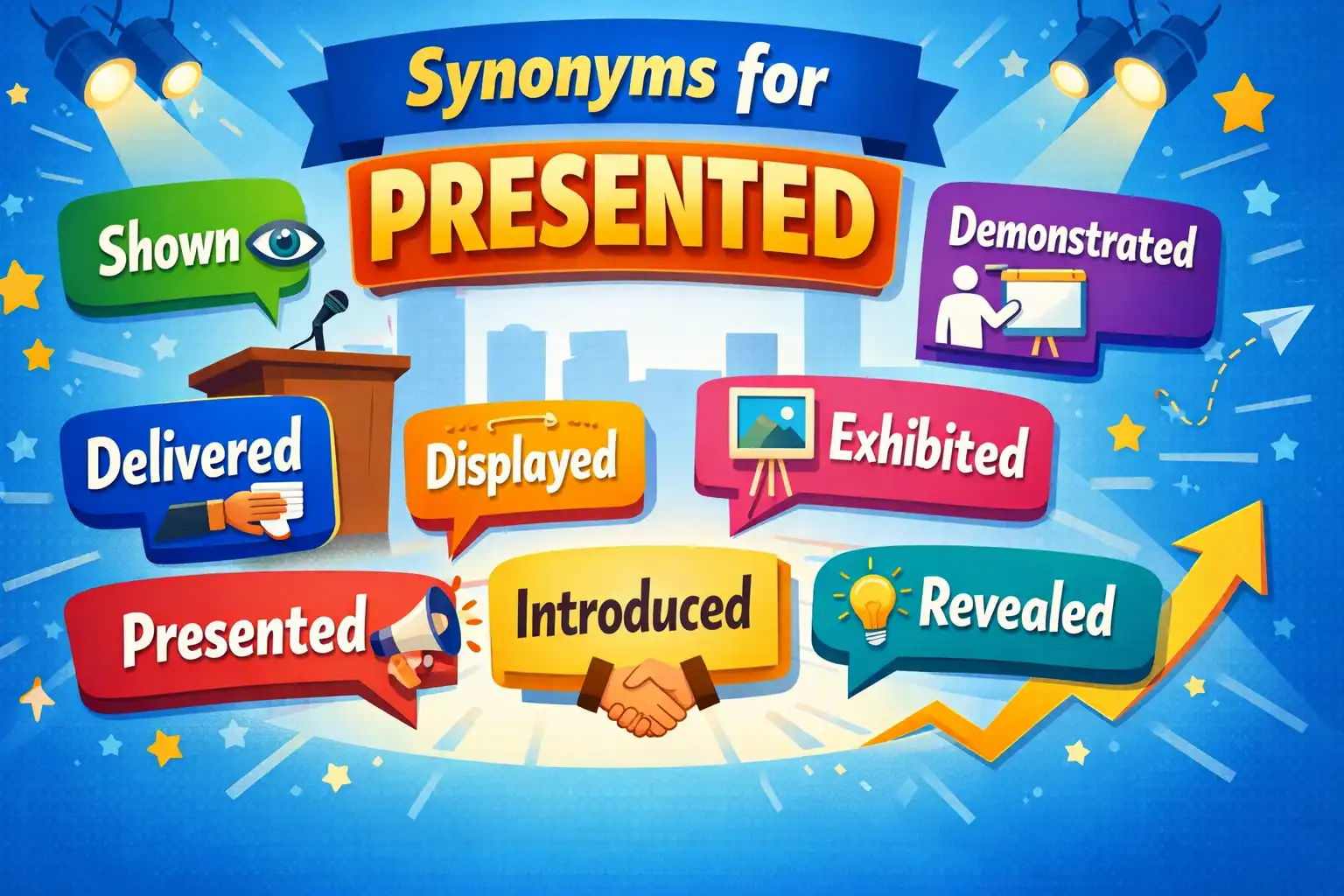
If you want to make your speech or writing shine, using the best synonyms for presented is a great place to start. Finding varied synonyms for presented helps you avoid repeating the same word in your essays and work emails. When you know these synonyms for presented, you can express your thoughts with maximum impact and clarity.
Imagine standing in a bright meeting room. A worker steps up to show their new business plan to the boss. They say, “I presented the project.” A few minutes later, they say, “I presented the data.” Before long, everyone in the room feels bored because they keep hearing the exact same word. Using a fresh word makes a huge difference in how people listen to you.
“The right word makes your message clear and beautiful.”
For example, instead of saying you “presented” a gift to your mother, you could say you “gifted” or “handed” it to her. If you are showing a school project, you can say you “displayed” or “showcased” your work. To be presented simply means to show something, to give something to someone, or to introduce a new idea to a group.
“Sharing an idea is good, but showing it with the perfect word is great.”
For students, using different words makes school essays look smart and polished. Bloggers can use them to write catchy headlines and keep online readers hooked. Content writers can make their articles sound highly professional. Even in daily English, changing your vocabulary makes your everyday chats and emails much more interesting.
Linguistic Profile of “Presented”
Before we explore the full list, let us look at how the word presented is built, pronounced, and understood.
Connotative Meaning
While the denotative meaning of presented is simply to show or give, its connotations evoke feelings of pride, sharing, formal delivery, and stepping into the spotlight. It suggests an active, deliberate choice to bring something forward for others to see.
Etymology
- Origin: Old French presenter (meaning to show, offer, or formally introduce)
- Latin Root: praesentare (meaning to place before or make present)
- Derived from: praesens (meaning being at hand or in sight)
Pronunciation & Properties
- US Pronunciation (IPA): /prɪˈzen.tɪd/
- UK Pronunciation (IPA): /prɪˈzen.tɪd/
- Syllables: pre-sent-ed (3 syllables)
- Affixation Pattern: Root verb present + past-tense suffix -ed.
Word Comparison Table
This comparison table shows how different words related to presented fit into different situations.
| Keyword | Meaning | Usage Type | Context |
|---|---|---|---|
| Presented | Showed or gave something formally. | Professional / Daily Use | Business, school, formal events |
| Offered | Put forward to see if someone wants it. | Casual / Professional | Deals, food, suggestions |
| Showcased | Displayed the best parts of something. | Professional / Creative | Portfolios, talents, designs |
| Submitted | Handed in a task for review. | Academic / Professional | Homework, tax files, applications |
| Awarded | Gave a prize or honor to someone. | Formal / Emotional | Contests, graduations, ceremonies |
| Staged | Set up a public show or performance. | Creative / Dramatic | Plays, events, protests |
| Unveiled | Showed something new for the first time. | Professional / Dramatic | Product launches, art shows |
“To present your work is to share a piece of your mind.”
50 Powerful Synonyms for Presented
1. Offered
- Pronunciation: US: /ˈɑː.fɚd/ | UK: /ˈɒf.əd/
- Meaning: You put something forward to see if someone wants to take it.
- Examples:
- She offered me a cup of hot tea.
- The store offered a big discount on shoes.
2. Shown
- Pronunciation: US: /ʃoʊn/ | UK: /ʃəʊn/
- Meaning: You let other people look at something.
- Examples:
- I have shown my art to the teacher.
- The film was shown on a giant screen.
3. Exhibited
- Pronunciation: US: /ɪɡˈzɪb.ɪ.tɪd/ | UK: /ɪɡˈzɪb.ɪ.tɪd/
- Meaning: You put something in a public place for people to look at.
- Examples:
- The museum exhibited old dinosaur bones last week.
- She proudly exhibited her new painting.
4. Displayed
- Pronunciation: US: /dɪˈspleɪd/ | UK: /dɪˈspleɪd/
- Meaning: You put something where it is very easy to see.
- Examples:
- They displayed the trophies in a glass case.
- The computer screen displayed a bright blue light.
5. Submitted
- Pronunciation: US: /səbˈmɪt.ɪd/ | UK: /səbˈmɪt.ɪd/
- Meaning: You turned in a document or work for someone to check.
- Examples:
- We submitted our science project on Friday.
- He submitted the job application online.
6. Awarded
- Pronunciation: US: /əˈwɔːr.dɪd/ | UK: /əˈwɔː.dɪd/
- Meaning: You gave a prize or money as a reward for hard work.
- Examples:
- The judge awarded the gold medal to the runner.
- She was awarded a scholarship to go to college.
7. Showcased
- Pronunciation: US: /ˈʃoʊ.keɪst/ | UK: /ˈʃəʊ.keɪst/
- Meaning: You showed off the best parts of something in a clear way.
- Examples:
- The festival showcased local food and music.
- He showcased his coding skills during the test.
8. Introduced
- Pronunciation: US: /ˌɪn.trəˈduːst/ | UK: /ˌɪn.trəˈdjuːst/
- Meaning: You made people known to each other or brought in a new idea.
- Examples:
- I introduced my sister to my best friend.
- The company introduced a new phone model today.
9. Delivered
- Pronunciation: US: /dɪˈlɪv.ɚd/ | UK: /dɪˈlɪv.əd/
- Meaning: You carried and handed over a message, talk, or package.
- Examples:
- The mayor delivered a great speech at the park.
- The mailman delivered the letters to our door.
10. Unveiled
- Pronunciation: US: /ʌnˈveɪld/ | UK: /ʌnˈveɪld/
- Meaning: You showed something new to the public for the first time.
- Examples:
- The artist unveiled her new statue yesterday.
- The car company unveiled a fast electric car.
11. Tendered
- Pronunciation: US: /ˈten.dɚd/ | UK: /ˈten.dəd/
- Meaning: You formally offered money, help, or a resignation letter.
- Examples:
- He tendered his resignation to the boss.
- The firm tendered a bid for the building contract.
12. Bestowed
- Pronunciation: US: /bɪˈstoʊd/ | UK: /bɪˈstəʊd/
- Meaning: You gave an important gift, prize, or honor to someone.
- Examples:
- The queen bestowed a special title upon the hero.
- The school bestowed honor on its top graduate.
13. Conferred
- Pronunciation: US: /kənˈfɝːd/ | UK: /kənˈfɜːd/
- Meaning: You gave an official title, degree, or honor to a person.
- Examples:
- The university conferred degrees upon the students.
- The president conferred a medal of honor.
14. Granted
- Pronunciation: US: /ɡræn.tɪd/ | UK: /ɡrɑːn.tɪd/
- Meaning: You gave someone permission or money that they formally asked for.
- Examples:
- The city granted the team permission to play.
- She was granted a free pass to the museum.
15. Staged
- Pronunciation: US: /steɪdʒd/ | UK: /steɪdʒd/
- Meaning: You set up and put on a play, show, or public event.
- Examples:
- The drama club staged a funny play last night.
- They staged a peaceful protest in the square.
16. Performed
- Pronunciation: US: /pɚˈfɔːrmd/ | UK: /pəˈfɔːmd/
- Meaning: You did an action, play, or piece of music in front of people.
- Examples:
- The band performed three energetic songs.
- He performed his daily duties without any help.
17. Executed
- Pronunciation: US: /ˈek.sə.kjuː.tɪd/ | UK: /ˈek.sɪ.kjuː.tɪd/
- Meaning: You successfully completed a plan, task, or movement.
- Examples:
- The dancer executed a perfect spin on stage.
- We executed our business plan step by step.
18. Revealed
- Pronunciation: US: /rɪˈviːld/ | UK: /rɪˈviːld/
- Meaning: You let people see something that was hidden before.
- Examples:
- He pulled the curtain and revealed the surprise.
- The map revealed where the gold was hidden.
19. Demonstrated
- Pronunciation: US: /ˈdem.ən.streɪ.tɪd/ | UK: /ˈdem.ən.streɪ.tɪd/
- Meaning: You showed people exactly how something works by using it.
- Examples:
- The teacher demonstrated the safe way to mix chemicals.
- I demonstrated how to use the new camera app.
20. Produced
- Pronunciation: US: /prəˈduːst/ | UK: /prəˈdjuːst/
- Meaning: You brought something out so that people could look at it.
- Examples:
- He produced a ticket from his deep pocket.
- The farm produced fresh apples for the market.
21. Expressed
- Pronunciation: US: /ɪkˈsprest/ | UK: /ɪkˈsprest/
- Meaning: You showed your inner thoughts or feelings using words or actions.
- Examples:
- She expressed her deep thanks to the helpers.
- He expressed his joy with a huge smile.
22. Suggested
- Pronunciation: US: /səˈdʒes.tɪd/ | UK: /səˈdʒes.tɪd/
- Meaning: You put forward an idea or plan for others to think about.
- Examples:
- I suggested going to the park for lunch.
- The doctor suggested getting more active sleep.
23. Proposed
- Pronunciation: US: /prəˈpoʊzd/ | UK: /prəˈpəʊzd/
- Meaning: You formally shared a plan or suggestion for people to vote on.
- Examples:
- The mayor proposed a new park for kids.
- He proposed a smart way to save water.
24. Advanced
- Pronunciation: US: /ədˈvænst/ | UK: /ədˈvɑːnst/
- Meaning: You put forward an idea, claim, or plan for discussion.
- Examples:
- The scientist advanced a new theory about stars.
- She advanced a smart argument during the debate.
25. Detailed
- Pronunciation: US: /dɪˈteɪld/ | UK: /ˈdiː.teɪld/
- Meaning: You gave all the tiny facts and information about something.
- Examples:
- The guide detailed the rich history of the castle.
- She detailed her summer travel plans to us.
26. Reported
- Pronunciation: US: /rɪˈpɔːr.tɪd/ | UK: /rɪˈpɔː.tɪd/
- Meaning: You gave people spoken or written facts about an event.
- Examples:
- The news reported a big storm near the coast.
- He reported his findings to the office team.
27. Shared
- Pronunciation: US: /ʃerd/ | UK: /ʃeəd/
- Meaning: You gave a part of something or told your ideas to others.
- Examples:
- She shared her delicious lunch with her friend.
- I shared my travel photos on social media.
28. Handed
- Pronunciation: US: /ˈhæn.dɪd/ | UK: /ˈhæn.dɪd/
- Meaning: You passed something physically to another person with your hand.
- Examples:
- He handed the heavy keys to the driver.
- Please hand this notebook to the teacher.
29. Disclosed
- Pronunciation: US: /dɪˈskloʊzd/ | UK: /dɪˈskləʊzd/
- Meaning: You shared secret information with other people.
- Examples:
- The company disclosed its financial gains today.
- He disclosed his secret recipe to his son.
30. Outlined
- Pronunciation: US: /ˈaʊt.laɪnd/ | UK: /ˈaʊt.laɪnd/
- Meaning: You gave a short description of the main parts of a plan.
- Examples:
- The coach outlined the play on the board.
- She outlined her essay before she started writing.
31. Manifested
- Pronunciation: US: /ˈmæn.ə.fes.tɪd/ | UK: /ˈmæn.ɪ.fes.tɪd/
- Meaning: You showed a trait or feeling very clearly through your actions.
- Examples:
- Her bad flu manifested as a hot fever.
- His great courage manifested during the rescue.
32. Conveyed
- Pronunciation: US: /kənˈveɪd/ | UK: /kənˈveɪd/
- Meaning: You communicated a message, feeling, or idea to someone.
- Examples:
- The sad song conveyed a feeling of loneliness.
- He conveyed the news to his family quickly.
33. Proffered
- Pronunciation: US: /ˈprɑː.fɚd/ | UK: /ˈprɒf.əd/
- Meaning: You held out something for someone to take.
- Examples:
- She proffered a hand to help him up.
- He proffered a warm apology for being late.
34. Aired
- Pronunciation: US: /erd/ | UK: /eəd/
- Meaning: You sent a show out over the radio or TV, or shared your opinions.
- Examples:
- The hit show was aired on television last night.
- She aired her concerns during the town meeting.
35. Exposed
- Pronunciation: US: /ɪkˈspoʊzd/ | UK: /ɪkˈspəʊzd/
- Meaning: You uncovered something so that it could be seen.
- Examples:
- The low tide exposed the smooth wet rocks.
- The news writer exposed the truth about the case.
36. Launched
- Pronunciation: US: /lɑːntʃt/ | UK: /lɔːntʃt/
- Meaning: You started a new project, business, or product.
- Examples:
- The team launched a helpful new website today.
- They launched a rocket into the night sky.
37. Rolled Out
- Pronunciation: US: /ˈroʊld.aʊt/ | UK: /ˈrəʊld.aʊt/
- Meaning: You introduced a new product or system to the public step by step.
- Examples:
- The tech firm rolled out a fast software update.
- They rolled out new recycling rules for the town.
38. Pitched
- Pronunciation: US: /pɪtʃt/ | UK: /pɪtʃt/
- Meaning: You tried to sell an idea or product to someone.
- Examples:
- We pitched our business idea to rich investors.
- He pitched a story idea to the magazine editor.
39. Illustrated
- Pronunciation: US: /ˈɪl.ə.streɪ.tɪd/ | UK: /ˈɪl.ə.streɪ.tɪd/
- Meaning: You made something clear by using pictures, drawings, or examples.
- Examples:
- The artist illustrated the sweet children’s book.
- She illustrated her point using a colorful chart.
40. Formulated
- Pronunciation: US: /ˈfɔːr.mjə.leɪ.tɪd/ | UK: /ˈfɔː.mjə.leɪ.tɪd/
- Meaning: You created a clear, detailed plan or system.
- Examples:
- They formulated a path to clean the oceans.
- The doctor formulated a special skin cream.
41. Depicted
- Pronunciation: US: /dɪˈpɪk.tɪd/ | UK: /dɪˈpɪk.tɪd/
- Meaning: You showed something in a painting, drawing, or story.
- Examples:
- The old painting depicted a quiet forest scene.
- The book depicted the hard life of a soldier.
42. Portrayed
- Pronunciation: US: /pɔːrˈtreɪd/ | UK: /pɔːˈtreɪd/
- Meaning: You described or acted out a character or situation.
- Examples:
- The actor portrayed a kind king in the movie.
- The article portrayed the town as a safe place.
43. Rendered
- Pronunciation: US: /ˈren.dɚd/ | UK: /ˈren.dəd/
- Meaning: You gave help, made a visual image, or translated words.
- Examples:
- The computer rendered a 3D model of the house.
- They rendered first aid to the hurt boy.
44. Represented
- Pronunciation: US: /ˌrep.rɪˈzen.tɪd/ | UK: /ˌrep.rɪˈzen.tɪd/
- Meaning: You spoke or acted officially on behalf of a group.
- Examples:
- The lawyer represented the young man in court.
- This red sign represented a high danger zone.
45. Arranged
- Pronunciation: US: /əˈreɪndʒd/ | UK: /əˈreɪndʒd/
- Meaning: You put things into a neat, organized order or pattern.
- Examples:
- She arranged the pretty flowers on the table.
- We arranged a meeting for next Tuesday.
46. Put Forward
- Pronunciation: US: /ˈpʊt.ˈfɔːr.wɚd/ | UK: /ˈpʊt.ˈfɔː.wəd/
- Meaning: You suggested an idea or person for other people to think about.
- Examples:
- He put forward a clever plan to save energy.
- She put forward her name for class president.
47. Spread Out
- Pronunciation: US: /spred.aʊt/ | UK: /spred.aʊt/
- Meaning: You opened something up and laid it flat over an area.
- Examples:
- We spread out the big map on the desk.
- He spread out the clean sheets on the bed.
48. Discovered
- Pronunciation: US: /dɪˈskʌv.ɚd/ | UK: /dɪˈskʌv.əd/
- Meaning: You found something that was not known or seen before.
- Examples:
- The diver discovered an old shipwreck.
- She discovered a great new coffee shop nearby.
49. Published
- Pronunciation: US: /ˈpʌb.lɪʃt/ | UK: /ˈpʌb.lɪʃt/
- Meaning: You printed a book or put writing online for everyone to read.
- Examples:
- The writer published her first novel last month.
- They published the research results in a journal.
50. Gifted
- Pronunciation: US: /ˈɡɪf.tɪd/ | UK: /ˈɡɪf.tɪd/
- Meaning: You gave something to another person as a present.
- Examples:
- I gifted my brother a cool watch for his birthday.
- She gifted her old books to the neighborhood library.
Antonyms of “Presented”
If you want to know what the opposite of presented is, here is a quick list of antonyms:
- Withheld: You kept something back instead of giving it.
- Concealed: You hid an object or secret from view.
- Retained: You kept possession of something instead of showing it.
- Suppressed: You stopped information or feelings from being shown.
- Withdrew: You took something back out of sight.
Prototype Meaning and Categorization of “Presented”
In linguistics, we look at the core idea behind a word to understand it fully.
- Prototype: The physical act of holding out an object in your hands and giving it to another person.
- Grammatical Category: Transitive Verb (past tense or past participle). It requires an object (e.g., “We presented the trophy“).
- Semantic Domain: Communication, Giving, Performance, and Visual Display.
- Syntactic Patterns: Subject + Verb + Object + to + Indirect Object (e.g., “They presented the prize to him”).
Frequently Asked Questions
1. What is the most common synonym for “presented”?
The most common synonym is showed or offered. They are used in daily conversations when you talk about letting someone see something or giving them an item.
2. Which synonym for “presented” is best for a professional resume?
On a resume, use strong action verbs like delivered, executed, showcased, or spearheaded. These words make your professional tasks sound powerful and successful.
3. Can I use “introduced” instead of “presented”?
Yes, but mostly when you are talking about bringing people together for the first time or starting a brand-new idea, product, or rule.
4. What is a formal, fancy word for “presented”?
Fancy and formal words include proffered, bestowed, or tendered. These are perfect for legal documents or very high-level events.
5. How is “presented” different from “offered”?
To present something means you showed or gave it to someone formally. To offer something means you asked if they wanted to take it, but they can still say no.
6. Is “shown” a good word to use in school papers?
Yes, shown is a clear and simple word, but words like displayed or demonstrated often sound more detailed in science reports or essays.
Conclusion
Learning different synonyms for presented is an excellent way to boost your writing, blogging, speaking, and daily communication. Using a variety of terms keeps your readers highly interested and makes your thoughts clear. Instead of writing the word “presented” over and over again, you can now use “showcased,” “delivered,” or “unveiled” to paint a clearer picture.
We encourage you to practice these new terms when you draft your next work email, write a school essay, or chat with your friends. Changing standard words for rich, varied terms is the absolute fastest way to sound like an expert speaker!
“Words are the key to unlocking human connection.”
“A diverse vocabulary gives you the power to share your truth.”

Michael Turner is a published fiction writer and creative writing tutor with over a decade of experience helping writers find the words that make their stories breathe ( Biography ).