Introduction
Hazy means unclear, foggy, or hard to see or understand. When something is hazy, it looks blurred, dim, or covered in a light mist. A hazy memory or a hazy sky both share the same idea: things are not sharp or clear. This word works for two situations. It can describe weather, like a foggy morning sky. It can also describe your mind, like a memory you cannot recall well.
Picture this. You wake up on a summer morning. You look out the window. The sky is not blue. It is not gray either. It sits somewhere in between, soft and dull, like someone rubbed a thumb across wet chalk. That is a hazy sky. Now picture a different moment. Someone asks you what you did last New Year’s Eve. You try to remember. Faces blur. Sounds fade. Details slip away. That memory is hazy too.
Writers use this word all the time. It paints a picture without shouting. Students use it to describe weather in essays. Bloggers use it to describe soft, moody scenes. Content writers use it to describe confusion or uncertainty in a topic. Daily English speakers use it to describe a groggy morning after little sleep. One small word, many big uses.
But here is the problem. Writers repeat “hazy” again and again. That gets boring fast. Readers notice repeated words. Search engines notice them too. This guide fixes that problem. Below you will find 50 strong, natural synonyms for hazy, each with clear meaning, pronunciation, and real example sentences.
Connotative Meaning, Etymology, and Pronunciation of Hazy
The word hazy carries a soft, gentle connotation when used for weather, and a slightly negative connotation when used for thinking or memory, since it suggests confusion or forgetfulness.
Etymology of Hazy:
- Rooted in the noun “haze,” first recorded in English in the 1700s
- Likely connected to Old English “hasu,” meaning gray or ashy in color
- Possibly linked to German dialect words describing fog and mist
- Grew into figurative use (mental confusion) by the 1800s
Pronunciation of Hazy:
- US: /ˈheɪ.zi/
- UK: /ˈheɪ.zi/
Syllables: ha-zy (2 syllables)
Affixation Pattern: haze (root noun) + -y (adjective-forming suffix) = hazy. The suffix “-y” turns a noun into a descriptive adjective, similar to “cloud” becoming “cloudy” or “fog” becoming “foggy.”
Comparison Table: Hazy vs Other Common Synonyms
| Keyword | Meaning | Usage Type | Context |
| Hazy | Unclear, foggy, or dim | Casual/Descriptive | Weather, memory, thinking |
| Foggy | Covered with thick mist | Casual | Weather, mental state |
| Blurry | Not sharp or clear in sight | Casual | Vision, images, memory |
| Vague | Not clearly stated or defined | Formal/Casual | Instructions, plans, ideas |
| Murky | Dark, unclear, and dirty-looking | Casual/Descriptive | Water, motives, situations |
| Obscure | Hard to understand or notice | Formal | Writing, topics, references |
| Muddled | Confused and disorganized | Casual/Emotional | Thoughts, plans, arguments |
| Ambiguous | Open to more than one meaning | Formal/Professional | Contracts, statements, language |
| Dazed | Stunned and unable to think clearly | Emotional | After shock, injury, surprise |
| Nebulous | Vague and without clear shape | Formal | Ideas, concepts, goals |
50 Powerful Synonyms for Hazy
1. Foggy
Pronunciation: US /ˈfɔː.ɡi/ | UK /ˈfɒ.ɡi/
Meaning: Foggy means covered with thick mist that makes it hard to see.
Examples:
- The road was foggy, so the driver slowed down.
- My brain feels foggy after staying up all night.
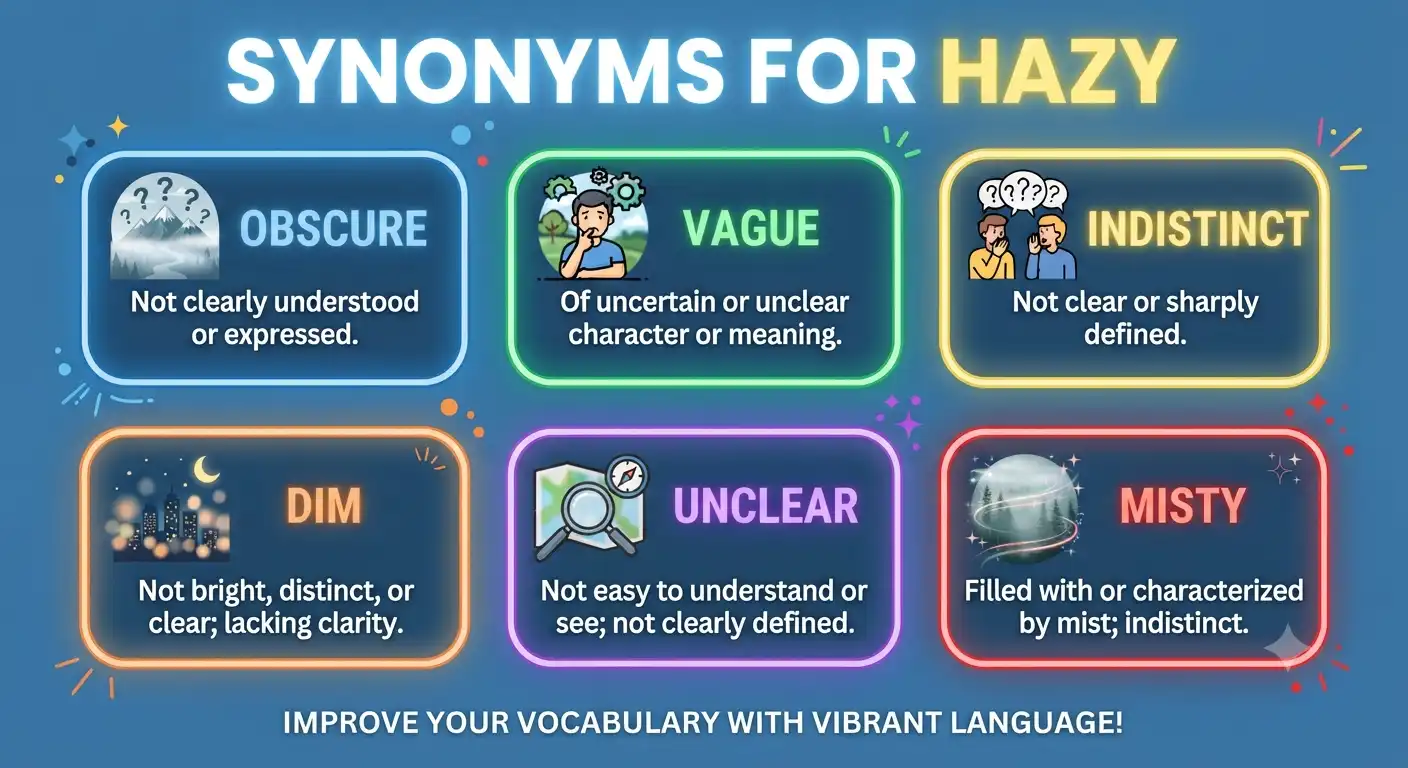
2. Misty
Pronunciation: US /ˈmɪs.ti/ | UK /ˈmɪs.ti/
Meaning: Misty describes air filled with tiny drops of water that block clear sight.
Examples:
- The hills looked misty in the early morning light.
- Her eyes turned misty when she heard the good news.
3. Murky
Pronunciation: US /ˈmɝː.ki/ | UK /ˈmɜː.ki/
Meaning: Murky means dark, dirty, and hard to see through clearly.
Examples:
- The pond water looked murky after the storm.
- His plans for the company seemed murky at best.
4. Blurry
Pronunciation: US /ˈblɝː.i/ | UK /ˈblʌr.i/
Meaning: Blurry means not sharp or clear, like an out-of-focus photo.
Examples:
- The old photograph looked blurry and faded.
- Without my glasses, everything looks blurry.
5. Cloudy
Pronunciation: US /ˈklaʊ.di/ | UK /ˈklaʊ.di/
Meaning: Cloudy means covered by clouds or lacking clearness.
Examples:
- The sky turned cloudy before the rainstorm hit.
- My thinking felt cloudy after the long flight.
6. Smoky
Pronunciation: US /ˈsmoʊ.ki/ | UK /ˈsməʊ.ki/
Meaning: Smoky means filled with or covered by smoke.
Examples:
- The bar had a smoky haze hanging near the ceiling.
- The valley looked smoky after the wildfire.
7. Dim
Pronunciation: US /dɪm/ | UK /dɪm/
Meaning: Dim means not bright or clear, giving little light or detail.
Examples:
- Only a dim light shone through the curtains.
- His memory of that day is dim now.
8. Faint
Pronunciation: US /feɪnt/ | UK /feɪnt/
Meaning: Faint means weak, soft, or barely noticeable.
Examples:
- I heard a faint sound coming from the attic.
- She had only a faint idea of the plan.
9. Indistinct
Pronunciation: US /ˌɪn.dɪˈstɪŋkt/ | UK /ˌɪn.dɪˈstɪŋkt/
Meaning: Indistinct means not clearly separate or defined from other things.
Examples:
- The voices in the next room were indistinct.
- His handwriting was indistinct and hard to read.
10. Vague
Pronunciation: US /veɪɡ/ | UK /veɪɡ/
Meaning: Vague means not clear or exact in meaning or detail.
Examples:
- The manager gave vague instructions about the project.
- I have only a vague memory of that trip.
11. Obscure
Pronunciation: US /əbˈskjʊr/ | UK /əbˈskjʊə/
Meaning: Obscure means not well known or hard to understand.
Examples:
- The professor used an obscure example in his lecture.
- The reason for his absence remains obscure.
12. Unclear
Pronunciation: US /ʌnˈklɪr/ | UK /ʌnˈklɪə/
Meaning: Unclear means not easy to understand or see plainly.
Examples:
- The rules of the game were unclear to me.
- Her tone made her feelings unclear.
13. Fuzzy
Pronunciation: US /ˈfʌz.i/ | UK /ˈfʌz.i/
Meaning: Fuzzy means blurred or not sharply defined.
Examples:
- The signal made the picture look fuzzy.
- My memory of the accident is fuzzy.
14. Opaque
Pronunciation: US /oʊˈpeɪk/ | UK /əʊˈpeɪk/
Meaning: Opaque means not clear enough to see through or understand.
Examples:
- The frosted glass window was completely opaque.
- His answer felt opaque and confusing.
15. Veiled
Pronunciation: US /veɪld/ | UK /veɪld/
Meaning: Veiled means hidden or partly covered, so it’s hard to see clearly.
Examples:
- The mountain peak was veiled in soft cloud.
- Her comment carried a veiled warning.
16. Shadowy
Pronunciation: US /ˈʃæd.oʊ.i/ | UK /ˈʃæd.əʊ.i/
Meaning: Shadowy means dark, unclear, or hard to make out.
Examples:
- A shadowy figure stood near the door.
- His past remained shadowy to his coworkers.
17. Muddled
Pronunciation: US /ˈmʌd.əld/ | UK /ˈmʌd.əld/
Meaning: Muddled means confused, mixed up, and unclear in thought.
Examples:
- Her explanation sounded muddled and hard to follow.
- I felt muddled after the long meeting.
18. Bleary
Pronunciation: US /ˈblɪr.i/ | UK /ˈblɪə.ri/
Meaning: Bleary means tired eyes that cannot see clearly.
Examples:
- He looked bleary after pulling an all-nighter.
- Her bleary eyes struggled to read the small text.
19. Filmy
Pronunciation: US /ˈfɪl.mi/ | UK /ˈfɪl.mi/
Meaning: Filmy means covered with a thin layer that blocks clear sight.
Examples:
- A filmy layer of dust covered the old mirror.
- The lake had a filmy shine under the sun.
20. Gauzy
Pronunciation: US /ˈɡɔː.zi/ | UK /ˈɡɔː.zi/
Meaning: Gauzy means thin, light, and slightly see-through.
Examples:
- The curtains were gauzy and let in soft light.
- A gauzy fog covered the quiet field.
21. Nebulous
Pronunciation: US /ˈneb.jə.ləs/ | UK /ˈneb.jʊ.ləs/
Meaning: Nebulous means vague, unclear, and without a firm shape.
Examples:
- The company’s future plans felt nebulous.
- His goals were nebulous at best.
22. Overcast
Pronunciation: US /ˌoʊ.vɚˈkæst/ | UK /ˌəʊ.vəˈkɑːst/
Meaning: Overcast means covered by gray clouds with no sunlight.
Examples:
- The sky stayed overcast all afternoon.
- We hiked under an overcast sky.
23. Dusky
Pronunciation: US /ˈdʌs.ki/ | UK /ˈdʌs.ki/
Meaning: Dusky means dim, shadowy, and lacking bright light.
Examples:
- The room had a dusky glow at sunset.
- A dusky path led into the woods.
24. Dull
Pronunciation: US /dʌl/ | UK /dʌl/
Meaning: Dull means lacking brightness, sharpness, or clear detail.
Examples:
- The mirror looked dull and needed cleaning.
- His memory of the speech was dull and broken.
25. Blurred
Pronunciation: US /blɝːd/ | UK /blɜːd/
Meaning: Blurred means made unclear, especially in shape or focus.
Examples:
- The runner’s motion blurred in the photo.
- Tears blurred her view of the stage.
26. Ill-defined
Pronunciation: US /ˌɪl.dɪˈfaɪnd/ | UK /ˌɪl.dɪˈfaɪnd/
Meaning: Ill-defined means not clearly explained or given exact limits.
Examples:
- The project goals were ill-defined from the start.
- His role in the team felt ill-defined.
27. Indefinite
Pronunciation: US /ɪnˈdef.ə.nət/ | UK /ɪnˈdef.ɪ.nət/
Meaning: Indefinite means not fixed, certain, or clearly stated.
Examples:
- The trip was postponed for an indefinite time.
- She gave an indefinite answer about the deal.
28. Ambiguous
Pronunciation: US /æmˈbɪɡ.juː.əs/ | UK /æmˈbɪɡ.ju.əs/
Meaning: Ambiguous means having more than one possible meaning.
Examples:
- The contract had an ambiguous clause about payment.
- His ambiguous reply left everyone guessing.
29. Muzzy
Pronunciation: US /ˈmʌz.i/ | UK /ˈmʌz.i/
Meaning: Muzzy means confused and unable to think clearly, often from tiredness.
Examples:
- He felt muzzy after the long car ride.
- The cold medicine made her head muzzy.
30. Groggy
Pronunciation: US /ˈɡrɑː.ɡi/ | UK /ˈɡrɒɡ.i/
Meaning: Groggy means weak and unsteady, often after little sleep.
Examples:
- I felt groggy after the early morning flight.
- The patient was still groggy from the medicine.
31. Dazed
Pronunciation: US /deɪzd/ | UK /deɪzd/
Meaning: Dazed means unable to think clearly because of shock or surprise.
Examples:
- She stood dazed after hearing the news.
- The boxer looked dazed after the final round.
32. Woozy
Pronunciation: US /ˈwuː.zi/ | UK /ˈwuː.zi/
Meaning: Woozy means dizzy and unable to think or stand steadily.
Examples:
- He felt woozy after standing up too fast.
- The heat made her woozy by noon.
33. Disoriented
Pronunciation: US /dɪsˈɔːr.i.ˌen.t̬ɪd/ | UK /dɪsˈɔː.ri.en.tɪd/
Meaning: Disoriented means confused about where you are or what is happening.
Examples:
- The hikers felt disoriented in the thick forest.
- Waking up in a new city left him disoriented.
34. Perplexing
Pronunciation: US /pɚˈplek.sɪŋ/ | UK /pəˈplek.sɪŋ/
Meaning: Perplexing means confusing and hard to understand or solve.
Examples:
- The math problem was perplexing for the class.
- Her sudden silence was perplexing to him.
35. Unfocused
Pronunciation: US /ʌnˈfoʊ.kəst/ | UK /ʌnˈfəʊ.kəst/
Meaning: Unfocused means not sharp, clear, or aimed at one clear point.
Examples:
- The camera lens looked unfocused in the picture.
- His speech felt unfocused and hard to follow.
36. Smoggy
Pronunciation: US /ˈsmɑː.ɡi/ | UK /ˈsmɒɡ.i/
Meaning: Smoggy means filled with a mix of smoke and fog in the air.
Examples:
- The city looked smoggy during rush hour.
- We could barely see the towers on that smoggy day.
37. Thick
Pronunciation: US /θɪk/ | UK /θɪk/
Meaning: Thick, in this sense, means dense and hard to see through.
Examples:
- A thick fog rolled over the harbor at dawn.
- The air felt thick with smoke from the fire.
38. Pale
Pronunciation: US /peɪl/ | UK /peɪl/
Meaning: Pale means faded, light, and lacking full color or clarity.
Examples:
- The moon looked pale through the clouds.
- His pale memory of the event faded with time.
39. Wispy
Pronunciation: US /ˈwɪs.pi/ | UK /ˈwɪs.pi/
Meaning: Wispy means thin, light, and barely there.
Examples:
- Wispy clouds drifted across the pale sky.
- A wispy trail of smoke rose from the chimney.
40. Ghostly
Pronunciation: US /ˈɡoʊst.li/ | UK /ˈɡəʊst.li/
Meaning: Ghostly means pale, faint, and eerie, like a shadow of something real.
Examples:
- A ghostly mist covered the old cemetery.
- Her ghostly figure appeared through the fog.
41. Imprecise
Pronunciation: US /ˌɪm.prɪˈsaɪs/ | UK /ˌɪm.prɪˈsaɪs/
Meaning: Imprecise means not exact or clearly stated.
Examples:
- The old map gave imprecise directions to the town.
- His imprecise answer left the team confused.
42. Sketchy
Pronunciation: US /ˈsketʃ.i/ | UK /ˈsketʃ.i/
Meaning: Sketchy means incomplete and lacking clear detail.
Examples:
- The witness gave a sketchy account of the crash.
- Her plan for the trip was still sketchy.
43. Undefined
Pronunciation: US /ˌʌn.dɪˈfaɪnd/ | UK /ˌʌn.dɪˈfaɪnd/
Meaning: Undefined means not given a clear meaning, shape, or limit.
Examples:
- The border between the two lands stayed undefined.
- Her job duties felt undefined in the new role.
44. Confusing
Pronunciation: US /kənˈfjuː.zɪŋ/ | UK /kənˈfjuː.zɪŋ/
Meaning: Confusing means hard to understand or making one feel unsure.
Examples:
- The instructions on the form were confusing.
- His mixed signals were confusing to everyone.
45. Clouded
Pronunciation: US /ˈklaʊ.dɪd/ | UK /ˈklaʊ.dɪd/
Meaning: Clouded means made unclear or blocked from clear view or thought.
Examples:
- Anger clouded her judgment during the fight.
- The old glass jar looked clouded with dust.
46. Foggy-minded
Pronunciation: US /ˈfɔː.ɡi ˈmaɪn.dɪd/ | UK /ˈfɒ.ɡi ˈmaɪn.dɪd/
Meaning: Foggy-minded means unable to think clearly or focus well.
Examples:
- Lack of sleep left him foggy-minded at work.
- She felt foggy-minded during the long lecture.
47. Semi-transparent
Pronunciation: US /ˈsem.i.trænsˈpær.ənt/ | UK /ˈsem.i.trænˈspær.ənt/
Meaning: Semi-transparent means letting some light through but not giving a clear view.
Examples:
- The bathroom door had semi-transparent glass.
- A semi-transparent curtain hung over the window.
48. Dreamlike
Pronunciation: US /ˈdriːm.laɪk/ | UK /ˈdriːm.laɪk/
Meaning: Dreamlike means soft, unclear, and similar to the feeling of a dream.
Examples:
- The old town had a dreamlike quality at sunset.
- Her memory of that night felt dreamlike and distant.
49. Blear-eyed
Pronunciation: US /ˈblɪr.aɪd/ | UK /ˈblɪə.raɪd/
Meaning: Blear-eyed means having tired eyes that cannot focus well.
Examples:
- He walked in blear-eyed after the night shift.
- The blear-eyed student struggled to read the board.
50. Indeterminate
Pronunciation: US /ˌɪn.dɪˈtɝː.mɪ.nət/ | UK /ˌɪn.dɪˈtɜː.mɪ.nət/
Meaning: Indeterminate means not clearly known, fixed, or decided.
Examples:
- The exact cause of the delay remained indeterminate.
- His age looked indeterminate, somewhere between thirty and fifty.
As one old saying goes, “Clarity is the counterbalance of profound thoughts.” Choosing the right synonym for hazy brings that clarity to your own writing, one word at a time.
Antonyms of Hazy
Words that mean the opposite of hazy include: clear, sharp, crisp, distinct, vivid, lucid, bright, transparent, precise, and defined.
Prototype Meaning and Categorization of Hazy
The prototype, or core, meaning of hazy centers on a lack of clarity caused by something blocking full view or full understanding. It falls into two main categories:
- Physical/Visual category: fog, mist, smoke, or dust that blocks clear sight (foggy, misty, murky, blurry)
- Mental/Cognitive category: confusion, forgetfulness, or unclear thinking (muddled, dazed, groggy, vague)
Both categories share one root idea: something stands between the viewer and a clear, sharp result.
Frequently Asked Questions About Synonyms for Hazy
1. What is the best synonym for hazy? “Foggy” and “blurry” are the most common and natural synonyms for hazy, since they match its meaning in both weather and memory contexts.
2. Is hazy a positive or negative word? It depends on context. A hazy sunset can sound soft and pleasant, while a hazy memory often suggests confusion, which feels more negative.
3. What is the difference between hazy and blurry? Hazy usually describes weather, light, or general unclear thinking, while blurry more often describes sight, images, or specific visual focus.
4. Can hazy describe a person’s mood? Yes. Hazy can describe a confused or unfocused mental state, similar to feeling groggy or dazed.
5. What word means the opposite of hazy? Clear, sharp, and vivid are strong opposites of hazy.
6. Is hazy formal or casual English? Hazy is a casual, everyday word. For formal writing, words like nebulous, ambiguous, or indeterminate work better.
7. Why do writers use synonyms for hazy instead of repeating it? Repeating the same word makes writing sound flat and robotic. Synonyms add variety, improve reader interest, and boost content quality for SEO.
Conclusion
Learning synonyms for hazy does more than expand your vocabulary. It sharpens your writing, adds color to your blogging, improves your speaking, and strengthens everyday communication. Instead of leaning on one tired word, you now hold fifty fresh tools ready to use.
Try one new word each day. Drop murky into a work email about an unclear project. Use groggy the next time you describe a rough morning to a friend. Slip nebulous into an essay about future plans. Small changes like these build strong writing habits over time.
“The difference between the almost right word and the right word is really a large matter.”
Practice makes these words feel natural. The more you use them, the faster they become part of your everyday English.
“To learn a language is to have one more window from which to look at the world.”
Keep this list close. Return to it often. Your writing will thank you.
“Good words are worth much, and cost little.”

Michael Turner is a published fiction writer and creative writing tutor with over a decade of experience helping writers find the words that make their stories breathe ( Biography ).