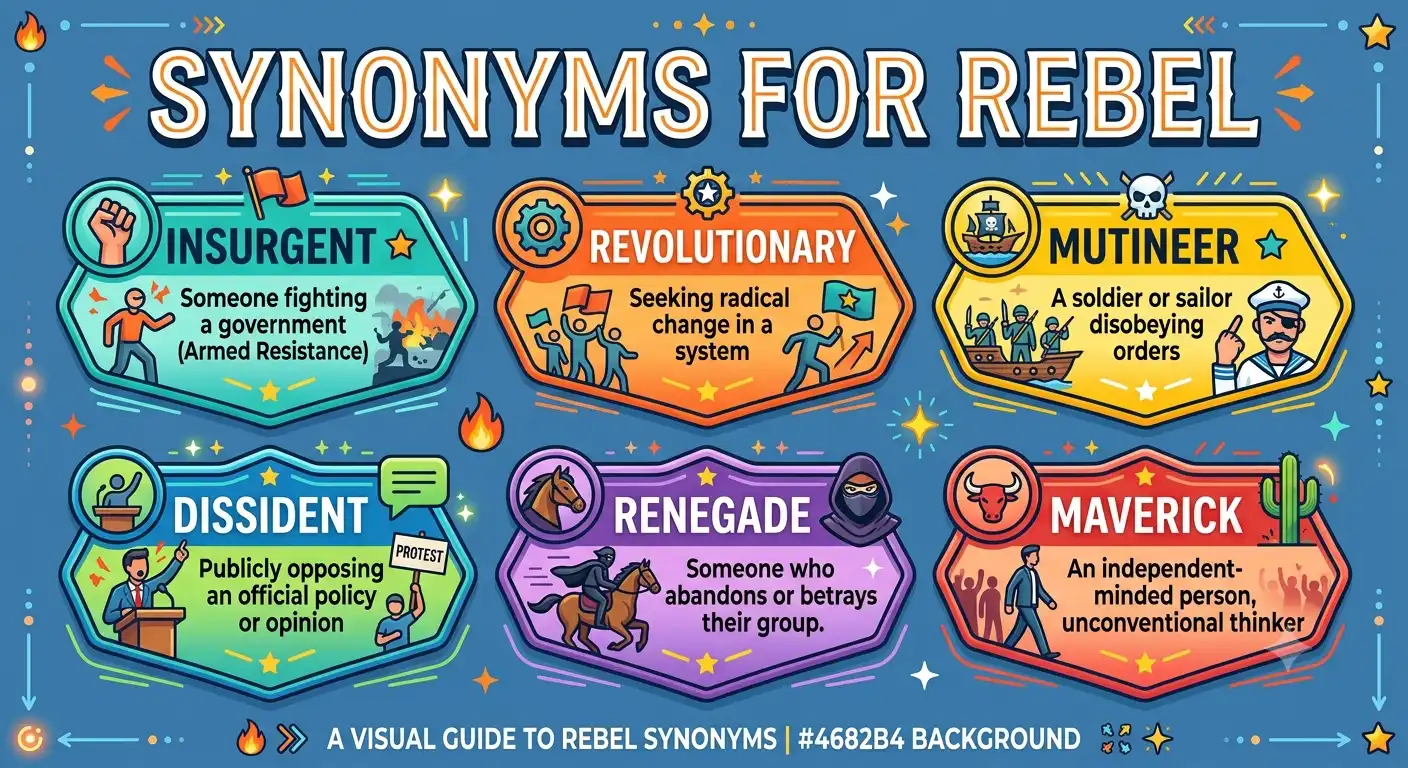
Finding accurate synonyms for rebel helps you select the exact words to describe individuals who stand up against authority, challenge rules, or think differently. Exploring synonyms for rebel allows your essays, story writing, and professional communication to express defiance, independence, or nonconformity clearly. Using precise synonyms for rebel ensures your message strikes the right tone with your audience.
Imagine a student standing up in a school meeting to ask for fairer rules when everyone else stays quiet. You could describe this person as a rebel, but words like maverick, dissident, nonconformist, or radical share the exact details of their action. A rebel is someone who resists control, breaks established rules, or fights against authority.
Building a strong command of these powerful words brings daily practical benefits:
- Students can craft strong essays and analyze literary characters with precision.
- Bloggers can write compelling headlines and keep readers engaged.
- Content writers can build vivid narratives and persuade readers with tone.
- Daily English users can explain human behavior and ideas with confidence.
“Standing up for a unique idea begins with choosing the right word to express it.”
“Clear words give strength to independent thoughts and powerful stories.”
Connotative Meaning of Rebel
The word rebel carries distinct emotional shades depending on how it is used:
- Positive Connotation: Independent thinker, brave pioneer, defender of freedom, reformer, and fearless trailblazer.
- Negative Connotation: Troublemaker, violent opposer, dangerous lawbreaker, or reckless agitator.
- Neutral Connotation: Someone who acts outside traditional rules or refuses standard routines.
Etymology of Rebel
- Prefix / Root Origin: Latin re- (again / back) + bellare (to wage war), from bellum (war).
- Historical Evolution: Entered Middle English through Old French as rebelle, describing someone taking up arms against a ruler.
- Modern Usage: Expanded from military conflict to describe social defiance, artistic nonconformity, and creative innovation.
Pronunciation, Syllables, and Affixation Pattern
- US Pronunciation (IPA): Noun: /ˈreb.əl/ | Verb: /rɪˈbel/
- UK Pronunciation (IPA): Noun: /ˈreb.əl/ | Verb: /rɪˈbel/
- Syllable Count: 2 syllables (reb-el)
- Root Word: Rebel
- Affixation Pattern:
- Root: rebel (noun/verb)
- Derivatives: rebellion (noun), rebellious (adjective), rebelliously (adverb)
Word Comparison Table
| Keyword | Meaning | Usage Type | Context |
| Rebel | A person who resists authority or control | General / Expressive | History, politics, personal behavior |
| Dissident | A person who publicly opposes official policy | Formal / Political | Government policy, human rights, news |
| Maverick | An independent person who thinks differently | Positive / Casual | Business, creative arts, leadership |
| Insurgent | A person fighting against a government | Military / Formal | War reports, political conflicts |
| Nonconformist | Someone who does not follow standard customs | Social / Cultural | Lifestyle, art, individual choices |
| Agitator | A person who urges others to protest | Neutral / Critical | Social movements, workplace strikes |
| Outlaw | A person who breaks laws and hides | Dramatic / Historical | Crime stories, history books, fiction |
50 Synonyms for Rebel
1. Dissident
- Pronunciation: US: /ˈdɪs.ə.dənt/ | UK: /ˈdɪs.ɪ.dənt/
- Meaning: A person who publicly speaks out against official rules or government laws.
- Examples:
- The dissident spoke bravely about human rights at the meeting.
- News reporters interviewed the dissident after the peaceful protest.
2. Insurgent
- Pronunciation: US: /ɪnˈsɝː.dʒənt/ | UK: /ɪnˈsɜː.dʒənt/
- Meaning: A person who takes up arms to fight against an established government.
- Examples:
- The army stopped the insurgent group near the border.
- History books record how the insurgent forces fought for change.
3. Maverick
- Pronunciation: US: /ˈmæv.ɚ.ɪk/ | UK: /ˈmæv.ər.ɪk/
- Meaning: An independent thinker who does not follow standard rules.
- Examples:
- The young scientist is a maverick who tests new ideas.
- Her maverick style helped the business create unique products.
4. Nonconformist
- Pronunciation: US: /ˌnɑːn.kənˈfɔːr.mɪst/ | UK: /ˌnɒn.kənˈfɔː.mɪst/
- Meaning: Someone who chooses not to follow normal social customs.
- Examples:
- As a nonconformist, he painted his house bright yellow.
- The artist lived as a nonconformist in a quiet town.
5. Mutineer
- Pronunciation: US: /ˌmjuː.təˈnɪr/ | UK: /ˌmjuː.tɪˈnɪər/
- Meaning: A person on a ship or in the military who refuses orders.
- Examples:
- The captain arrested the mutineer for refusing to sail.
- Sailors talked quietly about the mutineer during the night.
6. Radical
- Pronunciation: US: /ˈræd.kəl/ | UK: /ˈræd.ɪ.kəl/
- Meaning: A person who wants complete political or social change.
- Examples:
- The radical writer shared big ideas for city reform.
- She joined a radical group that protects forests.
7. Renegade
- Pronunciation: US: /ˈren.ə.ɡeɪd/ | UK: /ˈren.ɪ.ɡeɪd/
- Meaning: Someone who leaves a group to act against its principles.
- Examples:
- The renegade officer left the team to fight alone.
- Movie stories often feature a renegade hero.
8. Agitator
- Pronunciation: US: /ˈædʒ.ə.teɪ.t̬ɚ/ | UK: /ˈædʒ.ɪ.teɪ.tər/
- Meaning: A person who encourages people to protest or complain.
- Examples:
- The agitator asked workers to demand better pay.
- Security guards watched the agitator outside the building.
9. Subversive
- Pronunciation: US: /səbˈvɝː.sɪv/ | UK: /səbˈvɜː.sɪv/
- Meaning: Someone who tries to weaken or overthrow an established system.
- Examples:
- Police discovered a subversive plot against the city council.
- The author wrote a subversive book about unfair laws.
10. Heretic
- Pronunciation: US: /ˈher.ə.t̬ɪk/ | UK: /ˈher.ə.tɪk/
- Meaning: A person who holds beliefs that oppose accepted doctrines.
- Examples:
- Long ago, people called any scientific thinker a heretic.
- He felt like a heretic for questioning the old company policy.
11. Outlaw
- Pronunciation: US: /ˈaʊt.lɑː/ | UK: /ˈaʊt.lɔː/
- Meaning: A person who breaks the law and lives outside society.
- Examples:
- The outlaw hid deep in the forest after the bank robbery.
- Folk tales often tell stories of a famous outlaw.
12. Iconoclast
- Pronunciation: US: /aɪˈkɑː.nə.klæst/ | UK: /aɪˈkɒn.ə.klæst/
- Meaning: Someone who attacks cherished beliefs or traditional ideas.
- Examples:
- The new director is an iconoclast who changed old rules.
- An iconoclast questions accepted traditions in art.
13. Rioter
- Pronunciation: US: /ˈraɪ.ə.t̬ɚ/ | UK: /ˈraɪ.ə.tər/
- Meaning: A person who acts violently in a public crowd.
- Examples:
- Police used water cannons to disperse every rioter on the street.
- The rioter broke a shop window during the street rally.
14. Insurrectionist
- Pronunciation: US: /ˌɪn.səˈrek.ʃən.ɪst/ | UK: /ˌɪn.səˈrek.ʃən.ɪst/
- Meaning: A person who takes part in an armed uprising.
- Examples:
- Guards stopped the insurrectionist at the castle gate.
- The insurrectionist movement spread across the nation quickly.
15. Resister
- Pronunciation: US: /rɪˈzɪs.t̬ɚ/ | UK: /rɪˈzɪs.tər/
- Meaning: Someone who actively opposes or fights against something.
- Examples:
- Every resister stood silently outside the government building.
- She was a strong resister against bad environmental plans.
16. Opposer
- Pronunciation: US: /əˈpoʊ.zɚ/ | UK: /əˈpəʊ.zər/
- Meaning: A person who speaks or acts against an idea or plan.
- Examples:
- The opposer presented clear facts against the new tax rule.
- He proved to be a tough opposer during the town debate.
17. Dissenter
- Pronunciation: US: /dɪˈsen.t̬ɚ/ | UK: /dɪˈsen.tər/
- Meaning: A person who disagrees with majority opinion or official views.
- Examples:
- One dissenter voted no while everyone else voted yes.
- The dissenter explained her reasons to the committee clearly.
18. Individualist
- Pronunciation: US: /ˌɪn.dəˈvɪdʒ.u.ə.lɪst/ | UK: /ˌɪn.dɪˈvɪdʒ.u.ə.lɪst/
- Meaning: Someone who prefers independent thought and personal freedom.
- Examples:
- As an individualist, she creates her own clothing designs.
- He is an individualist who works best on solo projects.
19. Anarchist
- Pronunciation: US: /ˈæn.ɚ.kɪst/ | UK: /ˈæn.ə.kɪst/
- Meaning: A person who believes that governments and laws are unnecessary.
- Examples:
- The anarchist wrote pamphlets calling for direct freedom.
- Police monitored the anarchist meeting in the park.
20. Extremist
- Pronunciation: US: /ɪkˈstriː.mɪst/ | UK: /ɪkˈstriː.mɪst/
- Meaning: A person who holds extreme political or religious views.
- Examples:
- The political extremist refused to compromise on any topic.
- Laws prevent an extremist group from causing public harm.
21. Saboteur
- Pronunciation: US: /ˌsæb.əˈtɝː/ | UK: /ˌsæb.əˈtɜː/
- Meaning: Someone who intentionally damages property or ruins plans.
- Examples:
- The saboteur cut the wires to stop the factory machines.
- Detectives looked for the saboteur after the train delay.
22. Challenger
- Pronunciation: US: /ˈtʃæl.ɪn.dʒɚ/ | UK: /ˈtʃæl.ɪn.dʒər/
- Meaning: A person who disputes established rules or competes against a leader.
- Examples:
- The challenger ran a strong campaign against the mayor.
- Our team faced a tough challenger in the chess tournament.
23. Protestor
- Pronunciation: US: /prəˈtes.t̬ɚ/ | UK: /prəˈtes.tər/
- Meaning: Someone who publicly shows strong disagreement with something.
- Examples:
- Each protestor held a sign asking for clean drinking water.
- The protestor spoke calmly to the news camera outside.
24. Defier
- Pronunciation: US: /dɪˈfaɪ.ɚ/ | UK: /dɪˈfaɪ.ər/
- Meaning: A person who openly refuses to obey authority or expectations.
- Examples:
- She stood as a defier of unjust village rules.
- The defier refused to bow before the greedy king.
25. Fighter
- Pronunciation: US: /ˈfaɪ.t̬ɚ/ | UK: /ˈfaɪ.tər/
- Meaning: Someone who struggles determinedly against hardship or authority.
- Examples:
- She is a true fighter for community safety rights.
- The young boxer proved to be a brave fighter in court.
“True vocabulary mastery allows you to describe nonconformity with complete precision.”
26. Troublemaker
- Pronunciation: US: /ˈtrʌb.əlˌmeɪ.kɚ/ | UK: /ˈtrʌb.əlˌmeɪ.kər/
- Meaning: A person who often causes arguments, problems, or trouble.
- Examples:
- The teacher moved the troublemaker to the front desk.
- He gained a reputation as a troublemaker at work.
27. Rabble-rouser
- Pronunciation: US: /ˈræb.əlˌraʊ.zɚ/ | UK: /ˈræb.əlˌraʊ.zər/
- Meaning: A speaker who stirs up violent public feelings or anger.
- Examples:
- The rabble-rouser gave a fiery speech on the corner.
- Police warned the rabble-rouser not to cause a panic.
28. Insubordinate
- Pronunciation: US: /ˌɪn.səˈbɔːr.də.nət/ | UK: /ˌɪn.səˈbɔː.dɪ.nət/
- Meaning: A person who refuses to accept orders from higher authority.
- Examples:
- The manager scolded the insubordinate worker for ignoring duties.
- An insubordinate soldier faces strict military review.
29. Disobedient
- Pronunciation: US: /ˌdɪs.əˈbiː.di.ənt/ | UK: /ˌdɪs.əˈbiː.di.ənt/
- Meaning: Refusing or failing to obey rules or authority figures.
- Examples:
- The disobedient child ran outside without wearing shoes.
- Training helps a disobedient dog follow basic commands.
30. Mutinous
- Pronunciation: US: /ˈmjuː.tən.əs/ | UK: /ˈmjuː.tɪ.nəs/
- Meaning: Willing or intending to revolt against authority.
- Examples:
- The captain faced a mutinous crew after weeks at sea.
- Whispers of a mutinous plot filled the castle halls.
31. Defiant
- Pronunciation: US: /dɪˈfaɪ.ənt/ | UK: /dɪˈfaɪ.ənt/
- Meaning: Proudly showing open resistance to authority or forces.
- Examples:
- The player gave a defiant look after scoring the goal.
- She remained defiant even when faced with unfair criticism.
32. Recalcitrant
- Pronunciation: US: /rɪˈkæl.sə.trənt/ | UK: /rɪˈkæl.sɪ.trənt/
- Meaning: Unwilling to obey rules or accept discipline from others.
- Examples:
- Officers tried to reason with the recalcitrant driver.
- The recalcitrant student refused to complete the assignment.
33. Unruly
- Pronunciation: US: /ʌnˈruː.li/ | UK: /ʌnˈruː.li/
- Meaning: Difficult to control or keep orderly in behavior.
- Examples:
- Security escorted the unruly fan out of the stadium.
- The teacher restored order to the unruly classroom.
34. Headstrong
- Pronunciation: US: /ˈhed.strɑːŋ/ | UK: /ˈhed.strɒŋ/
- Meaning: Determined to do what one wants without listening to advice.
- Examples:
- Her headstrong nature made her push through hard challenges.
- The headstrong boy refused to wear his winter coat.
35. Wayward
- Pronunciation: US: /ˈweɪ.wɚd/ | UK: /ˈweɪ.wəd/
- Meaning: Turning away from acceptable conduct to do as one pleases.
- Examples:
- The story follows a wayward youth finding the right path.
- She helped redirect the wayward student back to study.
36. Contender
- Pronunciation: US: /kənˈten.dɚ/ | UK: /kənˈten.dər/
- Meaning: A competitor who struggles against others for a position or title.
- Examples:
- The new contender challenged the champion to a match.
- She stepped forward as a strong contender for president.
37. Opponent
- Pronunciation: US: /əˈpoʊ.nənt/ | UK: /əˈpəʊ.nənt/
- Meaning: A person who competes against or opposes another in a contest.
- Examples:
- He shook hands with his opponent after the debate.
- The team analyzed how their opponent plays defense.
38. Partisan
- Pronunciation: US: /ˈpɑːr.t̬ə.zæn/ | UK: /ˈpɑː.tɪ.zæn/
- Meaning: A strong supporter of a party or a guerrilla fighter opposing control.
- Examples:
- The partisan fighter hid in the mountain caves.
- News channels featured a partisan speaker discussing laws.
39. Refractory
- Pronunciation: US: /rɪˈfræk.tɚ.i/ | UK: /rɪˈfræk.tər.i/
- Meaning: Stubbornly resistant to control or authority.
- Examples:
- The refractory animal refused to walk into the barn.
- Doctors treated the refractory infection with strong medicine.
40. Combative
- Pronunciation: US: /kəmˈbæt̬.ɪv/ | UK: /kəmˈbæt.ɪv/
- Meaning: Ready or eager to fight and argue against control.
- Examples:
- He took a combative tone during the press interview.
- Her combative spirit helped her win tough negotiations.
41. Lawbreaker
- Pronunciation: US: /ˈlɑːˌbreɪ.kɚ/ | UK: /ˈlɔːˌbreɪ.kər/
- Meaning: A person who violates formal laws established by authority.
- Examples:
- Police caught the lawbreaker speeding down the highway.
- The judge warned the lawbreaker about severe penalties.
42. Deviant
- Pronunciation: US: /ˈdiː.vi.ənt/ | UK: /ˈdiː.vi.ənt/
- Meaning: Someone whose behavior departs significantly from social standards.
- Examples:
- Sociologists study how society defines deviant actions.
- His deviant ideas shocked the conservative town council.
43. Objector
- Pronunciation: US: /əbˈdʒek.tɚ/ | UK: /əbˈdʒek.tər/
- Meaning: A person who expresses disagreement or refusal to participate.
- Examples:
- The objector stated his moral reasons for skipping the war.
- Committee members listened to every objector at the hearing.
44. Free spirit
- Pronunciation: US: /ˌfriː ˈspɪr.ət/ | UK: /ˌfriː ˈspɪr.ɪt/
- Meaning: An independent person who lives unconstrained by social rules.
- Examples:
- She is a free spirit who travels the world with a backpack.
- My sister lives as a free spirit pursuing creative art.
45. Contrarian
- Pronunciation: US: /kənˈtrer.i.ən/ | UK: /kənˈtreə.ri.ən/
- Meaning: Someone who automatically takes an opposing view to popular opinion.
- Examples:
- As a contrarian, he bought stocks when everyone else sold.
- The contrarian columnist argued against popular trends.
46. Restless
- Pronunciation: US: /ˈrest.ləs/ | UK: /ˈrest.ləs/
- Meaning: Unable to stay still due to dissatisfaction with rules or status quo.
- Examples:
- The restless youth searched for adventure outside town.
- A restless crowd gathered outside the mayor’s office.
47. Reformer
- Pronunciation: US: /rɪˈfɔːr.mɚ/ | UK: /rɪˈfɔː.mər/
- Meaning: A person who works to improve a system by changing bad rules.
- Examples:
- The reformer introduced cleaner waste laws for schools.
- History remembers her as a great social reformer.
48. Freedom fighter
- Pronunciation: US: /ˈfriː.dəm ˌfaɪ.t̬ɚ/ | UK: /ˈfriː.dəm ˌfaɪ.tər/
- Meaning: A person who takes part in a struggle to achieve political freedom.
- Examples:
- Citizens honored the local freedom fighter with a statue.
- The freedom fighter led peaceful marches through the capital.
49. Counteractor
- Pronunciation: US: /ˌkaʊn.tɚˈæk.tɚ/ | UK: /ˌkaʊn.tərˈæk.tər/
- Meaning: Someone who actively works to prevent or defeat an opposing force.
- Examples:
- She acted as a effective counteractor to unfair corporate policies.
- The team needed a strong counteractor against rivals.
50. Non-follower
- Pronunciation: US: /nɑːnˈfɑː.loʊ.ɚ/ | UK: /nɒnˈfɒl.əʊ.ər/
- Meaning: A person who refuses to copy the choices or habits of the crowd.
- Examples:
- Being a non-follower helped her build a unique career path.
- He remains a proud non-follower of social media trends.
Antonyms of Rebel
Knowing opposite words allows you to highlight clear contrast when writing:
- Conformist: A person who willingly follows established customs or rules.
- Loyalist: A firm supporter of a government, leader, or traditional system.
- Obeyor: Someone who routinely complies with rules and commands.
- Follower: A person who accepts the leadership or ideas of others.
- Traditionalist: Someone who strongly supports traditional practices.
- Compliant: Yielding easily to authority, requests, or commands.
- Supporter: A person who encourages and agrees with a leader or plan.
- Peacekeeper: Someone who maintains calm and stops opposition or disorder.
Prototype Meaning and Categorization of Rebel
The core prototype meaning of rebel is a person who actively resists, challenges, or refuses to obey authority, rules, or societal expectations.
Conceptual Categories:
- Political & Armed Resistance: Insurgent, dissident, mutineer, insurrectionist, renegade, partisan, freedom fighter, saboteur.
- Social & Intellectual Nonconformity: Maverick, nonconformist, iconoclast, individualist, heretic, contrarian, free spirit, non-follower.
- Behavioral & Personal Defiance: Defiant, recalcitrant, insubordinate, disobedient, unruly, headstrong, wayward, troublemaker.
- Active Opposition & Agitation: Agitator, rabble-rouser, protestor, challenger, opposer, resister, subversive, radical.
Frequently Asked Questions (FAQs)
1. What is the best synonym for rebel on a resume or job application?
On a resume, positive synonyms for rebel like maverick, individualist, reformer, or challenger work best. These words emphasize creative thinking, innovation, and leadership without sounding unprofessional.
2. How are rebel and dissident different?
A rebel resists authority or rules in general (which can be personal, political, or social). A dissident specifically opposes official government policies, state doctrines, or totalitarian regimes publicly.
3. Which synonym for rebel fits best in academic writing?
In academic essays, terms like dissident, iconoclast, nonconformist, or insurgent carry the exact formal tone required for scholarly analysis.
4. Can rebel be used as both a noun and a verb?
Yes! As a noun (pronounced /ˈreb.əl/), it describes the person (He is a rebel). As a verb (pronounced /rɪˈbel/), it describes the action (They rebel against unfair laws).
5. What makes a fictional character a compelling rebel?
A fictional rebel becomes memorable when driven by clear personal values, high emotional stakes, and a fight against unfair control rather than simple misbehavior.
6. Is maverick an exact synonym for rebel?
Maverick is an exact synonym when describing someone who thinks independently and ignores standard rules, particularly in business or art. However, it rarely implies violent or military resistance.
Conclusion
Expanding your command of synonyms for rebel strengthens your writing, blogging, public speaking, and daily communication. Swapping common words for precise choices like maverick, dissident, iconoclast, or nonconformist gives your ideas emotional power and logical clarity.
For students, using varied vocabulary sharpens character analysis in literature essays and history papers, bloggers and content writers, dynamic words capture reader attention and craft persuasive headlines, daily English users, learning these words allows you to express thoughts on human behavior, politics, and individuality with natural confidence.
Incorporate these high-impact terms into your regular writing routine:
- Use maverick or reformer when describing innovative workplace leaders.
- Use dissident or insurgent when writing history essays or political reports.
- Use nonconformist or free spirit when describing creative personalities in stories.
“The right synonym transforms simple description into deep insight.”
“Expanding your word choices gives power, clarity, and authority to your voice.”

Michael Turner is a published fiction writer and creative writing tutor with over a decade of experience helping writers find the words that make their stories breathe ( Biography ).