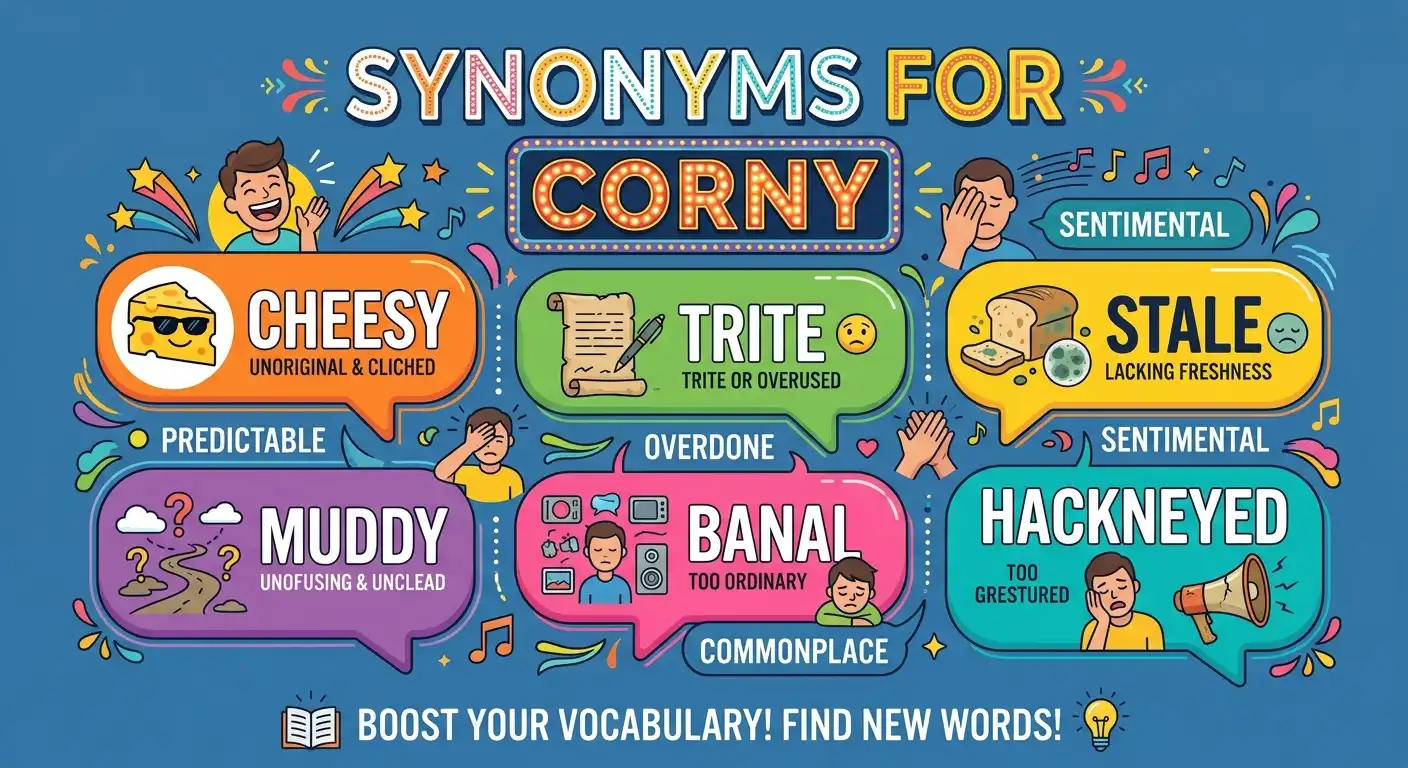
When you hear a bad dad joke or watch a predictable romance movie, you might call it corny. Finding the best synonyms for corny helps you express yourself clearly in everyday conversation, creative writing, and blogging. Using varied synonyms for corny prevents repetitive writing and makes your English sound natural, vivid, and engaging.
Imagine telling your friends about a movie with silly, over-the-top dialogue. Calling everything “corny” gets boring quickly. By learning different synonyms for corny, you can easily choose the perfect word for any situation.
In simple terms, the word corny describes something that is overly sentimental, silly, old-fashioned, or overused. It refers to jokes, songs, or ideas that try too hard to be emotional or funny.
Learning these word alternatives is very useful for everyone:
- Students: Write better essays and descriptive stories without repeating words.
- Bloggers: Keep readers engaged with fresh, playful vocabulary.
- Content Writers: Craft catchy headlines and natural social media posts.
- Daily English Users: Speak more confidently and express subtle feelings accurately.
“Words are the leaves on the tree of language; choosing the right one brings your thoughts to life.”
“A rich vocabulary turns simple everyday stories into unforgettable memories.”
Linguistic Breakdown of “Corny”
Connotative Meaning of Corny
The word corny carries a lighthearted, mildly negative, or affectionate connotation. It suggests that something lacks original thought or relies on cheap emotional tricks. While it can criticize bad jokes, it is often used warmly to describe harmless, silly romantic gestures.
Etymology of Corny
- Origin: American English slang from the early 1900s.
- Root Context: Derived from “corn-fed” or “seed-catalog” humor, which referred to simple, rustic jokes targeted at rural farming communities.
- Modern Evolution: Shifted in the 1930s to describe old-fashioned jazz music and eventually settled into modern slang for unoriginal or overly sweet content.
Pronunciation
- US IPA: /ˈkɔːr.ni/
- UK IPA: /ˈkɔː.ni/
Syllables & Affixation Pattern
- Syllables: 2 syllables (corn-y)
- Base Word: Corn
- Suffix: -y (forming an adjective meaning “resembling or characteristic of”)
Comparison Table: Popular Synonyms for Corny
| Synonym / Keyword | Meaning | Usage Type | Context |
| Corny | Silly, overused, or overly sentimental | Casual | Jokes, movies, romance |
| Cheesy | Cheap, low quality, or fake | Casual | Fashion, lines, music |
| Trite | Lacking originality due to overuse | Formal / Professional | Writing, speeches, essays |
| Sappy | Excessively emotional or sweet | Casual / Emotional | Love notes, drama films |
| Banal | Boring and ordinary | Formal | Art, conversation, literature |
| Hokey | Obviously artificial or staged | Casual / Professional | Acting, advertisements |
| Clichéd | Overused and predictable | Professional / Creative | Plots, sayings, ideas |
50 Synonyms for Corny
1. Cheesy
- Pronunciation: US: /ˈtʃiː.zi/ | UK: /ˈtʃiː.zi/
- Meaning: Cheesy describes something cheap, silly, or trying too hard to be cool.
- Examples:
- He wrote a cheesy poem on the birthday card.
- That movie had a very cheesy happy ending.
2. Hokey
- Pronunciation: US: /ˈhoʊ.ki/ | UK: /ˈhəʊ.ki/
- Meaning: Hokey describes something that feels artificial, fake, or staged.
- Examples:
- The commercial used hokey sound effects to make us laugh.
- Her speech felt a bit hokey, but people enjoyed it.
3. Sappy
- Pronunciation: US: /ˈsæp.i/ | UK: /ˈsæp.i/
- Meaning: Sappy describes something that is way too sweet or emotional.
- Examples:
- I do not like sappy romance novels.
- He gave her a sappy speech at the party.
4. Schmaltzy
- Pronunciation: US: /ˈʃmɑːlt.si/ | UK: /ˈʃmɒlt.si/
- Meaning: Schmaltzy describes art or music that is overly sentimental.
- Examples:
- The restaurant played schmaltzy violin music all night.
- It was a schmaltzy holiday film with a predictable ending.
5. Cringey
- Pronunciation: US: /ˈkrɪn.dʒi/ | UK: /ˈkrɪn.dʒi/
- Meaning: Cringey describes something that makes you feel awkward or embarrassed.
- Examples:
- His attempt at dancing was totally cringey.
- She made a cringey joke during the family dinner.
6. Banal
- Pronunciation: US: /bəˈnɑːl/ | UK: /bəˈnɑːl/
- Meaning: Banal describes something boring and lacking original ideas.
- Examples:
- The plot of the show was very banal.
- We had a banal conversation about the rainy weather.
7. Trite
- Pronunciation: US: /traɪt/ | UK: /traɪt/
- Meaning: Trite describes an idea or remark that is overused and dull.
- Examples:
- Try to avoid trite phrases in your school essay.
- His advice sounded trite and unhelpful.
8. Hackneyed
- Pronunciation: US: /ˈhæk.nid/ | UK: /ˈhæk.nid/
- Meaning: Hackneyed describes language or ideas that have lost meaning from overuse.
- Examples:
- The writer used a hackneyed storyline about a lost hero.
- That song has a hackneyed rhythm you hear everywhere.
9. Clichéd
- Pronunciation: US: /kliːˈʃeɪd/ | UK: /ˈkliː.ʃeɪd/
- Meaning: Clichéd describes something that is full of overused expressions.
- Examples:
- The villain in the book felt very clichéd.
- It sounds clichéd, but time really flies when you have fun.
10. Tacky
- Pronunciation: US: /ˈtæk.i/ | UK: /ˈtæk.i/
- Meaning: Tacky describes something that shows poor style or bad taste.
- Examples:
- They put up tacky plastic decorations for the party.
- Wearing bright sunglasses indoors looked a bit tacky.
11. Campy
- Pronunciation: US: /ˈkæm.pi/ | UK: /ˈkæm.pi/
- Meaning: Campy describes something foolish or absurd in an amusing way.
- Examples:
- We loved watching the old campy monster movie.
- The play had a fun, campy style of humor.
12. Mushy
- Pronunciation: US: /ˈmʌʃ.i/ | UK: /ˈmʌʃ.i/
- Meaning: Mushy describes feelings or actions that are excessively romantic.
- Examples:
- My brother hates watching mushy love stories.
- She wrote a mushy note to her boyfriend.
13. Cornball
- Pronunciation: US: /ˈkɔːrn.bɑːl/ | UK: /ˈkɔːn.bɔːl/
- Meaning: Cornball describes a person or joke that is silly and old-fashioned.
- Examples:
- My uncle is a real cornball when he tells jokes.
- It was a cornball comedy show from the nineties.
14. Stale
- Pronunciation: US: /steɪl/ | UK: /steɪl/
- Meaning: Stale describes an idea or joke that is no longer fresh or interesting.
- Examples:
- The comedian lost the crowd with his stale jokes.
- That excuse is getting very stale.
15. Overused
- Pronunciation: US: /ˌoʊ.vɚˈjuːzd/ | UK: /ˌəʊ.vəˈjuːzd/
- Meaning: Overused describes something that has been seen or done too many times.
- Examples:
- “Break a leg” is an overused saying.
- The designer warned against overused color themes.
16. Tired
- Pronunciation: US: /ˈtaɪ.ɚd/ | UK: /ˈtaɪəd/
- Meaning: Tired describes an argument or style that feels old and unexciting.
- Examples:
- The movie relied on tired tricks to scare people.
- He repeated the same tired point again.
17. Threadbare
- Pronunciation: US: /ˈθred.beɚ/ | UK: /ˈθred.beə/
- Meaning: Threadbare describes an excuse or idea that is weak from overuse.
- Examples:
- Her threadbare reasoning failed to convince the group.
- The author used a threadbare plot line.
18. Platitudinous
- Pronunciation: US: /ˌplæt.əˈtuː.də.nəs/ | UK: /ˌplæt.ɪˈtjuː.dɪ.nəs/
- Meaning: Platitudinous describes statements that sound wise but are empty of deep meaning.
- Examples:
- The politician gave a platitudinous speech.
- Avoid platitudinous phrases when giving real advice.
19. Unoriginal
- Pronunciation: US: /ˌʌn.əˈrɪdʒ.ən.əl/ | UK: /ˌʌn.əˈrɪdʒ.ən.əl/
- Meaning: Unoriginal describes something made by copying existing work.
- Examples:
- The song melody sounded completely unoriginal.
- Her artwork was criticized for being unoriginal.
20. Predictable
- Pronunciation: US: /prɪˈdɪk.tə.bəl/ | UK: /prɪˈdɪk.tə.bəl/
- Meaning: Predictable describes something easy to guess before it happens.
- Examples:
- The action movie had a predictable mystery ending.
- It was predictable that he would lose his keys.
21. Goofy
- Pronunciation: US: /ˈɡuː.fi/ | UK: /ˈɡuː.fi/
- Meaning: Goofy describes something harmlessly silly, funny, or strange.
- Examples:
- He wore a goofy hat to make his baby smile.
- We took some goofy photos at the booth.
22. Gushy
- Pronunciation: US: /ˈɡʌʃ.i/ | UK: /ˈɡʌʃ.i/
- Meaning: Gushy describes someone who shows too much enthusiasm or affection.
- Examples:
- She made a gushy post about her best friend online.
- The reviewer was overly gushy about the new restaurant.
23. Syrupy
- Pronunciation: US: /ˈsɪr.ə.pi/ | UK: /ˈsɪr.ə.pi/
- Meaning: Syrupy describes tone or music that is excessively sweet and sentimental.
- Examples:
- The pop song had a syrupy melody.
- He spoke in a syrupy voice to get what he wanted.
24. Saccharine
- Pronunciation: US: /ˈsæk.ɚ.ɪn/ | UK: /ˈsæk.ər.iːn/
- Meaning: Saccharine describes sweetness or politeness that feels fake and exaggerated.
- Examples:
- She gave me a saccharine smile before walking away.
- The drama film was criticized for its saccharine dialogue.
25. Kitschy
- Pronunciation: US: /ˈkɪtʃ.i/ | UK: /ˈkɪtʃ.i/
- Meaning: Kitschy describes art or decor that is amusingly tacky or outdated.
- Examples:
- Her living room is full of kitschy souvenirs.
- We bought a kitschy clock shaped like a cat.
26. Mawkish
- Pronunciation: US: /ˈmɑː.kɪʃ/ | UK: /ˈmɔː.kɪʃ/
- Meaning: Mawkish describes something so emotional that it makes you feel uncomfortable.
- Examples:
- The film ruined the ending with a mawkish scene.
- I found the poem to be too mawkish for my taste.
27. Oversentimental
- Pronunciation: US: /ˌoʊ.vɚ.sen.t̬əˈmen.t̬əl/ | UK: /ˌəʊ.və.sen.tɪˈmen.təl/
- Meaning: Oversentimental describes showing far too much tenderness or nostalgia.
- Examples:
- He gets oversentimental whenever he looks at old photos.
- The story was oversentimental and lacked real drama.
28. Drippy
- Pronunciation: US: /ˈdrɪp.i/ | UK: /ˈdrɪp.i/
- Meaning: Drippy describes behavior or writing that is weakly emotional.
- Examples:
- I skipped the drippy love ballad on the album.
- He wrote a drippy card for Valentine’s Day.
29. Lame
- Pronunciation: US: /leɪm/ | UK: /leɪm/
- Meaning: Lame describes something weak, unconvincing, or lacking spark.
- Examples:
- That was a really lame excuse for being late.
- The magician pulled a lame prank on stage.
30. Dorky
- Pronunciation: US: /ˈdɔːr.ki/ | UK: /ˈdɔː.ki/
- Meaning: Dorky describes foolish or socially clumsy actions that are often cute.
- Examples:
- He did a dorky little dance when he won.
- She wears dorky glasses that look stylish on her.
31. Melodramatic
- Pronunciation: US: /ˌmel.ə.drəˈmæt̬.ɪk/ | UK: /ˌmel.ə.drəˈmæt.ɪk/
- Meaning: Melodramatic describes overreacting with exaggerated emotion.
- Examples:
- Stop being so melodramatic over a tiny spill.
- The actor gave a very melodramatic performance.
32. Outdated
- Pronunciation: US: /ˌaʊtˈdeɪ.t̬ɪd/ | UK: /ˌaʊtˈdeɪ.tɪd/
- Meaning: Outdated describes things that belong to the past and are no longer modern.
- Examples:
- The textbook contains outdated slang words.
- That style of comedy feels outdated now.
33. Old-fashioned
- Pronunciation: US: /ˌoʊldˈfæʃ.ənd/ | UK: /ˌəʊldˈfæʃ.ənd/
- Meaning: Old-fashioned describes customs or ideas typical of an earlier era.
- Examples:
- My grandpa uses old-fashioned greetings.
- She likes old-fashioned manners and courtesy.
34. Formulaic
- Pronunciation: US: /ˌfɔːr.mjəˈleɪ.ɪk/ | UK: /ˌfɔː.mjəˈleɪ.ɪk/
- Meaning: Formulaic describes something made by following a fixed pattern without creativity.
- Examples:
- The superhero film felt very formulaic.
- Her essay had a formulaic five-paragraph structure.
35. Derivative
- Pronunciation: US: /dɪˈrɪv.ə.t̬ɪv/ | UK: /dɪˈrɪv.ə.tɪv/
- Meaning: Derivative describes work copied directly from another source.
- Examples:
- The novel felt derivative of famous fantasy books.
- Critics called his art style derivative.
36. Stereotyped
- Pronunciation: US: /ˈster.i.ə.taɪpt/ | UK: /ˈster.i.ə.taɪpt/
- Meaning: Stereotyped describes characters or ideas based on fixed, oversimplified assumptions.
- Examples:
- The movie featured a stereotyped high school bully.
- Avoid stereotyped descriptions in creative writing.
37. Routine
- Pronunciation: US: /ruːˈtiːn/ | UK: /ruːˈtiːn/
- Meaning: Routine describes things done as a habit without special effort or imagination.
- Examples:
- The comedian offered a routine performance.
- It was a routine answer to a common question.
38. Pedestrian
- Pronunciation: US: /pəˈdes.tri.ən/ | UK: /pəˈdes.tri.ən/
- Meaning: Pedestrian describes writing or speech that is ordinary and uninspired.
- Examples:
- The poetry in the magazine was quite pedestrian.
- He gave a pedestrian speech at the ceremony.
39. Commonplace
- Pronunciation: US: /ˈkɑː.mən.pleɪs/ | UK: /ˈkɒm.ən.pleɪs/
- Meaning: Commonplace describes ordinary things that happen every day without interest.
- Examples:
- Cell phones are commonplace in modern life.
- Her opening remarks were simple and commonplace.
40. Shopworn
- Pronunciation: US: /ˈʃɑːp.wɔːrn/ | UK: /ˈʃɒp.wɔːn/
- Meaning: Shopworn describes ideas or expressions that feel dull from long use.
- Examples:
- He used a shopworn cliché to explain his choice.
- The plot relies on shopworn tropes.
41. Wearisome
- Pronunciation: US: /ˈwɪr.i.səm/ | UK: /ˈwɪə.ri.səm/
- Meaning: Wearisome describes something so repetitive that it causes boredom.
- Examples:
- Listening to his wearisome excuses was tiring.
- The meeting turned into a wearisome lecture.
42. Boring
- Pronunciation: US: /ˈbɔː.rɪŋ/ | UK: /ˈbɔː.rɪŋ/
- Meaning: Boring describes something that fails to hold your interest.
- Examples:
- The lecture was long and boring.
- I found the movie plot very boring.
43. Uninspired
- Pronunciation: US: /ˌʌn.ɪnˈspaɪɚd/ | UK: /ˌʌn.ɪnˈspaɪəd/
- Meaning: Uninspired describes work made without enthusiasm or creative spark.
- Examples:
- The team gave an uninspired effort in the final match.
- The meal was simple and uninspired.
44. Dulled
- Pronunciation: US: /dʌld/ | UK: /dʌld/
- Meaning: Dulled describes something that has lost its sharpness or novelty.
- Examples:
- The joke lost its punch and felt dulled.
- Repeated use dulled the impact of his story.
45. Hackneyed-sounding
- Pronunciation: US: /ˈhæk.nid ˈsaʊn.dɪŋ/ | UK: /ˈhæk.nid ˈsaʊn.dɪŋ/
- Meaning: Hackneyed-sounding describes words that sound immediately familiar and overdone.
- Examples:
- That sounded like a hackneyed-sounding slogan.
- The song had a hackneyed-sounding chorus.
46. Corny-vibe
- Pronunciation: US: /ˈkɔːr.ni vaɪb/ | UK: /ˈkɔː.ni vaɪb/
- Meaning: Corny-vibe describes a general feeling of silly, old-fashioned sweetness.
- Examples:
- The café gave off a cute, corny-vibe with its decor.
- They shared a romantic moment with a bit of a corny-vibe.
47. Melodramatized
- Pronunciation: US: /ˌmel.əˈdræm.ə.taɪzd/ | UK: /ˌmel.əˈdræm.ə.taɪzd/
- Meaning: Melodramatized describes something made to look bigger or more emotional than it is.
- Examples:
- The news report felt slightly melodramatized.
- He melodramatized his minor injury for attention.
48. Oversweet
- Pronunciation: US: /ˌoʊ.vɚˈswiːt/ | UK: /ˌəʊ.vəˈswiːt/
- Meaning: Oversweet describes behavior that tries too hard to be kind or romantic.
- Examples:
- Her speech was oversweet and lacked truth.
- The romantic gesture felt a bit oversweet.
49. Molasses-like
- Pronunciation: US: /məˈlæs.əz laɪk/ | UK: /məˈlæs.ɪz laɪk/
- Meaning: Molasses-like describes something moving slowly with thick, heavy sentimentality.
- Examples:
- The movie moved at a slow, molasses-like pace.
- He spoke with a thick, molasses-like affection.
50. Tear-jerker
- Pronunciation: US: /ˈtɪrˌdʒɝː.kɚ/ | UK: /ˈtɪəˌdʒɜː.kə/
- Meaning: Tear-jerker describes a story or film calculated to make people cry.
- Examples:
- That movie was a real tear-jerker from start to finish.
- Bring tissues if you watch this tear-jerker film.
Antonyms of Corny
While synonyms for corny help you describe overly sweet or overused things, antonyms describe things that are original, sharp, and authentic.
- Original: Fresh and created without copying others.
- Authentic: Genuine, real, and true to feelings.
- Sophisticated: Refined, clever, and mature in style.
- Profound: Showing deep thought and wisdom.
- Subtle: Not obvious or loud; delicate and clever.
- Cutting-edge: Highly modern and novel.
“Language grows when we replace tired words with crisp, precise expressions.”
Prototype Meaning and Categorization of Corny
Understanding word categories helps you select the correct word quickly:
┌───────────────────────────────┐
│ CORNY (Base) │
└───────────────┬───────────────┘
│
┌───────────────────────────┼───────────────────────────┐
▼ ▼ ▼
┌───────────┐ ┌───────────┐ ┌───────────┐
│ Emotion │ │ Overuse │ │ Tone │
└─────┬─────┘ └─────┬─────┘ └─────┬─────┘
│ │ │
Sappy Trite Cheesy
Schmaltzy Hackneyed Hokey
Mushy Clichéd Cringey
- Emotional Overload: Words like sappy, schmaltzy, and mushy focus on excessive romantic feelings.
- Repetition & Overuse: Words like trite, hackneyed, and clichéd focus on ideas that feel worn out.
- Style & Tone: Words like cheesy, hokey, and cringey focus on awkwardness or poor style.
Frequently Asked Questions (FAQs)
1. What is the most common synonym for corny?
The most common casual synonym for corny is cheesy. For formal writing, clichéd or trite are preferred.
2. Is “corny” a rude word to use?
No, “corny” is usually harmless. It is often used affectionately to describe silly jokes or sweet romantic gestures.
3. What is the difference between corny and cheesy?
“Corny” often refers to old-fashioned or overly emotional humor. “Cheesy” usually refers to poor quality, cheap style, or fake charm.
4. Which synonym for corny should I use in professional writing?
In professional or academic writing, avoid slang like cheesy or corny. Instead, use trite, banal, hackneyed, or clichéd.
5. Can a person be described as corny?
Yes, a person can be called corny if they frequently tell dad jokes, wear silly clothes, or use exaggerated romantic lines.
6. Where did the word corny originate?
It originated in American slang in the early 20th century to describe simple jokes from rural farm areas (“corn-fed” regions).
Conclusion
Expanding your vocabulary by learning various synonyms for corny will transform how you communicate. Swapping repetitive terms for precise alternatives instantly enhances your writing, blogging, speaking, and everyday conversations.
When you know words like trite, sappy, banal, and cheesy, you can accurately convey subtle differences in tone. Practice using these new terms in your daily emails, academic essays, blog posts, and text messages. Over time, choosing the right word will become second nature.
“Clear writing comes from having the exact word ready when you need it.”
“Expand your vocabulary daily, and your voice will naturally carry greater clarity and influence.”

Michael Turner is a published fiction writer and creative writing tutor with over a decade of experience helping writers find the words that make their stories breathe ( Biography ).