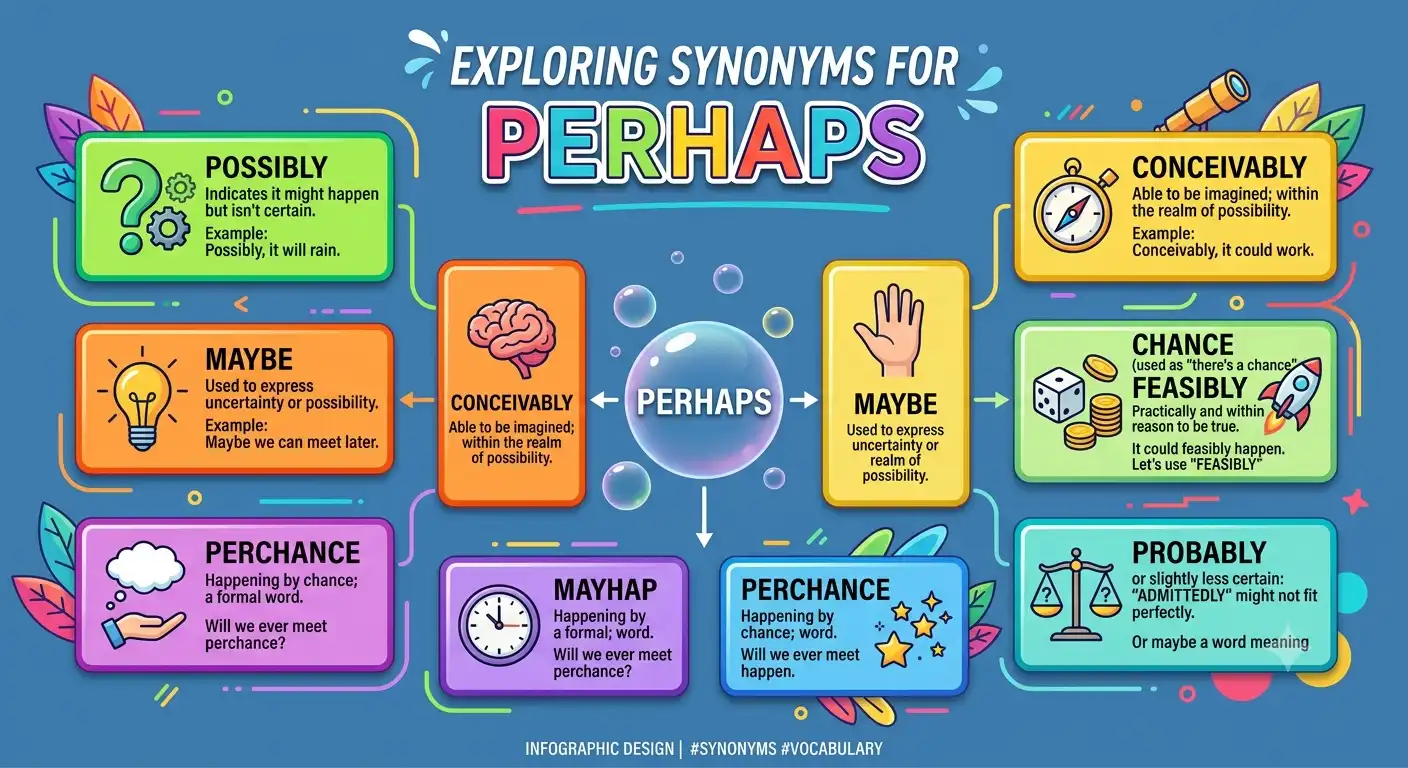
Exploring different synonyms for perhaps helps you express uncertainty, possibility, and polite suggestions with precision. Learning varied synonyms for perhaps gives you the exact words needed for academic essays, professional emails, and creative writing. Using proper synonyms for perhaps allows you to avoid repetitive phrasing while keeping your message engaging and natural.
Picture standing at a fork in the road during a casual walk. You might turn left, or you might turn right. In daily conversations, we often rely on the word “perhaps” to share an idea without sounding too rigid or forceful. However, using the same word repeatedly can make your writing feel stiff and monotone.
Understanding these vocabulary choices provides clear daily benefits:
- Students can write balanced persuasive essays and improve standardized test scores.
- Bloggers can write engaging advice posts and conversational opinion pieces.
- Content writers can draft persuasive landing pages and soft call-to-action copy.
- Daily English users can speak politely, offer friendly suggestions, and avoid sounding aggressive.
“Choosing the right word for uncertainty allows your ideas to feel open and inviting.”
“A well-selected synonym transforms simple statements into subtle, persuasive thoughts.”
Connotative Meaning of Perhaps
The word perhaps carries distinct emotional tones depending on the context:
- Positive Connotation: Open possibility, gentle suggestion, or optimistic hope (e.g., hopefully, plausibly, conceivably).
- Negative Connotation: Doubtful outcome, hesitation, or lack of confidence (e.g., dubiously, questionably, uncertainly).
- Neutral Connotation: Logical chance, scientific hypothesis, or structural condition (e.g., possibly, potentially, theoretically).
Etymology of Perhaps
- Prefix / Root Origin: Formed from the Middle English prefix per- (meaning “by” or “through”) and hap (meaning “chance” or “luck”).
- Historical Evolution: Originated in the 15th century as per happe, evolving from Old Norse happ (luck), replacing earlier words like peradventure.
- Modern Usage: Shifted from denoting pure random luck to expressing polite possibility and logical condition in modern English.
Pronunciation, Syllables, and Affixation Pattern
- US Pronunciation (IPA): /pɚˈhæps/
- UK Pronunciation (IPA): /pəˈhæps/
- Syllable Count: 2 syllables (per-haps)
- Root Word: Hap
- Affixation Pattern:
- Prefix: Per- (by/through)
- Root: Hap (chance/luck)
- Suffix: -s (adverbial suffix)
- Derivatives: Hapless (adjective), Happen (verb), Haply (adverb)
Word Comparison Table
| Keyword | Meaning | Usage Type | Context |
| Perhaps | Used to express uncertainty or a soft choice | Formal / Neutral | Essays, polite dialogue, general writing |
| Maybe | Used to show a chance of something happening | Informal / Casual | Everyday speech, text messages |
| Possibly | Used to state that an event can happen | Neutral / Technical | Science, planning, problem-solving |
| Potentially | Used to show future capability or outcome | Professional | Business reports, strategy, growth |
| Perchance | Used to express chance in a poetic style | Literary / Historic | Creative stories, poetry, drama |
| Feasibly | Used to describe a realistic option | Practical / Professional | Engineering, project management |
| Conceivably | Used for options that can be imagined | Intellectual / Academic | Debates, research, philosophy |
50 Synonyms for Perhaps
1. Maybe
- Pronunciation: US: /ˈmeɪ.bi/ | UK: /ˈmeɪ.bi/
- Meaning: Used to show that something might be true or happen.
- Examples:
- Maybe we can go to the park later today.
- She will maybe call us after her work finishes.
2. Possibly
- Pronunciation: US: /ˈpɑː.sə.bli/ | UK: /ˈpɒs.ə.bli/
- Meaning: Used to state that an event can happen in reality.
- Examples:
- I could possibly finish this book tonight.
- That plan is possibly the best choice for us.
3. Potentially
- Pronunciation: US: /pəˈten.ʃəl.i/ | UK: /pəˈten.ʃəl.i/
- Meaning: Used to describe something that could happen in the future.
- Examples:
- This new job is potentially a great opportunity.
- Rain could potentially ruin our outdoor picnic.
4. Perchance
- Pronunciation: US: /pɚˈtʃæns/ | UK: /pəˈtʃɑːns/
- Meaning: Used in a classic style to mean by chance.
- Examples:
- Did you perchance see my lost key on the table?
- The traveler wondered if perchance help was near.
5. Feasibly
- Pronunciation: US: /ˈfiː.zə.bli/ | UK: /ˈfiː.zə.bli/
- Meaning: Used for an idea that is easy and practical to complete.
- Examples:
- We can feasibly complete the task by noon.
- The team could feasibly build the small shed today.
6. Conceivably
- Pronunciation: US: /kənˈsiː.və.bli/ | UK: /kənˈsiː.və.bli/
- Meaning: Used for an option that a person can imagine.
- Examples:
- They could conceivably win the match this afternoon.
- That old car could conceivably run again with care.
7. Plausibly
- Pronunciation: US: /ˈplɑː.zə.bli/ | UK: /ˈplɔː.zə.bli/
- Meaning: Used when an idea sounds reasonable and likely true.
- Examples:
- He plausibly argued his point during the meeting.
- The lost dog could plausibly be in the yard.
8. Likely
- Pronunciation: US: /ˈlaɪk.li/ | UK: /ˈlaɪk.li/
- Meaning: Used to show that something has a strong chance of happening.
- Examples:
- It will likely snow before the morning comes.
- She is likely the top student in our class.
9. Probably
- Pronunciation: US: /ˈprɑː.bə.bli/ | UK: /ˈprɒb.ə.bli/
- Meaning: Used when an outcome is almost certain to happen.
- Examples:
- We will probably arrive at six in the evening.
- He probably left his jacket inside the car.
10. Imaginably
- Pronunciation: US: /ɪˈmædʒ.ə.nə.bli/ | UK: /ɪˈmædʒ.ɪ.nə.bli/
- Meaning: Used for anything that your mind can picture.
- Examples:
- It was the prettiest sight imaginably seen today.
- That is the hardest problem imaginably solved.
11. Mayhap
- Pronunciation: US: /ˈmeɪ.hæp/ | UK: /ˈmeɪ.hæp/
- Meaning: An old word used to mean perhaps or maybe.
- Examples:
- Mayhap the sun will shine after the rain stops.
- We shall meet again next week, mayhap.
12. Supposedly
- Pronunciation: US: /səˈpoʊ.zəd.li/ | UK: /səˈpəʊ.zəd.li/
- Meaning: Used when people think something is true without proof.
- Examples:
- The new movie is supposedly very funny.
- That old house is supposedly built of stone.
13. Reportedly
- Pronunciation: US: /rɪˈpɔːr.t̬ɪd.li/ | UK: /rɪˈpɔː.tɪd.li/
- Meaning: Used when repeating news told by other people.
- Examples:
- The store is reportedly opening early tomorrow.
- She is reportedly moving to a new city.
14. Ostensibly
- Pronunciation: US: /ɑːˈsten.sə.bli/ | UK: /ɒsˈten.sə.bli/
- Meaning: Used when something appears true on the surface.
- Examples:
- He visited the shop ostensibly to buy bread.
- The rule was ostensibly made to save time.
15. Hypothetically
- Pronunciation: US: /ˌhaɪ.pəˈθet̬.ɪ.kəl.i/ | UK: /ˌhaɪ.pəˈθet.ɪ.kəl.i/
- Meaning: Used when imagining an idea to test a thought.
- Examples:
- Hypothetically, we could travel by train instead.
- Let us look at this problem hypothetically.
16. Theoretically
- Pronunciation: US: /ˌθiː.əˈret̬.kəl.i/ | UK: /ˌθɪəˈret.ɪ.kəl.i/
- Meaning: Used for ideas based on rules rather than facts.
- Examples:
- The machine works well theoretically on paper.
- Theoretically, this recipe should taste sweet.
17. Presumably
- Pronunciation: US: /prɪˈzuː.mə.bli/ | UK: /prɪˈzjuː.mə.bli/
- Meaning: Used when assuming something is true based on facts.
- Examples:
- Presumingly, the bus will arrive on time today.
- He is presumably busy with his school work.
18. Apparently
- Pronunciation: US: /əˈper.ənt.li/ | UK: /əˈpær.ənt.li/
- Meaning: Used when something seems true from what you see.
- Examples:
- Apparently, the rain has finally stopped falling.
- She is apparently very happy with her test grade.
19. Seemingly
- Pronunciation: US: /ˈsiː.mɪŋ.li/ | UK: /ˈsiː.mɪŋ.li/
- Meaning: Used to describe how an event looks to an observer.
- Examples:
- He solved the hard puzzle seemingly without effort.
- The path led into a seemingly dark room.
20. Arguably
- Pronunciation: US: /ˈɑːrɡ.ju.ə.bli/ | UK: /ˈɑːɡ.ju.ə.bli/
- Meaning: Used when a claim can be backed by good reasons.
- Examples:
- This is arguably the best pizza in town.
- She is arguably the fastest runner on the team.
21. Peradventure
- Pronunciation: US: /ˌpɚ.ədˈven.tʃɚ/ | UK: /ˌpər.ədˈven.tʃər/
- Meaning: An old word used to express chance or uncertainty.
- Examples:
- Peradventure we will find shade under the oak tree.
- There was no peradventure left in his mind.
22. Haply
- Pronunciation: US: /ˈhæp.li/ | UK: /ˈhæp.li/
- Meaning: Used in stories to mean by good fortune or chance.
- Examples:
- They met haply near the quiet river bank.
- Haply, a passing carriage offered them a ride.
23. Tentatively
- Pronunciation: US: /ˈten.t̬ə.t̬ɪv.li/ | UK: /ˈten.tə.tɪv.li/
- Meaning: Used when making a plan that might change later.
- Examples:
- We tentatively set our party date for Saturday.
- She tentatively agreed to join our study group.
24. Speculatively
- Pronunciation: US: /ˈspek.jə.lə.t̬ɪv.li/ | UK: /ˈspek.jə.lə.tɪv.li/
- Meaning: Used when guessing without having all the clear facts.
- Examples:
- He looked speculatively at the old wooden map.
- They bought the land speculatively for future use.
25. Allegedly
- Pronunciation: US: /əˈledʒ.ɪd.li/ | UK: /əˈledʒ.ɪd.li/
- Meaning: Used when something is claimed but not proven true.
- Examples:
- The painting is allegedly three hundred years old.
- He allegedly lost his wallet at the market.
26. Purportedly
- Pronunciation: US: /pɚˈpɔːr.t̬ɪd.li/ | UK: /pəˈpɔː.tɪd.li/
- Meaning: Used when something is stated to be true by reputation.
- Examples:
- This drink is purportedly good for your health.
- The letter was purportedly written by the mayor.
27. Contingently
- Pronunciation: US: /kənˈtɪn.dʒənt.li/ | UK: /kənˈtɪn.dʒənt.li/
- Meaning: Used when an outcome depends on another event happening.
- Examples:
- Our trip is planned contingently on good weather.
- They signed the contract contingently today.
28. Conditionally
- Pronunciation: US: /kənˈdɪʃ.ən.əl.i/ | UK: /kənˈdɪʃ.ən.əl.i/
- Meaning: Used when an agreement needs special rules met first.
- Examples:
- He passed the course conditionally this term.
- The offer was accepted conditionally by the team.
29. Optionally
- Pronunciation: US: /ˈɑːp.ʃən.əl.i/ | UK: /ˈɒp.ʃən.əl.i/
- Meaning: Used when a choice can be taken or left open.
- Examples:
- You may optionally add cheese to your meal.
- Students can optionally complete extra work.
30. Uncertainly
- Pronunciation: US: /ʌnˈsɝː.tən.li/ | UK: /ʌnˈsɜː.tən.li/
- Meaning: Used when feeling unsure or lacking confidence in a choice.
- Examples:
- She walked uncertainly into the dark room.
- He answered the hard question uncertainly.
31. Dubiously
- Pronunciation: US: /ˈduː.bi.əs.li/ | UK: /ˈdjuː.bi.əs.li/
- Meaning: Used when feeling doubt or mistrust about a claim.
- Examples:
- He looked dubiously at the strange green soup.
- She smiled dubiously at his grand story.
32. Credibly
- Pronunciation: US: /ˈkred.ə.bli/ | UK: /ˈkred.ə.bli/
- Meaning: Used when a story can be believed as true.
- Examples:
- The witness credibly explained the entire event.
- He credibly claimed to have finished the work.
33. Expectantly
- Pronunciation: US: /ɪkˈspek.tənt.li/ | UK: /ɪkˈspek.tənt.li/
- Meaning: Used when waiting for an expected outcome to happen.
- Examples:
- The dog waited expectantly by the kitchen door.
- The crowd looked up expectantly at the stage.
34. Hopefully
- Pronunciation: US: /ˈhoʊp.fəl.i/ | UK: /ˈhəʊp.fəl.i/
- Meaning: Used to express a wish for a good result.
- Examples:
- Hopefully, the sun will shine bright all weekend.
- We will hopefully catch the morning train.
35. Supposably
- Pronunciation: US: /səˈpoʊ.zə.bli/ | UK: /səˈpəʊ.zə.bli/
- Meaning: Used for an option that can be assumed true.
- Examples:
- They could supposably fix the car by tonight.
- This plan is supposably safe for everyone.
36. Debatably
- Pronunciation: US: /dɪˈbeɪ.t̬ə.bli/ | UK: /dɪˈbeɪ.tə.bli/
- Meaning: Used when a topic is open to different opinions.
- Examples:
- It is debatably the hardest test of the year.
- That rule is debatably fair to all players.
37. Provisionally
- Pronunciation: US: /prəˈvɪʒ.ən.əl.i/ | UK: /prəˈvɪʒ.ən.əl.i/
- Meaning: Used for temporary plans that may be updated later.
- Examples:
- The meeting is provisionally set for two o’clock.
- She was provisionally named team captain.
38. Presumptively
- Pronunciation: US: /prɪˈzʌmp.tɪv.li/ | UK: /prɪˈzʌmp.tɪv.li/
- Meaning: Used when an idea is taken as true until proven wrong.
- Examples:
- He is presumptively the winner of the race.
- The claim was presumptively accepted by all.
39. Questionably
- Pronunciation: US: /ˈkwes.tʃə.nə.bli/ | UK: /ˈkwes.tʃə.nə.bli/
- Meaning: Used when an action causes doubt or concern.
- Examples:
- He acted questionably during the final game.
- The answer was questionably correct on paper.
40. Indefinitely
- Pronunciation: US: /ɪnˈdef.ə.nət.li/ | UK: /ɪnˈdef.ɪ.nət.li/
- Meaning: Used when a period of time is left undecided.
- Examples:
- The game was delayed indefinitely due to rain.
- We can indefinitely hold this seat for you.
41. Vaguely
- Pronunciation: US: /ˈveɪɡ.li/ | UK: /ˈveɪɡ.li/
- Meaning: Used when an idea is not clearly seen or expressed.
- Examples:
- I vaguely remember meeting him two years ago.
- She smiled vaguely at the distant crowd.
42. Abstractly
- Pronunciation: US: /æbˈstrækt.li/ | UK: /ˈæb.strækt.li/
- Meaning: Used when thinking about general ideas rather than real things.
- Examples:
- We discussed the topic abstractly in class today.
- He thinks abstractly about numbers and shapes.
43. Believably
- Pronunciation: US: /bɪˈliː.və.bli/ | UK: /bɪˈliː.və.bli/
- Meaning: Used when a story or event can easily be accepted as real.
- Examples:
- The actor spoke believably in the drama scene.
- She believably explained her reason for being late.
44. Doubtfully
- Pronunciation: US: /ˈdaʊt.fəl.i/ | UK: /ˈdaʊt.fəl.i/
- Meaning: Used when showing a lack of trust in an outcome.
- Examples:
- He shook his head doubtfully at the strange plan.
- She looked doubtfully at the grey rain clouds.
45. Intuitively
- Pronunciation: US: /ɪnˈtuː.ɪ.t̬ɪv.li/ | UK: /ɪnˈtjuː.ɪ.tɪv.li/
- Meaning: Used when knowing something naturally without deep thought.
- Examples:
- She intuitively knew which door was the exit.
- He solved the math puzzle intuitively and fast.
46. Reckonably
- Pronunciation: US: /ˈrek.ən.ə.bli/ | UK: /ˈrek.ən.ə.bli/
- Meaning: Used for things that can be calculated or expected.
- Examples:
- The bus will reckonably arrive in ten minutes.
- We can reckonably expect a sunnier day tomorrow.
47. Suppositionally
- Pronunciation: US: /səˌpɑː.zəˈtɪʃ.ən.əl.i/ | UK: /səˌpɒz.ɪˈtɪʃ.ən.əl.i/
- Meaning: Used when forming a statement based on a guess.
- Examples:
- We spoke suppositionally about next year’s plans.
- The theory was introduced suppositionally.
48. Practically
- Pronunciation: US: /ˈpræk.tɪ.kəl.i/ | UK: /ˈpræk.tɪ.kəl.i/
- Meaning: Used to state that something is almost completely true.
- Examples:
- The job is practically finished at this point.
- We are practically ready to leave the house.
49. Subjectively
- Pronunciation: US: /səbˈdʒek.tɪv.li/ | UK: /səbˈdʒek.tɪv.li/
- Meaning: Used when an opinion is based on personal feelings.
- Examples:
- Art is judged subjectively by every viewer.
- She spoke subjectively about her favorite book.
50. Openly
- Pronunciation: US: /ˈoʊ.pən.li/ | UK: /ˈəʊ.pən.li/
- Meaning: Used when sharing thoughts freely without hiding choices.
- Examples:
- They openly shared their ideas with the group.
- We can openly choose which movie to watch.
Antonyms of Perhaps
Understanding opposite words helps you create clear contrasts when expressing absolute certainty:
- Certainly: Without any doubt; completely sure.
- Definitely: In a clear and definite manner; absolutely true.
- Surely: With firm confidence; without question.
- Absolutely: Totally and completely without exceptions.
- Positively: With complete certainty and positive proof.
- Undoubtedly: Beyond any doubt; universally accepted.
Prototype Meaning and Categorization of Perhaps
The core prototype meaning of perhaps is an adverb used to express a non-committal state of possibility, gentle suggestion, or open-ended chance.
“Language gives us the tools to speak with bold certainty or delicate possibility.”
Conceptual Categories:
- Casual Every-Day Possibility: Maybe, possibly, hopefully, practically, reckonably.
- Formal & Academic Speculation: Conceivably, hypothetically, theoretically, presumably, arguably, abstractly, suppositionally.
- Professional & Strategic Options: Potentially, feasibly, tentatively, contingently, conditionally, provisionally, optionally.
- Literary & Classical Expressions: Perchance, mayhap, peradventure, haply.
- Evidential & Reported Claims: Supposedly, reportedly, ostensibly, apparently, seemingly, allegedly, purportedly, credibly, believably.
- Hesitant or Doubtful Choices: Uncertainly, dubiously, questionably, doubtfully, subjectively, speculatively.
Frequently Asked Questions (FAQs)
1. What is the most common synonym for perhaps in casual conversations?
The most common daily synonym for “perhaps” is maybe. It is used widely in spoken English, text messages, and informal chats.
2. Which synonym for perhaps is best for business and professional writing?
Words like potentially, tentatively, feasibly, or provisionally work best in business reports and work emails because they sound structured and professional.
3. What is the difference between perhaps and maybe?
Both words mean the same thing, but perhaps is more formal and common in writing, while maybe is more casual and common in daily speech.
4. Can a synonym for perhaps express a strong probability?
Yes! Adverbs like probably or likely show a much higher chance of an event happening compared to the neutral possibility of “perhaps.”
5. What are old or historic synonyms for perhaps?
Classic and historic terms include perchance, mayhap, peradventure, and haply. They are frequently found in classic literature and poetry.
6. Is perhaps used differently in British and American English?
No! The word perhaps carries the exact same meaning and spelling in both American and British English.
Conclusion
Expanding your vocabulary with varied synonyms for perhaps boosts your writing, blogging, public speaking, and daily communication skills. Swapping basic terms for precise choices like conceivably, tentatively, feasibly, or plausibly gives your thoughts exact clarity and proper emotional tone.
For students, using varied conditional words sharpens argumentative essays, research papers, and reading comprehension, bloggers and content writers, dynamic adverbs engage readers while keeping recommendations polite and persuasive, daily English users, mastering these words helps you share ideas, invite opinions, and build friendly conversations with confidence.
Try using these new terms in your routine starting today:
- Use tentatively or provisionally when suggesting meeting times in work emails.
- Use conceivably or plausibly in essays when explaining complex theories.
- Use hopefully or maybe in personal texts and casual catch-ups with friends.
“Unlocking new words gives your communication the flexibility it needs to connect with everyone.”
“Expressing possibility with care opens doors to better understanding and deeper conversations.”

Michael Turner is a published fiction writer and creative writing tutor with over a decade of experience helping writers find the words that make their stories breathe ( Biography ).