Finding the right synonyms for confrontation can transform your writing from basic to brilliant. When you use synonyms for confrontation, you clearly express arguments, tense meetings, or emotional conflicts.
Imagine two co-workers arguing in a busy office hallway over a missed deadline. That intense moment is a classic real-life example of a confrontation. A confrontation is a direct face-to-face disagreement, fight, or argument between people or groups.
- “Words have the power to turn a tense confrontation into a calm conversation.”
Learning these vocabulary choices is very helpful for everyone. Students can write better essays without repeating the same words. Bloggers and content writers can keep readers interested with varied vocabulary. Daily English users can express their feelings clearly in conversations and emails.
- “Choosing the right word at the right moment changes how people hear your story.”
Connotative Meaning of Confrontation
The word confrontation usually carries a strong negative or tense tone. It suggests anger, emotional pressure, hostility, or direct opposition. However, in professional or personal growth contexts, it can sometimes have a neutral or constructive meaning, such as confronting a hard truth to solve a problem.
Etymology of Confrontation
- Latin Root: Comes from con- (meaning “together”) and frons (meaning “forehead”).
- Middle French: Evolved into confronter (meaning “to face front-to-front”).
- Late 16th Century English: Entered English as confrontation, meaning a face-to-face meeting or opposition.
Pronunciation
- US IPA: /ˌkɑːn.frənˈteɪ.ʃən/
- UK IPA: /ˌkɒn.frʌnˈteɪ.ʃən/
Word Details
- Syllables: 4 (con-fron-ta-tion)
- Affixation Pattern: Prefix: con- | Base: front | Suffix: -ation
Comparison Table of Key Synonyms
| Keyword | Meaning | Usage Type | Context |
| Confrontation | A direct face-to-face disagreement or fight. | Neutral to Hostile | Workplace, personal life, legal disputes |
| Showdown | A final argument or test to settle a dispute. | Intense / Dramatic | Business, sports, film climaxes |
| Clash | A quick disagreement or conflict between opposing sides. | Casual / Expressive | News reports, daily arguments, sports |
| Dispute | An ongoing formal argument over facts or rights. | Formal / Professional | Contracts, workplace issues, legal matters |
| Altercation | A noisy and angry public argument. | Formal / Serious | Public spaces, police reports, legal news |
| Face-off | A direct competition or tense stand-off between rivals. | Casual / Competitive | Sports games, politics, quick rivalries |
| Run-in | An unexpected, unpleasant brief argument. | Casual / Conversational | Friendly chats, neighborhood stories |
50 Synonyms for Confrontation
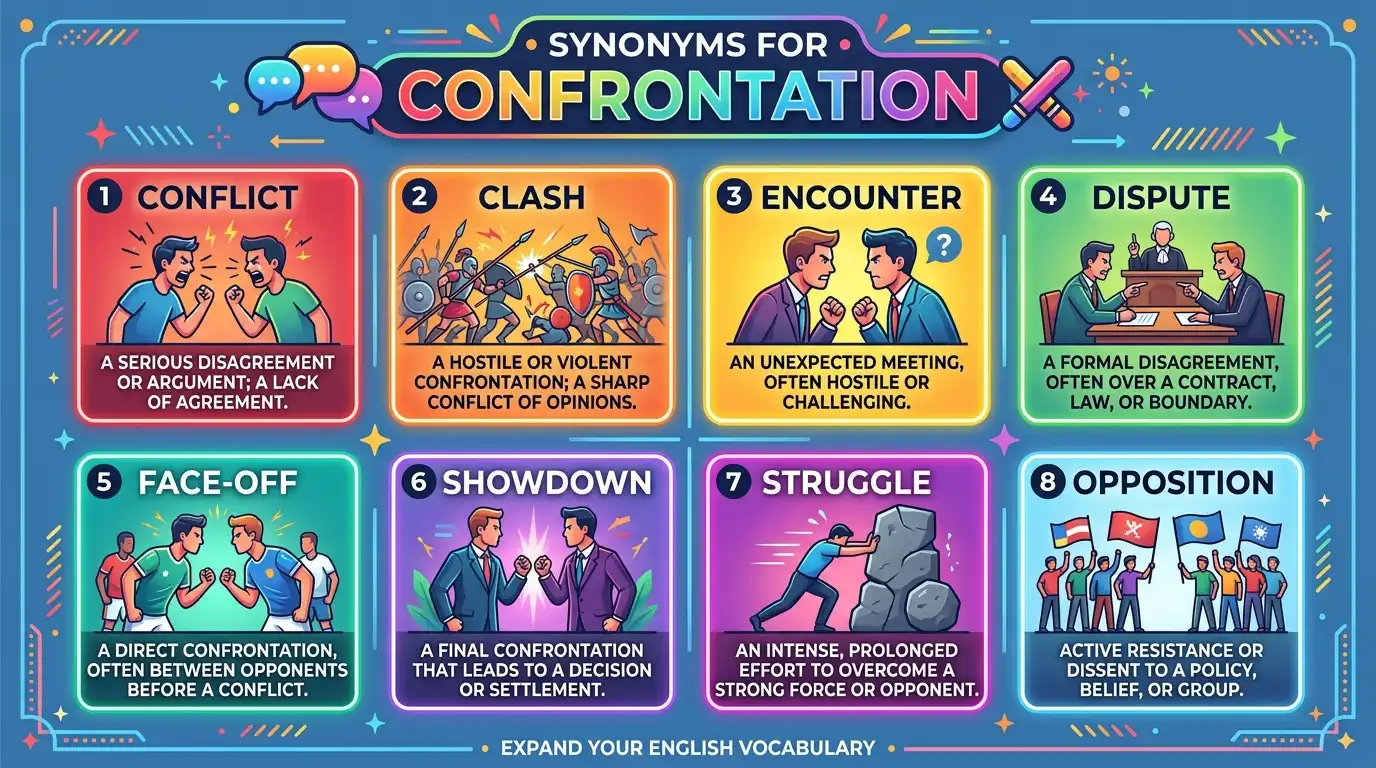
1. Showdown
- Pronunciation: US /ˈʃoʊ.daʊn/ | UK /ˈʃəʊ.daʊn/
- Meaning: A final meeting or argument that resolves a long dispute.
- Examples:
- The two team leaders had a final showdown in the conference room.
- This weekend’s game will be a thrilling showdown between rival teams.
2. Clash
- Pronunciation: US /klæʃ/ | UK /klæʃ/
- Meaning: A quick, sharp disagreement between two people or ideas.
- Examples:
- Their sharp clash of opinions slowed down the project.
- I had a brief clash with my brother over who should drive.
3. Dispute
- Pronunciation: US /dɪˈspjuːt/ | UK /dɪˈspjuːt/
- Meaning: An argument or disagreement that lasts for some time.
- Examples:
- The neighbors settled their land dispute peacefully.
- We resolved the payment dispute after reading the contract carefully.
4. Altercation
- Pronunciation: US /ˌɑːl.tɚˈkeɪ.ʃən/ | UK /ˌɒl.təˈkeɪ.ʃən/
- Meaning: A noisy and public argument with loud words.
- Examples:
- A loud altercation broke out near the store entrance.
- He got into a minor altercation at the parking lot.
5. Face-off
- Pronunciation: US /ˈfeɪs.ɑːf/ | UK /ˈfeɪs.ɒf/
- Meaning: A direct struggle or competition between two rivals.
- Examples:
- The political debate turned into an intense face-off.
- Both players prepared for the big ice hockey face-off.
6. Run-in
- Pronunciation: US /ˈrʌn.ɪn/ | UK /ˈrʌn.ɪn/
- Meaning: A short, unexpected, and bad argument with someone.
- Examples:
- She had a small run-in with her manager this morning.
- I hope we do not have another run-in with that rude neighbor.
7. Quarrel
- Pronunciation: US /ˈkwɑːr.əl/ | UK /ˈkwɒr.əl/
- Meaning: An angry argument between friends or family members.
- Examples:
- The kids had a quick quarrel over a plastic toy.
- We fixed our quarrel and shook hands warmly.
8. Encounter
- Pronunciation: US /ɪnˈkaʊn.t̬ɚ/ | UK /ɪnˈkaʊn.tə/
- Meaning: An unexpected meeting that may cause trouble or surprise.
- Examples:
- My first encounter with the new boss was very tense.
- The police described the night event as a dangerous encounter.
9. Conflict
- Pronunciation: US /ˈkɑːn.flɪkt/ | UK /ˈkɒn.flɪkt/
- Meaning: A strong disagreement between people, ideas, or interests.
- Examples:
- Good managers know how to solve workplace conflict quickly.
- There was a clear conflict between their schedules.
10. Fight
- Pronunciation: US /faɪt/ | UK /faɪt/
- Meaning: A test of strength or words between opposing sides.
- Examples:
- They had a foolish fight over the last slice of cake.
- The sports teams put up a great fight during the game.
11. Skirmish
- Pronunciation: US /ˈskɝː.mɪʃ/ | UK /ˈskɜː.mɪʃ/
- Meaning: A small, minor fight or quick argument.
- Examples:
- The politicians had a small verbal skirmish during the interview.
- A quick skirmish broke out before security stepped in.
12. Battle
- Pronunciation: US /ˈbæt̬.əl/ | UK /ˈbæt.əl/
- Meaning: A long and difficult struggle between two forces.
- Examples:
- The company won the legal battle in court.
- Living in a noisy neighborhood can feel like a daily battle.
13. Feud
- Pronunciation: US /fjuːd/ | UK /fjuːd/
- Meaning: A bitter, long-lasting argument between two groups or families.
- Examples:
- The family feud lasted for more than ten years.
- They finally ended their old feud with a friendly dinner.
14. Row
- Pronunciation: US /raʊ/ | UK /raʊ/
- Meaning: A noisy, angry argument among people.
- Examples:
- The noisy row in the hallway woke up the neighbors.
- They had a silly row about which movie to watch.
15. Standoff
- Pronunciation: US /ˈstænd.ɑːf/ | UK /ˈstænd.ɒf/
- Meaning: A situation where no side can win or agree.
- Examples:
- The meeting reached a complete standoff after two hours.
- Police resolved the standoff peacefully without any injuries.
16. Friction
- Pronunciation: US /ˈfrɪk.ʃən/ | UK /ˈfrɪk.ʃən/
- Meaning: Unfriendly feelings or disagreement between people.
- Examples:
- Tight deadlines can cause friction among team members.
- There was obvious friction between the two roommates.
17. Contention
- Pronunciation: US /kənˈten.ʃən/ | UK /kənˈten.ʃən/
- Meaning: Angry disagreement or a struggle for power.
- Examples:
- The main point of contention was the project budget.
- Her claims caused a lot of contention in the meeting.
18. Discord
- Pronunciation: US /ˈdɪs.kɔːrd/ | UK /ˈdɪs.kɔːd/
- Meaning: A lack of agreement or harmony between people.
- Examples:
- Unfair rules can create discord inside a company.
- The group worked hard to remove all discord among members.
19. Strife
- Pronunciation: US /straɪf/ | UK /straɪf/
- Meaning: Bitter conflict or trouble between groups.
- Examples:
- The workplace suffered months of internal strife.
- Kind words can reduce family strife during hard times.
20. Collide
- Pronunciation: US /kəˈlaɪd/ | UK /kəˈlaɪd/
- Meaning: To come together with strong force or disagreement.
- Examples:
- Their strong personalities always collide in meetings.
- The two different plans will collide if we are not careful.
21. Argument
- Pronunciation: US /ˈɑːrɡ.jə.mənt/ | UK /ˈɑːɡ.jə.mənt/
- Meaning: A conversation where people express opposing views angrily.
- Examples:
- They got into a heated argument about money.
- A calm explanation works much better than a loud argument.
22. Controversy
- Pronunciation: US /ˈkɑːn.trə.vɝː.si/ | UK /ˈkɒn.trə.vɜː.si/
- Meaning: A public disagreement that involves many people.
- Examples:
- The new tax law caused a big controversy nationwide.
- The author avoided any public controversy on social media.
23. Disagreement
- Pronunciation: US /ˌdɪs.əˈɡriː.mənt/ | UK /ˌdɪs.əˈɡriː.mənt/
- Meaning: A failure to agree on an idea, plan, or fact.
- Examples:
- We had a slight disagreement about the travel path.
- A polite disagreement is normal during team planning.
24. Challenge
- Pronunciation: US /ˈtʃæl.ɪndʒ/ | UK /ˈtʃæl.ɪndʒ/
- Meaning: A direct call to fight, argue, or test strength.
- Examples:
- He accepted the challenge from his main rival.
- She met the hard challenge with patience and focus.
25. Brush
- Pronunciation: US /brʌʃ/ | UK /brʌʃ/
- Meaning: A brief, mild conflict or argument with someone.
- Examples:
- He had a quick brush with the local traffic officer.
- She recalled her brief brush with the strict store manager.
26. Collision
- Pronunciation: US /kəˈlɪʒ.ən/ | UK /kəˈlɪʒ.ən/
- Meaning: A crash or strong clash between two opposing views.
- Examples:
- The meeting saw a sudden collision of different work habits.
- We must prevent a collision of interests among board members.
27. Set-to
- Pronunciation: US /ˈset.tuː/ | UK /ˈset.tuː/
- Meaning: A brief but sudden fight or sharp argument.
- Examples:
- They had a quick set-to in the office kitchen.
- A minor set-to disrupted the morning practice.
28. Wrestling
- Pronunciation: US /ˈres.lɪŋ/ | UK /ˈres.lɪŋ/
- Meaning: A hard struggle to control or solve a tough situation.
- Examples:
- He spent all night wrestling with the complex problem.
- Their constant wrestling for power harmed team morale.
29. Duel
- Pronunciation: US /ˈduː.əl/ | UK /ˈdʒuː.əl/
- Meaning: A contest or argument between two main opponents.
- Examples:
- The debate felt like an intellectual duel between scholars.
- Both chess players locked into a tactical duel.
30. Match
- Pronunciation: US /mætʃ/ | UK /mætʃ/
- Meaning: A contest where two people or teams compete directly.
- Examples:
- The championship match tested their skill and focus.
- It was a tough match between two equal rivals.
31. Hostility
- Pronunciation: US /hɑːˈstɪl.ə.t̬i/ | UK /hɒˈstɪl.ə.ti/
- Meaning: Unfriendly behavior or angry feelings toward an opponent.
- Examples:
- His sudden hostility surprised everyone at the meeting.
- We worked together to clear the hostility in the room.
32. Opposition
- Pronunciation: US /ˌɑː.pəˈzɪʃ.ən/ | UK /ˌɒp.əˈzɪʃ.ən/
- Meaning: Strong resistance or disagreement against a plan or leader.
- Examples:
- The new rule faced heavy opposition from office workers.
- She stated her strong opposition to the budget cuts.
33. Warfare
- Pronunciation: US /ˈwɔːr.fer/ | UK /ˈwɔː.feər/
- Meaning: A prolonged period of intense struggle or conflict.
- Examples:
- Price warfare between tech companies helped consumers save money.
- The political leaders engaged in verbal warfare on live television.
34. Dogfight
- Pronunciation: US /ˈdɑːɡ.faɪt/ | UK /ˈdɒɡ.faɪt/
- Meaning: A fierce, close struggle between competing forces.
- Examples:
- The election became a tight dogfight down to the last votes.
- Both firms entered a tough dogfight for market share.
35. Grapple
- Pronunciation: US /ˈɡræp.əl/ | UK /ˈɡræp.əl/
- Meaning: A close struggle to deal with or solve a difficult issue.
- Examples:
- Managers must grapple with rising production costs daily.
- The team had a tough grapple with the computer virus.
36. Tug-of-war
- Pronunciation: US /ˌtʌɡ.əvˈwɔːr/ | UK /ˌtʌɡ.əvˈwɔː/
- Meaning: A struggle for power or control between two equal sides.
- Examples:
- The negotiation was a slow tug-of-war over price.
- A constant tug-of-war existed between old and new rules.
37. Head-to-head
- Pronunciation: US /ˌhed.təˈhed/ | UK /ˌhed.təˈhed/
- Meaning: A direct conflict or competition between two people.
- Examples:
- The top candidates went head-to-head during the town hall.
- They met head-to-head to settle the contract terms.
38. Combat
- Pronunciation: US /ˈkɑːm.bæt/ | UK /ˈkɒm.bæt/
- Meaning: A active fight or struggle between opposing sides.
- Examples:
- The company took strong action to combat bad service.
- Verbal combat in the courtroom lasted all afternoon.
39. Rivalry
- Pronunciation: US /ˈraɪ.vəl.ri/ | UK /ˈraɪ.vəl.ri/
- Meaning: Ongoing competition between rivals over time.
- Examples:
- The healthy rivalry between the two brothers made them faster runners.
- Their business rivalry led to better products for customers.
40. Engagement
- Pronunciation: US /ɪnˈɡeɪdʒ.mənt/ | UK /ɪnˈɡeɪdʒ.mənt/
- Meaning: A planned or formal battle or competitive conflict.
- Examples:
- The two armies avoided a direct military engagement.
- Our debate team prepared well for the evening engagement.
41. Wrangle
- Pronunciation: US /ˈræŋ.ɡəl/ | UK /ˈræŋ.ɡəl/
- Meaning: A noisy, complicated argument that lasts a long time.
- Examples:
- The legal wrangle over property rights took five years.
- They settled their political wrangle with a quick vote.
42. Tiff
- Pronunciation: US /tɪf/ | UK /tɪf/
- Meaning: A petty, unimportant quarrel between friends or lovers.
- Examples:
- They had a minor tiff over who should wash the dishes.
- Don’t worry about their small tiff; they will reconcile soon.
43. Hassle
- Pronunciation: US /ˈhæs.əl/ | UK /ˈhæs.əl/
- Meaning: An annoying argument, struggle, or complication.
- Examples:
- Getting my passport renewed was a huge hassle at the office.
- He wanted to avoid any extra hassle with customer service.
44. Friction Point
- Pronunciation: US /ˈfrɪk.ʃən poɪnt/ | UK /ˈfrɪk.ʃən pɔɪnt/
- Meaning: A specific issue or stage where disagreements happen.
- Examples:
- Money management is often a major friction point for couples.
- The new workflow removed every friction point in the office.
45. Action
- Pronunciation: US /ˈæk.ʃən/ | UK /ˈæk.ʃən/
- Meaning: A physical fight or intense competitive contest.
- Examples:
- Security guards moved in quickly to stop the physical action.
- The players saw plenty of action on the field today.
46. Disputation
- Pronunciation: US /ˌdɪs.pjəˈteɪ.ʃən/ | UK /ˌdɪs.pjuːˈteɪ.ʃən/
- Meaning: A formal academic or logical argument between scholars.
- Examples:
- The professors engaged in a lengthy disputation about history.
- His thesis statement led to a lively academic disputation.
47. Dissension
- Pronunciation: US /dɪˈsen.ʃən/ | UK /dɪˈsen.ʃən/
- Meaning: Strong disagreement that splits a group apart.
- Examples:
- Unfair decisions caused growing dissension among group members.
- The manager stepped in to heal dissension on the team.
48. Controvert
- Pronunciation: US /ˌkɑːn.trəˈvɝːt/ | UK /ˌkɒn.trəˈvɜːt/
- Meaning: To oppose, dispute, or argue strongly against a point.
- Examples:
- The lawyer moved quickly to controvert the key testimony.
- New facts emerged that controvert his original story.
49. Challenge Match
- Pronunciation: US /ˈtʃæl.ɪndʒ mætʃ/ | UK /ˈtʃæl.ɪndʒ mætʃ/
- Meaning: A arranged contest where one opponent challenges another.
- Examples:
- The chess champion accepted the new challenge match.
- Their challenge match attracted thousands of enthusiastic viewers.
50. Show-down Meeting
- Pronunciation: US /ˈʃoʊ.daʊn ˈmiː.t̬ɪŋ/ | UK /ˈʃəʊ.daʊn ˈmiː.tɪŋ/
- Meaning: A formal, critical face-to-face meeting held to solve an issue.
- Examples:
- The board scheduled a show-down meeting to select the CEO.
- “A direct conversation can turn a sharp confrontation into a shared victory.”
- We solved all open issues during yesterday’s show-down meeting.
- The board scheduled a show-down meeting to select the CEO.
Antonyms of Confrontation
While synonyms for confrontation describe tension or argument, these antonyms describe peace and agreement:
- Peace: A state of quiet, calm, and freedom from fight or war.
- Harmony: A state of peaceful agreement and working well together.
- Concord: Agreement or peaceful harmony between groups or people.
- Agreement: A shared position, decision, or arrangement without argument.
- Calm: A tranquil state free from agitation, anger, or disturbance.
- Reconciliation: The restoring of friendly relations after a dispute.
Prototype Meaning and Categorization
Language experts group words by how intense or formal they sound. Here is how synonyms for confrontation are categorized:
- Formal / Legal: Dispute, Contention, Disputation, Altercation. (Best for business, courtrooms, and official reports.)
- Casual / Conversational: Run-in, Tiff, Hassle, Set-to, Row. (Best for daily chats and personal stories.)
- Dramatic / Intense: Showdown, Face-off, Dogfight, Battle, Warfare. (Best for storytelling, sports, and news.)
- Emotional / Relationship: Quarrel, Friction, Discord, Dissension, Feud. (Best for personal growth, counseling, and fiction.)
Frequently Asked Questions (FAQs)
What is the most common synonym for confrontation?
The most common synonyms for confrontation are conflict, clash, dispute, and showdown. These words fit easily into daily conversation, news reports, and business writing.
Is confrontation always a negative word?
Usually, confrontation implies anger or hostility. However, in personal development or therapy, “healthy confrontation” means directly addressing a difficult issue to solve a problem and improve relationships.
What is the difference between a clash and an altercation?
A clash usually refers to a quick disagreement between different opinions, ideas, or schedules. An altercation is a noisy, angry, and public verbal argument that often attracts unwanted attention.
How do I choose the right synonym for confrontation in my writing?
Match your word choice to your audience and context. Use formal terms like dispute or contention for legal or academic essays. Use casual words like run-in or tiff for light storytelling and everyday chats.
What is an antonym for confrontation?
The main antonyms for confrontation are peace, harmony, agreement, concord, and reconciliation. These words express calm and cooperation rather than conflict.
Conclusion
Mastering these synonyms for confrontation helps you become a much stronger communicator. When you vary your vocabulary, your writing becomes more engaging, expressive, and clear.
- “Expanding your vocabulary builds a stronger bridge toward clearer communication.”
For students, using different words prevents boring repetition in essays and academic papers, bloggers and content writers, rich vocabulary improves SEO performance and keeps readers interested longer, daily English users, selecting exact words helps you express emotions clearly in business emails and daily chats.
- “The words you choose define the strength and clarity of your message.”
Try practicing these new words today. Use them when writing emails, drafting essays, or speaking in daily conversations.
- “Great communicators do not avoid difficult words; they master them.”

Michael Turner is a published fiction writer and creative writing tutor with over a decade of experience helping writers find the words that make their stories breathe ( Biography ).