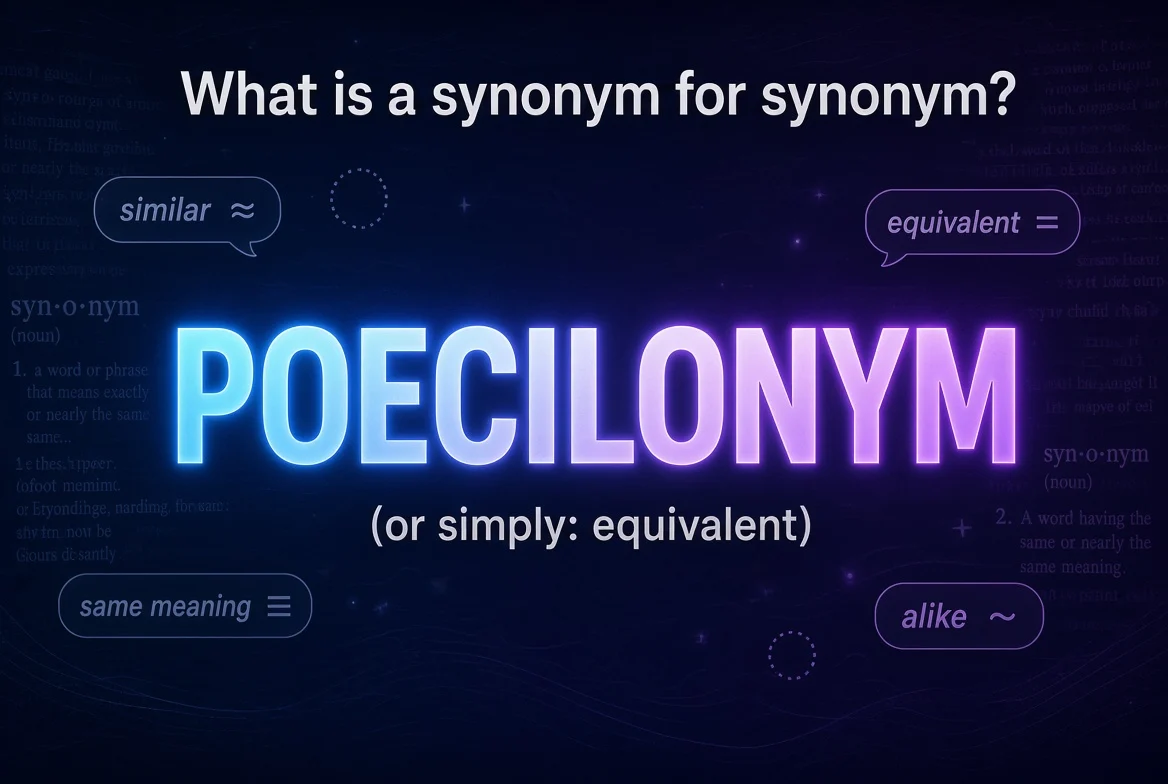
A synonym for synonym is equivalent, analogue, parallel word, or another name, depending on the context. These terms describe words or expressions that share the same or a similar meaning. For everyday writing, equivalent word is a clear alternative, while another name works when referring to a different term for the same person, thing, or idea.
Key Takeaways
- Equivalent is a useful alternative when two words or expressions have similar meanings.
- Analogue refers to something comparable to another thing in a particular respect.
- Another name works when one person, place, or thing has an alternative name.
- Not every synonym is interchangeable in every sentence.
- Context determines which alternative sounds natural and communicates the right meaning.
What Is Another Word for Synonym?
The closest alternatives to synonym include equivalent word, parallel word, analogue, equivalent, and another name. The best choice depends on whether you are discussing language, comparing concepts, or describing an alternative name.
A synonym is a word or phrase that has the same or nearly the same meaning as another word or phrase. For example, happy and joyful are synonyms.
When you want another word for synonym itself, consider these five options:
- Equivalent word: A word with the same or a very similar meaning.
- Parallel word: A word that corresponds to another in meaning or function.
- Analogue: Something comparable to another thing in a particular way.
- Equivalent: Something that has the same value, function, or meaning in a given context.
- Another name: A different name or expression used for the same person, place, thing, or concept.
These alternatives are supported by dictionary and thesaurus references, including the Cambridge English Thesaurus.
For a school assignment or simple explanation, equivalent word is usually the clearest option. In a discussion of names or terminology, another name may be more natural.
Synonyms for Synonym and Their Differences
Although these words are related, they have slightly different uses. Understanding those differences helps you avoid awkward or inaccurate sentences.
| Alternative | Meaning | Best use |
|---|---|---|
| Equivalent word | A word with the same or similar meaning | Vocabulary lessons and writing |
| Parallel word | A corresponding word with a similar role or meaning | Language comparisons |
| Analogue | Something comparable in a particular respect | Academic or technical writing |
| Equivalent | Something equal or similar in meaning, value, or function | General and formal writing |
| Another name | A different name for the same thing | Names, labels, and terminology |
| Alternative expression | Another way to express an idea | Editing and communication |
| Substitute | Something used in place of another thing | Practical replacement |
| Replacement | Something that takes the place of another | General writing |
Important distinction: These words are not all exact synonyms of synonym. For example, substitute usually describes something used in place of something else. A substitute word may have a different meaning from the original word.
Likewise, an analogue is something comparable to another thing, but the two items do not necessarily mean the same thing.
For the most precise wording, use equivalent word when discussing vocabulary and another name when discussing alternative labels.
Examples of Synonym Alternatives in Sentences
Seeing these alternatives in context makes their differences easier to understand.
1. Equivalent word
Original: “Can you find a synonym for the word beautiful?”
Rewritten: “Can you find an equivalent word for beautiful?”
The rewritten sentence asks for a word with the same or a similar meaning. Possible answers include lovely, attractive, and pretty, depending on the sentence.
2. Parallel word
Original: “The student found a synonym for begin.”
Rewritten: “The student found a parallel word for begin.”
The second sentence is understandable, but parallel word sounds less natural in everyday English. A better choice would be “The student found another word for begin.”
3. Analogue
Original: “This term has a synonym in another language.”
Alternative: “This term has an analogue in another language.”
The second sentence suggests a comparable term, but it does not guarantee that the terms have identical meanings.
4. Equivalent
Original: “Find a synonym for quick.”
Alternative: “Find an equivalent for quick.”
The alternative is possible, although “Find an equivalent word for quick” is clearer because it identifies the type of equivalent being requested.
5. Another name
Original: “The writer used a synonym for the technical term.”
Alternative: “The writer used another name for the technical term.”
The second version works when the writer is referring to a different label for the same concept.
These examples show why replacing a word requires more than choosing something from a thesaurus. The replacement must fit the sentence and preserve the intended meaning.
How to Choose the Right Word
If you need a synonym for synonym, follow these simple steps.
Step 1: Identify your purpose
Are you writing a vocabulary definition, editing an essay, or explaining an alternative name?
- For vocabulary: use equivalent word.
- For a different label: use another name.
- For a comparison between concepts: consider analogue.
- For a general replacement: use alternative expression when discussing wording.
Step 2: Check the meaning
Read the original sentence and the proposed replacement. Ask whether both communicate the same idea.
For example, small and tiny are related, but tiny usually suggests a smaller size. They may work as synonyms in some sentences without being identical in every context.
Step 3: Check the tone
Some words are more formal than others. Equivalent often suits academic writing, while another word is simpler and more conversational.
Step 4: Read the sentence aloud
A technically correct word may still sound unnatural. If the sentence becomes confusing, choose a simpler expression.
Writing tip: When in doubt, use “another word for” instead of searching for a more complicated replacement. Clear language is often the best choice.
What Does Synonym Mean?
A synonym is a word or phrase that has the same or nearly the same meaning as another word or phrase in the same language.
For example:
- Big and large: Both describe considerable size.
- Begin and start: Both describe the beginning of an activity.
- Quick and fast: Both can describe speed.
- Happy and joyful: Both describe a positive emotional state.
- Correct and accurate: Both can express that something is right, although their uses differ.
According to the Cambridge Dictionary, a synonym shares the same or almost the same meaning as another word or phrase.
However, similar meaning does not always mean identical usage. You can say “a fast car,” but “a quick car” may sound less natural in ordinary American English. The surrounding words matter.
Synonym vs. Antonym vs. Thesaurus
These three terms are related to vocabulary, but they have different meanings.
| Term | Definition | Example |
|---|---|---|
| Synonym | A word with the same or a similar meaning | Happy / joyful |
| Antonym | A word with an opposite meaning | Happy / sad |
| Thesaurus | A reference source that lists synonyms and often antonyms | A book or online vocabulary tool |
A thesaurus helps you find alternative words, but you should still check their definitions and usage before replacing a word.
For instance, large and huge can both describe size, but huge usually conveys a greater degree. Choosing the right word helps preserve your intended message.
Common Mistakes When Replacing Synonym
Writers and English learners sometimes make these mistakes when searching for an alternative to synonym.
Mistake 1: Treating every alternative as an exact synonym.
Words such as equivalent, analogue, and substitute have related meanings, but they are not interchangeable in every sentence.
Mistake 2: Choosing a complicated word unnecessarily.
Using analogue when you simply mean “another word” can make a sentence harder to read. Prefer familiar words when they communicate your meaning clearly.
Mistake 3: Ignoring context.
A word that works in an academic paper might sound unnatural in a text message. Always consider the audience and purpose.
Mistake 4: Replacing words only to avoid repetition.
Repetition is not always bad. Repeating a precise term can make technical writing clearer than using several loosely related alternatives.
Mistake 5: Confusing synonyms with antonyms.
Synonyms have similar meanings, while antonyms express opposite meanings. Checking a reliable dictionary can prevent this error.
Frequently Asked Questions
1. What is the closest synonym for synonym?
Equivalent word is one of the closest and clearest alternatives when discussing vocabulary. Other options include parallel word, analogue, and another name. The best choice depends on the context because these expressions do not have exactly the same meaning or use.
2. Does equivalent mean the same as synonym?
Not always. An equivalent is something equal or comparable in meaning, value, or function. A synonym is specifically a word or phrase with the same or a similar meaning as another. The terms overlap, but equivalent has a broader range of uses.
3. What is a simple example of a synonym?
Happy and joyful are simple examples of synonyms. Both describe a positive emotional state. Other examples include begin and start, and big and large. Their meanings overlap, although their tone or natural use can differ depending on the sentence.
4. What is the difference between a synonym and an antonym?
A synonym is a word with the same or a similar meaning as another word. An antonym has the opposite meaning. For example, hot and warm can be synonyms in some contexts, while hot and cold are antonyms.
5. Can two words have exactly the same meaning?
Yes, some words can share the same meaning in a particular context. However, many synonyms differ in tone, formality, intensity, or usage. For example, child and kid refer to a young person, but kid is more informal in everyday American English.
6. How do you use synonym in a sentence?
You can write, “The teacher asked us to find a synonym for happy.” You could answer with joyful, cheerful, or glad. Each option has a similar meaning, but the best choice depends on how the word is used in the original sentence.
7. Is another word for synonym the same as a synonym of synonym?
Yes, both expressions ask for an alternative term for the word synonym. The phrase “another word for synonym” is more common in everyday conversation. “A synonym for synonym” is also correct and often appears in vocabulary searches.
8. What is the difference between a synonym and a thesaurus?
A synonym is a word or phrase with a similar meaning to another. A thesaurus is a reference tool that helps you find synonyms and often antonyms. For example, large is a synonym of big, while a thesaurus is where you might look up alternatives for big.
Final Thoughts
The best answer to “What is a synonym for synonym?” is equivalent word, especially when discussing vocabulary. Other alternatives include parallel word, analogue, equivalent, and another name, but each fits a different context.
Before choosing a replacement, check its meaning, tone, and natural use in the sentence. The goal is not simply to use a different word. It is to communicate the same idea clearly and accurately.

Sophia Reed edits and reviews language comparison content to maintain accuracy and readability.