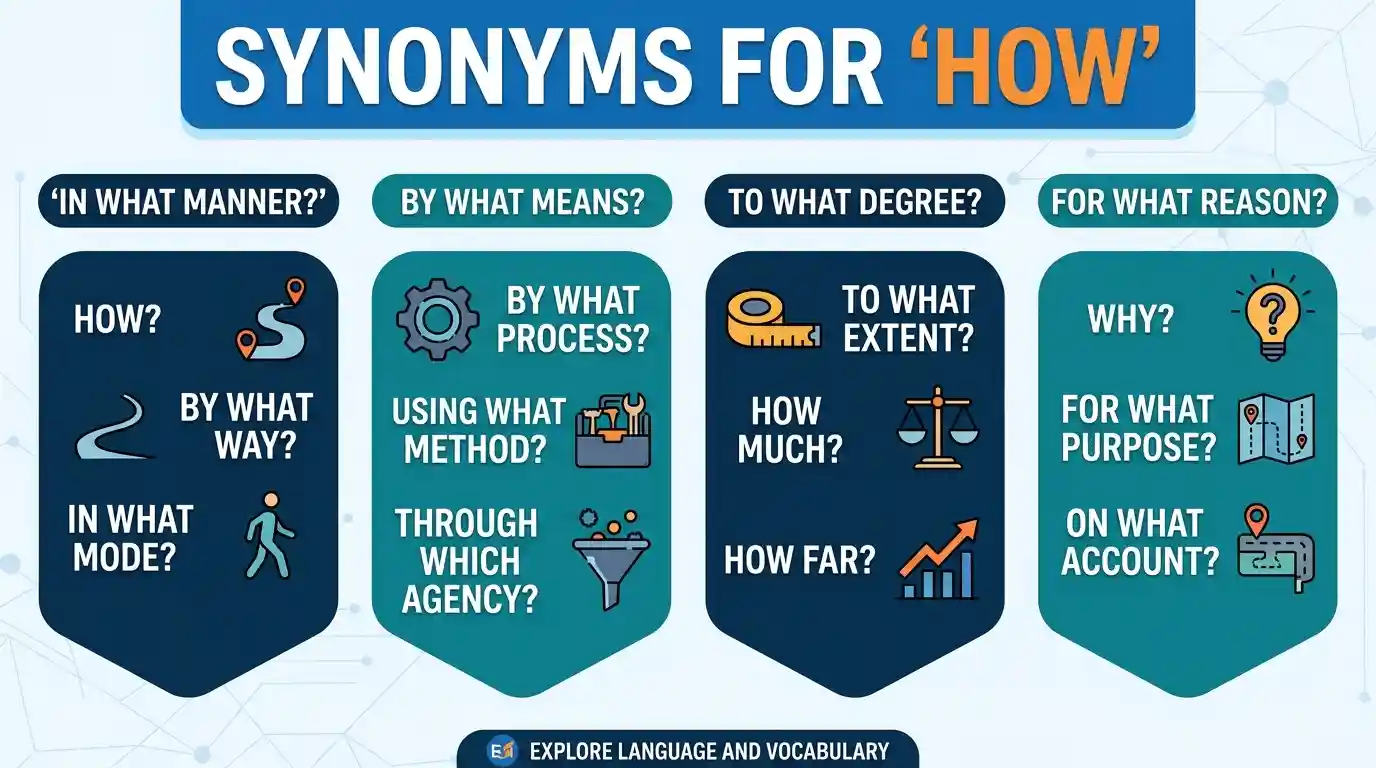
A useful synonym for how is “in what way.” Other alternatives include “by what means,” “in what manner,” “by what method,” and “to what extent.” The best choice depends on the sentence. Some expressions ask about a method, while others describe degree, condition, or the way something happens.
Key Takeaways
- In what way is one of the closest general alternatives to how.
- By what means and by what method work well when asking about a process.
- To what extent is useful when discussing degree or impact.
- The way often replaces how in statements, but the sentence structure may need to change.
- Do not replace every instance of how. Sometimes it is the clearest and most natural choice.
What Does How Mean?
The word how is commonly used to ask about the manner, method, condition, degree, or circumstances of something. It can appear in direct questions, indirect questions, and statements.
For example:
- Method: How did you fix the computer?
- Manner: How did she respond to the news?
- Condition: How are you feeling today?
- Degree: How difficult was the test?
- Duration: How long will the meeting last?
Each sentence uses how differently. This is why a synonym that works in one example may sound incorrect in another.
When looking for another word for how, first identify the information you want to express. Then choose an alternative that preserves the original meaning.
15 Synonyms and Alternatives for How
Here are 15 useful alternatives, with meanings, examples, and guidance on when to use them.
| Alternative | Best use | Example |
|---|---|---|
| 1. In what way | General manner | In what way can we improve the plan? |
| 2. In what manner | Formal descriptions | In what manner did the visitor respond? |
| 3. By what means | Method or resources | By what means was the data collected? |
| 4. By what method | Procedures | By what method did you test the sample? |
| 5. Through what process | Steps or stages | Through what process was the result obtained? |
| 6. Using what technique | A particular skill or method | Using what technique did she create the design? |
| 7. By what procedure | Formal instructions | By what procedure should the request be submitted? |
| 8. In what way exactly | A request for clarification | In what way exactly does the change help? |
| 9. To what extent | Degree or impact | To what extent did the policy improve results? |
| 10. To what degree | Level or intensity | To what degree was the outcome predictable? |
| 11. At what level | Amount or standard | At what level does performance become acceptable? |
| 12. In what condition | State or condition | In what condition was the equipment found? |
| 13. The way | Manner in a statement | I like the way you explain things. |
| 14. The manner in which | Formal statements | The report describes the manner in which the test was conducted. |
| 15. The method by which | Formal or technical writing | The paper explains the method by which the results were calculated. |
Important: These expressions are alternatives to particular uses of how, not 15 interchangeable synonyms. For example, “to what extent” concerns degree, while “by what method” focuses on a procedure.
Alternatives for Manner and Method
Use these expressions when asking how someone performed an action or how something happened.
In what way
This is one of the closest general alternatives to how. It works when you want someone to explain a particular aspect of an action.
- Original: How can this plan help students?
- Alternative: In what way can this plan help students?
By what means
This phrase asks which resources or methods were used to achieve a result. It sounds more formal than everyday English.
- Original: How did they obtain the information?
- Alternative: By what means did they obtain the information?
By what method
Use this phrase when the procedure itself matters, particularly in research, education, or technical writing.
- Original: How did you measure the temperature?
- Alternative: By what method did you measure the temperature?
Through what process
This expression emphasizes the steps or stages that lead to a result.
- Original: How was the application approved?
- Alternative: Through what process was the application approved?
Alternatives for Degree and Condition
Sometimes how does not ask about a method. It asks how much, how strongly, or in what state something exists.
To what extent
Use this phrase to explore the amount, influence, or impact of something.
- Original: How did the changes affect employees?
- Alternative: To what extent did the changes affect employees?
The second sentence emphasizes the degree of the effect rather than simply asking what happened.
To what degree
This expression is similar to “to what extent” and often appears in formal or analytical writing.
- Original: How important is customer feedback?
- Alternative: To what degree is customer feedback important?
Depending on the context, “How important is customer feedback?” may sound more natural.
In what condition
This phrase is useful when asking about the physical state or general condition of an object or place.
- Original: How was the vehicle when it arrived?
- Alternative: In what condition was the vehicle when it arrived?
It is not a good replacement for questions about methods, such as “How did you repair the vehicle?”
Alternatives for Instructions and Statements
You can also rewrite a sentence without using how at all.
For example:
- “How to write a strong introduction” becomes “A Guide to Writing a Strong Introduction.”
- “How to prepare for an interview” becomes “Steps for Preparing for an Interview.”
- “I understand how she solved the problem” becomes “I understand the way she solved the problem.”
Other useful expressions include “instructions for,” “a guide to,” “steps for,” “the process of,” and “ways to.”
These are sentence-level alternatives, not direct synonyms for the word how.
Synonyms for How by Context
The most suitable alternative depends on your purpose and audience.
| Context | Best alternatives | Example |
|---|---|---|
| Everyday conversation | In what way, the way | In what way can I help? |
| Academic writing | By what method, to what extent | To what extent did the results support the hypothesis? |
| Business communication | By what means, through what process | Through what process are applications reviewed? |
| Technical explanations | By what procedure, using what technique | Using what technique was the material tested? |
| Describing behavior | In what manner, the manner in which | The manager explained the manner in which complaints were handled. |
| Instructions and guides | Steps for, a guide to, ways to | A Guide to Organizing Your Workspace |
In ordinary conversations, how is usually the simplest option. Longer expressions are most useful when you need a specific meaning, a more formal tone, or a clearer sentence structure.
How to Choose the Right Alternative
Follow these three steps to find the best synonym for how.
Step 1: Identify the meaning.
Ask yourself whether the sentence concerns a method, manner, degree, condition, or process.
Step 2: Match the phrase to the meaning.
Choose “by what method” for a procedure, “in what way” for a general manner, or “to what extent” for degree.
Step 3: Read the revised sentence aloud.
Check that it sounds natural and keeps the original meaning. If the alternative makes the sentence awkward, keep how.
For example:
- Natural: How did you learn English?
- More formal: By what means did you acquire your English skills?
- More direct: What methods did you use to learn English?
All three ask related questions, but they differ in tone and emphasis.
How vs. Similar Question Words
Some words may seem interchangeable with how, but they ask for different information.
How vs. Why
How generally asks about a method, manner, condition, or degree. Why asks about a reason or cause.
- How did the computer shut down? (The process or events)
- Why did the computer shut down? (The reason)
The answers might overlap, but the questions are different.
How vs. What
How often asks about a manner or process, while what usually asks for identification or information.
- How did you solve the problem? (The method)
- What solved the problem? (The cause or thing responsible)
Sometimes you can rewrite a question using what, but you may need to change its structure.
How vs. The Way
These expressions can have similar meanings in statements.
- I like how you arranged the room.
- I like the way you arranged the room.
Both sentences express approval of the arrangement. However, the way is a noun phrase, while how introduces a clause. You cannot replace one with the other mechanically in every sentence.
Common Mistakes When Replacing How
1. Treating every alternative as an exact synonym
“In what way” and “to what extent” serve different purposes. Choose the phrase that matches the intended meaning.
2. Using overly formal language
Changing “How did you do it?” to “By what means did you accomplish the task?” may sound unnecessarily stiff in a casual conversation.
3. Confusing how with why
Use how to ask about a method or process and why to ask about a reason. Choose based on the information you need.
4. Ignoring sentence structure
“How she solved the problem” can become “the way she solved the problem,” but the surrounding sentence may need adjustment.
5. Forcing a synonym into an instructional heading
“How to Save Money” is clear and natural. “By What Means to Save Money” is awkward. A better alternative is “Practical Ways to Save Money.”
Frequently Asked Questions
What is another word for how?
“In what way” is one of the closest general alternatives. Other choices include “by what means,” “by what method,” and “in what manner.” The best expression depends on whether the sentence asks about a method, manner, or another aspect of a situation.
What is the closest synonym for how?
“In what way” is a close alternative when how asks about manner or method. However, there is no single synonym that works in every sentence because how also expresses degree, condition, quantity, and duration.
What is a formal synonym for how?
Formal alternatives include “by what means,” “by what method,” “in what manner,” and “through what process.” These expressions are useful in academic, technical, and professional writing, but they can sound unnatural in casual conversation.
Can I use “the way” instead of “how”?
Yes, in many statements. For example, “I like how she teaches” can become “I like the way she teaches.” However, “the way” is not a universal replacement. Direct questions such as “How does she teach?” need a different sentence structure if rewritten.
Is why a synonym for how?
No. How generally asks about a method, manner, condition, or degree, while why asks about a reason. “How did the accident happen?” asks about the events or process, while “Why did the accident happen?” asks about its cause.
Does how have an antonym?
No conventional antonym exists for how. It is mainly a question word, not a descriptive word with an opposite. Words such as why, when, and where ask different types of questions rather than expressing the opposite of how.
How can I avoid repeating how in my writing?
First, check what each sentence means. Use “in what way” for manner, “by what method” for procedures, and “to what extent” for degree. In statements, consider rewriting the sentence with “the way,” “the process,” or “steps for.” Keep how whenever it is the clearest choice.
What is another way to write “how to”?
For instructional headings, try “a guide to,” “steps for,” “ways to,” “instructions for,” or “the process of.” For example, “How to Improve Your Vocabulary” could become “Ways to Improve Your Vocabulary” or “A Guide to Improving Your Vocabulary.”
Conclusion
The best synonym for how depends on what you want to communicate. “In what way” works for many general questions, “by what means” focuses on methods, and “to what extent” expresses degree. For statements, “the way” may be a natural alternative.
Before replacing how, check the sentence’s meaning, grammar, and tone. The goal is not to use a different word every time. It is to express your idea clearly and naturally.

Sophia Reed edits and reviews language comparison content to maintain accuracy and readability.