Quick Introduction
The word inquisitive appears in daily conversation, school writing, and professional communication. It describes curiosity about people or information. Learning synonyms helps you speak more clearly, avoid repetition, and match the right tone in different situations.
Direct Answer
Inquisitive means wanting to learn more or asking many questions. It describes a curious and interested mind.
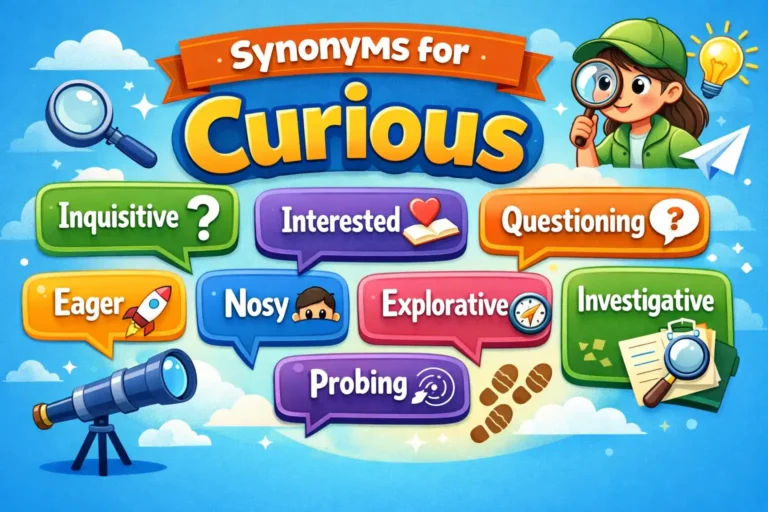
Common synonyms include:
- curious
- interested
- questioning
- probing
- investigative
- eager
- exploratory
- attentive
- nosy
- prying
Meaning of Inquisitive
Inquisitive describes a strong desire to know or understand something. It often refers to a person who asks questions or explores ideas.
Example:
She is inquisitive and always asks how things work.
Categories of Synonyms
Intellectual Curiosity
These words describe a healthy desire to learn or understand ideas.
Investigative Curiosity
These terms suggest active searching, examining, or studying information.
Social Curiosity
These words focus on interest in people’s lives and private matters. Some can sound negative.
Synonyms Table
| Word | Simple Meaning | Example Sentence |
| curious | wanting to know more | He felt curious about the new machine. |
| interested | paying attention | She is interested in science topics. |
| questioning | asking many questions | The questioning student raised her hand again. |
| probing | searching deeply | The reporter asked probing questions. |
| investigative | focused on finding facts | He has an investigative mind. |
| eager | excited to learn | The eager child opened the book quickly. |
| exploratory | learning by exploring | The team took an exploratory approach. |
| attentive | carefully observing | The attentive listener noticed details. |
| nosy | too curious about others | The neighbor seemed nosy. |
| prying | asking about private things | The prying questions made him uncomfortable. |
Master Synonyms List (Grouped by Level)
Beginner / Simple
curious — wanting to know more
Sentence: The curious child looked inside the box. (Neutral)
interested — paying attention
Sentence: She is interested in history. (Neutral)
eager — excited to learn
Sentence: He felt eager to start the lesson. (Neutral)
Intermediate
questioning — asking for explanation
Sentence: The questioning student wanted details. (Neutral)
attentive — watching carefully
Sentence: She stayed attentive during class. (Neutral)
exploratory — learning by exploring
Sentence: The exploratory trip revealed new facts. (Formal)
Advanced / Formal
probing — deeply investigating
Sentence: The lawyer asked probing questions. (Formal)
investigative — focused on research
Sentence: His investigative approach solved the case. (Formal)
nosy — too curious about others
Sentence: The nosy comment annoyed her. (Informal)
prying — invading privacy
Sentence: His prying behavior felt rude. (Informal)
Formal vs Informal Synonyms
Formal synonyms like probing and investigative work well in academic or professional writing. Informal words like nosy and prying are better for casual conversation. Choosing the right tone helps you avoid sounding rude or overly serious.
Real-Life Usage Examples
Conversation:
She’s curious about how the system works.
Academic Writing:
The researcher used an investigative method.
Business Writing:
The manager asked probing questions.
Blogging:
Readers are eager to learn practical tips.
Emotional Expression:
I feel curious about your idea.
Similar Words Comparison
Inquisitive vs Curious
Curious is more common and neutral.
Example: A curious child asks questions.
Inquisitive sounds slightly more formal.
Inquisitive vs Nosy
Nosy has a negative meaning.
Example: A nosy neighbor invades privacy.
Inquisitive is usually positive.
Example Sentences
- Her inquisitive mind helps her learn fast.
- The boy asked inquisitive questions.
- Teachers appreciate inquisitive students.
- He gave an inquisitive look.
- Scientists remain inquisitive.
- She stayed inquisitive during the lesson.
- His inquisitive nature impressed the coach.
- Children are naturally inquisitive.
- The reporter sounded inquisitive.
- An inquisitive attitude supports growth.
- The class encouraged inquisitive thinking.
- She kept an inquisitive expression.
- His inquisitive behavior led to discovery.
- The intern appeared inquisitive.
- Curiosity makes people inquisitive.
Common Mistakes
- Using nosy when you mean positive curiosity
- Using formal synonyms in casual speech
- Repeating inquisitive too often
- Choosing words that imply rudeness
- Ignoring tone and audience
Tips / Best Practices
- Match the synonym to the tone
- Consider the social context
- Use formal words in writing
- Use casual words in conversation
- Avoid overusing one term
When NOT to Use Inquisitive
Do not use inquisitive when describing rude privacy invasion. In those cases, words like nosy or prying are more accurate.
Opposite Words (Antonyms)
- indifferent
- uninterested
- passive
- unconcerned
- apathetic
FAQs
What does inquisitive mean?
It means wanting to learn or know more.
Is inquisitive formal or informal?
It is neutral but slightly formal.
How can I use it in conversation?
Describe someone who asks questions often.
What is the best synonym for inquisitive?
Curious is the most common substitute.
Can inquisitive be replaced with curious?
Yes, in most situations.
Conclusion
Learning synonyms for inquisitive improves writing and speaking clarity. It helps you choose the right tone and avoid repetition. A strong vocabulary supports confident communication.
Try using 3 new synonyms in your next sentence.

Michael Turner creates simple synonym guides that help readers expand their vocabulary and choose the right word for the right context.