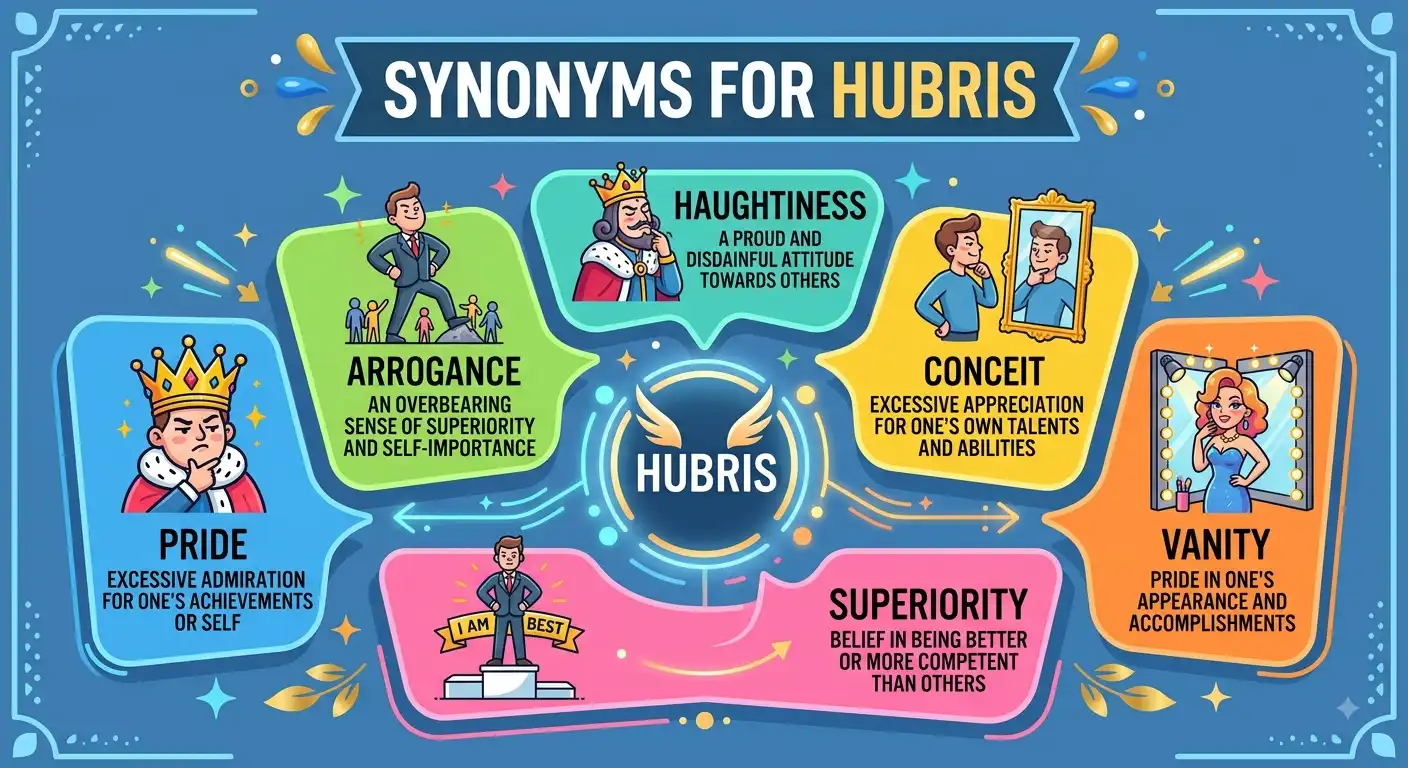
Finding the best synonyms for hubris helps you write better essays, stories, and emails. When you look for synonyms for hubris, you discover words that describe dangerous pride and foolish overconfidence. Learning synonyms for hubris gives you exact terms to describe people who think they are better than everyone else.
Imagine a top athlete who stops training because he believes no one can beat him. On race day, a humble runner passes him easily. That athlete suffered from extreme pride. Hubris means having way too much pride or self-importance. When someone has hubris, they ignore warnings, overestimate their power, and usually fail in the end.
This word is very helpful for many people:
- Students: Use it in essays to analyze characters in books or history lessons.
- Bloggers: Make your articles more engaging by choosing stronger descriptive words.
- Content Writers: Enhance your brand storytelling and avoid repeating the same word.
- Daily English Users: Speak more clearly and express complex human behavior easily.
“Pride goes before destruction, and a haughty spirit before a fall.”
“Hubris is the blind spot created by past success.”
Linguistic Breakdown of Hubris
Connotative Meaning
Hubris carries a strong negative connotation. It does not just mean feeling proud of your work. It describes foolish, blind pride that leads to a big mistake or sudden downfall.
Etymology (Origin)
- Language of Origin: Ancient Greek (ὕβρις – hybris).
- Original Meaning: Insolence, violence, or outrage against the gods or society.
- Historical Context: In Greek tragedy, hubris was the tragic flaw of heroes who challenged divine laws and suffered punishment (nemesis).
- Modern Evolution: Reached English in the 19th century as a word for dangerous, excessive self-confidence.
Key Linguistic Properties
- Pronunciation: US: /ˈhjuː.brɪs/ | UK: /ˈhjuː.brɪs/
- Syllables: 2 (hu-bris)
- Affixation Pattern: Root word (hubris). Derivative forms include hubristic (adjective) and hubristically (adverb).
Word Comparison Table
| Keyword | Meaning | Usage Type | Context |
| Hubris | Extreme, foolish pride that causes a fall | Formal / Literary | History, politics, tragic drama |
| Arrogance | An unpleasant attitude of superiority | Professional / Casual | Workplace, daily life, social settings |
| Vanity | Excessive pride in appearance or skills | Casual / Emotional | Relationships, personal behavior |
| Conceit | Too high an opinion of oneself | Casual / General | Daily conversations, personality traits |
| Overconfidence | Expecting success without equal ability | Professional / Educational | Business, sports, academic tests |
| Haughtiness | Looking down on others as inferior | Formal / Literary | High society, formal gatherings |
50 Synonyms for Hubris
1. Arrogance
- Pronunciation: US: /ˈær.ə.ɡəns/ | UK: /ˈær.ə.ɡəns/
- Meaning: Arrogance is an unpleasant feeling that you are better or smarter than other people.
- Examples:
- His arrogance made him ignore the helpful advice from his team.
- She lost many friends because of her growing arrogance.
2. Overconfidence
- Pronunciation: US: /ˌoʊ.vɚˈkɑːn.fə.dəns/ | UK: /ˌəʊ.vəˈkɒn.fɪ.dəns/
- Meaning: Overconfidence is having too much trust in your own abilities.
- Examples:
- The team lost the game because of overconfidence.
- His overconfidence caused him to skip studying for the test.
3. Conceit
- Pronunciation: US: /kənˈsiːt/ | UK: /kənˈsiːt/
- Meaning: Conceit is having too high an opinion of your own worth or looks.
- Examples:
- Her conceit was clear when she kept looking in the mirror.
- Nobody liked his conceit at the dinner party.
4. Haughtiness
- Pronunciation: US: /ˈhɑː.t̬i.nəs/ | UK: /ˈhɔː.ti.nəs/
- Meaning: Haughtiness is behaving in an unfriendly way because you think you are superior.
- Examples:
- The queen treated the servants with great haughtiness.
- His haughtiness turned away potential business partners.
5. Vanity
- Pronunciation: US: /ˈvæn.ə.t̬i/ | UK: /ˈvæn.ə.ti/
- Meaning: Vanity is too much pride in your personal appearance or achievements.
- Examples:
- He bought expensive cars just to satisfy his vanity.
- Her vanity stopped her from admitting her mistake.
6. Self-Importance
- Pronunciation: US: /ˌself.ɪmˈpɔːr.təns/ | UK: /ˌself.ɪmˈpɔː.təns/
- Meaning: Self-importance is believing that you are much more important than others.
- Examples:
- He spoke with a strong sense of self-importance.
- Her deep self-importance made her interrupt the speaker.
7. Presumption
- Pronunciation: US: /prɪˈzʌmp.ʃən/ | UK: /prɪˈzʌmp.ʃən/
- Meaning: Presumption is behavior that shows you are too bold or disrespectful.
- Examples:
- It was a bold presumption to use his boss’s office.
- Her presumption annoyed the whole group.
8. Insolence
- Pronunciation: US: /ˈɪn.sə.ləns/ | UK: /ˈɪn.sə.ləns/
- Meaning: Insolence is rude behavior that shows a lack of respect for authority.
- Examples:
- The student was punished for his insolence in class.
- Her insolence upset the manager during the meeting.
9. Audacity
- Pronunciation: US: /ɑːˈdæs.ə.t̬i/ | UK: /ɔːˈdæs.ə.ti/
- Meaning: Audacity is shocking behavior that is too bold or rude.
- Examples:
- He had the audacity to demand a promotion after failing his task.
- Her audacity surprised everyone in the room.
10. Smugness
- Pronunciation: US: /ˈsmʌɡ.nəs/ | UK: /ˈsmʌɡ.nəs/
- Meaning: Smugness is being too pleased with your own success or situation.
- Examples:
- His smugness showed after he won the simple game.
- She could not hide her smugness when her plan worked.
11. Egotism
- Pronunciation: US: /ˈiː.ɡə.tɪ.zəm/ | UK: /ˈeɡ.ə.tɪ.zəm/
- Meaning: Egotism is thinking and talking about yourself all the time.
- Examples:
- His constant egotism annoyed his friends.
- Her egotism prevented her from listening to feedback.
12. Egomania
- Pronunciation: US: /ˌiː.ɡoʊˈmeɪ.ni.ə/ | UK: /ˌeɡ.əʊˈmeɪ.ni.ə/
- Meaning: Egomania is extreme self-centeredness that hurts normal thinking.
- Examples:
- The leader’s egomania drove away all his supporters.
- His egomania made him believe he was never wrong.
13. Superiority
- Pronunciation: US: /sə-ˌpir-e-ˈȯr-ə-te/ | UK: /sjuːˌpɪə.riˈɒr.ə.ti/
- Meaning: Superiority is believing or acting like you are better than others.
- Examples:
- He acted with a feeling of superiority toward his team.
- Her superiority complex ruined her relationship.
14. Superciliousness
- Pronunciation: US: /ˌsuː.pɚˈsɪl.i.əs.nəs/ | UK: /ˌsuː.pəˈsɪl.i.əs.nəs/
- Meaning: Superciliousness is behaving as if you think others are worthless.
- Examples:
- Her superciliousness made her look down on the new employee.
- The clerk showed superciliousness toward the poor customer.
15. Pomposity
- Pronunciation: US: /pɑːmˈpɑː.sə.t̬i/ | UK: /pɒmˈpɒs.ə.ti/
- Meaning: Pomposity is acting overly serious and grand to impress people.
- Examples:
- The mayor spoke with great pomposity at the ceremony.
- I dislike the pomposity of that TV presenter.
16. Overweening
- Pronunciation: US: /ˌoʊ.vɚˈwiː.nɪŋ/ | UK: /ˌəʊ.vəˈwiː.nɪŋ/
- Meaning: Overweening describes extreme pride or ambition that goes too far.
- Examples:
- His overweening pride led to his business failure.
- She failed because of her overweening ambition.
17. Pretension
- Pronunciation: US: /prɪˈten.ʃən/ | UK: /prɪˈten.ʃən/
- Meaning: Pretension is claiming or acting like you have great importance or skill.
- Examples:
- He lived a life full of artistic pretension.
- Her pretension made her seem fake to her peers.
18. Pretentiousness
- Pronunciation: US: /prɪˈten.ʃəs.nəs/ | UK: /prɪˈten.ʃəs.nəs/
- Meaning: Pretentiousness is trying to appear more important or intelligent than you are.
- Examples:
- The book suffered from too much pretentiousness.
- I could not stand the pretentiousness of the speech.
19. Pride
- Pronunciation: US: /praɪd/ | UK: /praɪd/
- Meaning: Pride is a high feeling of pleasure or self-respect, which can turn negative.
- Examples:
- Blind pride kept him from saying sorry.
- Excessive pride was her main personal weakness.
20. Overbearingness
- Pronunciation: US: /ˌoʊ.vɚˈber.ɪŋ.nəs/ | UK: /ˌəʊ.vəˈbeə.rɪŋ.nəs/
- Meaning: Overbearingness is trying to control other people in a pushy way.
- Examples:
- Her overbearingness scared away the quiet team members.
- The boss ruined office morale with his overbearingness.
21. Snottiness
- Pronunciation: US: /ˈsnɑː.t̬i.nəs/ | UK: /ˈsnɒt.i.nəs/
- Meaning: Snottiness is an annoying, rude attitude of superiority.
- Examples:
- The waiter answered with clear snottiness.
- Her snottiness made no one want to sit with her.
22. Snootiness
- Pronunciation: US: /ˈsnuː.t̬i.nəs/ | UK: /ˈsnuː.ti.nəs/
- Meaning: Snootiness is treating people as inferior because of class or wealth.
- Examples:
- The store clerk displayed unbearable snootiness.
- We left the club because of the staff’s snootiness.
23. Impertinence
- Pronunciation: US: /ɪmˈpɝː.t̬ən.əns/ | UK: /ɪmˈpɜː.tɪ.nəns/
- Meaning: Impertinence is a lack of respect or bad manners toward elders or bosses.
- Examples:
- The child was scolded for his impertinence.
- She regretted her impertinence during the formal interview.
24. Effrontery
- Pronunciation: US: /ɪˈfrʌn.t̬ɚ.i/ | UK: /ɪˈfrʌn.tər.i/
- Meaning: Effrontery is extreme rudeness without any shame.
- Examples:
- He had the effrontery to ask for a free meal.
- Her effrontery shocked the entire panel of judges.
25. Cheekiness
- Pronunciation: US: /ˈtʃiː.ki.nəs/ | UK: /ˈtʃiː.ki.nəs/
- Meaning: Cheekiness is slightly rude behavior that lacks proper respect.
- Examples:
- His cheekiness made the teacher smile, but he was still warned.
- She was known for her playful cheekiness.
26. Swagger
- Pronunciation: US: /ˈswæɡ.ɚ/ | UK: /ˈswæɡ.ər/
- Meaning: Swagger is walking or behaving in a very confident and proud way.
- Examples:
- He walked into the room with a boastful swagger.
- Her swagger disappeared after she lost the match.
27. Bluster
- Pronunciation: US: /ˈblʌs.tɚ/ | UK: /ˈblʌs.tər/
- Meaning: Bluster is loud and aggressive talk with little real substance.
- Examples:
- His threats were just empty bluster.
- The politician used bluster to hide his weak argument.
28. Bravado
- Pronunciation: US: /brəˈvɑː.doʊ/ | UK: /brəˈvɑː.dəʊ/
- Meaning: Bravado is a show of courage intended to impress or hide fear.
- Examples:
- Behind his bravado lay a lot of secret fear.
- Her bold speech was just an act of bravado.
29. Boastfulness
- Pronunciation: US: /ˈboʊst.fəl.nəs/ | UK: /ˈbəʊst.fəl.nəs/
- Meaning: Boastfulness is speaking too proudly about what you own or can do.
- Examples:
- His constant boastfulness tired everyone around him.
- She avoided boastfulness and let her good work speak.
30. Bragging
- Pronunciation: US: /ˈbræɡ.ɪŋ/ | UK: /ˈbræɡ.ɪŋ/
- Meaning: Bragging is talking excessively about your own achievements.
- Examples:
- He spent the whole party bragging about his car.
- Her constant bragging annoyed her classmates.
31. Bigheadedness
- Pronunciation: US: /ˌbɪɡˈhed.ɪd.nəs/ | UK: /ˌbɪɡˈhed.ɪd.nəs/
- Meaning: Bigheadedness is being overly proud and thinking you are very smart.
- Examples:
- Success led directly to his bigheadedness.
- Her bigheadedness caused her to stop learning.
32. Self-Glory
- Pronunciation: US: /ˌselfˈɡlɔː.ri/ | UK: /ˌselfˈɡlɔː.ri/
- Meaning: Self-glory is seeking praise and high honor for yourself alone.
- Examples:
- The king cared only for his own self-glory.
- He worked for team success, not self-glory.
33. Self-Admiration
- Pronunciation: US: /ˌself.æd.məˈreɪ.ʃən/ | UK: /ˌself.æd.mɪˈreɪ.ʃən/
- Meaning: Self-admiration is loving and respecting yourself way too much.
- Examples:
- His deep self-admiration was clear in his self-portraits.
- Her self-admiration blinded her to her own flaws.
34. Narcissism
- Pronunciation: US: /ˈnɑːr.sə.sɪ.zəm/ | UK: /ˈnɑː.sɪ.sɪ.zəm/
- Meaning: Narcissism is extreme interest in or admiration of yourself.
- Examples:
- His extreme narcissism destroyed his family life.
- Social media can sometimes encourage narcissism in young people.
35. Vanity-Fair
- Pronunciation: US: /ˈvæn.ə.t̬iˌfer/ | UK: /ˈvæn.ə.tiˌfeər/
- Meaning: Vanity-fair describes a foolish world or behavior focused only on personal pride.
- Examples:
- He got lost in the empty vanity-fair of fame.
- Her life became a shallow vanity-fair of showy parties.
36. Loftiness
- Pronunciation: US: /ˈlɑːf.ti.nəs/ | UK: /ˈlɒf.ti.nəs/
- Meaning: Loftiness is acting distant and better than ordinary people.
- Examples:
- The judge spoke with a cool loftiness.
- Her loftiness made it hard for co-workers to talk to her.
37. Disdainfulness
- Pronunciation: US: /dɪsˈdeɪn.fəl.nəs/ | UK: /dɪsˈdeɪn.fəl.nəs/
- Meaning: Disdainfulness is showing that you think someone is not worthy of respect.
- Examples:
- He looked at the old clothes with disdainfulness.
- Her disdainfulness hurt the feelings of the team.
38. Scornfulness
- Pronunciation: US: /ˈskɔːrn.fəl.nəs/ | UK: /ˈskɔːn.fəl.nəs/
- Meaning: Scornfulness is showing complete disrespect and dislike for others.
- Examples:
- He replied with sharp scornfulness.
- Her scornfulness was clear in her harsh tone.
39. Contemptuousness
- Pronunciation: US: /kənˈtemp.tʃu.əs.nəs/ | UK: /kənˈtemp.tʃu.əs.nəs/
- Meaning: Contemptuousness is a strong feeling that someone or something is worthless.
- Examples:
- He treated the rule with total contemptuousness.
- Her contemptuousness upset her friends.
40. Lordliness
- Pronunciation: US: /ˈlɔːrd.li.nəs/ | UK: /ˈlɔːd.li.nəs/
- Meaning: Lordliness is acting like a ruler who orders others around.
- Examples:
- He managed his small shop with ridiculous lordliness.
- Her lordliness annoyed her fellow volunteers.
41. Imperiousness
- Pronunciation: US: /ɪmˈpɪr.i.əs.nəs/ | UK: /ɪmˈpɪə.ri.əs.nəs/
- Meaning: Imperiousness is expecting people to obey you immediately without question.
- Examples:
- The boss gave orders with harsh imperiousness.
- Her imperiousness created fear in the kitchen.
42. High-Handedness
- Pronunciation: US: /ˌhaɪˈhæn.dɪd.nəs/ | UK: /ˌhaɪˈhæn.dɪd.nəs/
- Meaning: High-handedness is using power in an unfair and bossy way.
- Examples:
- The manager lost respect due to his high-handedness.
- Citizens complained about the government’s high-handedness.
43. Over-Sufficiency
- Pronunciation: US: /ˈoʊ.vɚ.səˈfɪʃ.ən.si/ | UK: /ˈəʊ.və.səˈfɪʃ.ən.si/
- Meaning: Over-sufficiency is believing you need no help or advice from anyone.
- Examples:
- His over-sufficiency led to poor planning.
- Her over-sufficiency made her refuse expert help.
44. Self-Opinionatedness
- Pronunciation: US: /ˌself.əˈpɪn.jə.neɪ.t̬ɪd.nəs/ | UK: /ˌself.əˈpɪn.jə.neɪ.tɪd.nəs/
- Meaning: Self-opinionatedness is holding your own views stubbornly as the only truth.
- Examples:
- Debating him was hard because of his self-opinionatedness.
- Her self-opinionatedness stopped her from learning new ideas.
45. Uppityness
- Pronunciation: US: /ˈʌp.ə.ti.nəs/ | UK: /ˈʌp.ɪ.ti.nəs/
- Meaning: Uppityness is acting as if you are more important than your true status.
- Examples:
- People disliked his sudden uppityness after getting money.
- Her uppityness annoyed her long-time neighbors.
46. Hoity-Toitiness
- Pronunciation: US: /ˌhɔɪ.t̬iˈtɔɪ.ti.nəs/ | UK: /ˌhɔɪ.tiˈtɔɪ.ti.nəs/
- Meaning: Hoity-toitiness is snobbish and patronizing behavior toward others.
- Examples:
- She dropped her hoity-toitiness when she needed help.
- We laughed at the guest’s hoity-toitiness.
47. Cheek
- Pronunciation: US: /tʃiːk/ | UK: /tʃiːk/
- Meaning: Cheek is rude, bold behavior that shows a lack of respect.
- Examples:
- He had the cheek to ask for more money without finishing the job.
- She could not believe his absolute cheek.
48. Gall
- Pronunciation: US: /ɡɑːl/ | UK: /ɡɔːl/
- Meaning: Gall is extreme boldness combined with rude disrespect.
- Examples:
- He had the gall to blame others for his mistake.
- Her gall shocked everyone present in the room.
49. Nerve
- Pronunciation: US: /nɝːv/ | UK: /nɜːv/
- Meaning: Nerve is impudent behavior or inappropriate boldness.
- Examples:
- You have a lot of nerve coming here after what you said.
- It took real nerve to interrupt the manager.
50. Presumptuousness
- Pronunciation: US: /prɪˈzʌmp.tʃu.əs.nəs/ | UK: /prɪˈzʌmp.tʃu.əs.nəs/
- Meaning: Presumptuousness is doing things without permission because you are overly bold.
- Examples:
- His presumptuousness ruined his chances of getting the job.
- She apologized for her presumptuousness in making the decision alone.
“The greatest of all faults is to be conscious of none.”
Antonyms of Hubris
Understanding opposites makes your vocabulary even stronger. Here are the main antonyms of hubris:
- Humility: The quality of not thinking you are better than others.
- Modesty: Keeping a low profile about your skills and success.
- Meekness: Being quiet, gentle, and willing to listen.
- Diffidence: Shy behavior caused by a lack of self-confidence.
- Respectfulness: Showing care and polite treatment to everyone.
- Lowliness: Being humble in status or mind.
Prototype Meaning and Semantic Categorization
Linguists categorize terms like hubris based on their intensity and underlying emotional drivers:
HUMAN PRIDE (Root Concept)
|
+—————————-+—————————-+
| |
Ego & Self-Focus Social Superiority
(Internal Pride) (External Attitude)
| |
1. Conceit 1. Arrogance
2. Egotism 2. Haughtiness
3. Narcissism 3. Superciliousness
4. Vanity 4. Snobbishness
| |
+—————————-+—————————-+
|
EXTREME DESTRUCTIVE PRIDE
|
[ HUBRIS ]
|
+—————–+—————–+
| |
Behavioral Audacity Social Insolence
1. Overconfidence 1. Effrontery
2. Presumption 2. Impudence
3. Bravado 3. Gall
Frequently Asked Questions (FAQ)
What is the simple definition of hubris?
Hubris means foolish, extreme pride or overconfidence that usually leads to a big failure or downfall.
What is the main difference between pride and hubris?
Pride can be positive, such as taking satisfaction in good work. Hubris is always negative; it is blind, dangerous pride that ignores reality and advice.
What are the 3 most common synonyms for hubris?
The three most common synonyms for hubris are arrogance, overconfidence, and conceit.
Can hubris be used as an adjective?
Yes, the adjective form of hubris is hubristic, which describes actions or people driven by extreme pride.
Is hubris a formal or casual word?
Hubris is a formal word often used in literary analysis, history, political news, and professional business discussions.
Where does the word hubris come from?
Hubris comes from Ancient Greece, where it described foolish pride that insulted or challenged the gods.
Conclusion
Learning useful synonyms for hubris is one of the best ways to improve your vocabulary. When you know precise synonyms for hubris, your writing becomes clearer, more vivid, and far more engaging. Using diverse terms allows you to express exact shades of meaning, whether you are writing an academic essay, drafting a blog post, or preparing a professional presentation.
When you practice these synonyms for hubris in your daily conversations, emails, and stories, you boost your speech and writing quality quickly. Replacing plain words with strong choices helps you communicate with power and authority. Try using terms like arrogance, conceit, or haughtiness in your next project to see how much stronger your sentences sound.
“Knowledge is power, but knowing how to express it with the right words is true mastery.”
“Expand your vocabulary daily, for your words define the boundaries of your thought.”

Michael Turner is a published fiction writer and creative writing tutor with over a decade of experience helping writers find the words that make their stories breathe ( Biography ).