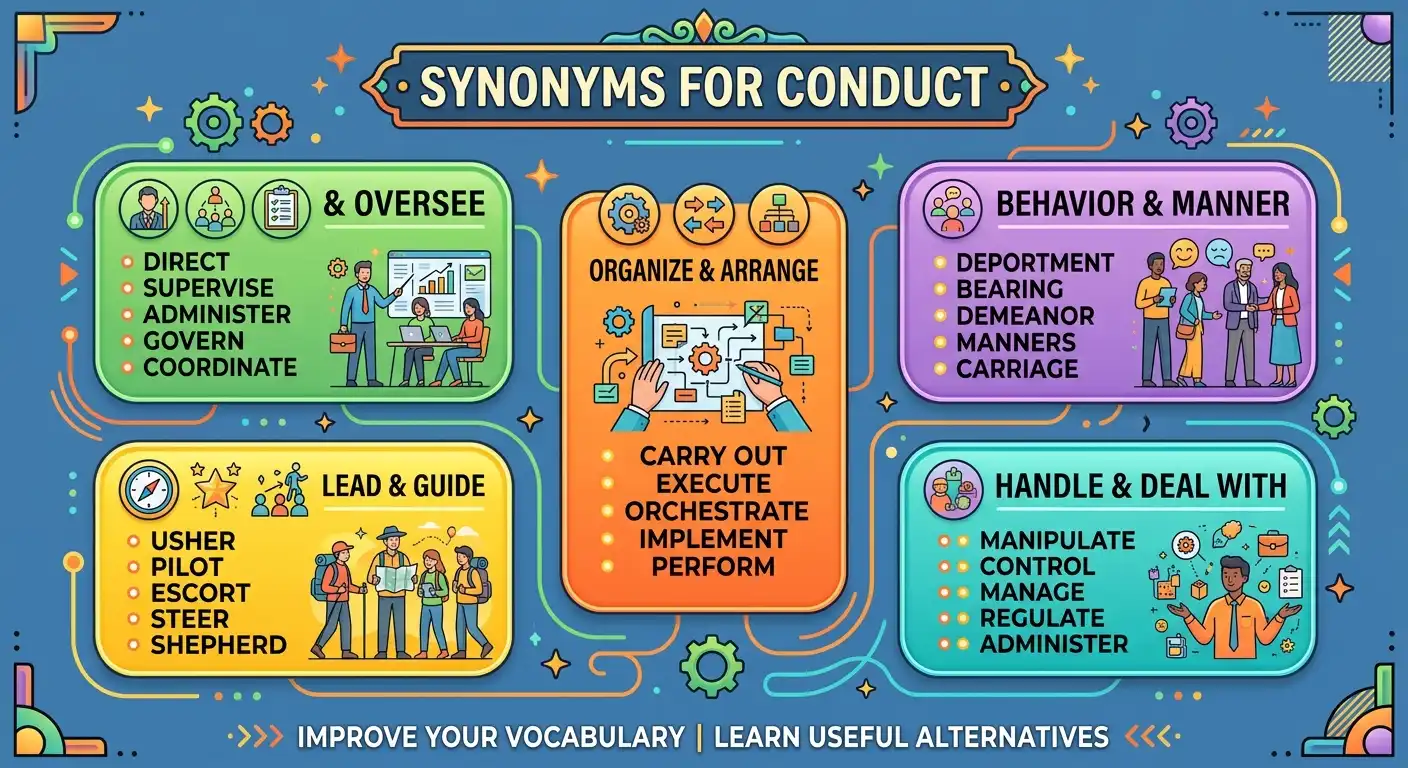
Finding the right synonyms for conduct can quickly change how you write and speak. The word conduct is very common in English. When you use top synonyms for conduct, your writing becomes clear and strong. Knowing different synonyms for conduct helps you choose the exact word for any sentence.
Imagine a manager leading a team project at work. The manager needs to direct the team and show good behavior. Here, the word conduct means two things. It means to lead an action, and it means how a person behaves.
In plain English, conduct means to lead, run, or do an activity. It also means personal behavior. This single word works as both a verb and a noun.
Learning these words is very helpful for many people:
- Students can write better essays for school exams.
- Bloggers can keep their articles interesting for readers.
- Content writers can improve SEO rankings with fresh vocabulary.
- Daily English users can speak with confidence in daily chats.
“Words are light in the hands of those who know how to choose them.”
“To change your words is to change the way others see your thoughts.”
Connotative Meaning of Conduct
The word conduct carries strong connotations of authority, order, and moral responsibility.
- As a verb, it feels organized, official, and planned. It implies that someone is taking charge of a task or guiding a group.
- As a noun, it feels formal and evaluative. It often connects to rules, ethics, and professional standards.
Etymology of Conduct
- Origin: Derived from Middle English conducten.
- Latin Roots: Comes from Latin conductus, the past participle of conducere.
- Prefix: Con- (meaning “together”).
- Base Root: Ducere (meaning “to lead” or “to guide”).
- Historical Meaning: Originally meant “to guide or escort troops safely.”
Pronunciation, Syllables, and Affixation Pattern
- US Pronunciation:
- Verb: /kənˈdʌkt/
- Noun: /ˈkɑːn.dʌkt/
- UK Pronunciation:
- Verb: /kənˈdʌkt/
- Noun: /ˈkɒn.dʌkt/
- Syllables: 2 syllables (con-duct).
- Stress Pattern: Stress is on the second syllable for the verb (con-DUCT). Stress is on the first syllable for the noun (CON-duct).
- Affixation Pattern:
- Prefix: con- (together)
- Root: duct (lead)
- Derivatives: Conductor (noun), conduction (noun), conductive (adjective), misconduct (noun/verb).
Comparison Table of Key Synonyms for Conduct
| Keyword / Synonym | Meaning | Usage Type | Context |
| Conduct | To lead an activity or behave in a certain way. | Formal / Professional | Workplace, academic writing, legal reports. |
| Lead | To go ahead and show the path to others. | Neutral / Daily | Group projects, sports teams, hiking. |
| Manage | To control and organize tasks or people. | Professional | Office work, business operations, events. |
| Behavior | The way a person acts around others. | Daily / General | School, parenting, public spaces. |
| Direct | To give clear instructions and guidance. | Formal | Movie set, business team, traffic control. |
| Execute | To perform or complete a planned action. | Professional / Technical | Computer programs, business plans, tasks. |
| Perform | To carry out a task or act in front of people. | Casual / Creative | Music shows, work tasks, lab tests. |
| Demeanor | Outward impression or attitude. | Formal / Descriptive | Job interviews, courtrooms, doctor visits. |
28 Synonyms for Conduct
1. Lead
- Pronunciation: US /liːd/ | UK /liːd/
- Meaning: To guide a person or group toward a clear goal.
- Examples:
- She will lead the morning team meeting today.
- The teacher helps lead students to success.
2. Direct
- Pronunciation: US /dəˈrɛkt/ | UK /daɪˈrɛkt/
- Meaning: To tell people what to do in an organized way.
- Examples:
- The officer will direct traffic at the corner.
- He will direct the new company project.
3. Manage
- Pronunciation: US /ˈmæn.ədʒ/ | UK /ˈmæn.ɪdʒ/
- Meaning: To control and organize daily tasks or businesses.
- Examples:
- She knows how to manage her time well.
- He was hired to manage the new store.
4. Guide
- Pronunciation: US /ɡaɪd/ | UK /ɡaɪd/
- Meaning: To show someone the right way to go.
- Examples:
- Map apps guide us when we travel.
- Wise mentors guide young workers.
5. Run
- Pronunciation: US /rʌn/ | UK /rʌn/
- Meaning: To operate or be in charge of an organization.
- Examples:
- They run a small family bakery in town.
- Who will run the computer program now?
6. Perform
- Pronunciation: US /pɚˈfɔːrm/ | UK /pəˈfɔːm/
- Meaning: To do a task, job, or action completely.
- Examples:
- Doctors perform checks to keep us healthy.
- The team will perform the test again.
7. Execute
- Pronunciation: US /ˈɛk.sə.kjuːt/ | UK /ˈɛk.sɪ.kjuːt/
- Meaning: To carry out a plan or set of orders.
- Examples:
- Workers execute the plan step by step.
- The team will execute the strategy today.
8. Behavior
- Pronunciation: US /bɪˈheɪ.vjɚ/ | UK /bɪˈheɪ.vjə/
- Meaning: The manner in which a person acts toward others.
- Examples:
- Good behavior is praised in school.
- His polite behavior made everyone feel happy.
9. Organize
- Pronunciation: US /ˈɔːr.ɡə.naɪz/ | UK /ˈɔː.ɡən.aɪz/
- Meaning: To arrange items or plan an event neatly.
- Examples:
- We need to organize the files on the desk.
- She will organize the community party.
10. Operate
- Pronunciation: US /ˈɑː.pə.reɪt/ | UK /ˈɒp.ər.eɪt/
- Meaning: To work or control a machine or system.
- Examples:
- You must learn how to operate this machine safely.
- They operate a successful online store.
11. Handle
- Pronunciation: US /ˈhæn.dəl/ | UK /ˈhæn.dəl/
- Meaning: To deal with or take care of a situation.
- Examples:
- She can handle hard questions with ease.
- Please handle those glass bowls carefully.
12. Escort
- Pronunciation: US /ɪˈskɔːrt/ | UK /ɪˈskɔːt/
- Meaning: To go with someone to protect or guide them.
- Examples:
- Guards will escort visitors through the main gate.
- The guide will escort us to the bus.
13. Administer
- Pronunciation: US /ədˈmɪn.ə.stɚ/ | UK /ədˈmɪn.ɪ.stə/
- Meaning: To give out or manage official duties.
- Examples:
- Nurses administer care to every patient.
- Teachers administer the final test in May.
14. Oversee
- Pronunciation: US /ˌoʊ.vɚˈsiː/ | UK /ˌəʊ.vəˈsiː/
- Meaning: To watch over work to make sure it is done right.
- Examples:
- Managers oversee daily work in the office.
- She will oversee the building project.
15. Control
- Pronunciation: US /kənˈtroʊl/ | UK /kənˈtrəʊl/
- Meaning: To have power over actions, events, or machines.
- Examples:
- Drivers control the speed of their cars.
- Good habits help control daily stress.
16. Demeanor
- Pronunciation: US /dɪˈmiː.nɚ/ | UK /dɪˈmiː.nə/
- Meaning: A person’s outward behavior and appearance.
- Examples:
- Her calm demeanor helped relax the group.
- His friendly demeanor wins many friends.
17. Stage
- Pronunciation: US /steɪdʒ/ | UK /steɪdʒ/
- Meaning: To organize and produce a public event or plan.
- Examples:
- The club will stage a show this weekend.
- Workers stage a peaceful protest outside.
18. Steer
- Pronunciation: US /stɪr/ | UK /stɪə/
- Meaning: To direct the course of something moving.
- Examples:
- You must steer the boat toward the shore.
- Leaders steer their teams past obstacles.
19. Govern
- Pronunciation: US /ˈɡʌv.ɚn/ | UK /ˈɡʌv.ən/
- Meaning: To rule or control actions with laws and rules.
- Examples:
- Clear rules govern game play.
- Laws govern how businesses operate fairly.
20. Transact
- Pronunciation: US /trænˈzækt/ | UK /trænˈzækt/
- Meaning: To conduct or carry out business affairs.
- Examples:
- Banks transact money matters safely every day.
- We transact deals online using safe systems.
21. Bearing
- Pronunciation: US /ˈbɛr.ɪŋ/ | UK /ˈbeə.rɪŋ/
- Meaning: The way a person stands, walks, and behaves.
- Examples:
- The soldier had a proud and posture-perfect bearing.
- Her dignified bearing won respect from all.
22. Regulate
- Pronunciation: US /ˈrɛɡ.jə.leɪt/ | UK /ˈreɡ.jə.leɪt/
- Meaning: To control something so that it operates correctly.
- Examples:
- Thermostats regulate the warmth in rooms.
- Traffic lights regulate car movement.
23. Supervise
- Pronunciation: US /ˈsuː.pɚ.vaɪz/ | UK /ˈsuː.pə.vaɪz/
- Meaning: To watch and direct an activity or work team.
- Examples:
- Teachers supervise students during recess.
- She will supervise the lab research.
24. Action
- Pronunciation: US /ˈæk.ʃən/ | UK /ˈæk.ʃən/
- Meaning: Something that a person does.
- Examples:
- Every good action makes a difference.
- Quick action saved the day.
25. Command
- Pronunciation: US /kəˈmænd/ | UK /kəˈmɑːnd/
- Meaning: To give orders or control with authority.
- Examples:
- Captains command respect on their ships.
- She can command attention in a big room.
26. Carry out
- Pronunciation: US /ˈkæri aʊt/ | UK /ˈkæri aʊt/
- Meaning: To complete a task or follow instructions.
- Examples:
- Please carry out the safety steps carefully.
- They will carry out the test tomorrow.
27. Convey
- Pronunciation: US /kənˈveɪ/ | UK /kənˈveɪ/
- Meaning: To take or carry something to a place, or communicate a message.
- Examples:
- Pipes convey clean water to homes.
- Words convey feelings clearly.
“Clear words bring clear thinking to every conversation.”
28. Shepherd
- Pronunciation: US /ˈʃɛp.ɚd/ | UK /ˈʃɛp.əd/
- Meaning: To guide and protect a group gently.
- Examples:
- Teachers shepherd kids on field trips.
- Leaders shepherd their groups through changes.
Antonyms of Conduct
- Mismanage (US /ˌmɪsˈmæn.ədʒ/ | UK /ˌmɪsˈmæn.ɪdʒ/) – To handle a task poorly.
- Neglect (US /nɪˈɡlɛkt/ | UK /nɪˈɡlekt/) – To fail to care for something.
- Misbehave (US /ˌmɪs.bɪˈheɪv/ | UK /ˌmɪs.bɪˈheɪv/) – To act in a bad or rude way.
- Abandon (US /əˈbæn.dən/ | UK /əˈbæn.dən/) – To leave a task or person behind.
- Follow (US /ˈfɑː.loʊ/ | UK /ˈfɒl.əʊ/) – To go behind instead of leading.
Prototype Meaning and Categorization of Conduct
- Prototype Meaning: The central idea of conduct is taking charge of an action or displaying a specific pattern of behavior.
- Semantic Category: Action / Leadership / Social Behavior.
- Grammar Category: Transitive verb, intransitive verb, and countable/uncountable noun.
- Domain Usage:
- Business & Law: Managing events, executing agreements, ethical standards.
- Science & Physics: Allowing heat or electricity to pass through a substance.
- Social Contexts: Public manners, personal choices, and general attitude.
Frequently Asked Questions (FAQ)
1. What are the most common synonyms for conduct?
The most common verb synonyms for conduct are lead, manage, direct, and run. For the noun form, the top synonyms are behavior, demeanor, and actions.
2. Can conduct mean both leading an event and personal behavior?
Yes. As a verb, conduct means to lead or manage a task. As a noun, conduct means personal behavior or manners.
3. What is the difference between conduct and manage?
To conduct often means to carry out a specific event or task. To manage means to handle ongoing systems, budgets, or people over time.
4. How do I choose between conduct and lead in writing?
Use lead when talking about people following a leader. Use conduct when talking about carrying out a planned test, survey, or meeting.
5. What is the physics meaning of conduct?
In science, to conduct means to pass heat, sound, or electricity through a wire or object.
6. Is conduct a formal word?
Yes, conduct is slightly formal. In casual conversation, people usually say run, do, or lead.
Conclusion
Learning useful synonyms for conduct will greatly improve your communication skills. When you learn new words, your writing becomes lively and clear. You do not need to repeat the same word over and over again.
Using varied synonyms for conduct helps bloggers write engaging articles that rank higher on search engines. Students can write better essays that score high marks. Professionals can craft polished emails that build strong respect at work.
You can practice these words today. Try swapping the word conduct for direct, manage, lead, or demeanor in your next email, essay, or chat. Small changes in your word choice make a massive difference in how others understand your ideas.
“Vocabulary expands the horizon of human thought.”
“A rich vocabulary is the key that unlocks confident expression.”

Michael Turner is a published fiction writer and creative writing tutor with over a decade of experience helping writers find the words that make their stories breathe ( Biography ).