The word boisterous is common in daily speech and writing.
It often describes loud people, noisy events, or high energy behavior.
Learning synonyms for boisterous helps you speak and write more clearly and naturally.
Direct Answer
Boisterous means loud, energetic, and full of strong excitement or noise.
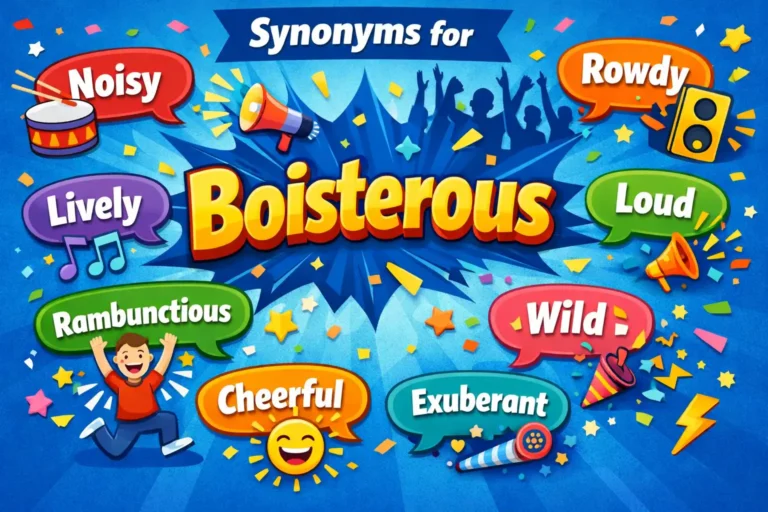
Common synonyms include:
- Loud
- Noisy
- Rowdy
- Wild
- Lively
- Energetic
- Rambunctious
- Clamorous
- Tumultuous
- Raucous
Meaning of Boisterous
Boisterous describes someone or something that is very loud, energetic, and sometimes slightly out of control.
It can describe people, crowds, children, parties, or even weather.
Example:
The children were boisterous during recess.
Types of Synonyms Based on Tone
When people search for synonyms for boisterous, they usually want words that match a specific tone. Below are the main types based on meaning and feeling.
1. Positive & Energetic Tone
Use these when the energy feels fun or exciting.
Examples: lively, energetic
These words suggest enthusiasm and excitement without negative behavior.
2. Loud & Attention-Grabbing Tone
Use these when the focus is strong sound or noise.
Examples: loud, noisy, raucous, clamorous
These emphasize volume more than behavior.
3. Rough or Slightly Out of Control Tone
Use these when behavior feels chaotic or disruptive.
Examples: rowdy, wild, rambunctious, tumultuous
These can suggest playful disorder or serious chaos depending on context.
Synonyms Table
| Word | Simple Meaning | Example Sentence |
| Loud | Making strong sound | The loud crowd cheered all night. |
| Noisy | Full of noise | The classroom became noisy. |
| Rowdy | Rough and noisy | The rowdy fans celebrated loudly. |
| Wild | Hard to control | The party became wild. |
| Lively | Full of energy | It was a lively discussion. |
| Energetic | Very active | She is energetic in the morning. |
| Rambunctious | Noisy and playful | The rambunctious puppy ran everywhere. |
| Clamorous | Making strong noise | The clamorous protest filled the streets. |
| Tumultuous | Very noisy and chaotic | The meeting was tumultuous. |
| Raucous | Harsh and loud | They gave a raucous laugh. |
Master Synonyms List (Grouped by Level)
Beginner / Simple
Loud
Simple meaning: Making strong sound
Example: The loud crowd could be heard outside.
Noisy
Simple meaning: Full of noise
Example: The room became noisy after lunch.
Wild
Simple meaning: Hard to control
Example: The party turned wild quickly.
Intermediate
Lively
Simple meaning: Full of energy
Example: The debate was lively and engaging.
Energetic
Simple meaning: Very active
Example: The coach gave an energetic speech.
Rowdy
Simple meaning: Rough and noisy
Example: The rowdy audience shouted loudly.
Rambunctious
Simple meaning: Noisy in a playful way
Example: The rambunctious kids ran around the yard.
Advanced / Formal
Raucous (Neutral)
Simple meaning: Harsh and loud
Example: The crowd gave a raucous cheer.
Clamorous (Formal)
Simple meaning: Making a lot of noise
Example: The clamorous crowd demanded answers.
Tumultuous (Formal)
Simple meaning: Very noisy and chaotic
Example: The speech caused a tumultuous reaction.
Formal vs Informal Synonyms
- Use loud, noisy, or wild in casual conversation.
- Use rambunctious for playful situations.
- Use clamorous or tumultuous in academic or formal writing.
- Raucous works in both conversation and media writing.
Always match the word to the tone of your situation.
Real-Life Usage Examples
Conversation
The kids were boisterous after eating cake.
Academic Writing
The protest became boisterous as tensions increased.
Business Writing
The meeting grew boisterous during the debate.
Blogging
The festival had a boisterous crowd.
Emotional Expression
He felt uncomfortable in the boisterous room.
Similar Words Comparison
Boisterous vs Rowdy
- Boisterous suggests loud energy.
- Rowdy suggests rough or slightly bad behavior.
Example:
The children were boisterous but not rowdy.
Boisterous vs Lively
- Boisterous is louder and stronger.
- Lively is positive and energetic but controlled.
Example:
The party was lively, not boisterous.
Example Sentences
- The crowd became boisterous after the win.
- His boisterous laugh filled the room.
- The students were boisterous before class started.
- The celebration grew boisterous late at night.
- The team gave a boisterous cheer.
- The wind was boisterous during the storm.
- The guests were boisterous but friendly.
- The audience remained boisterous throughout the show.
- The children became boisterous at the park.
- The rally turned boisterous quickly.
- The bar was loud and boisterous.
- Their boisterous energy made the event exciting.
- The fans were boisterous after the goal.
- The party stayed boisterous until midnight.
Common Mistakes
- Using “boisterous” for quiet excitement
Incorrect: She gave a boisterous smile.
Boisterous usually involves noise. - Confusing it with “angry”
Boisterous means loud and energetic, not angry. - Using formal synonyms in casual talk
Avoid saying “clamorous children” in everyday speech. - Overusing strong synonyms
Not every loud event is “tumultuous.”
Tips / Best Practices
- Choose based on tone: casual or formal.
- Consider the situation: playful, chaotic, or simply loud.
- Match the word to the emotion: positive or negative.
- Avoid repeating the same synonym too often.
- Focus on clarity, not complexity.
When NOT to Use Boisterous
Do not use boisterous for:
- Quiet happiness
- Silent excitement
- Calm environments
- Formal emotional descriptions
It usually implies noise and strong energy.
Opposite Words (Antonyms)
- Quiet
- Calm
- Peaceful
- Gentle
- Reserved
FAQs
What does boisterous mean?
It means loud, energetic, and full of strong excitement.
Is boisterous formal or informal?
It is neutral and can be used in both casual and formal writing.
How can I use it in conversation?
You can describe loud children, parties, or crowds.
What is the best synonym for boisterous?
“Loud” is the simplest and most common alternative.
Can boisterous be replaced with lively?
Yes, but lively is usually less loud and more positive.
Conclusion
Understanding synonyms for boisterous helps you describe loud, energetic, and lively situations with more precision. Instead of repeating boisterous, you can choose words like loud, rowdy, lively, or raucous depending on tone and context.
Expanding your vocabulary improves clarity, confidence, and writing quality.
Now try this: Write one sentence about a party, one about children, and one about a crowd using three different synonyms for boisterous.

Michael Turner creates simple synonym guides that help readers expand their vocabulary and choose the right word for the right context.