Introduction
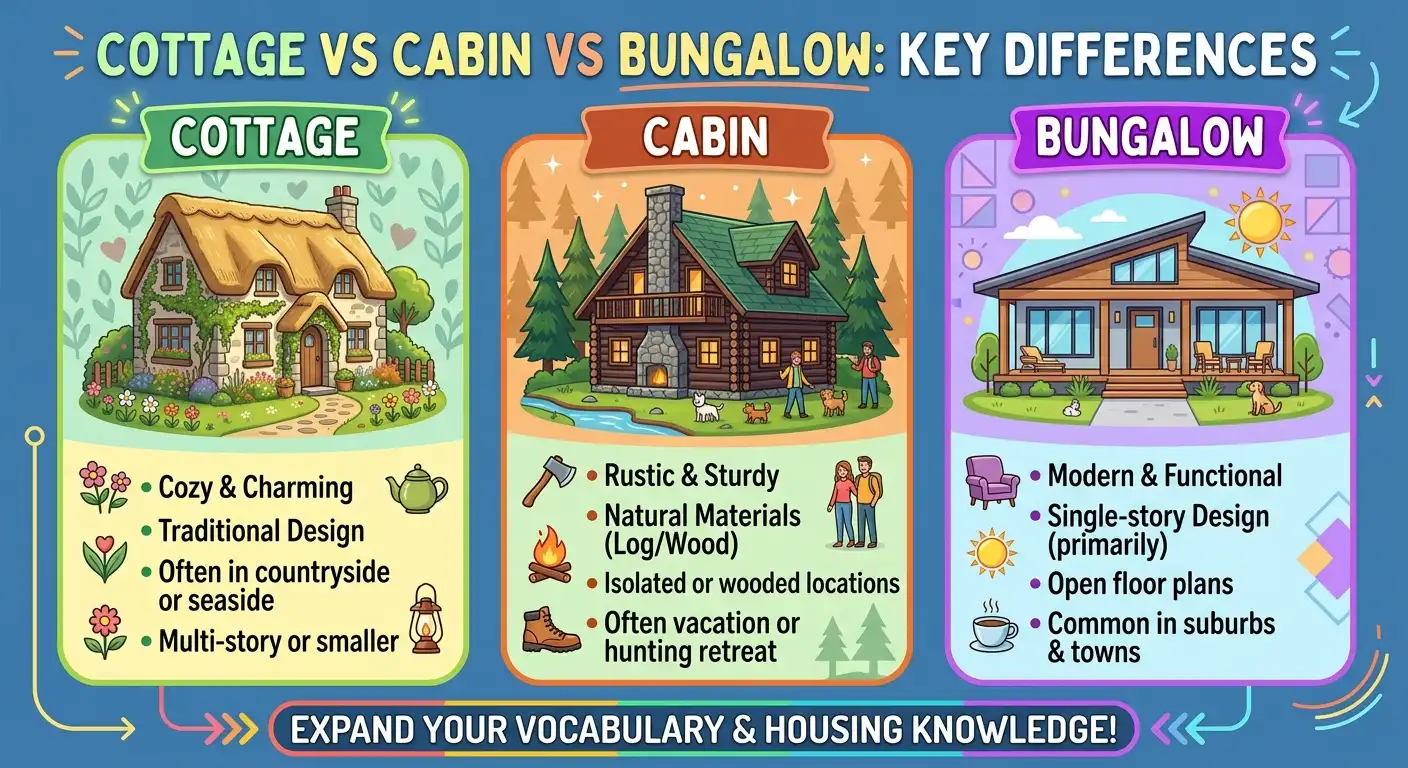
Understanding cottage vs cabin vs bungalow helps you pick the right home or vacation spot. A cottage is a charming small house with steep roofs usually near water or countryside. A cabin is a rugged wooden home built in wilderness or mountains using natural logs. A bungalow is a low single-story house with a wide front porch and an open floor plan. When comparing cottage vs cabin vs bungalow, each building offers a different lifestyle, design, and history.
Imagine planning a weekend trip with your family. You see three choices online: a lakefront cottage, a mountain cabin, and a beach bungalow. Picking the right one depends on whether you want cozy multi-story charm, rustic wood survival, or single-level easy living. Analyzing cottage vs cabin vs bungalow gives clear choices for buyers, travelers, and writers.
Learning these building types is very helpful for students, bloggers, content writers, and daily English speakers. Writers can describe settings accurately in stories and real estate articles. Students can master property vocabulary easily. Daily users can book vacation rentals without confusion.
“Architecture is the learned game, correct and magnificent, of forms assembled in the light.” – Le Corbusier
“The home should be the treasure chest of living.” – Le Corbusier
Word Profile: Cottage, Cabin, and Bungalow
Connotative Meanings
- Cottage: Evokes feelings of warmth, cozy comfort, traditional English countryside, fairy-tale aesthetics, and tranquil relaxation.
- Cabin: Evokes feelings of wilderness adventure, quiet isolation, raw wooden warmth, mountain air, and simple outdoor survival.
- Bungalow: Evokes feelings of horizontal comfort, modern accessibility, sunny porch relaxation, and easy family living without stairs.
Etymology (Short History)
- Cottage: Originates from Old French cotage and Middle English cot (a small dwelling for rural laborers or cotters).
- Cabin: Originates from Late Latin capana and Old French cabane (a temporary hut or simple wooden shelter).
- Bungalow: Originates from the Hindi word bangla (meaning “belonging to Bengal”), adapted by British builders for single-story homes with wide verandas.
Pronunciation (IPA)
- Cottage: US: /ˈkɑː.t̬ɪdʒ/ | UK: /ˈkɒt.ɪdʒ/
- Cabin: US: /ˈkæb.ɪn/ | UK: /ˈkæb.ɪn/
- Bungalow: US: /ˈbʌŋ.ɡə.loʊ/ | UK: /ˈbʌŋ.ɡə.ləʊ/
Syllables & Structure
- Cottage: 2 Syllables (cot-tage) | Root: Cot + Suffix: -age
- Cabin: 2 Syllables (cab-in) | Root: Cab + Suffix: -in
- Bungalow: 3 Syllables (bun-ga-low) | Root: Bangla (adapted compound form)
Comparison Table: Cottage vs Cabin vs Bungalow
| Keyword / Term | Simple Meaning | Architectural Style & Tone | Primary Location & Setting | Key Building Materials | Primary Usage Context |
| Cottage | Small cozy multi-story home | Traditional, picturesque, cozy, steep roofs | Lakes, countryside, coastal villages | Stone, painted wood, plaster, thatch | Vacation home, cozy living, romantic getaway |
| Cabin | Simple rustic wooden structure | Rugged, raw, wilderness-focused, compact | Forests, mountain slopes, remote woods | Unfinished logs, heavy timber, metal roofs | Camping, hunting retreat, wilderness trip |
| Bungalow | Wide single-story house | Accessible, horizontal, Craftsman style | Suburbs, warm coastal towns, urban lots | Brick, stucco, siding, tiled roof | Permanent home, aging-in-place, family living |
32 Synonyms and Related Building Terms
1. Cottage
- Pronunciation: US: /ˈkɑː.t̬ɪdʒ/ | UK: /ˈkɒt.ɪdʒ/
- Meaning: A small and charming home usually located near water or in a rural village.
- Examples:
- We spent our summer vacation in a small lake cottage.
- Her favorite home design is a cozy English cottage with stone walls.
2. Cabin
- Pronunciation: US: /ˈkæb.ɪn/ | UK: /ˈkæb.ɪn/
- Meaning: A simple house built with logs in a forest or mountain area.
- Examples:
- They built a log cabin deep inside the pine forest.
- Our family rented a mountain cabin for winter skiing.
3. Bungalow
- Pronunciation: US: /ˈbʌŋ.ɡə.loʊ/ | UK: /ˈbʌŋ.ɡə.ləʊ/
- Meaning: A single-story house with a low roof and a large front porch.
- Examples:
- My grandparents live in a comfortable beach bungalow.
- The street is lined with historic Craftsman bungalow homes.
4. Chalet
- Pronunciation: US: /ʃæˈleɪ/ | UK: /ˈʃæl.eɪ/
- Meaning: A wooden house with sloping roofs commonly found in mountain ski regions.
- Examples:
- We stayed in an Alpine chalet during our trip to Switzerland.
- The snow fell gently on the roof of the mountain chalet.
5. Lodge
- Pronunciation: US: /lɑːdʒ/ | UK: /lɒdʒ/
- Meaning: A large rural building used by people doing outdoor activities.
- Examples:
- Hunters gathered at the timber lodge before sunrise.
- The national park offers a historic stone lodge for guests.
6. Villa
- Pronunciation: US: /ˈvɪl.ə/ | UK: /ˈvɪl.ə/
- Meaning: A large luxury country house with extensive private grounds.
- Examples:
- They rented a seaside villa for their anniversary trip.
- The Mediterranean villa featured beautiful marble floors.
7. Shack
- Pronunciation: US: /ʃæk/ | UK: /ʃæk/
- Meaning: A small, crude, and rough shelter made from basic materials.
- Examples:
- The fisherman kept his tools inside a wooden shack.
- They built a temporary weather shack near the beach.
8. Hut
- Pronunciation: US: /hʌt/ | UK: /hʌt/
- Meaning: A small, simple shelter with one or two rooms.
- Examples:
- Hikers rested inside a stone hut along the trail.
- The island villagers built a thatch-roof hut near the shore.
9. Camp
- Pronunciation: US: /kæmp/ | UK: /kæmp/
- Meaning: A simple outdoor shelter or collection of temporary buildings.
- Examples:
- Our summer camp sat next to a clear mountain stream.
- He spent the weekend fixing up his hunting camp.
10. Retreat
- Pronunciation: US: /rɪˈtriːt/ | UK: /rɪˈtriːt/
- Meaning: A quiet home where people go to rest and escape daily stress.
- Examples:
- The quiet woods provided an ideal creative retreat.
- She bought a lakeside retreat to escape city noise.
11. Getaway
- Pronunciation: US: /ˈɡet.ə.weɪ/ | UK: /ˈɡet.ə.weɪ/
- Meaning: A place used for short restful vacations and relaxation.
- Examples:
- The island home is their favorite weekend getaway.
- They booked a quick mountain getaway for the holiday.
12. Homestead
- Pronunciation: US: /ˈhoʊm.sted/ | UK: /ˈhəʊm.sted/
- Meaning: A farmhouse and the surrounding land lived on by a family.
- Examples:
- The historic homestead has belonged to the family for generations.
- They raise chickens and crops on their rural homestead.
13. Lean-to
- Pronunciation: US: /ˈliːn.tuː/ | UK: /ˈliːn.tuː/
- Meaning: A simple shelter with a roof that rests against another structure or trees.
- Examples:
- We built a wooden lean-to for protection against the rain.
- The campsite had a three-sided lean-to for sleeping.
14. Abode
- Pronunciation: US: /əˈboʊd/ | UK: /əˈbəʊd/
- Meaning: A formal term for a home or place where someone lives.
- Examples:
- Welcome to our humble abode for dinner.
- He returned to his cozy abode after a long work journey.
15. Dwelling
- Pronunciation: US: /ˈdwel.ɪŋ/ | UK: /ˈdwel.ɪŋ/
- Meaning: A building or place where people make their home.
- Examples:
- Ancient people built stone dwelling structures near rivers.
- The town approved three new residential dwelling units.
“The detail is an integral part of the building, telling its story with simplicity.” – Frank Lloyd Wright
16. Residence
- Pronunciation: US: /ˈrez.ə.dəns/ | UK: /ˈrez.ɪ.dəns/
- Meaning: A formal word for the house where a person resides.
- Examples:
- The governor lives in an official residence downtown.
- Private security guards protect the seaside residence.
17. Farmhouse
- Pronunciation: US: /ˈfɑːrm.haʊs/ | UK: /ˈfɑːm.haʊs/
- Meaning: A home attached to a farm that usually features a large kitchen.
- Examples:
- The old farmhouse overlooks rolling green fields.
- They restored the vintage wooden farmhouse last year.
18. Tiny House
- Pronunciation: US: /ˈtaɪ.ni haʊs/ | UK: /ˈtaɪ.ni haʊs/
- Meaning: A small dwelling designed to maximize functional space efficiently.
- Examples:
- He built a tiny house on wheels to travel freely.
- Living in a tiny house helps reduce monthly energy costs.
19. A-frame
- Pronunciation: US: /ˈeɪ.freɪm/ | UK: /ˈeɪ.freɪm/
- Meaning: A house shaped like an A with steeply angled rooflines.
- Examples:
- The snow slid easily off the roof of the A-frame.
- We stayed in a modern A-frame cabin in the woods.
20. Beach House
- Pronunciation: US: /biːtʃ haʊs/ | UK: /biːtʃ haʊs/
- Meaning: A home built near the ocean for seaside living.
- Examples:
- They spend every July at their family beach house.
- Ocean winds blew softly past the coastal beach house.
21. Hunting Lodge
- Pronunciation: US: /ˈhʌn.tɪŋ lɑːdʒ/ | UK: /ˈhʌn.tɪŋ lɒdʒ/
- Meaning: A rural structure used as a base during hunting trips.
- Examples:
- The hunting lodge featured a warm stone fireplace.
- Guides met at the mountain hunting lodge before sunrise.
22. Guesthouse
- Pronunciation: US: /ˈɡest.haʊs/ | UK: /ˈɡest.haʊs/
- Meaning: A smaller extra home on a property for visiting guests.
- Examples:
- Relatives stayed in the backyard guesthouse over the holidays.
- The owners turned their barn into a cozy guesthouse.
23. Cabin Cruiser
- Pronunciation: US: /ˈkæb.ɪn ˈkruː.zɚ/ | UK: /ˈkæb.ɪn ˈkruː.zər/
- Meaning: A motorboat equipped with living space inside a cabin.
- Examples:
- They sailed down the river in their white cabin cruiser.
- We slept on the cabin cruiser during our lake trip.
24. Log Cabin
- Pronunciation: US: /lɑːɡ ˈkæb.ɪn/ | UK: /lɒɡ ˈkæb.ɪn/
- Meaning: A cabin constructed using whole or split tree logs.
- Examples:
- Early settlers built strong log cabin homes for safety.
- The log cabin kept everyone warm during the snowstorm.
25. Structure
- Pronunciation: US: /ˈstrʌk.tʃɚ/ | UK: /ˈstrʌk.tʃər/
- Meaning: Anything constructed or built out of connected parts.
- Examples:
- The wooden structure survived the strong storm winds.
- Inspectors checked the safety of the new building structure.
26. Shelter
- Pronunciation: US: /ˈʃel.t̬ɚ/ | UK: /ˈʃel.tər/
- Meaning: A place that gives protection from bad weather or danger.
- Examples:
- The small cave gave hikers a dry shelter from rain.
- Volunteers built a storm shelter in the village.
27. House
- Pronunciation: US: /haʊs/ | UK: /haʊs/
- Meaning: A building designed for people to live in.
- Examples:
- They painted their new house light blue.
- She walked inside the house to grab her coat.
28. Home
- Pronunciation: US: /hoʊm/ | UK: /həʊm/
- Meaning: The place where a person lives and feels belonging.
- Examples:
- There is no place like home after a trip.
- They worked hard to make their apartment feel like home.
29. Manor
- Pronunciation: US: /ˈmæn.ɚ/ | UK: /ˈmæn.ər/
- Meaning: A large historical estate house surrounded by land.
- Examples:
- Visitors toured the grounds of the historic manor.
- Stone walls surrounded the old English manor.
30. Cottagecore House
- Pronunciation: US: /ˈkɑː.t̬ɪdʒ.kɔːr haʊs/ | UK: /ˈkɒt.ɪdʒ.kɔːr haʊs/
- Meaning: A home decorated with charming vintage rural style.
- Examples:
- She decorated her room like a cozy cottagecore house.
- Wildflowers grew all around the cottagecore house.
31. Craftsman House
- Pronunciation: US: /ˈkræfts.mən haʊs/ | UK: /ˈkrɑːfts.mən haʊs/
- Meaning: A bungalow style focusing on hand-crafted woodwork and porches.
- Examples:
- The craftsman house had custom wood cabinets inside.
- Broad pillars supported the front porch of the craftsman house.
32. Row House
- Pronunciation: US: /roʊ haʊs/ | UK: /rəʊ haʊs/
- Meaning: One of a continuous row of joined houses sharing side walls.
- Examples:
- They bought a classic brick row house downtown.
- Each row house on the street had a unique painted door.
Antonyms of Focus Keyword (Opposite Dwellings)
- Skyscraper: A tall multi-story city building made of steel and glass.
- High-rise: A tall apartment building located in dense urban settings.
- Mansion: An extremely huge luxury residence with many rooms.
- Palace: A massive grand building housing royalty or rulers.
- Apartment Complex: A large multi-unit structure sharing common halls.
Prototype Meaning and Categorization
- Core Category: Residential Architecture / Dwellings & Shelters
- Prototype Meaning: Small-scale residential properties designed for specialized living environments, ranging from countryside charm (cottage) to wilderness utility (cabin) to single-level accessibility (bungalow).
- Domain Usage: Real Estate, Travel & Lodging, Architectural Design, English Vocabulary.
Frequently Asked Questions (FAQ)
1. Is a bungalow cheaper to build than a cottage or cabin?
Yes, bungalows are often cheaper to build per square foot because they require simple single-story construction without complex staircases or heavy timber framing.
2. Can a cottage have two stories?
Yes, traditional cottages frequently feature two stories or one-and-a-half stories with bedrooms located upstairs under sloped rooflines.
3. What makes a cabin different from a regular cottage?
Cabins focus on raw natural materials like unfinished logs and are placed in wilderness settings. Cottages feature finished walls, modern amenities, and decorative styling near lakes or villages.
4. Why are bungalows popular for seniors?
Bungalows have all living areas and bedrooms on a single level. Eliminating stairs makes them accessible and safe for older adults or individuals with mobility needs.
5. Can a cabin be used as a permanent home?
Yes, modern cabins include insulation, heating, water systems, and electricity, making them comfortable for year-round permanent living.
6. Which property type has the best resale value?
Cottages and bungalows generally hold high resale value because they appeal strongly to both vacation buyers and families seeking permanent homes.
Conclusion
Understanding cottage vs cabin vs bungalow improves your writing, blogging, speaking, and real estate communication. Using precise terms allows writers to paint vivid pictures in readers’ minds. Bloggers can create better descriptive content that ranks well on search engines. Daily speakers can express housing choices clearly when buying, renting, or traveling.
We encourage you to practice these words in your daily emails, creative writing, and conversations. Comparing cottage vs cabin vs bungalow helps you master English descriptive skills effortlessly. Choose the right word every time you describe a quiet mountain hideaway, a lakeside sanctuary, or a cozy single-story neighborhood home.
“The ache for home lives in all of us, the safe place where we can go as we are.” – Maya Angelou
“A house is made of walls and beams; a home is built with love and dreams.” – Ralph Waldo Emerson

Michael Turner is a published fiction writer and creative writing tutor with over a decade of experience helping writers find the words that make their stories breathe ( Biography ).