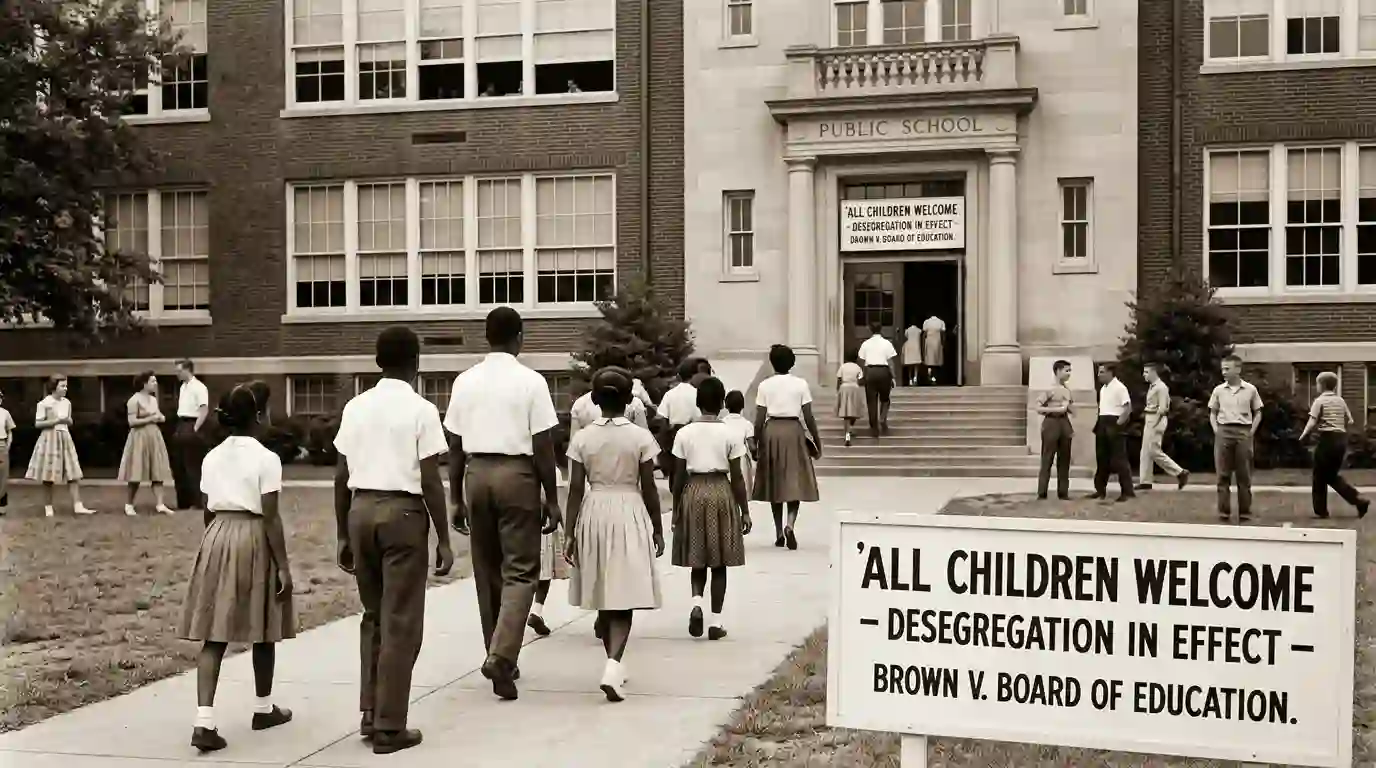
Brown v. Board of Education was a landmark 1954 U.S. Supreme Court case that ruled racial segregation in public schools unconstitutional. The Court held unanimously that separating students by race violated the Equal Protection Clause of the Fourteenth Amendment, rejecting the idea that segregated public education could be legally equal.
Key Takeaways
- Brown v. Board of Education was decided by the U.S. Supreme Court on May 17, 1954.
- The Court ruled that racial segregation in public schools violated the Fourteenth Amendment.
- The case actually combined five separate cases from Kansas, South Carolina, Virginia, Delaware, and Washington, D.C.
- Chief Justice Earl Warren delivered the unanimous opinion.
- A follow-up ruling, known as Brown II, addressed how school desegregation should be implemented in 1955.
What Was Brown v. Board of Education?
Brown v. Board of Education of Topeka was a U.S. Supreme Court case about racial segregation in public schools. It challenged laws and policies that required Black and white children to attend separate schools.
The case reached the Supreme Court after lower courts had relied on the earlier doctrine of “separate but equal,” associated with Plessy v. Ferguson. The plaintiffs argued that legally separated schools denied Black children equal protection under the Fourteenth Amendment.
On May 17, 1954, the Supreme Court ruled unanimously for the plaintiffs. Chief Justice Earl Warren wrote that racial segregation in public education was unconstitutional.
Why the Case Was Called Brown
The name can be confusing because Oliver Brown was not the only parent involved.
Brown was the lead name in the Topeka, Kansas, case. The Supreme Court had combined five separate cases involving school segregation into one proceeding. The other cases came from South Carolina, Virginia, Delaware, and Washington, D.C.
Oliver Brown’s daughter, Linda Brown, became closely associated with the case because she had to travel farther to attend a segregated Black school even though a white school was located much closer to her home.
Why Was School Segregation Challenged?
During the period of legal segregation, many states required or permitted separate schools for Black and white students. Kansas, for example, had allowed certain communities to maintain separate elementary schools by law. African American families had challenged school segregation there for decades before the case that became Brown.
The legal challenge was not based only on differences in buildings, books, or other physical resources. The plaintiffs argued that government-required separation itself violated constitutional equality.
The Role of the Fourteenth Amendment
The Fourteenth Amendment, ratified in 1868, contains the Equal Protection Clause. In simple terms, it requires states to provide equal protection of the laws.
The Brown cases asked whether a state could satisfy that constitutional requirement while deliberately separating public-school students by race.
The Supreme Court answered no. The Court concluded that racial segregation in public education deprived the affected students of equal protection, even when physical facilities and other measurable resources might appear comparable.
Plessy v. Ferguson and “Separate but Equal”
Before Brown, Plessy v. Ferguson had established the legal doctrine commonly described as “separate but equal.” That 1896 decision involved railroad segregation, but the doctrine was later applied in other areas, including education.
Brown rejected that doctrine specifically in the field of public education. The Court concluded that separate educational facilities were inherently unequal.
This distinction matters: Brown did not simply say that some segregated schools had poor facilities. It held that state-imposed racial separation in public education itself was unconstitutional.
The Five Cases Behind Brown
The Supreme Court’s 1954 decision combined five cases involving similar constitutional questions.
| Case | Location | Main issue |
|---|---|---|
| Brown v. Board of Education | Topeka, Kansas | Segregated elementary schools |
| Briggs v. Elliott | Clarendon County, South Carolina | Segregated public schools |
| Davis v. County School Board | Prince Edward County, Virginia | School segregation |
| Gebhart v. Belton | Delaware | Admission to nonsegregated schools |
| Bolling v. Sharpe | Washington, D.C. | Segregated public schools in the nation’s capital |
The first four cases raised Fourteenth Amendment issues involving state-supported education. Bolling v. Sharpe involved Washington, D.C., which was governed under federal authority rather than by a state. The Court therefore addressed that case separately under the Fifth Amendment’s Due Process Clause.
What Did the Supreme Court Decide in 1954?
On May 17, 1954, the Supreme Court announced a unanimous decision.
Chief Justice Earl Warren wrote the Court’s opinion. The central holding was that racial segregation in public schools violated the Equal Protection Clause of the Fourteenth Amendment.
The Unanimous Ruling
All nine justices joined the Brown opinion. The Court’s unanimous position gave the ruling significant constitutional authority at a time when school segregation remained required by law in many parts of the country.
The Court also relied on evidence concerning the effects of legally enforced segregation on children. The opinion concluded that separating children by race in public schools could affect their educational and social development.
Why “Separate” Was Considered Unequal
The key point was not simply whether two school buildings had similar physical resources.
The Court reasoned that government-mandated racial separation placed Black children in an unequal legal and social position. Therefore, even supposedly comparable facilities could not make the system constitutionally equal.
That reasoning represented a major departure from the application of the Plessy doctrine to public education.
What Was Brown II?
The 1954 ruling established the constitutional principle, but it did not provide a detailed timetable for eliminating segregated school systems.
The Supreme Court heard additional arguments about implementation and issued a second decision on May 31, 1955. This decision is commonly called Brown II.
Brown II directed school authorities to begin desegregation with “all deliberate speed” and gave federal district courts an important role in supervising implementation.
The phrase did not create an immediate nationwide deadline. As a result, implementation varied widely, and many communities resisted or delayed desegregation.
What Happened After the Brown Decisions?
Brown was a constitutional ruling, but changing school systems required action by local officials, state governments, federal courts, and the federal government.
Resistance was substantial in some areas. For example, Prince Edward County, Virginia, eventually closed its public schools rather than immediately comply with desegregation requirements. The schools remained closed for several years before reopening.
The National Park Service notes that Brown faced intense resistance and that Brown II was followed by a prolonged process of implementation.
Resistance to Desegregation
The legal end of segregation did not mean that every school became integrated immediately.
Southern communities used various legal and political strategies to delay compliance. The process also produced major confrontations, including the 1957 crisis surrounding Central High School in Little Rock, Arkansas.
Later federal civil-rights legislation strengthened the government’s ability to enforce school desegregation. The Civil Rights Act of 1964, for example, gave the federal government additional tools to address segregation in education.
Connection to the Civil Rights Movement
Brown became one of the major legal developments of the modern Civil Rights Movement. It demonstrated that constitutional litigation could challenge a major part of the legal structure supporting racial segregation.
However, Brown should not be understood as the single event that ended racial discrimination in America. It was part of a much longer legal, political, and social struggle involving organizations, families, students, lawyers, and activists.
The NAACP’s legal campaign against school segregation had begun years before the Supreme Court’s 1954 ruling.
Brown v. Board of Education vs. Plessy v. Ferguson
| Issue | Plessy v. Ferguson | Brown v. Board of Education |
|---|---|---|
| Year | 1896 | 1954 |
| Main issue | Racial separation in public facilities | Racial separation in public schools |
| Key principle | “Separate but equal” | Separate public education is inherently unequal |
| Constitutional provision | Fourteenth Amendment | Fourteenth Amendment |
| Outcome | Upheld the challenged segregation law | Declared school segregation unconstitutional |
| Historical effect | Supported the legal segregation framework | Rejected segregation in public education |
The two cases are often taught together because Brown directly challenged the constitutional reasoning that had allowed racial segregation to persist under the Plessy doctrine.
Why Brown v. Board of Education Still Matters
Brown remains important because it established a major constitutional principle: states cannot operate racially segregated public schools consistently with the Equal Protection Clause of the Fourteenth Amendment.
It also illustrates the difference between changing the law and changing institutions. The 1954 ruling was immediate as a constitutional judgment, but actual school desegregation took many years and required additional court cases, government action, and enforcement.
Modern discussions of school segregation also distinguish between segregation created directly by law and racial separation that can result from residential patterns, school boundaries, and other social and economic factors. The Library of Congress’s Brown resource guide points readers to research examining the long-term changes in school districts affected by Brown and later desegregation decisions.
Frequently Asked Questions
What was Brown v. Board of Education?
Brown v. Board of Education was a 1954 U.S. Supreme Court case challenging racial segregation in public schools. The Court unanimously ruled that segregated public education violated the Equal Protection Clause of the Fourteenth Amendment.
What amendment did Brown v. Board of Education use?
The main constitutional provision was the Equal Protection Clause of the Fourteenth Amendment. The Court held that state-imposed racial segregation in public schools denied Black students equal protection under the law.
Was Brown v. Board of Education unanimous?
Yes. On May 17, 1954, all nine Supreme Court justices joined the decision. Chief Justice Earl Warren delivered the opinion.
What is Brown II?
Brown II is the name commonly given to the Supreme Court’s 1955 follow-up decision concerning implementation of the 1954 ruling. It directed school authorities to proceed with desegregation “with all deliberate speed.”
Did Brown immediately integrate all public schools?
No. The 1954 decision made state-enforced school segregation unconstitutional, but actual desegregation took years. Some officials and communities resisted compliance, and later federal court orders and civil-rights legislation played important roles in enforcement.
Conclusion
Brown vs Board of Education, formally Brown v. Board of Education of Topeka, was a landmark 1954 Supreme Court decision that declared racial segregation in public schools unconstitutional. By rejecting the application of “separate but equal” to public education, the Court established a major constitutional barrier to state-sponsored school segregation.
The decision did not instantly transform America’s schools. Brown II, federal enforcement, subsequent court cases, and the broader Civil Rights Movement were all part of the long process that followed. Understanding both the 1954 ruling and what happened afterward provides a clearer picture of why Brown remains one of the most significant Supreme Court decisions in U.S. history.

Michael Turner is a published fiction writer and creative writing tutor with over a decade of experience helping writers find the words that make their stories breathe ( Biography ).