
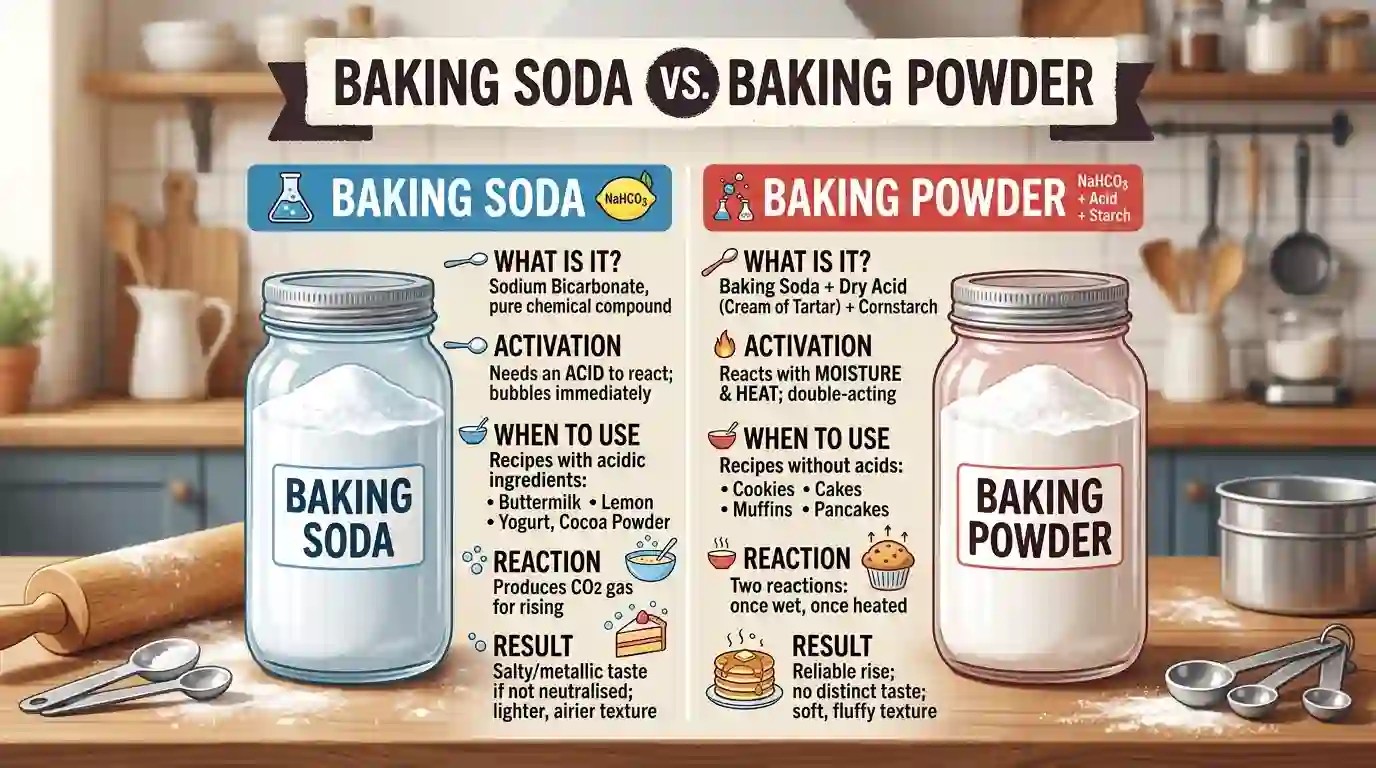
Baking soda and baking powder are both chemical leaveners, but they work differently. Baking soda is pure sodium bicarbonate and needs an acid to produce carbon dioxide and help baked goods rise. Baking powder contains baking soda plus acidic ingredients, so it can provide leavening without relying entirely on acid from the recipe.
Key Takeaways
- Baking soda needs acid such as buttermilk, yogurt, lemon juice, or natural cocoa to react effectively.
- Baking powder contains its own acid, so it can work in recipes without a separate acidic ingredient.
- Baking soda is generally stronger by volume and can affect browning, spread, and flavor.
- You should not substitute either ingredient 1:1.
- Some recipes use both because they need acidity balanced as well as additional leavening.
What Is the Difference Between Baking Soda and Baking Powder?
The simplest way to remember the difference is this:
Baking soda needs acid. Baking powder already contains acid.
Both ingredients help cakes, cookies, muffins, biscuits, and other baked goods rise by producing carbon dioxide gas. However, the ingredients and chemical reactions behind that rise are different.
Baking soda
Baking soda is sodium bicarbonate, an alkaline compound. By itself, it does not provide the same complete leavening system as baking powder. It needs an acidic ingredient and moisture to produce carbon dioxide.
Common acidic ingredients include:
- Buttermilk
- Yogurt
- Sour cream
- Lemon juice
- Vinegar
- Molasses
- Brown sugar
- Natural cocoa powder
The reaction can happen quickly, which is one reason recipes containing baking soda often need to be mixed and baked without unnecessary delay.
Baking soda can also promote browning and influence how much cookies spread. That means it is not simply a tool for making food rise. It can affect the finished product’s color, texture, and flavor.
Baking powder
Baking powder contains sodium bicarbonate along with acidic components and usually a starch that helps keep the mixture stable.
Most baking powder used in home baking is double-acting. That means it produces leavening at more than one stage, beginning when the ingredients are mixed and producing additional gas as the batter heats in the oven.
This makes baking powder useful when a recipe needs reliable lift but does not contain enough natural acid to activate plain baking soda.
Baking Soda vs Baking Powder at a Glance
| Feature | Baking Soda | Baking Powder |
|---|---|---|
| Main ingredient | Sodium bicarbonate | Sodium bicarbonate + acids + other ingredients |
| Needs recipe acid? | Usually yes | No, its acid is included |
| Main job | Leavening plus browning and texture effects | Primarily leavening |
| Relative strength | Stronger by volume | Weaker by volume |
| Common uses | Cookies, gingerbread, acidic batters | Cakes, muffins, biscuits, scones |
| Can you swap 1:1? | No | No |
The exact choice depends on the recipe’s other ingredients. A recipe may be designed around the acidity, moisture, and amount of flour already present, so changing the leavener can change more than just how much the food rises.
How Baking Soda Works
Think of baking soda as a base waiting for an acid.
When baking soda encounters an appropriate acidic ingredient in a moist batter or dough, a reaction produces carbon dioxide bubbles. Those bubbles become trapped in the food’s structure and help it expand.
For example, buttermilk pancakes often contain both an acidic ingredient and baking soda. The acid provides the reaction baking soda needs.
Baking soda can also encourage browning and may make cookies spread more than a recipe made with baking powder alone. This is why experienced bakers choose it for more than its leavening ability.
Why acidity matters
Using baking soda without enough available acid can leave excess alkaline material behind. The result may include an unpleasant soapy, bitter, or metallic taste and poor texture.
Adding more baking soda is therefore not a reliable way to make a cake rise higher. The recipe needs the right balance of ingredients.
How Baking Powder Works
Baking powder is essentially a prepared leavening system. It combines sodium bicarbonate with acidic components, so the recipe does not have to supply all of the acid needed for the reaction.
In a typical double-acting baking powder, moisture begins the reaction, while heat in the oven promotes additional leavening.
That makes baking powder particularly useful for recipes such as:
- Vanilla cakes
- Muffins
- Biscuits
- Scones
- Some pancakes
- Quick breads
The exact behavior depends on the formulation and the recipe, so the package instructions and recipe should take priority over general substitution rules.
When Should You Use Baking Soda vs Baking Powder?
A useful rule is to look at the recipe’s acidity.
Use baking soda when the recipe has enough acid
Recipes containing ingredients such as buttermilk, yogurt, molasses, brown sugar, or natural cocoa may use baking soda because those ingredients can participate in the acid-base reaction.
Chocolate chip cookies are another familiar example. Baking soda can contribute to both leavening and browning, while also influencing how the cookies spread.
Use baking powder when you need built-in leavening
If a recipe does not contain enough acidic ingredients to activate baking soda, baking powder is often the better choice.
For example, a basic cake made without strongly acidic ingredients may rely on baking powder for its rise.
Why do some recipes use both?
Using both is not necessarily redundant.
A recipe may contain enough acidity for some baking soda to react but still need additional leavening. In that situation, baking soda can help neutralize acidity and contribute to browning and texture, while baking powder supplies additional lift.
The combination can therefore be intentional and important to the recipe’s final flavor and structure.
Can You Substitute Baking Soda for Baking Powder?
Yes, sometimes, but it is not a simple 1:1 substitution.
A common emergency guideline is approximately 1/4 teaspoon of baking soda for every 1 teaspoon of baking powder, provided there is enough acid in the recipe. If the recipe does not contain sufficient acid, you would need to introduce an appropriate acidic ingredient as well.
For example, if a recipe calls for 2 teaspoons of baking powder, a rough starting point would be 1/2 teaspoon of baking soda. But that does not guarantee the same result because baking powder also contributes its own acid and other ingredients.
This is why following the original recipe is preferable when possible.
Can You Substitute Baking Powder for Baking Soda?
You can sometimes use baking powder instead, but you generally need more baking powder.
A commonly cited emergency conversion is:
1 teaspoon baking soda ≈ 3 teaspoons baking powder.
However, this is a practical approximation rather than a universal baking formula.
Using three times as much powder can introduce more of the other ingredients in baking powder and may change the taste, texture, browning, spread, or rise. It can also make a recipe behave differently from the original.
For the most predictable result, use the leavener specified by the recipe.
What Happens If You Use Too Much or Too Little?
Leavening agents need balance.
Too much baking soda can leave a baked good with an unpleasant alkaline taste and can alter its color and texture. It may also cause excessive spreading in some cookies.
Too little baking soda can leave an acidic recipe less developed in color or texture and may reduce its expected rise.
Too much baking powder can produce an undesirable taste and may interfere with the structure of the finished bake.
Too little baking powder can result in a denser product when the recipe depends on it for most of its rise.
In other words, more leavener does not automatically mean a lighter cake. Baking is a chemical balance, so the amount specified in a tested recipe matters.
How to Choose the Right One for a Recipe
If you are unsure which ingredient belongs in a recipe, ask three questions:
- Does the recipe contain an acidic ingredient?
- Does the recipe need baking soda’s browning or spreading effects?
- Does it need a dependable source of additional lift?
If the recipe is built around acidity, baking soda may be important. If it lacks enough acid, baking powder may be the better choice. If the recipe calls for both, there is probably a deliberate reason for combining their different effects.
The safest approach is still to follow a reliable recipe rather than changing the leavener based only on the appearance of the two powders.
Frequently Asked Questions
Is baking soda the same as baking powder?
No. Baking soda is sodium bicarbonate, while baking powder contains sodium bicarbonate plus acidic components and usually other ingredients. Both help baked goods rise, but they activate differently.
Which is better, baking soda or baking powder?
Neither is universally better. Baking soda is useful when a recipe has enough acid and may also need extra browning or spread. Baking powder is useful when the recipe needs built-in leavening. The correct choice depends on the recipe.
Can I use baking soda instead of baking powder?
Sometimes, but not directly. You generally need much less baking soda and enough acid to activate it. A common starting point is 1/4 teaspoon baking soda per 1 teaspoon baking powder, but the recipe may require additional adjustment.
Can I use baking powder instead of baking soda?
Sometimes. A common emergency guideline is about 3 teaspoons of baking powder for 1 teaspoon of baking soda. However, this can change the recipe’s flavor and texture, so using the specified ingredient is usually better.
Why do recipes use both baking soda and baking powder?
They perform different functions. Baking soda can react with acidic ingredients and influence browning and texture, while baking powder provides additional leavening. Using both can help a recipe achieve the intended balance of rise, flavor, and texture.
What happens if I accidentally use baking soda instead of baking powder?
The result depends on the recipe. If there is not enough acid, the baking soda may not react properly and can leave an alkaline taste. The baked good may also rise differently or have a different texture.
Conclusion
The main difference in baking soda vs baking powder comes down to activation. Baking soda is sodium bicarbonate that generally needs an acidic ingredient to produce its leavening effect. Baking powder already contains an acid, allowing it to provide leavening without depending entirely on the recipe for acidity.
Neither ingredient is automatically better. Baking soda can influence rise, browning, spread, and flavor, while baking powder is often chosen for dependable lift. Some recipes deliberately use both.
When possible, follow the recipe’s specified leavener rather than making a direct 1:1 swap. That small detail can make a major difference in the final texture and taste of your baked goods.

Michael Turner is a published fiction writer and creative writing tutor with over a decade of experience helping writers find the words that make their stories breathe ( Biography ).