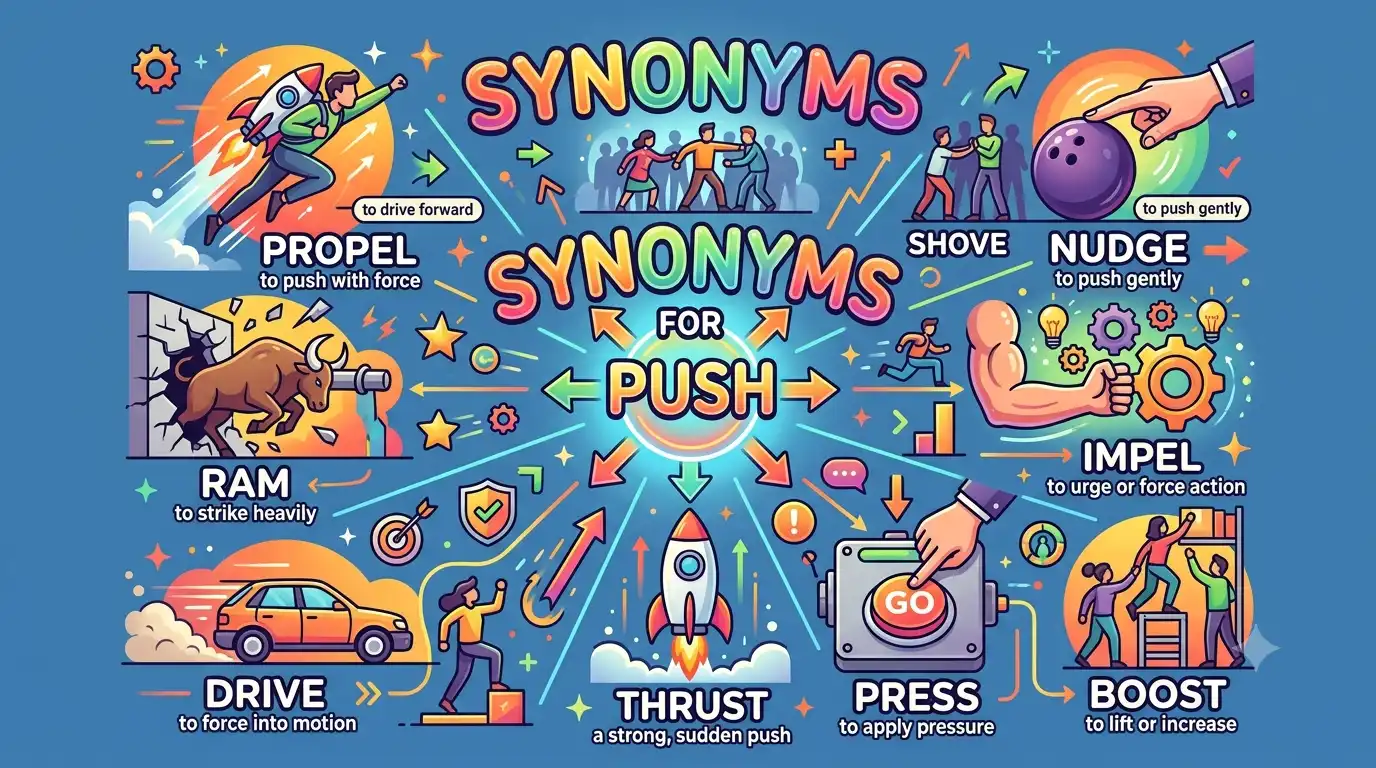
Learning synonyms for push helps you pick strong words for your everyday writing. When you look up synonyms for push, you discover many clear ways to describe physical movement, personal drive, or strong encouragement. Using exact synonyms for push makes your essays, blog posts, and emails sound clear and vivid.
Imagine trying to open a jammed wooden door in an old house. You place your hand on the panel and lean forward to force it open. That simple physical effort is what we call a push.
The word push means applying force against an object to move it away from you. It also means encouraging someone to work harder or promoting a new product to customers. The word comes from an old term that means to strike or press forward.
Mastering these descriptive words gives everyone a clear advantage:
- Students can write exciting essays and earn top grades.
- Bloggers can keep readers engaged with active action verbs.
- Content writers can craft powerful sales pages and call-to-action buttons.
- Daily English users can explain ideas accurately at home or work.
“Choosing the right verb brings every sentence to life with clear energy.”
“Strong vocabulary helps you express physical action and inner drive with total clarity.”
Linguistic Breakdown of Push
Connotative Meaning
The word push carries direct, active, and determined energy. Depending on the context, it can feel neutral, helpful, or slightly aggressive. It shows physical movement, strong personal effort, or gentle guidance.
Etymology
- Origin: Old French word pousser (meaning “to push, drive, or thrust”).
- Original Meaning: Derived from Latin pulsare, meaning “to strike, beat, or drive forward.”
- Evolution: Entered Middle English as pusshen, describing physical pressure or forward movement.
Pronunciation (US & UK)
- US IPA: /pʊʃ/
- UK IPA: /pʊʃ/
Syllables & Structure
- Syllables: 1 (push)
- Base Word: Push (Verb / Noun)
- Affixation: Can take suffixes like -ed (pushed), -ing (pushing), -er (pusher), or -y (pushy).
Comparison Table
| Keyword | Meaning | Usage Type | Context |
| Push | To exert force to move something away | Casual & Professional | Doors, buttons, self-improvement |
| Shove | To push roughly or quickly | Casual & Informal | Crowds, moving furniture |
| Thrust | To push suddenly with strong power | Professional & Creative | Swords, rocket engines, arguments |
| Press | To apply steady weight or pressure | Casual & Technical | Buttons, clothes, squeezing juice |
| Propel | To drive something forward quickly | Technical & Academic | Boats, rockets, careers |
| Prod | To poke gently to stir action | Casual & Workplace | Animals, slow coworkers |
| Nudge | To push lightly with an elbow | Casual & Friendly | Attention, gentle reminders |
| Drive | To force forward toward a goal | Professional & Personal | Cars, business motivation |
1. Shove
- Pronunciation: /ʃʌv/ (UK & US)
- Meaning: To push someone or something with sudden force.
- Examples:
- He gave the heavy box a quick shove across the floor.
- Please do not shove people when waiting in line.
2. Thrust
- Pronunciation: /θrʌst/ (UK & US)
- Meaning: To push forward with sudden speed and power.
- Examples:
- The knight used his sword to thrust forward.
- She thrust her hands into her warm jacket pockets.
3. Press
- Pronunciation: /pres/ (UK & US)
- Meaning: To apply steady weight or force against something.
- Examples:
- Press the green button to start the machine.
- He pressed his forehead against the cool glass window.
4. Propel
- Pronunciation: /prəˈpel/ (UK & US)
- Meaning: To drive or push something forward into motion.
- Examples:
- Strong wind helped propel the sailboat across the lake.
- Good grades can propel a student toward college success.
5. Force
- Pronunciation: /fɔːs/ (UK) | /fɔːrs/ (US)
- Meaning: To move something by using strong power.
- Examples:
- The key broke when he tried to force the lock.
- Water can force its way through tiny pipe cracks.
6. Prod
- Pronunciation: /prɒd/ (UK) | /prɑːd/ (US)
- Meaning: To poke something with a finger or pointed stick.
- Examples:
- The farmer used a wooden stick to prod the stubborn cow.
- She had to prod her brother to finish his homework.
7. Nudge
- Pronunciation: /nʌdʒ/ (UK & US)
- Meaning: To push lightly with your elbow to get attention.
- Examples:
- She gave him a small nudge during the movie.
- A gentle reminder can nudge customers to complete their orders.
8. Poke
- Pronunciation: /pəʊk/ (UK) | /poʊk/ (US)
- Meaning: To push against something using a finger or tool.
- Examples:
- Do not poke the sleeping dog with your foot.
- He used a long branch to poke the campfire.
9. Drive
- Pronunciation: /draɪv/ (UK & US)
- Meaning: To force or direct movement in a specific direction.
- Examples:
- The storm will drive the small boats back to shore.
- Ambition helps drive her to work hard every day.
10. Impel
- Pronunciation: /ɪmˈpel/ (UK & US)
- Meaning: To urge or force someone into strong action.
- Examples:
- Hunger will impel the wild wolf to hunt for food.
- Fear can impel people to run toward safety.
11. Squeeze
- Pronunciation: /skwiːz/ (UK & US)
- Meaning: To press tightly from opposite sides.
- Examples:
- Squeeze the fresh lemon to get clean fruit juice.
- He managed to squeeze through the small doorway.
12. Jostle
- Pronunciation: /ˈdʒɒs.əl/ (UK) | /ˈdʒɑː.səl/ (US)
- Meaning: To push and bump against people in a crowd.
- Examples:
- Shoppers jostle each other during big holiday sales.
- We had to jostle through the crowded train station.
13. Elbow
- Pronunciation: /ˈel.bəʊ/ (UK) | /ˈel.boʊ/ (US)
- Meaning: To push past people using your arms.
- Examples:
- He had to elbow his way to the front desk.
- She accidentally elbowed the water glass off the table.
14. Shoulder
- Pronunciation: /ˈʃəʊl.də/ (UK) | /ˈʃoʊl.dɚ/ (US)
- Meaning: To push through a crowd using your upper body.
- Examples:
- The firefighter had to shoulder past the heavy door.
- He shouldered through the busy hallway to reach class.
15. Ram
- Pronunciation: /ræm/ (UK & US)
- Meaning: To hit or push something with great violence.
- Examples:
- The boat collided and began to ram the wooden dock.
- They used a heavy log to ram the old gate.
16. Barge
- Pronunciation: /bɑːdʒ/ (UK) | /bɑːrdʒ/ (US)
- Meaning: To push forward in a rude or loud way.
- Examples:
- Do not barge into the room without knocking first.
- He barged through the meeting room doors without stopping.
17. Muscle
- Pronunciation: /ˈmʌs.əl/ (UK & US)
- Meaning: To force your way using physical strength.
- Examples:
- They tried to muscle their way into the store early.
- He used his strength to muscle the couch up the stairs.
18. Urge
- Pronunciation: /ɜːdʒ/ (UK) | /ɝːdʒ/ (US)
- Meaning: To push someone with words to take action.
- Examples:
- Teachers urge every student to read good books daily.
- Doctors urge people to drink water every morning.
19. Spur
- Pronunciation: /spɜː/ (UK) | /spɝː/ (US)
- Meaning: To encourage something to move or happen faster.
- Examples:
- Low prices can spur quick online store sales.
- The prize will spur the runners to finish fast.
20. Incite
- Pronunciation: /ɪnˈsaɪt/ (UK & US)
- Meaning: To push or stir someone up to act.
- Examples:
- Loud speeches can incite a crowd to shout.
- Do not incite arguments during lunch breaks.
21. Motivate
- Pronunciation: /ˈməʊ.tɪ.veɪt/ (UK) | /ˈmoʊ.t̬ə.veɪt/ (US)
- Meaning: To give someone a reason to work hard.
- Examples:
- Good teachers motivate children to learn new things.
- Praise will motivate workers to do their best work.
22. Encourage
- Pronunciation: /ɪnˈkʌr.ɪdʒ/ (UK) | /ɪnˈkɝː.ɪdʒ/ (US)
- Meaning: To give hope and confidence to someone.
- Examples:
- Parents encourage their kids to try new sports.
- Friendly words encourage nervous speakers.
23. Persuade
- Pronunciation: /pəˈsweɪd/ (UK) | /pɚˈsweɪd/ (US)
- Meaning: To push someone to agree using logical reasons.
- Examples:
- She managed to persuade her friend to join the club.
- Good advertising can persuade buyers to try a product.
24. Promote
- Pronunciation: /prəˈməʊt/ (UK) | /prəˈmoʊt/ (US)
- Meaning: To push an idea or product forward for success.
- Examples:
- Writers use social media to promote new books.
- Stores promote seasonal items during holidays.
25. Plug
- Pronunciation: /plʌɡ/ (UK & US)
- Meaning: To push or advertise a product publicly.
- Examples:
- The guest spoke on TV to plug his novel.
- Bloggers often plug their favorite software tools online.
“A single active word can move an entire story forward with total grace.”
26. Hype
- Pronunciation: /haɪp/ (UK & US)
- Meaning: To push a product by talking about it with excitement.
- Examples:
- Gaming companies hype new game releases online.
- Do not hype a product if it does not work well.
27. Tout
- Pronunciation: /taʊt/ (UK & US)
- Meaning: To praise something publicly to encourage sales.
- Examples:
- Advertisers tout the health benefits of green tea.
- Experts tout this new phone as the best choice.
28. Advance
- Pronunciation: /ədˈvɑːns/ (UK) | /ədˈvæns/ (US)
- Meaning: To move forward toward a higher level.
- Examples:
- Reading daily helps advance your reading skills.
- The army began to advance across the field.
29. Launch
- Pronunciation: /lɔːntʃ/ (UK & US)
- Meaning: To push an object or new project into motion.
- Examples:
- Engineers will launch the space rocket tomorrow morning.
- The company will launch a new website next week.
30. Boost
- Pronunciation: /buːst/ (UK & US)
- Meaning: To push something upward to improve its value.
- Examples:
- Fresh fruit can boost your daily energy level.
- Extra practice will boost your test score.
31. Pressurize
- Pronunciation: /ˈpreʃ.ər.aɪz/ (UK) | /ˈpreʃ.ɚ.aɪz/ (US)
- Meaning: To apply intense pressure on someone to do something.
- Examples:
- Do not pressurize your team to work late hours.
- Peer influence can pressurize teens to fit in.
32. Coerce
- Pronunciation: /kəʊˈɜːs/ (UK) | /koʊˈɝːs/ (US)
- Meaning: To force someone to act using threats or power.
- Examples:
- You cannot coerce a person to sign a contract.
- Fear was used to coerce the witness into silence.
33. Railroad
- Pronunciation: /ˈreɪl.rəʊd/ (UK) | /ˈreɪl.roʊd/ (US)
- Meaning: To push an action through quickly without proper review.
- Examples:
- They tried to railroad the new law through council.
- Do not let anyone railroad you into a quick choice.
34. Bulldoze
- Pronunciation: /ˈbʊl.dəʊz/ (UK) | /ˈbʊl.doʊz/ (US)
- Meaning: To push through barriers without caring about objections.
- Examples:
- The boss tried to bulldoze his plan through the meeting.
- Heavy trucks bulldozed path openings through the thick snow.
35. Hustle
- Pronunciation: /ˈhʌs.əl/ (UK & US)
- Meaning: To push forward with fast effort and urgency.
- Examples:
- Workers must hustle to complete orders before closing time.
- The coach told the team to hustle onto the field.
36. Shift
- Pronunciation: /ʃɪft/ (UK & US)
- Meaning: To push or change something from one position to another.
- Examples:
- Please shift your chair closer to the table.
- Strong wind can shift loose sand across the road.
37. Budge
- Pronunciation: /bʌdʒ/ (UK & US)
- Meaning: To move slightly after applying heavy force.
- Examples:
- The heavy stone door would not budge an inch.
- Even after a push, the rusted bolt did not budge.
38. Displace
- Pronunciation: /dɪsˈpleɪs/ (UK & US)
- Meaning: To push something out of its normal position.
- Examples:
- Rising flood waters can displace many river rocks.
- New machines can displace old factory tools.
39. Move
- Pronunciation: /muːv/ (UK & US)
- Meaning: To change position by applying physical force.
- Examples:
- Help me move this heavy wood desk to the wall.
- A strong breeze can move the fallen tree leaves.
40. Manhandle
- Pronunciation: /ˈmænˌhæn.dəl/ (UK & US)
- Meaning: To push or move heavy objects roughly with hands.
- Examples:
- Three workers had to manhandle the grand piano upstairs.
- Do not manhandle fragile art pieces during moving.
41. Jab
- Pronunciation: /dʒæb/ (UK & US)
- Meaning: To push something quickly with a sharp point.
- Examples:
- He used his finger to jab the elevator button.
- She used a sharp needle to jab the fabric pattern.
42. Butt
- Pronunciation: /bʌt/ (UK & US)
- Meaning: To hit or push forward with the head or horns.
- Examples:
- The farm goat began to butt against the wooden fence.
- The puppy used its nose to butt open the kitchen door.
43. Sweep
- Pronunciation: /swiːp/ (UK & US)
- Meaning: To push along smoothly with continuous force.
- Examples:
- Ocean waves can sweep beach toys far out to sea.
- She used a broom to sweep dirt off the porch.
44. Plunge
- Pronunciation: /plʌndʒ/ (UK & US)
- Meaning: To push or thrust something deep into liquid or space.
- Examples:
- Plunge the dirty dishes into hot soapy water.
- He chose to plunge his hands into cold snow.
45. Knock
- Pronunciation: /nɒk/ (UK) | /nɑːk/ (US)
- Meaning: To strike something and cause it to move or fall.
- Examples:
- Be careful not to knock the vase off the ledge.
- The dog can knock over small outdoor light posts.
46. Bump
- Pronunciation: /bʌmp/ (UK & US)
- Meaning: To push against an object accidentally while moving.
- Examples:
- Watch your head so you do not bump the door frame.
- People often bump shoulders in tight grocery aisles.
47. March
- Pronunciation: /mɑːtʃ/ (UK) | /mɑːrtʃ/ (US)
- Meaning: To push forward steadily with firm, deliberate steps.
- Examples:
- The troops march forward toward the camp location.
- Students march together into the school assembly hall.
48. Progress
- Pronunciation: /prəˈɡres/ (UK & US)
- Meaning: To push forward toward a goal or complete state.
- Examples:
- Builders progress quickly when weather conditions are dry.
- You will progress in learning English by writing daily sentences.
49. Campaign
- Pronunciation: /kæmˈpeɪn/ (UK & US)
- Meaning: To push actively for a goal or policy change.
- Examples:
- Volunteers campaign every fall for cleaner city parks.
- The club will campaign to raise funds for books.
50. Effort
- Pronunciation: /ˈef.ət/ (UK) | /ˈef.ɚt/ (US)
- Meaning: The push or energy used to complete a hard task.
- Examples:
- Winning the game required team effort and focus.
- She put great effort into her final history paper.
Antonyms of Push
Understanding opposite words builds a complete vocabulary:
- Pull: To exert force to move something toward yourself.
- Drag: To pull heavy objects slowly along the ground.
- Tow: To pull a vehicle behind another using a rope or chain.
- Halt: To stop all forward movement immediately.
- Retract: To draw something back inside or backward.
- Hold: To keep an object steady without moving it away.
Prototype Meaning & Categorization of Push
Prototype Meaning
The core prototype image of push is placing your hands on a door, car, or box and applying physical forward force to move it away from your body. It represents physical effort, directional force, and forward motion.
Semantic Categories
- Physical Force & Impact: Shove, thrust, press, propel, force, ram, manhandle, jab, knock, bump.
- Gentle Contact & Direction: Nudge, prod, poke, elbow, shoulder, shift, move, budge, displace.
- Motivation & Encouragement: Urge, spur, incite, motivate, encourage, persuade, hustle, drive, impel.
- Marketing & Public Promotion: Promote, plug, hype, tout, launch, boost, campaign.
- Pressure & Coercion: Pressurize, coerce, railroad, bulldoze.
Frequently Asked Questions (FAQs)
1. What is the best synonym for push on a job resume?
The top terms for resumes are drive, promote, advance, launch, and boost. These verbs show employers leadership, initiative, and productive energy.
2. What is the difference between push and shove?
Push is a general word for applying forward force with care or neutral tone. Shove means pushing roughly, suddenly, or with anger.
3. Can push be used as a noun?
Yes. Push works as a noun when describing an effort or movement (e.g., “We made one final push to finish the project.”).
4. How do I choose between push, propel, and drive?
Use push for basic physical actions, propel for scientific, mechanical, or fast movement, drive when talking about motivation or long-term goals.
5. What are formal synonyms for push in academic writing?
Academic writing prefers words like impel, displace, advance, propel, and encourage over casual words like shove or poke.
6. What is the direct antonym of push?
The primary direct antonym of push is pull. Other opposites include drag, tow, and draw.
Conclusion
Learning synonyms for push is a simple way to elevate your everyday writing and speaking. Expanding your vocabulary allows you to describe physical actions, business promotions, and personal motivation with perfect precision. Avoiding repetitive words makes your content engaging, memorable, and clear.
Using diverse action verbs helps bloggers craft strong calls to action and improve reader interest. Students write higher-scoring essays when using precise terms like propel, impel, or advance. Professionals build authority by choosing clear verbs in business emails and project plans.
Start practicing these new words today. Try swapping the word push for terms like shove, nudge, drive, and promote in your daily notes and conversations. Regular practice builds lasting confidence and sharp writing skills.
“Words shape our ideas, and choosing exact verbs gives every idea its true strength.”
“A rich set of action words turns simple writing into clear, impactful communication.”

Michael Turner is a published fiction writer and creative writing tutor with over a decade of experience helping writers find the words that make their stories breathe ( Biography ).