Are you tired of repeating the word “playing” in your writing? Whether you’re crafting a story, writing dialogue, or describing an action scene, overusing the same word can make your work feel flat. That’s where learning strong synonyms for playing becomes essential.
In creative writing, word choice shapes tone, character, and imagery. The word “playing” can mean many things—having fun, performing music, acting, or even engaging in sports. But using the same word in every context weakens your expression. You need alternatives that match the exact meaning and mood you want to convey.
In this guide, you’ll discover a complete list of synonyms, how to use them correctly, and when to avoid them. As a fiction writer and tutor, I’ll also show you practical examples and common mistakes to watch out for. By the end, you’ll be able to replace “playing” with confidence and precision in your writing.
Quick Answer:
The best synonyms for “playing” include engaging, performing, acting, participating, frolicking, entertaining, rehearsing, competing, and recreating. The right synonym depends on context—use performing for music, acting for drama, and engaging for general involvement.
What Does “Playing” Mean?
The word “playing” is a versatile verb. In creative writing, it can describe:
- Having fun or enjoying leisure activities
- Performing music or acting in a role
- Participating in games or sports
- Pretending or imagining scenarios
Because it covers so many meanings, choosing the right synonym depends on context and tone.
Writer’s Tip:
In storytelling, vague verbs weaken imagery. Instead of “playing,” choose a word that shows how the action happens.
Complete Synonyms List
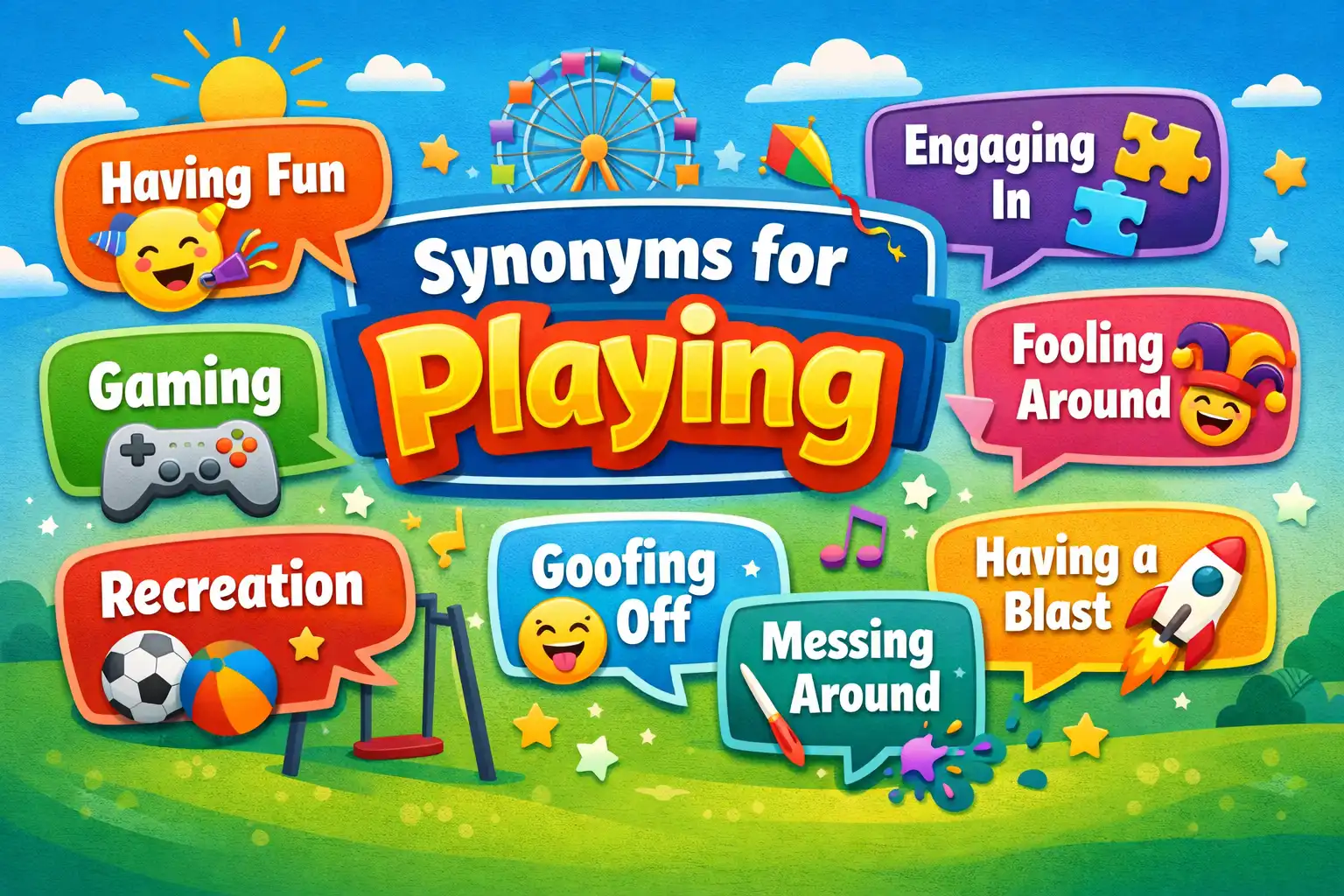
Here are strong and varied synonyms for playing you can use in different contexts:
- Engaging
- Participating
- Performing
- Acting
- Competing
- Frolicking
- Recreating
- Entertaining
- Rehearsing
- Amusing oneself
- Sporting
- Dabbling
Grouped by Meaning
Fun / Leisure:
- Frolicking
- Amusing oneself
- Recreating
Performance:
- Acting
- Performing
- Rehearsing
For Sports or Games:
- Competing
- Participating
- Sporting
Comparison Table
| Word | Simple Meaning | Best Used When | Avoid When |
| Playing | General action of activity | Casual or broad context | You need precision |
| Performing | Doing music or acting | Stage, music, or artistic scenes | Casual play situations |
| Engaging | Taking part actively | Formal or neutral writing | Informal storytelling |
| Frolicking | Playing energetically | Descriptive, playful scenes | Serious tone |
| Competing | Taking part in a contest | Sports or rivalry contexts | Casual fun situations |
| Acting | Performing a role | Drama or character portrayal | Physical games |
| Rehearsing | Practicing performance | Preparation scenes | Actual performance |
| Entertaining | Amusing others | Social or audience-focused scenes | Solo play |
Formal vs Informal Synonyms
| Formal Synonyms | Informal Synonyms |
| Participating | Hanging out |
| Engaging | Messing around |
| Performing | Goofing off |
| Rehearsing | Playing around |
| Competing | Kicking about |
Writer’s Tip:
In dialogue, informal synonyms feel more natural. In narration, formal or precise verbs often work better.
Real Example Sentences
Here are practical examples using different synonyms for playing:
- The children were frolicking in the garden under the summer sun.
- She spent hours rehearsing her lines before the big performance.
- He was competing in the final match of the tournament.
- The band was performing live at the downtown club.
- They were engaging in a friendly game of chess.
- The actor was acting with remarkable emotional depth.
- The kids were amusing themselves with a simple cardboard box.
- She was participating in a school drama competition.
When to Use vs When NOT to Use
When to Use Synonyms for Playing
Use alternatives when:
- You want to avoid repetition
- You need specific meaning
- You’re creating vivid imagery
- You’re writing for professional or creative audiences
When NOT to Use Them
Avoid replacing “playing” when:
- The context is simple and clear
- The synonym sounds forced or unnatural
- The tone requires casual simplicity
- The meaning becomes confusing
In our experience helping writers, overcomplicating simple actions often reduces clarity. Sometimes “playing” is still the best choice.
Common Mistakes Writers Make
1. Choosing the Wrong Context
Using performing when describing children in a park feels unnatural.
2. Overusing Fancy Words
Writers often replace “playing” with complex words unnecessarily.
3. Ignoring Tone
“Frolicking” doesn’t fit serious or emotional scenes.
4. Repetition of One Synonym
Switching from “playing” to only “engaging” repeatedly creates a new problem.
5. Misusing Formal Words in Dialogue
Characters rarely say “I am participating in a game” in casual speech.
Tips and Best Practices
1. Match the Context
Always ask: What kind of playing is happening?
2. Focus on Imagery
Choose words that help readers visualize the action.
3. Read Aloud
If a synonym sounds awkward, it probably is.
4. Use Variety, Not Randomness
Rotate synonyms naturally, not mechanically.
5. Keep Your Audience in Mind
Creative writing allows flexibility, but clarity comes first.
Writer’s Tip:
When editing, highlight repeated verbs. Replace only the ones that weaken your writing.
Frequently Asked Questions
Q: What is the best synonym for “playing” in writing?
A: The best synonym depends on context. For general use, engaging works well. For creative scenes, frolicking or performing adds more detail. Always match the word to the action and tone of your sentence.
Q: Can “playing” be used in formal writing?
A: Yes, but it often sounds too casual. In formal contexts, words like participating, engaging, or performing are preferred. Academic writing values precision and clarity over general terms.
Q: What synonym should I use for playing music?
A: Use performing, playing, or executing (in technical contexts). “Performing” is the most natural choice for concerts or public settings, while “rehearsing” works when describing practice.
Q: Is “frolicking” a good replacement?
A: “Frolicking” is great for playful, energetic scenes, especially in descriptive or creative writing. However, it should not be used in serious or formal contexts because it carries a light and whimsical tone.
Q: How do I avoid repeating “playing” in my writing?
A: Identify the specific action and replace it with a precise verb. For example, use competing for sports or acting for drama. Reading your work aloud helps catch repetition effectively.
Q: Are synonyms always better than the original word?
A: No. Sometimes “playing” is the clearest and most natural option. Overusing synonyms can make your writing feel forced. Balance is key—clarity should always come first.
Q: What are informal alternatives to “playing”?
A: Informal options include messing around, goofing off, or hanging out. These work well in dialogue but should be avoided in formal narration or academic contexts.
Q: Why is choosing the right synonym important in creative writing?
A: Word choice shapes tone, imagery, and reader experience. According to storytelling principles, precise verbs improve engagement and clarity. Strong synonyms make scenes more vivid and believable.
CONCLUSION
Mastering synonyms for playing helps you write with clarity, variety, and impact. Instead of relying on one word, you can choose alternatives that match tone, context, and meaning. Remember to prioritize clarity, avoid overcomplication, and always consider your audience.
You might also want to read our guide on synonyms for fun to expand your creative vocabulary even further.
Keep practicing, stay curious, and your writing will naturally become more expressive and engaging.

Michael Turner is a published fiction writer and creative writing tutor with over a decade of experience helping writers find the words that make their stories breathe ( Biography ).