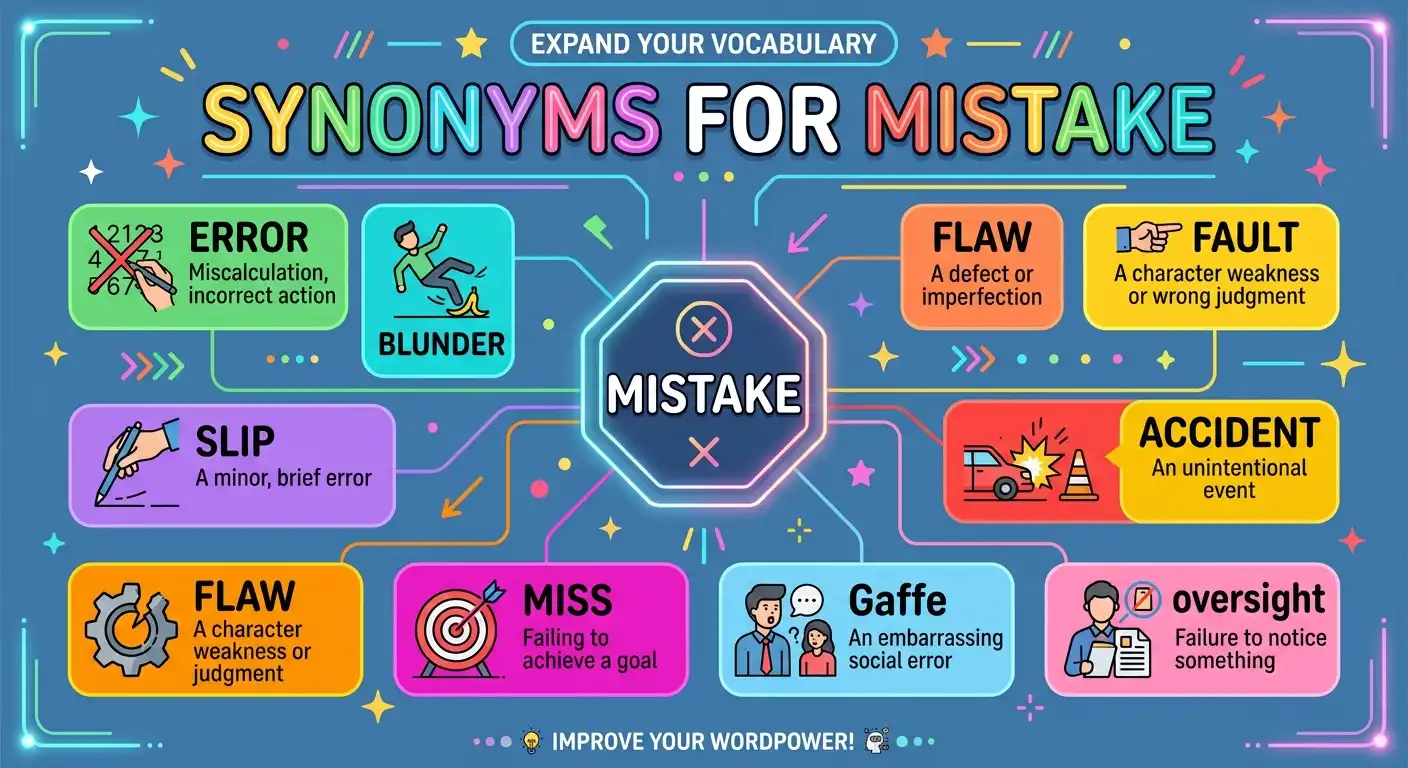
Exploring different synonyms for mistake helps you speak and write with clarity, power, and precision. When you learn helpful synonyms for mistake, you can easily describe everyday accidents, minor typos, or big structural errors without repeating yourself. Master key synonyms for mistake to express yourself accurately in school essays, emails, and online articles.
Imagine sending an important email to your manager at work. You write that you made a “mistake,” but what you really meant was a minor typing error or a temporary lapse in judgment. Calling every single error a “mistake” makes your language feel plain and imprecise. Using specific words like blunder, slip, or oversight instantly paints a clearer picture for your listener.
A mistake is an action, decision, or opinion that is incorrect or misplaced. It happens when someone makes a wrong judgment or misinterprets facts. Using targeted synonyms for mistake gives your language richness and nuance across every situation.
Learning synonyms for mistake is especially valuable for:
- Students: Add variety to school essays, assignments, and creative stories.
- Bloggers: Keep readers engaged with fresh, dynamic vocabulary.
- Content Writers: Craft polished product pages, ad copy, and articles.
- Daily English Users: Communicate clearly and express yourself with confidence.
“Choosing the right word turns simple thoughts into powerful statements.”
“A rich vocabulary helps us express our thoughts with exact precision.”
Linguistic Analysis of Mistake
Connotative Meaning of Mistake
- Human Imperfection: Represents learning, growth, and natural human experience.
- Carelessness or Inattention: Suggests rush, distraction, or missed details.
- Accidental Action: Highlights unintended consequences rather than bad intent.
- Correction Opportunity: Serves as a prompt to fix errors and improve future outcomes.
Etymology of Mistake
- Old Norse Origin (12th Century): Rooted in mistaka, meaning “to take wrongly” or “misapprehend.”
- Middle English Evolution: Transitioned into mystaken, meaning to misunderstand or choose incorrectly.
- Modern Adaptation: Broadened to describe any incorrect thought, action, calculation, or judgment.
Pronunciation Guide
- US IPA: /mɪˈsteɪk/
- UK IPA: /mɪˈsteɪk/
Syllables & Structure
- Syllables: 2 syllables (Mis-take)
- Affixation Pattern: Prefix mis- (meaning wrong or bad) + Root take.
- Adjectival Forms: mistaken, mistakenly.
Prototype Meaning & Categorization
- Primary Category: An unintended wrong action or incorrect judgment.
- Secondary Category: A misunderstanding or false concept.
Antonyms of Mistake
- Accuracy: Perfect alignment with truth or correct facts.
- Correctness: Freedom from fault or error.
- Perfection: Complete excellence without any flaws.
- Success: Reaching a desired, correct goal.
- Precision: Exact correctness in measurement or action.
Word Comparison Table
| Keyword | Meaning | Usage Type | Context |
| Error | A failure to hit a standard or rule | Formal / Professional | Science, math, formal reports |
| Blunder | A stupid or careless mistake | Casual / Dramatic | Daily life, news, public actions |
| Slip | A small, quick, unintended error | Casual / Mild | Conversation, simple tasks |
| Oversight | An error caused by forgetting a detail | Professional / Formal | Office work, planning, management |
| Gaffe | A socially awkward mistake | Social / Media | Public speaking, events, politics |
| Glitch | A brief technical fault or mistake | Tech / Modern | Computers, software, machinery |
| Flaw | A defect that spoils perfection | Descriptive / Formal | Design, character, reasoning |
| Fault | Responsibility for a bad result | Emotional / Formal | Personal relationships, legal |
50 Best Synonyms for Mistake
1. Error
- Pronunciation: US: /ˈer.ɚ/ | UK: /ˈer.ər/
- Meaning: An error is an action or result that is not correct.
- Examples:
- I found a small error on page five of the report.
- The computer made a processing error while saving the file.
2. Blunder
- Pronunciation: US: /ˈblʌn.dɚ/ | UK: /ˈblʌn.də/
- Meaning: A blunder is a big mistake caused by carelessness.
- Examples:
- Dropping the tray was a silly blunder in front of guests.
- The team made a costly blunder during the final game.
3. Slip
- Pronunciation: US: /slɪp/ | UK: /slɪp/
- Meaning: A slip is a small, fast mistake made without thinking.
- Examples:
- Saying the wrong date was just a simple slip of memory.
- She made a minor slip while writing down the phone number.
4. Misstep
- Pronunciation: US: /ˌmɪsˈstep/ | UK: /ˌmɪsˈstep/
- Meaning: A misstep is a wrong action or poor decision.
- Examples:
- Buying that old car proved to be a financial misstep.
- He fixed his misstep by apologizing to his friend immediately.
5. Oversight
- Pronunciation: US: /ˈoʊ.vɚ.saɪt/ | UK: /ˈəʊ.və.saɪt/
- Meaning: An oversight happens when you accidentally forget a detail.
- Examples:
- Forgetting to send the email was an unfortunate oversight.
- The missing signature was an honest oversight by the clerk.
6. Fault
- Pronunciation: US: /fɑːlt/ | UK: /fɒlt/
- Meaning: A fault is a mistake that causes a failure or defect.
- Examples:
- The power outage was caused by a fault in the main wire.
- It was my fault that we missed the afternoon bus.
7. Flaw
- Pronunciation: US: /flɑː/ | UK: /flɔː/
- Meaning: A flaw is a small defect that ruins a perfect thing.
- Examples:
- This glass dish has a small flaw on its outer rim.
- The judge found a main flaw in the speaker’s logic.
8. Gaffe
- Pronunciation: US: /ɡæf/ | UK: /ɡæf/
- Meaning: A gaffe is an embarrassing mistake made in social settings.
- Examples:
- Forgetting the host’s name was a funny social gaffe.
- The actor made a quick gaffe during his live interview.
9. Lapse
- Pronunciation: US: /læps/ | UK: /læps/
- Meaning: A lapse is a temporary failure in focus or judgment.
- Examples:
- A brief lapse in concentration caused him to spill the tea.
- She had a short memory lapse during the quiz today.
10. Miscalculation
- Pronunciation: US: /ˌmɪs.kæl.kjəˈleɪ.ʃən/ | UK: /ˌmɪs.kæl.kjəˈleɪ.ʃən/
- Meaning: A miscalculation is a wrong judgment of math or situation.
- Examples:
- The builder made a quick miscalculation on the wood length.
- Arriving late was the result of a timing miscalculation.
“Learning from a mistake helps us grow wiser every single day.”
11. Misjudgment
- Pronunciation: US: /ˌmɪsˈdʒʌdʒ.mənt/ | UK: /ˌmɪsˈdʒʌdʒ.mənt/
- Meaning: A misjudgment is a wrong decision about a person or event.
- Examples:
- Trusting the weather forecast was a clear misjudgment today.
- Leaving the door unlocked was an obvious misjudgment on my part.
12. Blooper
- Pronunciation: US: /ˈbluː.pɚ/ | UK: /ˈbluː.pər/
- Meaning: A blooper is a funny mistake made during speech or film.
- Examples:
- The movie cast laughed at the blooper during filming.
- News readers sometimes make a light blooper on television.
13. Mix-up
- Pronunciation: US: /ˈmɪks.ʌp/ | UK: /ˈmɪks.ʌp/
- Meaning: A mix-up is a confusing mistake involving wrong items or times.
- Examples:
- A schedule mix-up caused us to miss our train.
- There was a mix-up with our luggage at the hotel.
14. Botch
- Pronunciation: US: /bɑːtʃ/ | UK: /bɒtʃ/
- Meaning: A botch is a poorly executed task or ruined effort.
- Examples:
- The quick paint job turned out to be a complete botch.
- He made a botch of fixing the kitchen door latch.
15. Slip-up
- Pronunciation: US: /ˈslɪp.ʌp/ | UK: /ˈslɪp.ʌp/
- Meaning: A slip-up is a minor mistake in a task or plan.
- Examples:
- One small slip-up ruined our secret surprise party plan.
- Check your work carefully to avoid any easy slip-up.
16. Foul-up
- Pronunciation: US: /ˈfaʊl.ʌp/ | UK: /ˈfaʊl.ʌp/
- Meaning: A foul-up is a messy mistake that creates problems.
- Examples:
- The traffic foul-up delayed everyone on the main road.
- An order foul-up delayed our dinner delivery by an hour.
17. Faux Pas
- Pronunciation: US: /ˌfoʊ ˈpɑː/ | UK: /ˌfəʊ ˈpɑː/
- Meaning: A faux pas is a embarrassing breach of social etiquette.
- Examples:
- Wearing jeans to the formal dinner was a faux pas.
- She realized her social faux pas and apologized right away.
18. Typo
- Pronunciation: US: /ˈtaɪ.poʊ/ | UK: /ˈtaɪ.pəʊ/
- Meaning: A typo is a small typing error in written text.
- Examples:
- I caught a silly typo in the first sentence.
- Fix every typo before you print the final poster.
19. Misprint
- Pronunciation: US: /ˈmɪs.prɪnt/ | UK: /ˈmɪs.prɪnt/
- Meaning: A misprint is a printing mistake in a book or paper.
- Examples:
- The cheap book had a funny misprint on page ten.
- The newspaper fixed the misprint in their latest edition.
20. Inaccuracy
- Pronunciation: US: /ɪnˈæk.jɚ.ə.si/ | UK: /ɪnˈæk.jər.ə.si/
- Meaning: An inaccuracy is a statement or fact that is incorrect.
- Examples:
- The report had an inaccuracy regarding the final sales numbers.
- Correct every inaccuracy before turning in your essay today.
21. Misunderstanding
- Pronunciation: US: /ˌmɪs.ʌn.dɚˈstæn.dɪŋ/ | UK: /ˌmɪs.ʌn.dəˈstæn.dɪŋ/
- Meaning: A misunderstanding is a failure to understand something correctly.
- Examples:
- Clear talk quickly solved our small misunderstanding yesterday.
- A simple misunderstanding caused us to wait at wrong doors.
22. Misconception
- Pronunciation: US: /ˌmɪs.kənˈsep.ʃən/ | UK: /ˌmɪs.kənˈsep.ʃən/
- Meaning: A misconception is a false belief based on wrong ideas.
- Examples:
- That bats are blind is a common scientific misconception.
- The teacher cleared up every misconception about space history.
23. Misinterpretation
- Pronunciation: US: /ˌmɪs.ɪn.tɚ.prəˈteɪ.ʃən/ | UK: /ˌmɪs.ɪn.tɜː.prəˈteɪ.ʃən/
- Meaning: A misinterpretation is explaining or understanding something incorrectly.
- Examples:
- His tone led to a quick misinterpretation of his intent.
- Read the law rules to avoid any wrong misinterpretation.
24. Bungle
- Pronunciation: US: /ˈbʌŋ.ɡəl/ | UK: /ˈbʌŋ.ɡəl/
- Meaning: A bungle is a clumsily handled job or task.
- Examples:
- The repair job was a bungle from start to finish.
- He tried not to bungle his speech on the stage.
25. Glitch
- Pronunciation: US: /ɡlɪtʃ/ | UK: /ɡlɪtʃ/
- Meaning: A glitch is a short sudden problem in a system.
- Examples:
- A system glitch caused the screen to freeze temporarily.
- The app was updated to fix a minor glitch today.
26. Stumble
- Pronunciation: US: /ˈstʌm.bəl/ | UK: /ˈstʌm.bəl/
- Meaning: A stumble is a trip or hesitation in speech or action.
- Examples:
- He had a slight stumble while reading the long poem.
- A temporary stumble in sales did not stop the business.
27. Misstatement
- Pronunciation: US: /ˌmɪsˈsteɪt.mənt/ | UK: /ˌmɪsˈsteɪt.mənt/
- Meaning: A misstatement is an incorrect or inaccurate remark.
- Examples:
- The speaker fixed his misstatement before closing the talk.
- The article contained a minor misstatement of historical facts.
28. Aberration
- Pronunciation: US: /ˌæb.əˈreɪ.ʃən/ | UK: /ˌæb.əˈreɪ.ʃən/
- Meaning: An aberration is a departure from what is normal or right.
- Examples:
- The low test score was an unusual aberration for her.
- Snow in May is a weather aberration in this region.
29. Omission
- Pronunciation: US: /oʊˈmɪʃ.ən/ | UK: /əʊˈmɪʃ.ən/
- Meaning: An omission is something left out by mistake or neglect.
- Examples:
- Leaving out his name on the list was an omission.
- The contract was updated to fix a key omission.
30. Indiscretion
- Pronunciation: US: /ˌɪn.dɪˈskreʃ.ən/ | UK: /ˌɪn.dɪˈskreʃ.ən/
- Meaning: An indiscretion is an action showing lack of good sense.
- Examples:
- Telling the secret was a careless indiscretion on his part.
- He regretted his youth indiscretion once he grew older.
31. Solecism
- Pronunciation: US: /ˈsɑː.lə.sɪz.əm/ | UK: /ˈsɒl.ɪ.sɪz.əm/
- Meaning: A solecism is a grammatical mistake in speech or writing.
- Examples:
- Using bad grammar in formal writing is a solecism.
- The speech editor corrected every minor solecism in the draft.
32. Fallacy
- Pronunciation: US: /ˈfæl.ə.si/ | UK: /ˈfæl.ə.si/
- Meaning: A fallacy is a false or mistaken belief or argument.
- Examples:
- Thinking money solves every problem is a clear fallacy.
- The logic behind his claim contains a major fallacy.
33. Illusion
- Pronunciation: US: /ɪˈluː.ʒən/ | UK: /ɪˈluː.ʒən/
- Meaning: An illusion is a false mental picture or wrong appearance.
- Examples:
- The desert heat created an illusion of blue water ahead.
- Do not live under the illusion that tests are easy.
34. Delusion
- Pronunciation: US: /dɪˈluː.ʒən/ | UK: /dɪˈluː.ʒən/
- Meaning: A delusion is a strongly held belief that is untrue.
- Examples:
- Believing he could fly without gear was a dangerous delusion.
- She held no delusion about the difficulties of the climb.
35. Misdeed
- Pronunciation: US: /ˌmɪsˈdiːd/ | UK: /ˌmɪsˈdiːd/
- Meaning: A misdeed is a wrong or improper action or crime.
- Examples:
- The child apologized sincerely for his small misdeed today.
- He worked hard to make up for past misdeed events.
36. Infraction
- Pronunciation: US: /ɪnˈfræk.ʃən/ | UK: /ɪnˈfræk.ʃən/
- Meaning: An infraction is a minor violation of a rule or law.
- Examples:
- Parking near the fire hydrants is a traffic infraction.
- The student received a warning for a rule infraction.
37. Transgression
- Pronunciation: US: /trænzˈɡreʃ.ən/ | UK: /trænzˈɡreʃ.ən/
- Meaning: A transgression is a breach of a moral code or law.
- Examples:
- Stealing fruit was a clear moral transgression by the boy.
- The court fined him for his legal transgression last week.
38. Defect
- Pronunciation: US: /ˈdiː.fekt/ | UK: /ˈdiː.fekt/
- Meaning: A defect is an imperfection or flaw in an item.
- Examples:
- The phone was returned because of a screen defect.
- Quality checks remove products with any major defect quickly.
39. Imperfection
- Pronunciation: US: /ˌɪm.pɚˈfek.ʃən/ | UK: /ˌɪm.pəˈfek.ʃən/
- Meaning: An imperfection is a small fault that lowers overall quality.
- Examples:
- Wood grain has natural imperfection that adds character and charm.
- Smooth out every surface imperfection before applying the varnish paint.
40. Muff
- Pronunciation: US: /mʌf/ | UK: /mʌf/
- Meaning: A muff is a clumsy mistake in catching or doing something.
- Examples:
- The fielder made a bad muff and dropped the ball.
- He made a complete muff of his introductory presentation speech.
41. Fluff
- Pronunciation: US: /flʌf/ | UK: /flʌf/
- Meaning: A fluff is a spoken mistake or spoken line error.
- Examples:
- The actor made a small fluff during the second act.
- Correct any verbal fluff while reading news copy aloud.
42. Failure
- Pronunciation: US: /ˈfeɪ.ljɚ/ | UK: /ˈfeɪ.ljər/
- Meaning: A failure is a lack of success in meeting an outcome.
- Examples:
- The project failure gave the team a valuable lesson.
- Engine failure caused the boat to drift near shore.
43. Deviation
- Pronunciation: US: /ˌdiː.viˈeɪ.ʃən/ | UK: /ˌdiː.viˈeɪ.ʃən/
- Meaning: A deviation is a turning away from the standard path.
- Examples:
- Any deviation from the safety rules is prohibited here.
- The path had a short deviation around the fallen oak tree.
44. Misapprehension
- Pronunciation: US: /ˌmɪs.æp.rəˈhen.ʃən/ | UK: /ˌmɪs.æp.rɪˈhen.ʃən/
- Meaning: A misapprehension is a wrong understanding of facts.
- Examples:
- He was under the misapprehension that the event was free.
- The manager cleared up the team misapprehension quickly today.
45. Misdirection
- Pronunciation: US: /ˌmɪs.daɪˈrek.ʃən/ | UK: /ˌmɪs.daɪˈrek.ʃən/
- Meaning: A misdirection is wrong advice or guiding someone incorrectly.
- Examples:
- Bad map signs led to a brief travel misdirection.
- The magician used clever misdirection during his card trick.
46. Screw-up
- Pronunciation: US: /ˈskruː.ʌp/ | UK: /ˈskruː.ʌp/
- Meaning: A screw-up is an informal term for a careless mistake.
- Examples:
- Losing the key was a huge personal screw-up yesterday.
- He fixed the schedule screw-up before the client arrived.
47. Slip-of-the-tongue
- Pronunciation: US: /slɪp.əv.ðə.tʌŋ/ | UK: /slɪp.əv.ðə.tʌŋ/
- Meaning: A slip-of-the-tongue is saying the wrong word accidentally.
- Examples:
- Calling the teacher “mom” was a classic slip-of-the-tongue.
- Her slip-of-the-tongue revealed the surprise party location early.
48. Mishearing
- Pronunciation: US: /ˌmɪsˈhɪr.ɪŋ/ | UK: /ˌmɪsˈhɪə.rɪŋ/
- Meaning: A mishearing is hearing words or sounds incorrectly.
- Examples:
- A mishearing over the noisy phone led to the wrong meeting location.
- Loud music caused a funny mishearing of the song lyrics.
49. Oversight Error
- Pronunciation: US: /ˈoʊ.vɚ.saɪt ˈer.ɚ/ | UK: /ˈəʊ.və.saɪt ˈer.ər/
- Meaning: An oversight error is a mistake caused by missing a step.
- Examples:
- Missing line item six was an oversight error on the bill.
- double-check your balance sheet to catch every oversight error.
50. Slip-up Error
- Pronunciation: US: /ˈslɪp.ʌp ˈer.ɚ/ | UK: /ˈslɪp.ʌp ˈer.ər/
- Meaning: A slip-up error is a minor operational mistake.
- Examples:
- The clerk made a quick slip-up error while entering data.
- We fixed the small slip-up error before shipping the order.
Frequently Asked Questions
1. What are the most common synonyms for mistake?
The most common synonyms for mistake are error, blunder, slip, oversight, fault, and flaw. These words work across daily speech, academic writing, and workplace communication.
2. What is the difference between an “error” and a “blunder”?
An error is a general term for anything that is incorrect or off-standard. A blunder is specifically a large, foolish, or careless mistake that leads to awkward or costly results.
3. Can I use “oversight” instead of “mistake” in professional emails?
Yes! Oversight is a polite and professional word to use when an error was made simply because a small detail was accidentally skipped or forgotten during a busy workday.
4. Which synonym for mistake should I use for small typing mistakes?
For typing mistakes in digital text or written work, the word typo or misprint is the most accurate term to use.
5. Why should I learn different synonyms for mistake?
Learning different synonyms helps you explain the exact nature of an error. It keeps your writing interesting, precise, and professional without relying on the same basic word repeatedly.
Conclusion
Expanding your vocabulary with precise synonyms for mistake transforms the quality and clarity of your communication. Swapping basic terms for exact words like blunder, oversight, slip, or gaffe makes your sentences vivid, professional, and memorable.
A varied vocabulary gives you a distinct advantage across many areas of life:
- Writing & Blogging: You can craft clearer descriptions and avoid dull word repetition.
- Speaking & Communication: Expressing exact thoughts builds confidence during conversations and public talks.
- Professional Growth: Choosing formal words like oversight or misstep helps you communicate gracefully at work.
Start putting these new words into action today! Practice swapping generic terms when drafting routine work emails, school essays, or casual daily chats.
“Clear words create clear understanding in every conversation.”
“Expanding your word choice opens new doors to confident communication.”

Michael Turner is a published fiction writer and creative writing tutor with over a decade of experience helping writers find the words that make their stories breathe ( Biography ).