Do you keep using the word “detailed” in your writing and feel like it’s starting to sound repetitive? You’re not alone. Many writers struggle to find fresh ways to express precision, depth, and clarity without overusing the same term. That’s exactly why understanding synonyms for detailed is essential for improving your style.
In this guide, you’ll learn not just a list of alternatives, but how to use them effectively in real writing situations. Whether you’re working on fiction, essays, or descriptive passages, choosing the right synonym can make your writing more vivid and engaging.
As a creative writing tutor, I’ve seen writers transform their work simply by replacing basic words with more precise ones. In this article, you’ll get practical examples, comparisons, and expert tips to help you do the same.
Quick Answer:
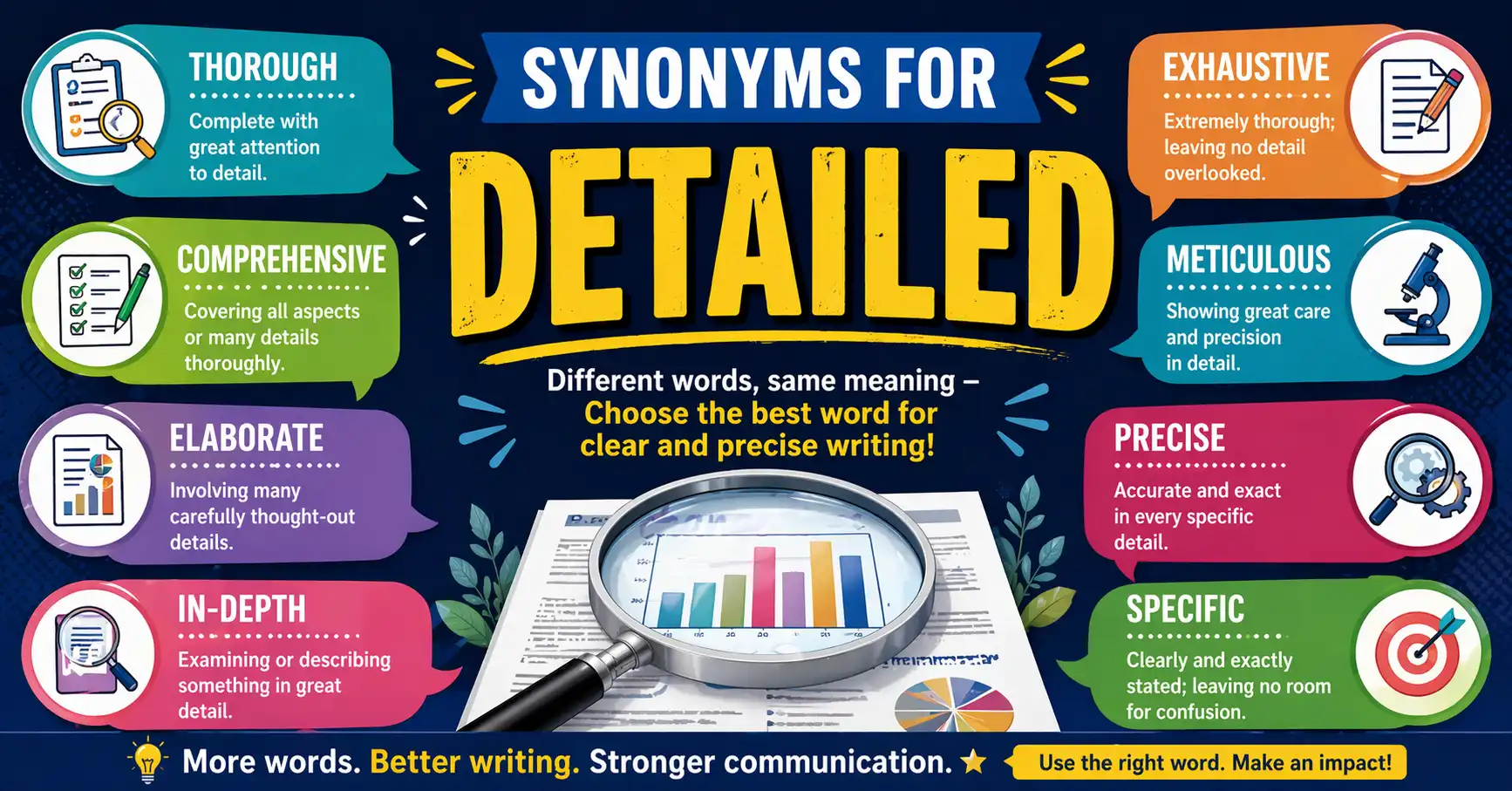
The best synonyms for “detailed” include thorough, comprehensive, elaborate, specific, in-depth, meticulous, and exhaustive. Each word carries a slightly different tone and level of depth, so choosing the right one depends on your context—formal writing, storytelling, or everyday communication.
What Does “Detailed” Mean?
The word detailed refers to something that includes a lot of specific information. It suggests depth, clarity, and careful explanation.
In creative writing, “detailed” often means:
- Rich description
- Clear imagery
- Precise information
According to academic writing conventions, using specific and descriptive language improves clarity and reader engagement. This is especially important in essays, reports, and storytelling.
Complete Synonyms List
Here are strong synonyms for detailed you can use in different contexts:
- Thorough
- Comprehensive
- Elaborate
- In-depth
- Specific
- Meticulous
- Exhaustive
- Precise
- Extensive
- Full
- Particularized
- Analytical
Writer’s Tip:
In our experience helping writers, the biggest improvement comes from choosing synonyms based on tone, not just meaning. For example, “meticulous” adds personality, while “comprehensive” sounds more formal.
Comparison Table
| Word | Simple Meaning | Best Used When | Avoid When |
| Thorough | Covers everything carefully | Reports, essays | Casual speech |
| Comprehensive | Includes all aspects | Academic writing | Short descriptions |
| Elaborate | Highly developed or complex | Creative writing | Simple explanations |
| In-depth | Deep and focused | Analysis or research | Quick summaries |
| Specific | Clear and exact | Instructions | Broad topics |
| Meticulous | Extremely careful | Character description | Fast-paced writing |
| Exhaustive | Covers everything completely | Research papers | Light writing |
| Precise | Exact and accurate | Technical writing | Emotional writing |
Formal vs Informal Synonyms
| Formal Synonyms | Informal Alternatives |
| Comprehensive | Very detailed |
| Exhaustive | Super detailed |
| Analytical | Thought-through |
| Precise | Spot-on |
| Thorough | Well-explained |
| In-depth | Deep |
Writer’s Tip:
Formal synonyms are essential for essays and professional writing. Informal ones work better in dialogue or casual storytelling.
Real Example Sentences
Here are practical examples showing how to use synonyms for detailed:
- She gave a thorough explanation of the plot twist.
- The report included a comprehensive overview of the data.
- His description of the forest was incredibly elaborate.
- The article provides an in-depth analysis of climate change.
- Please give specific instructions for the task.
- The artist paid meticulous attention to every brushstroke.
- The study offers an exhaustive review of previous research.
- Her writing is precise and easy to follow.
Writer’s Tip:
Notice how each word slightly changes the tone. “Meticulous” adds personality, while “precise” sounds more technical.
When to Use vs When NOT to Use
✅ When to Use Synonyms for Detailed
Use these words when you want to:
- Add variety to your writing
- Show depth and clarity
- Improve academic or creative tone
- Avoid repetition
❌ When NOT to Use
Avoid using complex synonyms when:
- Your audience needs simple language
- The detail level is actually low
- You risk sounding unnatural
- You’re writing dialogue for casual characters
In creative writing, overusing advanced synonyms can make dialogue feel unrealistic.
Common Mistakes Writers Make
Here are mistakes I frequently see in student writing:
1. Using the Wrong Tone
Writers often use “comprehensive” in casual writing. This sounds too formal.
2. Overusing One Synonym
Switching from “detailed” to “thorough” repeatedly doesn’t solve repetition.
3. Ignoring Context
“Exhaustive” suggests extreme depth. Don’t use it for short explanations.
4. Making Writing Too Complex
Using advanced synonyms unnecessarily can reduce clarity.
5. Confusing Similar Words
“Precise” and “specific” are close, but “precise” focuses more on accuracy.
Tips and Best Practices
1. Match the Tone to Your Writing
Choose formal synonyms for essays and simpler ones for storytelling.
2. Focus on Nuance
Each synonym has a slightly different meaning. Use it intentionally.
3. Read Your Sentence Aloud
If it sounds unnatural, choose a simpler word.
4. Build a Personal Word Bank
Keep a list of synonyms you use often.
5. Practice with Rewriting
Take a sentence and rewrite it using different synonyms.
Writer’s Tip:
Writers we work with often improve faster when they rewrite one paragraph using 3–4 different synonyms. This builds flexibility and confidence.
Frequently Asked Questions
Q1: What is the best synonym for detailed in academic writing?
A: “Comprehensive” and “thorough” are the best choices for academic writing. They clearly show depth and coverage, which aligns with academic standards. These words also meet expectations in IELTS and university-level essays.
Q2: Can I use “elaborate” instead of detailed?
A: Yes, but carefully. “Elaborate” suggests complexity and richness, often used in storytelling. It may sound too decorative for formal writing, so use it mainly in creative contexts rather than academic essays.
Q3: What’s the difference between detailed and precise?
A: “Detailed” focuses on including many pieces of information, while “precise” emphasizes accuracy and exactness. You can be detailed without being precise, but strong writing often combines both qualities effectively.
Q4: Is “in-depth” formal or informal?
A: “In-depth” is semi-formal. It works well in essays, articles, and reports, but may feel slightly conversational compared to “comprehensive.” It’s a good middle-ground option for clarity and readability.
Q5: Which synonym is best for storytelling?
A: “Elaborate” and “meticulous” work best in storytelling. They help create vivid imagery and strong character descriptions, which are essential for engaging creative writing and immersive narratives.
Q6: How can I avoid repeating “detailed” in writing?
A: Use a mix of synonyms like “thorough,” “specific,” and “in-depth,” depending on context. Also, restructure sentences instead of always replacing words. Variety in sentence structure improves writing more than simple word substitution.
CONCLUSION
Mastering synonyms for detailed can significantly improve your writing. You’ve learned not only alternative words, but also when and how to use them effectively. The key is understanding nuance—choosing the right word for the right situation.
Whether you’re writing essays or stories, these synonyms help you sound more natural, clear, and engaging. Keep practicing, and your vocabulary will grow quickly.
You might also want to read our guide on synonyms for descriptive to expand your writing even further.

Michael Turner is a published fiction writer and creative writing tutor with over a decade of experience helping writers find the words that make their stories breathe ( Biography ).