When you search for synonyms for colonialism, you want clear words that mean taking control of another country. Learning synonyms for colonialism helps you express ideas about foreign control, history, and power with exact detail. Using varied synonyms for colonialism makes your writing stronger, whether you are writing a school essay or a news blog.
Imagine reading a history textbook that repeats the same word ten times on one page. It quickly becomes hard to stay interested. A student writing a paper on world history might want to describe how one country took over another without sounding repetitive. By choosing the right word, you can show whether the takeover was peaceful, forced, or economic.
The word colonialism simply means when a powerful country moves into another land to rule it and use its wealth.
“Words are the powerful key to unlocking history and understanding human power.”
Understanding these terms is very helpful for different people:
- Students can write clearer essays and get better grades in history and social studies.
- Bloggers can keep their readers engaged with fresh and active vocabulary.
- Content writers can improve SEO rankings by using rich semantic keywords naturally.
- Daily English users can understand news stories and global debates much better.
“Choosing the correct word changes a simple sentence into a clear picture.”
Linguistic Breakdown of Colonialism
Connotative Meaning
While the dictionary definition of colonialism focuses on settlement and governance, the connotative meaning is almost always negative today. It carries strong associations with loss of freedom, resource exploitation, cultural disruption, and unequal power dynamics.
Etymology
- Root: From the Latin word colonia, meaning “settlement”, “farm”, or “landed estate”.
- Base Verb: Colere, which means “to cultivate” or “to till the soil”.
- Historical Shift: Entered Middle English via Middle French in reference to foreign settlements, evolving in the 19th century to mean political control over native populations.
Pronunciation (IPA)
- US IPA: /kəˈloʊ.ni.ə.lɪz.əm/
- UK IPA: /kəˈləʊ.ni.ə.lɪz.əm/
Word Structure
- Syllables: 5 syllables (co-lo-ni-al-ism)
- Affixation Pattern:
- Root: coloni (settle)
- Suffix 1: -al (pertaining to)
- Suffix 2: -ism (system, practice, or doctrine)
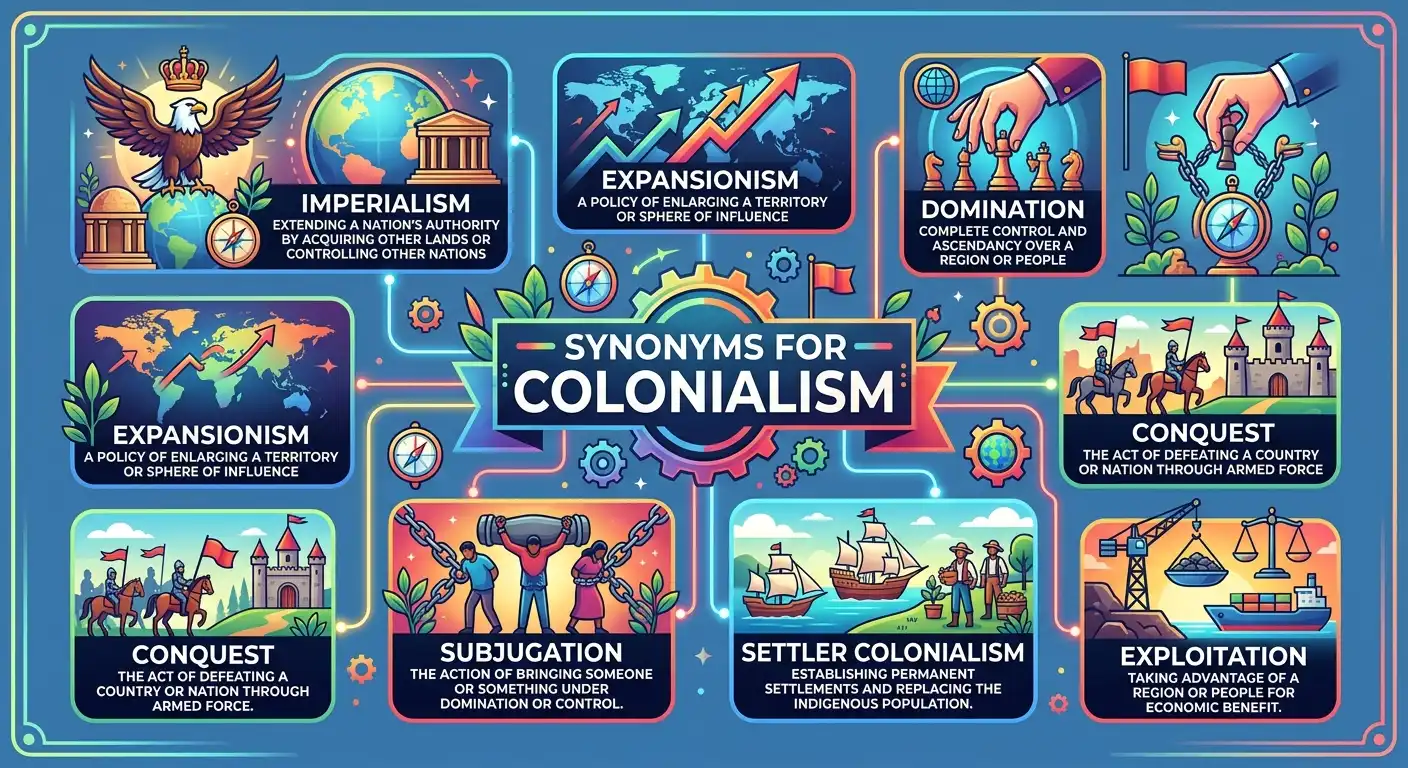
Comparison Table of Key Colonialism Synonyms
| Keyword / Synonym | Simple Meaning | Usage Type | Context |
| Imperialism | Extending power by conquering land | Formal / Academic | Global politics and empire building |
| Occupation | Controlling land using military force | Serious / Military | War zones and post-war control |
| Subjugation | Bringing people under complete control | Emotional / Strong | Human rights and social history |
| Expansionism | Growing a country’s borders outward | Political / Neutral | Government policy and state growth |
| Neocolonialism | Using money or trade to control nations | Modern / Academic | Global economics and trade |
| Annexation | Formally adding new land to a country | Legal / Formal | Treaties and border changes |
| Settlement | Building towns in a new territory | Historical / Casual | Early history and pioneers |
| Dominion | Having full control or rule over land | Formal / Literary | Monarchies and historic rule |
50 Synonyms for Colonialism
1. Imperialism
- Pronunciation: US /ɪmˈpɪr.i.ə.lɪz.əm/ | UK /ɪmˈpɪə.ri.ə.lɪz.əm/
- Meaning: Imperialism is the policy of growing a nation’s power by taking control of other lands.
- Examples:
- The king practiced imperialism to grow his large empire.
- Books on world history often discuss European imperialism in Asia.
2. Colonization
- Pronunciation: US /ˌkɑː.lə.nəˈzeɪ.ʃən/ | UK /ˌkɒl.ə.naɪˈzeɪ.ʃən/
- Meaning: Colonization is the act of setting up control over indigenous people in a new land.
- Examples:
- Colonization changed the native language of the island.
- The island history records early British colonization.
3. Subjugation
- Pronunciation: US /ˌsʌb.dʒəˈɡeɪ.ʃən/ | UK /ˌsʌb.dʒʊˈɡeɪ.ʃən/
- Meaning: Subjugation is bringing a group of people under total control by force.
- Examples:
- The army caused the subjugation of the local tribes.
- Citizens fought back against foreign subjugation.
4. Expansionism
- Pronunciation: US /ɪkˈspæn.ʃən.ɪz.əm/ | UK /ɪkˈspæn.ʃən.ɪz.əm/
- Meaning: Expansionism is a government plan to gain more land and territory.
- Examples:
- Territorial expansionism led to several wars between neighbors.
- The country pursued aggressive expansionism across the continent.
5. Domination
- Pronunciation: US /ˌdɑː.məˈneɪ.ʃən/ | UK /ˌdɒm.ɪˈneɪ.ʃən/
- Meaning: Domination means having complete power and control over someone else.
- Examples:
- Foreign domination lasted for over two hundred years.
- The people marched in the streets to end political domination.
6. Occupation
- Pronunciation: US /ˌɑː.kjəˈpeɪ.ʃən/ | UK /ˌɒk.jəˈpeɪ.ʃən/
- Meaning: Occupation is the presence of foreign military troops controlling a land.
- Examples:
- Life was difficult during the military occupation.
- The troop withdrawal ended fifty years of foreign occupation.
7. Annexation
- Pronunciation: US /ˌæn.ekˈseɪ.ʃən/ | UK /ˌæn.ekˈseɪ.ʃən/
- Meaning: Annexation is taking control of another region and adding it to your country.
- Examples:
- The annexation of the neighbor state caused international anger.
- Leaders signed documents to confirm the regional annexation.
8. Settlement
- Pronunciation: US /ˈset.əl.mənt/ | UK /ˈset.l.mənt/
- Meaning: Settlement is the act of establishing new towns in a territory.
- Examples:
- The coastal settlement grew into a major trading hub.
- Early coastal settlement displaced local native villages.
9. Conquest
- Pronunciation: US /ˈkɑːŋ.kwest/ | UK /ˈkɒŋ.kwest/
- Meaning: Conquest is taking victory and control over land through war.
- Examples:
- The Spanish conquest changed South American history.
- Norman conquest changed the English language forever.
10. Foreign Control
- Pronunciation: US /ˈfɔːr.ən kənˈtroʊl/ | UK /ˈfɒr.ən kənˈtrəʊl/
- Meaning: Foreign control happens when outside governments rule a local land.
- Examples:
- The nation won its freedom from foreign control.
- Local voters rejected all forms of foreign control.
“Language gives us the power to describe history with complete truth.”
11. Exploitation
- Pronunciation: US /ˌek.splɔɪˈteɪ.ʃən/ | UK /ˌek.splɔɪˈteɪ.ʃən/
- Meaning: Exploitation is using a country’s land and resources unfairly for profit.
- Examples:
- Resource exploitation left the local forests completely empty.
- The treaty stopped financial exploitation of the small island.
12. Neocolonialism
- Pronunciation: US /ˌniː.oʊ.kəˈloʊ.ni.ə.lɪz.əm/ | UK /ˌniː.əʊ.kəˈləʊ.ni.ə.lɪz.əm/
- Meaning: Neocolonialism is using trade and money to control poorer nations modernly.
- Examples:
- High loan terms are a form of economic neocolonialism.
- Modern trade agreements can sometimes feel like neocolonialism.
13. Dependency
- Pronunciation: US /dɪˈpen.dən.si/ | UK /dɪˈpen.dən.si/
- Meaning: Dependency is a land ruled and supported by a powerful foreign state.
- Examples:
- The island remained an overseas dependency for centuries.
- Economic dependency made local decisions very difficult.
14. Tyranny
- Pronunciation: US /ˈtɪr.ə.ni/ | UK /ˈtɪr.ə.ni/
- Meaning: Tyranny is cruel and unfair use of power by a ruler.
- Examples:
- The villagers revolted against foreign tyranny.
- Writers wrote poems attacking imperial tyranny.
15. Enslavement
- Pronunciation: US /ɪnˈsleɪv.mənt/ | UK /ɪnˈsleɪv.mənt/
- Meaning: Enslavement is making people slaves and taking away all their rights.
- Examples:
- Historical enslavement harmed generations of families.
- The law banned forced human enslavement.
16. Captivity
- Pronunciation: US /kæpˈtɪv.ə.ti/ | UK /kæpˈtɪv.ə.ti/
- Meaning: Captivity is being kept as a prisoner without personal freedom.
- Examples:
- The nation felt as if it lived in economic captivity.
- Rebels escaped from foreign army captivity.
17. Oppression
- Pronunciation: US /əˈpreʃ.ən/ | UK /əˈpreʃ.ən/
- Meaning: Oppression is treating a group of people in a cruel and unfair way.
- Examples:
- People marched together to stop state oppression.
- Free speech helps end unfair social oppression.
18. Vassalage
- Pronunciation: US /ˈvæs.əl.ɪdʒ/ | UK /ˈvæs.əl.ɪdʒ/
- Meaning: Vassalage is a system where a weak state depends on a strong ruler.
- Examples:
- The small kingdom paid money to maintain its vassalage.
- Feudal vassalage bound small leaders to the empire.
19. Overlordship
- Pronunciation: US /ˈoʊ.vɚ.lɔːrd.ʃɪp/ | UK /ˈəʊ.və.lɔːd.ʃɪp/
- Meaning: Overlordship is the supreme power or authority of a chief ruler.
- Examples:
- The tribe resisted northern overlordship.
- The king established total overlordship over the region.
20. Land Grabbing
- Pronunciation: US /ˈlænd ˌɡræb.ɪŋ/ | UK /ˈlænd ˌɡræb.ɪŋ/
- Meaning: Land grabbing is taking big pieces of land quickly and unfairly.
- Examples:
- Foreign corporations started massive land grabbing in the region.
- Laws were passed to stop illegal land grabbing.
21. Territory Control
- Pronunciation: US /ˈter.ə.tɔːr.i kənˈtroʊl/ | UK /ˈter.ə.tər.i kənˈtrəʊl/
- Meaning: Territory control means governing and managing a specific geographical area.
- Examples:
- Border guards enforced strict territory control.
- The treaty set rules for ocean territory control.
22. Incursion
- Pronunciation: US /ɪnˈkɝː.ʒən/ | UK /ɪnˈkɜː.ʃən/
- Meaning: Incursion is a sudden and brief invasion of foreign land.
- Examples:
- The border troops stopped a sudden foreign incursion.
- Reports confirmed an unexpected military incursion.
23. Intrusion
- Pronunciation: US /ɪnˈtruː.ʒən/ | UK /ɪnˈtruː.ʒən/
- Meaning: Intrusion is entering a land without permission or right.
- Examples:
- The peaceful tribe protested against foreign intrusion.
- Maps clearly showed illegal territory intrusion.
24. Encroachment
- Pronunciation: US /ɪnˈkroʊtʃ.mənt/ | UK /ɪnˈkrəʊtʃ.mənt/
- Meaning: Encroachment is gradually taking over someone else’s land or rights.
- Examples:
- Farmers complained about steady encroachment on native lands.
- Forest reserves protect nature from human encroachment.
25. Foreign Governance
- Pronunciation: US /ˈfɔːr.ən ˈɡʌv.ɚ.nəns/ | UK /ˈfɒr.ən ˈɡʌv.ən.əns/
- Meaning: Foreign governance is management of a nation by outside leaders.
- Examples:
- The colony struggled under centuries of foreign governance.
- Local leaders replaced the old foreign governance system.
26. Subversion
- Pronunciation: US /səbˈvɝː.ʒən/ | UK /səbˈvɜː.ʃən/
- Meaning: Subversion is secretly weakening an existing government or system.
- Examples:
- Foreign spies attempted political subversion.
- The government uncovered a plot for national subversion.
27. Dominion
- Pronunciation: US /dəˈmɪn.jən/ | UK /dəˈmɪn.jən/
- Meaning: Dominion is supreme power and complete right to rule.
- Examples:
- The queen claimed dominion over the new islands.
- The empire lost its dominion after the war.
28. Foreign Rule
- Pronunciation: US /ˈfɔːr.ən ruːl/ | UK /ˈfɒr.ən ruːl/
- Meaning: Foreign rule is leadership by leaders born in another nation.
- Examples:
- Independence ended two hundred years of foreign rule.
- Citizens celebrated the overthrow of foreign rule.
29. Outpost Rule
- Pronunciation: US /ˈaʊt.poʊst ruːl/ | UK /ˈaʊt.pəʊst ruːl/
- Meaning: Outpost rule is managing land using distant military bases.
- Examples:
- Trade posts grew into permanent outpost rule.
- Island forts maintained distant outpost rule.
30. Seizure
- Pronunciation: US /ˈsiː.ʒɚ/ | UK /ˈsiː.ʒə/
- Meaning: Seizure is taking property or land by force or legal order.
- Examples:
- The army ordered the total seizure of ship docks.
- Unfair land seizure caused outrage across the city.
31. Mastership
- Pronunciation: US /ˈmæs.tɚ.ʃɪp/ | UK /ˈmɑː.stə.ʃɪp/
- Meaning: Mastership is having full authority and power over others.
- Examples:
- The nation broke free from foreign mastership.
- Old documents claimed full mastership over trade.
32. Overseas Control
- Pronunciation: US /ˌoʊ.vɚˈsiːz kənˈtroʊl/ | UK /ˌəʊ.vəˈsiːz kənˈtrəʊl/
- Meaning: Overseas control is managing lands located across oceans.
- Examples:
- Navigation maps helped maintain overseas control.
- High costs made overseas control difficult to keep.
33. Paternalism
- Pronunciation: US /pəˈtɝː.nə.lɪz.əm/ | UK /pəˈtɜː.nə.lɪz.əm/
- Meaning: Paternalism is controlling people while acting like a parent for their good.
- Examples:
- Colonial paternalism limited the freedom of local people.
- Critics spoke against imperial paternalism in trade.
34. Cultural Imposition
- Pronunciation: US /ˈkʌl.tʃɚ.əl ˌɪm.pəˈzɪʃ.ən/ | UK /ˈkʌl.tʃər.əl ˌɪm.pəˈzɪʃ.ən/
- Meaning: Cultural imposition is forcing your own culture and ways on others.
- Examples:
- Forced language laws are a clear cultural imposition.
- The native tribe fought against cultural imposition.
35. Dispossession
- Pronunciation: US /ˌdɪs.pəˈzeʃ.ən/ | UK /ˌdɪs.pəˈzeʃ.ən/
- Meaning: Dispossession is taking land and property away from the owner.
- Examples:
- Land dispossession forced native tribes to move.
- New laws corrected historical land dispossession.
36. Satellite Rule
- Pronunciation: US /ˈsæt̬.ə.laɪt ruːl/ | UK /ˈsæt.əl.aɪt ruːl/
- Meaning: Satellite rule is controlling a smaller nation that stays nominally free.
- Examples:
- The big power kept satellite rule over surrounding states.
- Protesters wanted to break away from satellite rule.
37. Protectorate Status
- Pronunciation: US /prəˈtek.tɚ.ət ˈstæt̬.əs/ | UK /prəˈtek.tər.ət ˈsteɪ.təs/
- Meaning: Protectorate status is control of a small country while guarding its land.
- Examples:
- The island accepted protectorate status during wartime.
- Local kings kept titles under protectorate status.
38. Exploitative Governance
- Pronunciation: US /ɪkˈsplɔɪ.t̬ə.t̬ɪv ˈɡʌv.ɚ.nəns/ | UK /ɪkˈsplɔɪ.tə.tɪv ˈɡʌv.ən.əns/
- Meaning: Exploitative governance means ruling only to drain resources and wealth.
- Examples:
- Silver mines suffered under exploitative governance.
- Reforms ended decades of exploitative governance.
39. Sovereign Overreach
- Pronunciation: US /ˈsɑːv.rən ˌoʊ.vɚˈriːtʃ/ | UK /ˈsɒv.rɪn ˌəʊ.vəˈriːtʃ/
- Meaning: Sovereign overreach is taking more legal power than allowed by right.
- Examples:
- Setting taxes without consent was clear sovereign overreach.
- Judges ruled against recent sovereign overreach.
40. Forced Rule
- Pronunciation: US /fɔːrst ruːl/ | UK /fɔːst ruːl/
- Meaning: Forced rule is controlling people without their agreement or vote.
- Examples:
- The citizens rose up against long forced rule.
- Peaceful elections replaced decades of forced rule.
41. Power Grabbing
- Pronunciation: US /ˈpaʊ.ɚ ˌɡræb.ɪŋ/ | UK /ˈpaʊ.ə ˌɡræb.ɪŋ/
- Meaning: Power grabbing is taking political control in an unfair way.
- Examples:
- The army general attempted a quick power grabbing.
- News reports criticized political power grabbing.
42. Empire-Building
- Pronunciation: US /ˈem.paɪr ˌbɪl.dɪŋ/ | UK /ˈem.paɪə ˌbɪl.dɪŋ/
- Meaning: Empire-building is the active practice of growing an empire.
- Examples:
- Ancient kings spent their lives on empire-building.
- Trade routes were vital for active empire-building.
43. Subjection
- Pronunciation: US /səbˈdʒek.ʃən/ | UK /səbˈdʒek.ʃən/
- Meaning: Subjection is forcing people to obey a higher ruling authority.
- Examples:
- The treaty placed the small nation in subjection.
- Freedom fighters ended years of harsh subjection.
44. Foreign Hegemony
- Pronunciation: US /ˈfɔːr.ən hɪˈdʒem.ə.ni/ | UK /ˈfɒr.ən hɪˈɡem.ə.ni/
- Meaning: Foreign hegemony is complete political leadership by an outside power.
- Examples:
- Surrounding regions operated under foreign hegemony.
- Trade unions organized resistance against foreign hegemony.
45. Territorialism
- Pronunciation: US /ˌter.əˈtɔːr.i.ə.lɪz.əm/ | UK /ˌter.ɪˈtɔː.ri.ə.lɪz.əm/
- Meaning: Territorialism is strong focus on owning and defending land regions.
- Examples:
- Aggressive territorialism led to border skirmishes.
- Political leaders warned against extreme territorialism.
46. External Control
- Pronunciation: US /ɪkˈstɝː.nəl kənˈtroʊl/ | UK /ɪkˈstɜː.nəl kənˈtrəʊl/
- Meaning: External control is management coming completely from outside a country.
- Examples:
- The local bank operates free from external control.
- Citizens demanded freedom from all external control.
47. Colonial Rule
- Pronunciation: US /kəˈloʊ.ni.əl ruːl/ | UK /kəˈləʊ.ni.əl ruːl/
- Meaning: Colonial rule is government leadership set up by an occupying empire.
- Examples:
- India gained independence from British colonial rule in 1947.
- Historical monuments record the period of colonial rule.
48. Infiltration
- Pronunciation: US /ˌɪn.fɪlˈtreɪ.ʃən/ | UK /ˌɪn.fɪlˈtreɪ.ʃən/
- Meaning: Infiltration is entering an area secretly to gain control.
- Examples:
- Economic infiltration started long before military attack.
- Security guards detected foreign infiltration early.
49. Captive Governance
- Pronunciation: US /ˈkæp.tɪv ˈɡʌv.ɚ.nəns/ | UK /ˈkæp.tɪv ˈɡʌv.ən.əns/
- Meaning: Captive governance is a puppet leadership controlled by outside powers.
- Examples:
- The small nation suffered under captive governance.
- Voters rejected politicians who supported captive governance.
50. Hegemony
- Pronunciation: US /hɪˈdʒem.ə.ni/ | UK /hɪˈɡem.ə.ni/
- Meaning: Hegemony is strong social or economic leadership by one powerful nation.
- Examples:
- Global trade changed under regional hegemony.
- History studies explain how hegemony shapes trade rules.
Antonyms of Colonialism
Understanding opposites helps you see full word meanings clearly:
- Independence: Freedom from control by another country.
- Sovereignty: Complete power of a country to govern itself.
- Self-Determination: The right of a people to choose their own government.
- Autonomy: The power to make your own laws and decisions.
- Decolonization: The process of a colony becoming independent.
- Self-Governance: Direct control of a nation by its own citizens.
Prototype Meaning and Categorization of Colonialism
Core Conceptual Prototype
At its core, colonialism represents unilateral geopolitical power over territory and people. The central idea is an outside power moving into another land, establishing settlements, controlling government, and taking economic resources for itself.
Semantic Categories
- Political Category: State expansion, territorial dominance, statecraft.
- Economic Category: Resource extraction, trade monopoly, wealth transfer.
- Social / Cultural Category: Assimilation, displacement, language replacement.
- Historical Category: Modern era nation-building, imperial timelines.
Frequently Asked Questions (FAQs)
What is the most common synonym for colonialism?
The most common synonym for colonialism is imperialism. While both mean taking power over land, imperialism is broader and can refer to influence without permanent settlements.
How does colonization differ from imperialism?
Colonization specifically involves moving people to build new towns and settlements in a territory. Imperialism is the overarching policy of extending power through force, diplomacy, or economic pressure.
What is neocolonialism in simple terms?
Neocolonialism is modern economic control. Instead of using armies or sending governors, powerful countries use big loans, trade deals, and corporate influence to control weaker nations.
Is hegemony the same as colonialism?
Not completely. Hegemony refers to dominant influence or leadership by one nation over others, which can happen culturally or economically without direct territorial occupation.
Why should I use different synonyms for colonialism in essays?
Using varied synonyms makes your writing precise and interesting. Words like annexation, subjugation, or occupation convey specific historical facts and exact shades of meaning.
What is the opposite of colonialism?
The main opposites are sovereignty, independence, autonomy, and decolonization. These words represent self-rule and freedom from external control.
Conclusion
Learning varied synonyms for colonialism significantly improves your writing, blogging, speaking, and daily communication skills. When you choose exact words like imperialism, annexation, or subjugation, your readers immediately understand the precise historical or political context you wish to convey.
Using diverse words elevates your blog posts, sharpens your academic essays, and ensures your professional emails are clear and authoritative. Expanding your active vocabulary allows you to present complex ideas with confidence and precision.
“Rich vocabulary opens doors to clearer thinking and powerful communication.”
“When you master new words, you master the ability to share precise truth.”
“Strong writing begins with selecting the exact right word for every thought.”
Try practicing these words today in your history essays, vocabulary flashcards, or casual conversations about world news to elevate your communication skills!

Michael Turner is a published fiction writer and creative writing tutor with over a decade of experience helping writers find the words that make their stories breathe ( Biography ).