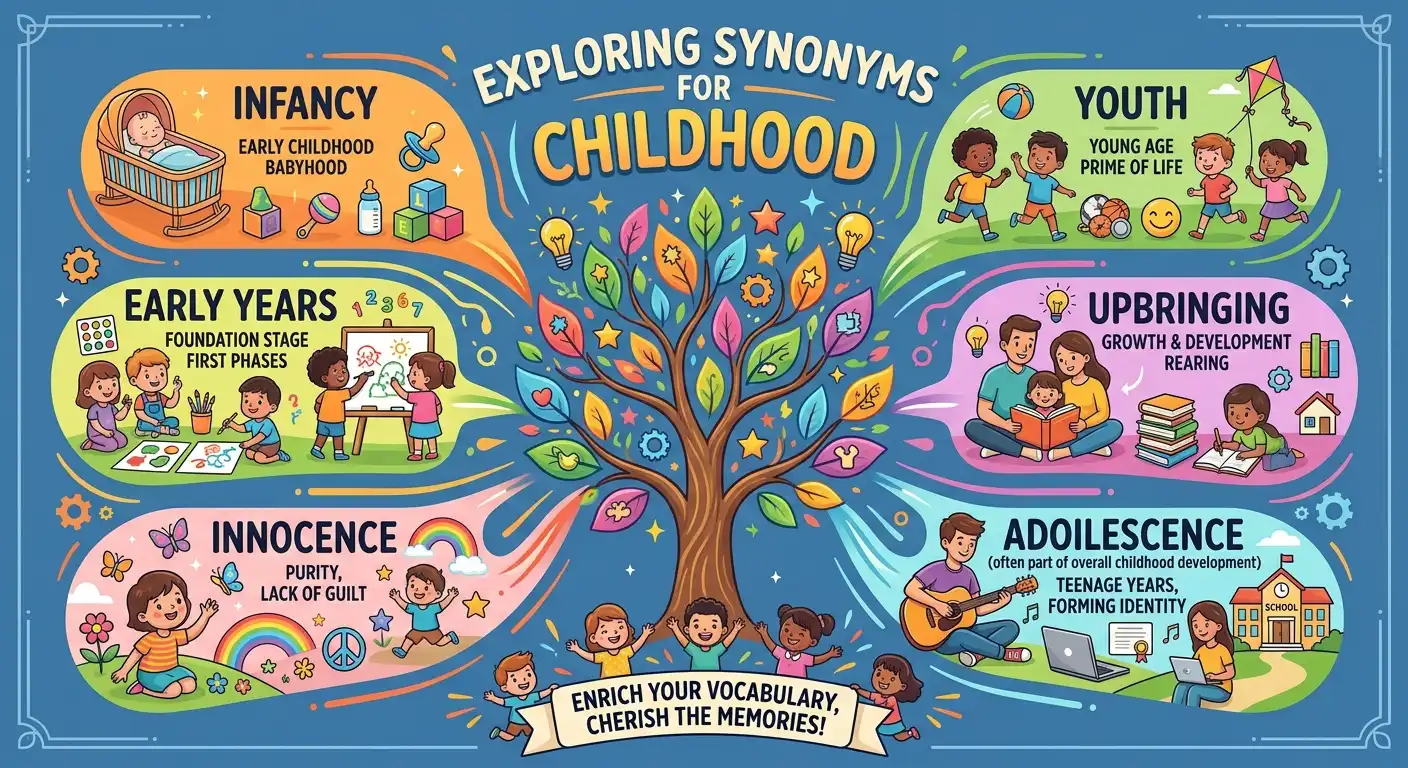
Finding the right synonyms for childhood helps you share sweet memories and write clear stories. When you look for synonyms for childhood, you find words that describe early life, growing up, and young age. Using different synonyms for childhood makes your sentences fresh, lively, and easy for everyone to read.
Picture a sunny afternoon where a little kid plays in a sandbox without any worries. That magical time in life is what we call early life or young days. For example, when you say, “I spent my young years in a small town,” you show people how you grew up. Childhood means the time when a person is a child before they grow into an adult.
Learning these words is very helpful for students, bloggers, content writers, and daily English users. Students can write better essay introductions about their past. Bloggers can tell personal stories that touch people’s hearts. Content writers can vary their vocabulary so readers stay interested. Daily English speakers can express their memories with total confidence.
“Childhood is the light of life where every simple moment becomes a timeless memory.”
“The words we use to recall our early days shape the stories we share with the world.”
Connotative Meaning, Etymology, and Grammar
Understanding how the word works behind the scenes helps you choose the perfect word every time.
- Connotative Meaning: The word carries feelings of warmth, innocence, fun, growth, safety, and sweet nostalgia.
- Etymology (Word History):
- Root Word: Comes from Old English cild (meaning child).
- Suffix: Combined with -hād (meaning state, condition, or quality).
- Historical Meaning: First used in early English to mean “the condition of being a child.”
- Pronunciation:
- US IPA: /ˈtʃaɪld.hʊd/
- UK IPA: /ˈtʃaɪld.hʊd/
- Syllables: 2 syllables (child-hood).
- Affixation Pattern: Root word (child) + Suffix (-hood).
“A rich vocabulary brings color and clarity to every simple memory we keep.”
Comparison Table of Childhood Synonyms
This simple table shows how different words compare in meaning, tone, and real-life context.
| Keyword | Meaning | Usage Type | Context |
| Youth | The state of being young. | General / Casual | Stories, daily talks, general writing. |
| Infancy | The earliest period of life as a baby. | Formal / Medical | Health, family history, early growth. |
| Boyhood | The period of being a young boy. | Personal / Casual | Personal stories, memoirs, family talk. |
| Girlhood | The period of being a young girl. | Personal / Casual | Personal memories, books, family talk. |
| Early years | The first few years of a person’s life. | Professional / Academic | School reports, growth studies, blogs. |
| Formative years | The years that shape a person’s character. | Professional / Educational | Job resumes, life reviews, essays. |
| Adolescence | The time between child age and adult age. | Scientific / Academic | Health guides, school essays, psychology. |
| Teen years | The age between thirteen and nineteen. | Casual / Daily | Conversations, youth blogs, stories. |
| Tender age | A very young and delicate age. | Emotional / Formal | Gentle stories, news articles, legal papers. |
| Puberty | The stage when a body matures sexually. | Medical / Educational | Science books, health guides, classes. |
| Minorship | The legal state of being under legal age. | Legal / Formal | Law papers, official forms, legal news. |
| Immaturity | The state of not being fully grown or wise. | Descriptive / Critical | Behavior reviews, personal notes. |
| Juniority | The state of being younger in age or rank. | Formal / Professional | Workplace status, team roles, age rank. |
| Nonage | The period of legal minority or youth. | Formal / Literary | Old legal texts, classic literature. |
| Schooldays | The period of life spent attending school. | Nostalgic / Casual | Reunions, memory blogs, chats. |
23 Best Synonyms for Childhood
Here is the complete list of top words you can use instead of childhood.
1. Youth
- Pronunciation: US: /juːθ/ | UK: /juːθ/
- Meaning: Youth means the time of life when a person is young.
- Examples:
- She spent her youth playing near the ocean.
- His youth was full of fun games and outdoor sports.
2. Infancy
- Pronunciation: US: /ˈɪn.fən.si/ | UK: /ˈɪn.fən.si/
- Meaning: Infancy means the very first time of life when someone is a baby.
- Examples:
- The photos show his infancy in the old house.
- Care during infancy helps babies grow up strong.
3. Boyhood
- Pronunciation: US: /ˈbɔɪ.hʊd/ | UK: /ˈbɔɪ.hʊd/
- Meaning: Boyhood means the time when a person lives as a young boy.
- Examples:
- He often talks about his boyhood on the farm.
- Their boyhood friendship lasted for fifty years.
4. Girlhood
- Pronunciation: US: /ˈɡɝːl.hʊd/ | UK: /ˈɡɜːl.hʊd/
- Meaning: Girlhood means the period of life spent as a young girl.
- Examples:
- She shared happy girlhood memories with her sister.
- My grandmother kept a diary during her girlhood.
5. Early years
- Pronunciation: US: /ˈɝː.li jɪrz/ | UK: /ˈɜː.li jɪəz/
- Meaning: Early years means the first part of a person’s life journey.
- Examples:
- Good books are important during your early years.
- He lived in Spain during his early years.
6. Formative years
- Pronunciation: US: /ˈfɔːr.mə.t̬ɪv jɪrz/ | UK: /ˈfɔː.mə.tɪv jɪəz/
- Meaning: Formative years means the time when your main character is shaped.
- Examples:
- Teachers play a big role in your formative years.
- She learned music during her formative years.
7. Adolescence
- Pronunciation: US: /ˌæd.əˈles.əns/ | UK: /ˌæd.əˈles.ns/
- Meaning: Adolescence means the stage when a child grows into an adult.
- Examples:
- Many physical changes happen during adolescence.
- His adolescence was filled with new hobbies and sports.
8. Teen years
- Pronunciation: US: /ˈtiːn jɪrz/ | UK: /ˈtiːn jɪəz/
- Meaning: Teen years means the time when someone is between thirteen and nineteen.
- Examples:
- She made wonderful friends during her teen years.
- His teen years went by very fast.
9. Tender age
- Pronunciation: US: /ˈten.dɚ eɪdʒ/ | UK: /ˈten.də r eɪdʒ/
- Meaning: Tender age means a time when a child is very young and delicate.
- Examples:
- He started playing piano at the tender age of five.
- She moved to the city at a tender age.
10. Puberty
- Pronunciation: US: /ˈpjuː.bɚ.ti/ | UK: /ˈpjuː.bə.ti/
- Meaning: Puberty means the natural time when a child’s body matures.
- Examples:
- Kids grow taller rapidly during puberty.
- Health class teaches students about puberty.
11. Minorship
- Pronunciation: US: /ˈmaɪ.nɚ.ʃɪp/ | UK: /ˈmaɪ.nə.ʃɪp/
- Meaning: Minorship means the legal time before a person turns eighteen.
- Examples:
- Parents protect their children during their minorship.
- The court looked after the boy during his minorship.
12. Immaturity
- Pronunciation: US: /ˌɪm.əˈtʊr.ə.t̬i/ | UK: /ˌɪm.əˈtjʊə.rə.ti/
- Meaning: Immaturity means the condition of being young and not yet fully wise.
- Examples:
- His silly joke showed his emotional immaturity.
- Young animals display charming immaturity as they play.
13. Juniority
- Pronunciation: US: /ˌdʒuː.njɔːr.ə.t̬i/ | UK: /ˌdʒuː.niˈɒr.ə.ti/
- Meaning: Juniority means the state of being younger than others in a group.
- Examples:
- His juniority made him the youngest player on the team.
- She handled her juniority with great grace.
14. Nonage
- Pronunciation: US: /ˈnɑː.nɪdʒ/ | UK: /ˈnɒn.ɪdʒ/
- Meaning: Nonage means the legal state of being a minor under the law.
- Examples:
- The family trust protected his money during his nonage.
- Old legal books describe rights during a child’s nonage.
15. Schooldays
- Pronunciation: US: /ˈskuːl.deɪz/ | UK: /ˈskuːl.deɪz/
- Meaning: Schooldays means the time of life spent going to school.
- Examples:
- I look back on my schooldays with a big smile.
- They met during their schooldays in Chicago.
16. Puerility
- Pronunciation: US: /ˌpjʊrˈɪl.ə.t̬i/ | UK: /ˌpjʊəˈrɪl.ə.ti/
- Meaning: Puerility means the quality of acting like a young child.
- Examples:
- The teacher asked the class to stop their puerility.
- His silly game was simple puerility.
17. Cradle days
- Pronunciation: US: /ˈkreɪ.dəl deɪz/ | UK: /ˈkreɪ.dəl deɪz/
- Meaning: Cradle days means the earliest days of life spent in a baby bed.
- Examples:
- My mother kept my baby shoes from my cradle days.
- She loves looking at photos from her cradle days.
18. Nursery age
- Pronunciation: US: /ˈnɝː.sɚ.i eɪdʒ/ | UK: /ˈnɜː.sər.i eɪdʒ/
- Meaning: Nursery age means the preschool years when children learn to play together.
- Examples:
- Kids learn to share toys at nursery age.
- She opened a school for children of nursery age.
19. Early life
- Pronunciation: US: /ˈɝː.li laɪf/ | UK: /ˈɜː.li laɪf/
- Meaning: Early life means the beginning section of a person’s life story.
- Examples:
- The book details the singer’s early life.
- He spent his early life living in the mountains.
20. Juvenile years
- Pronunciation: US: /ˈdʒuː.və.nəl jɪrz/ | UK: /ˈdʒuː.vən.aɪl jɪəz/
- Meaning: Juvenile years means the years when someone is legally a minor.
- Examples:
- He loved painting during his juvenile years.
- Youth centers support kids in their juvenile years.
21. Pre-teen years
- Pronunciation: US: /priːˈtiːn jɪrz/ | UK: /priːˈtiːn jɪəz/
- Meaning: Pre-teen years means the age right before a child turns thirteen.
- Examples:
- Kids read fun adventure books during their pre-teen years.
- Her pre-teen years were full of dance classes.
22. Upbringing years
- Pronunciation: US: /ˈʌpˌbrɪŋ.ɪŋ jɪrz/ | UK: /ˈʌpˌbrɪŋ.ɪŋ jɪəz/
- Meaning: Upbringing years means the time when your family guides and raises you.
- Examples:
- His upbringing years taught him honesty and kindness.
- She values the lessons from her upbringing years.
23. Early age
- Pronunciation: US: /ˈɝː.li eɪdʒ/ | UK: /ˈɜː.li eɪdʒ/
- Meaning: Early age means a point near the very start of life.
- Examples:
- She learned to read at an early age.
- Playing chess at an early age builds sharp focus.
Antonyms of Childhood
Knowing opposite words helps you create strong contrasts in your writing:
- Adulthood: The state of being fully grown.
- Maturity: The condition of being full-grown and wise.
- Old age: The final stage of life.
- Seniority: The status of being older or higher in age.
- Elderliness: The period of being advanced in years.
Prototype Meaning and Categorization
To understand where childhood fits in the English language, let us break it down into core categories:
- Prototype Meaning: The primary time of human development between infancy and adult life characterized by play, safety, and rapid learning.
- Grammar Category: Uncountable or Countable Noun (Abstract Noun).
- Semantic Field: Human Lifespan / Time Periods / Personal Growth.
- Tone Category: Warm, neutral, nostalgic, or formal depending on context.
Frequently Asked Questions (FAQ)
1. What is the best synonym for childhood in story writing?
The word youth or early years works best in stories because readers understand them instantly.
2. Is “adolescence” the same as childhood?
Not completely. Adolescence specifically means the teenage transition time between childhood and adulthood.
3. Which synonym for childhood is best for formal essays?
Formative years and early life are excellent choices for academic papers and formal essays.
4. What is the main difference between “infancy” and “childhood”?
Infancy refers only to the baby stage (ages 0-2), while childhood covers the whole period from babyhood up to the teenage years.
5. Can I use “schooldays” to mean childhood?
Yes! Schooldays specifically focuses on the childhood years you spend learning in primary and middle school.
6. Why should I use different synonyms for childhood?
Using different synonyms for childhood prevents your writing from feeling repetitive and makes your content far more engaging to read.
Conclusion
Mastering different synonyms for childhood gives you the tools to write with real clarity and feeling. When you pick the perfect word, your personal stories sound more authentic and your formal essays sound far more professional. Using fresh vocabulary keeps your audience reading from start to finish without getting bored.
You can try using these new words in your daily emails, school essays, blog posts, and conversations. Swap out common phrases for precise terms like formative years or schooldays to see how much stronger your sentences become. Good vocabulary opens doors to better communication every single day.
“Choosing precise words allows us to bring our past memories back to life.”
“A strong vocabulary is the best tool a writer can use to connect with people.”

Michael Turner is a published fiction writer and creative writing tutor with over a decade of experience helping writers find the words that make their stories breathe ( Biography ).